Qatar

Qatar 2022: Alcohol won’t be sold at World Cup stadiums

By Muhammadu Sabiu

Due to a policy change made by Fifa two days before the tournament’s commencement, alcohol will not be sold at any of the eight World Cup stadiums in Qatar.

Even though alcohol sales are legally prohibited in the Muslim nation, it was planned to be served in select places within stadiums.

Alcohol will still be available for purchase in the corporate sections of the stadiums during the competition.

When Qatar plays Ecuador on Sunday, the World Cup officially begins.

Beer manufacturer AB InBev owns Budweiser, a significant sponsor of Fifa, and it had exclusive rights to sell beer at the World Cup.

A statement from world football’s governing association states, “Following discussions between host country authorities and Fifa, a decision has been made to focus the sale of alcoholic beverages on the Fifa fan festival, other fan destinations and licensed venues, removing sales points of beer from Qatar’s Fifa World Cup 2022 stadium perimeters.”

Qatar: The veiled bride of emigrants

By Abubakar Aminu Ibrahim

Qatar is a peninsular Arab country whose terrain comprises an arid desert, and a long Persian (Arab) submerse shoreline of tantalising sceneries. It is also an industrial country with ultramodern architecture, dawning from its ancient Islamic infrastructure.

Doha, Qatar’s capital city, is well known for its elfin skyscrapers and alluring shores. It is a world-class capital city, home to the limestone Museum of Islamic Art. Thanks to the World Cup tournament, the oil-producing country is ready to spread its dominance by hosting the global spectacle this year.

However, this write-up is not purposely to eulogise Qatar or its capital city, nor attempt to lay statistical predictions of the World Cup tournament. No! But if you are an intending immigrant, if you have started giving a deposit to an agent that will take you to Qatar as a worker, if your dream is to get to Qatar and share all the pictures on WhatsApp, Facebook and Instagram, then fasten your seat belt. The ride is yours.

First of all, let me clarify one thing for you, my friend. Having a dream is not wrong at all; it is, in fact, something inherent in all of us. On the contrary, having the vision of migrating to any country is not wrong. So, chase your dream and work for it. However, you must be careful enough not to be fooled, enslaved and handcuffed by projections and assumptions. If you go anywhere, ensure you hold yourself tied to your honour and integrity. Make sure that your personality as a human is assured.

I write this piece to enlighten some of my people who intend to migrate, especially to Qatar. Qatar is a veiled bride if you are a third-class groom! This write-up shall unveil the bride.

This is an output of research that dip into the plight of migrants in Qatar. Perhaps, emigrants suffer in different places worldwide for specific reasons, but Qatar is uniquely infamous for its treatment of migrants.

 I watched a series of documentaries that taped agonising stories of how blacks and Asians are maltreated in Qatar. Usually, our people cooperate with agents and pay a lot of money to process their migration to countries like Qatar. Contracts are signed with promises, such as shelter, food and a monthly salary. Such deals are always mouth-watering to suffering Nigerians and others across developing countries. But they always come with unbearable prices.

 If you refer to how this write-up described Qatar in the opening lines, the least you should expect from such a country is having almost zero judicial systems that will handle civil charges in courts. But not until 2018 did the city of Doha get a labour court parlour with only six judges to address complaints of its migrant workers. It is even more baffling to hear that the labour court in Doha admitted that out of over two thousand complaints, only sixty-nine were processed (wow!).

These complaints are, in most cases, against host companies of these migrant workers whose salaries are withheld for months. Ibrahim (a Kenyan migrant in Qatar) laments in a France 24 documentary that he and his co-workers received no pay for over three months, and this practice is regular. He added that they were promised good living conditions, food and timely salaries in the contract they signed, but none of these was ever honoured. Worse still, their passports were seized, meaning they could not return home at will.

In another interview with some Philippinos working under a Qatari lady, they said that day was their first day off in their three years of work. Another one cried that he would not want his people to see his condition, and he sometimes goes out at night to snap some happy pictures, even though the police sometimes chase him!

It is disheartening that even in airports, Qatari security agents embarrass travellers and deny them basic provisions, especially if their visitor holds passports from an African country, especially a Nigerian one.

An undersecretary for the Minister of Labour admitted that despite having a tribunal now, some business leaders are opposed to them. Therefore some of the policies are purely and only theoretical. Some migrants taped in court waiting rooms appear visibly hopeless and helpless.

All these are only some of the realities in Qatar, only the victims of this ancient way of thinking can tell you how it feels to be denied your fundamental rights as a human just because of your skin colour or social status. The Doha News proclaimed how migrants build almost all the infrastructures in the country. Yet, when workers die at construction sites, the only tribute they get is having their pictures pasted on a wall. Thanks to the mobile stadium constructed for the World Cup, hundreds of people sacrificed their lives to win bread for their families.

In the final analysis, I aim to make you pause and pose a question for yourself: in what capacity are you migrating? Who are you going to work for? What type of job are you looking for? How are you planning to return home if things do not work out? But, on the other hand, what is your reward at the end if things are working?

Think twice. It is said in Hausa, “tsalle daya a ke a fada rijiya, amma sai an yi dubu ba a fito ba“, which means it takes a single jump into a well, but one will jump a thousand times without getting out.

Abubakar Aminu Ibrahim wrote from Katsina via matazu247@gmail.com.

Qatar introduces Islam to World Cup fans through murals

By Ahmad Deedat Zakari

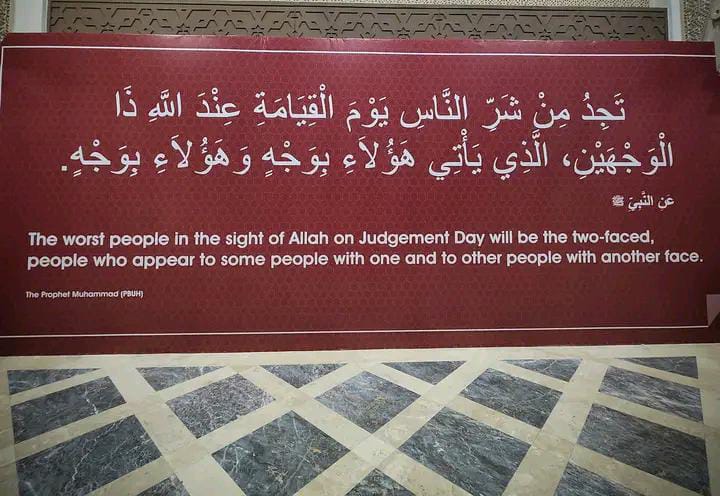
The Qatari government is preaching and introducing Islam to World Cup fans through murals placed in public places.

TRT World reported on Saturday that as Qatar prepares to host the 2022 FIFA World Cup, it has placed several murals in public places bearing Prophet Muhammad’s (PBUH) sayings and traditions written in Arabic and English.

According to the report, the murals feature various sayings on mercy, charity and good deeds. They are situated across the Pearl District, a popular tourist attraction in the Qatari capital, Doha.

The initiative of Qatar’s government has been applauded by many Arab journalists and Muslims worldwide.

Qatar’s government has been unpretentious about not compromising Islamic values because of the 2022 World Cup. However, their stance on homosexuality and the LGBTQ community has been critical; the government deems it unacceptable to their country’s values and norms.

The Head of Security for the 2022 Qatar World Cup, Major General Abdulaziz Abdullah Al Ansari, in a statement, said the country does not want LGBTQ flags in the venues of the World Cup, and LGBTQ is not acceptable to the country.

He said: You want to demonstrate your view about the LGBTQ situation, do it in a society where it will be accepted. Don’t insult the whole society because of this. You cannot change the religion for 28 days”.

Qatar is the first country in the Middle East to host the World Cup, the biggest tournament in the football world.

2022 World Cup: Qatar bans alcohol, LGBT, dating, others for fans

By Muhammadu Sabiu

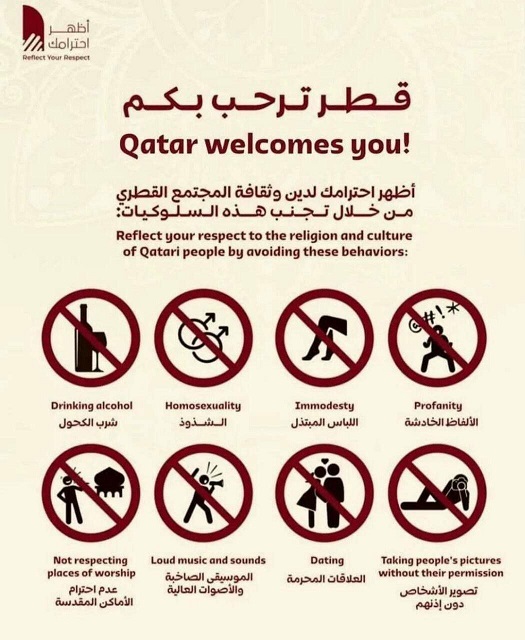
Ahead of the 2022 World Cup, which begins on November 20, the tournament host, Qatar, has released a list of dos and don’ts, especially for fans from other countries.

The wealthy Gulf nation has disclosed that spectators coming should note the bans that have been in place on alcohol, the LGBT community, exposing parts of the female body, and swearing are still in effect.

The host added that disrespect for mosques, loud music and sounds, dating, and taking pictures of people without their consent, are also banned.

Apart from the moral rules, there are also regulations concerning COVID-19 and its vaccine.

The Supreme Committee for Delivery & Legacy mandated that all visitors six years of age and older show proof of a negative PCR test result obtained within 48 hours of their departure or a positive rapid antigen test result obtained within 24 hours of arrival.

Rapid antigen test results from legitimate medical facilities that are not self-administered only will be accepted. If visitors do not exhibit COVID-19 symptoms, no additional testing will be necessary in Qatar.

Additionally, everybody above 18-year-old must download the Ehteraz contact tracing phone app, which the government manages.

A tribute to Sheikh Dr Youssef Al-Qardawiy (Rahimahullah)


By Dr. Isa Muhammad Inuwa

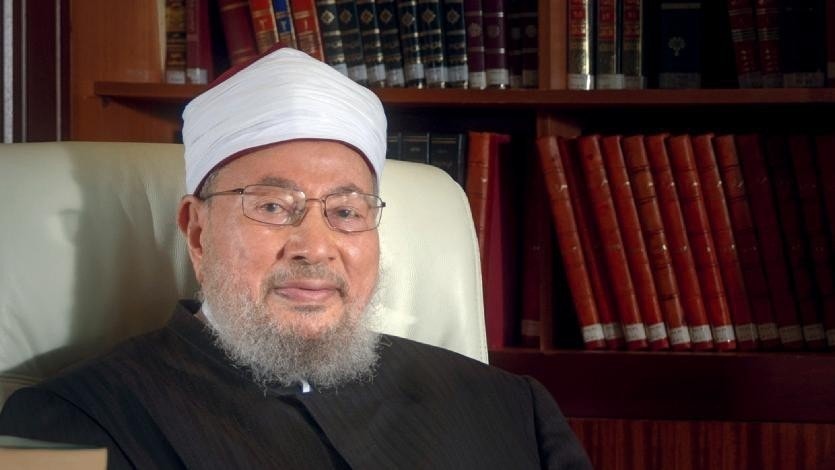
We woke up to the maddening, stunning macabre and grim sorrow of the demise of Sheikh Dr Youssef Al-Qardawi, renowned scholar and jihadist of international repute. As we weep profusely, both internally and outwardly, over this irreparable loss, his death indicates that the sun has set down for yet another era of Islam, as yet another chapter is closed.

Late Al-Qardawi can go down in history as a titanic whale in the fathomless ocean of Islamic knowledge and jurisprudence. He authored many valuable compendia and an estimated 120 to 200 books, famous among which is Al-Halal Wal Haram, that addressed and gave solutions to vital lawful and unlawful issues in Islam.

He was a contemporary of scholars and jihadists of like minds such as Sheikh Hasanul Bannah, Sayyid Qutub, Sa’eed Hawaah, Kishk and the rest. The personalities mentioned above formed the nucleus of the Islamic Brotherhood movement’ ‘Ikhwanul Muslimuuna’ in Egypt around the 1950s to 1960s.

Ikhwan’s formidable movement under the late Hassan Al-Banna’s leadership served as an alternative political group that brokered power in Egypt by participating in the democratic process and contesting political posts. Former president Muhammad Morsi was a testimony to Ikhwan’s influence in the mainstream politics of Egypt.

More so, the hitherto Islamic movement in Egypt, administered by vibrant and agile youths, had impacted and triggered similar gestures in many countries and Muslim communities worldwide.

While some Ikhwan eggheads, such as Hassan Al-Bannah, were martyred amidst the struggle, others, like the late Youssef Al-Qardawi, survived, lived longer and contributed to humanity on many fronts.

May The Almighty Allah accept the late Sheikh Qardawi and uplift his status in the highest and exalted Jannah, amen!

Dr Isa Muhammad Inuwa writes from Bayero University, Kano, Nigeria, via ismi2000ng@yahoo.com.

Kano: Muslims observe distant funeral prayer (Salatul Gha’ib) for Late Sheikh Yusuf Al-Qardawi

By Isa Muhammad Inuwa


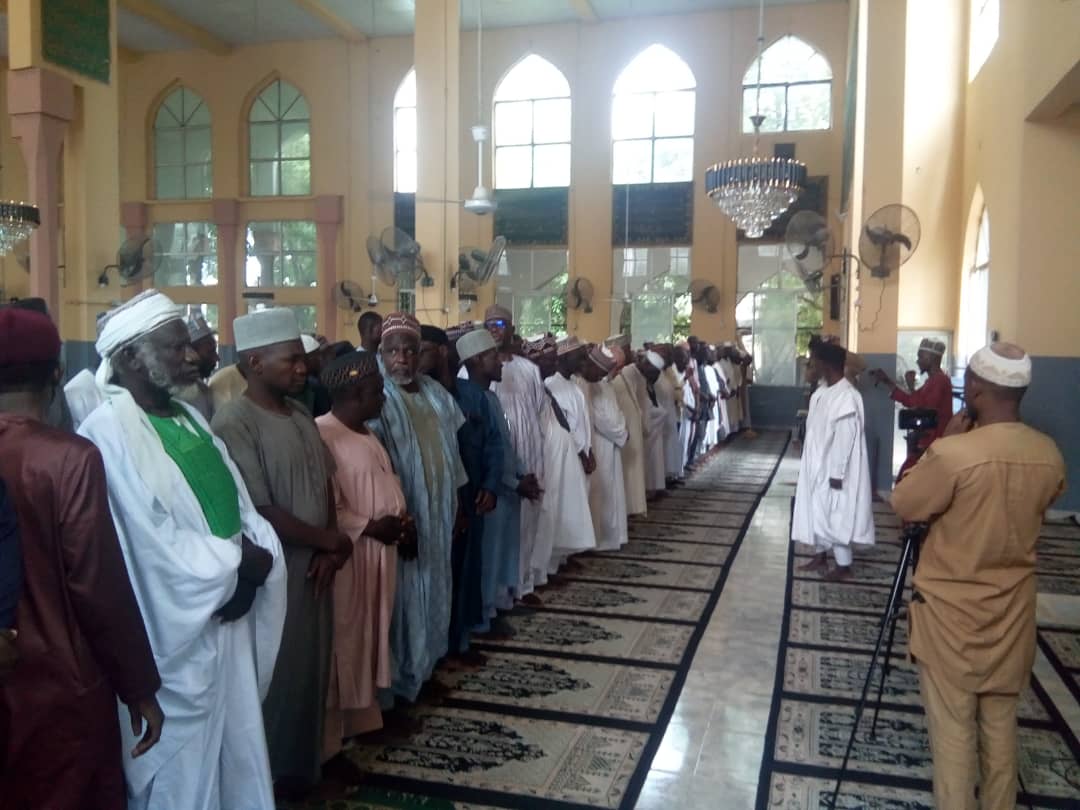
Thousands of Muslims in Kano, Nigeria, had Thursday converged at the Umar Bin Al-Khattab mosque, where they offered funeral prayer in absentia for the repose of the soul of the deceased Sheikh Youssef Al-Qardawi, who passed on in Doha, Qatar, recently.

Leading the congregation, Imam Sheikh Yahaya Tanko delivered the prayer interluded with four Takbirs (Allahu Akbar! chants) and supplications.

Addressing the crowd shortly after, Sheikh Tanko recalled that the distant funeral prayer was first conducted by the Prophet Muhammad (SAW), in Medina, for the soul of Al-Najjashi, the then late Emperor of Abyssinia (present Ethiopia). Al-Najjashi was deemed to have converted from Christianity to Islam before his death.

Also speaking to the gathering, Professor Muhammad Babangida of Bayero University, Kano, announced that the late Sheikh Al-Qardawi was “a famous Islamic scholar of international standing, who spent the largest part of his life contributing to Islamic knowledge, through his teachings, writings and extracting solutions to religious matters (Fatwa)”.

He added that the late Al-Qardawi authored no less than 170 books, some of which consisted of several volumes. He said he was head of numerous Islamic bodies and that he migrated from his home country Egypt to Qatar because of threats to his life by anti-Islamic forces.

He described the deceased as a moderate jurist who maintained a middle course in proposing solutions on matters of Islamic jurisprudence. “He neither swerved to the extreme nor tilted to the most lenient side”, adding that he was very apt in addressing current issues arising in modern life in his publications and jurisdictions.

The scholar also described Al-Qardawi’s death as a significant loss to the entire Muslim World, whose replacement is difficult to find. He then asked God to forgive the deceased and rest his soul in the highest abode of Paradise.