Qatar

Social media reactions trail Israeli strike in Qatar

By Sabiu Abdullahi

The Israeli airstrike in Doha, Qatar, has triggered heated reactions on Facebook, where users expressed anger and criticism over the relationship between Arab leaders and Western powers.

In a post by Facebook user Aisar Fagge, he reminded followers that, “Don’t forget, Qatar gave Trump a $400 million Boeing jet in May, this year. And now Trump has returned the favour. Keep collecting 🔥🔥.”

The comment sparked a flood of responses.Several users showed no sympathy for Qatar. Hussaini M Maccido wrote, “I have no sympathy for them. I can’t waste it on useless people.” Similarly, Bin Muhammad Tofu commented, “I’ve No Sympathy For The Useless Folks.”

Others expressed disappointment in Hausa. Abdulrahman Yunusa stated: “Ya Shiek ka mana da Hausa ‘Sun maida biki’ kenan. An musu alheri sun rama da tsiya,” meaning Qatar responded with hostility despite receiving goodwill.

Saeid Naser Ado argued that the Gulf state betrayed Muslims, saying, “Ba’a murnar shiga wani cikin masifa, amma da sai na ce Allah ya kara. Sbd sun ci amanar Musulunci da Musulmi thou daman ba addinin ne a gaban su ba.”

Musa Babanta criticized the country’s leadership, describing them as, “Shameless people, they should donate their land to Israel to please their western masters.”

Adding to the debate, Abubakar Jamo accused Arab rulers of idolizing former U.S. President Donald Trump. He wrote: “The Arab leaders view Trump as a God. He can save them from being overthrown. During his last visit to the Gulf, his hosts were bowing as they shook hands with him. This is the effect of being extremely rich without being Godly. They are slaves despite being rich.”

The discussions reflect how some Nigerians interpret the ties between Gulf leaders and Western powers, blaming such alliances for the Israeli strike on Doha.

Many commenters suggested that Arab rulers prioritize wealth and Western approval over protecting Islam and Muslims.

From us, by us, for us: How homegrown Waqf initiatives can shift our gaze from international donors

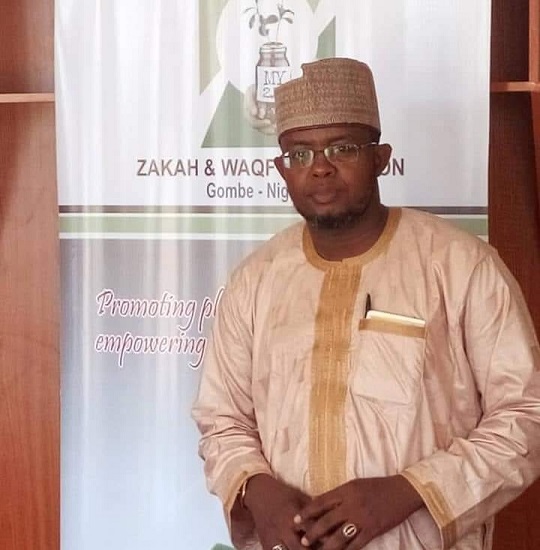
By Abdullahi Abubakar Lamido, PhD

It was a warm afternoon in my office at the Zakah and Waqf Foundation in Gombe, and I had cleared my schedule for what was described as a “very important meeting.” A group of nine young professionals—doctors, nurses, and medical administrators—filed in with purposeful expressions. These were respected Muslim health workers in our community, competent and resourceful in their own rights, leading their Muslim body. 

They sat down, exchanged pleasantries, and after a few minutes, one of them cleared his throat and spoke. “We were hoping you could help us reach Qatar Charity. We want to build a mosque in our hospital.”

I paused. My mind raced not with criticism but with confusion. These were not poor villagers. These were professionals, all salaried, some likely earning above average. I asked gently, “How much will the mosque cost?”

“About ten million naira.”

“And how many Muslim staff do you have?”

“Roughly 500,” they responded.

I picked up a pen and scribbled something. “That’s twenty thousand naira each,” I said. “Divided over four months, that’s 5,000 naira per month.”

There was a short silence. “You don’t need Qatar Charity,” I told them. “You need yourselves; you need Gombe Charity.”

From my limited understanding, I explained that most international charities, like Qatar Charity, raise funds from within their own people first. They identify a problem in a country, develop a proposal, return to their citizens and say: “Donate to build a mosque in Nigeria.” If they can do that for us, why can’t we do it for ourselves? I then told them to put my name as the first donor of the twenty thousand naira to kickstart the project. 

That brief meeting offered a glimpse into a deeper issue—our chronic psychological dependence on external aid, even when we can act. The problem isn’t always material poverty; often, it’s a lack of belief in our collective strength—a poverty of the mind and will.

The Turkey Phenomenon: A Lesson Misunderstood

Take, for example, the popular trend in some Northern Nigerian states where applications pour into Turkish and other organisations for Qurbani (Udhiya) distributions. Turkish charities, may Allah reward them, buy cows and distribute meat during Eid.

But here’s a crucial question: Is this a model to emulate or one to reconsider? If every year, our people look outward to receive—and never inward to learn how to organise, fund, and distribute—we risk cultivating a culture of constant reception without reciprocity.

Islam is not a religion of passivity. It teaches us to act before asking, to solve before seeking, and to build with what is already in our hands. Prophet Muhammad (peace be upon him) taught us that the upper hand is better than the lower one—the hand that gives is superior to the hand that receives.

The Al-Basar Example: From Vision to Visionary Impact

Now, let’s discuss a model worth following—Al-Basar International Foundation.

Al Basar International Foundation is a non-profit international NGO. Founded in 1989 by a group of concerned professionals. Al-Basar is a shining example of what happens when people come together to solve a problem themselves. Their focus? Combating preventable blindness across the Muslim world. No dependency. No grand donor campaigns. Just strategic self-mobilisation as well as waqf and collaborative mindset. 

It works in Yemen, Bangladesh, Sudan, Nigeria, Pakistan, etc. In Nigeria, for instance, a 2019 campaign funded by King Salman Humanitarian Aid and Relief Centre in collaboration with Al Basar International Foundation saw medical volunteers from Saudi Arabia meet 8,000 eye patients and perform 800 eye surgeries to remove cataract and glaucoma in Ibadan, Nigeria, as well as in Lafia in Nasarawa State. 

The foundation manages the Makkah Eye Specialist Hospital in Kano state, Nigeria, where 4,000 free eye surgeries were carried out in 2021. The hospital treats eye conditions, including diabetic retinopathy. In 2022, Al Basar International Foundation, in collaboration with the King Salman Relief Center, sponsored 400 free cataract surgeries for residents of Kano, which took place at Makkah Eye Specialist Hospital. 

Over the years, Al Basar has conducted over 2,000 outreach programs worldwide, performed over 700,000 cataract surgeries, and dispensed nearly 2 million glasses. With 28 hospitals across six countries, the foundation has recorded 26 million outpatient visits. It also invests in education by establishing colleges to train eye care professionals, impacting Africa and Asia. Their school screening program has reached over 1 million children, providing immediate interventions and ensuring a comprehensive approach to their eye health.

Now ask yourself: is Al-Basar a government-funded operation? No. Did it start with foreign aid? No. It was “from them, by them, for them.” And now it is for us, too—because they nurtured it to the point where it could grow beyond them.

We should not only admire such models. We should replicate them.

Historical Echoes: Islamic Proofs of Self-Driven Solutions

Uthman ibn Affan (RA) and the Well of Rumah

When water scarcity plagued Medina, and a private owner monopolised a well, the Prophet (SAW) called for someone to purchase it for the Muslims. Uthman (RA) stepped up, bought the well, and made it a public waqf. He didn’t write to Yemen. He didn’t petition the Romans. He simply used what Allah had given him to solve a problem for Allah’s sake.

So, What Can We Do? A Homegrown Waqf Blueprint

If we genuinely want to stop relying on donors and start building resilient communities, here are practical steps:

Think Within, Act Within: Begin every solution by asking what the community already has—not what it lacks. Do you have professionals? Land? Skills? Social networks? Then, start from there.

Group Economic Self-Waqfing: Encourage professional groups (doctors, teachers, engineers, traders, lawyers) to dedicate a portion of monthly income to a fund. Even a modest 5,000 naira monthly from 100 people can generate sustainable capital. At Zakah and Waqf Foundation, we enjoy that from some professionals, and it works. 

Community Challenge Waqf: Identify a local challenge—maternal health, education for orphans, access to clean water—and collectively endow a waqf around it. Let the yield solve that problem perpetually.

Transparent Management Structures: Set up trustworthy waqf boards to manage resources. Trust fuels contribution. Accountability sustains it.

Celebrate Independence: Create cultural pride around self-funded projects. Showcase schools, hospitals, orphanages, and mosques built without a single foreign dime.

It is Time to Change the Script

Imagine if each LGA in Nigeria had one waqf-funded primary health centre, one vocational training centre, and one scholarship fund—all funded by local contributions from professionals, retirees, and small traders.

We would not be beggars. We would be builders.

It’s time to write a new story. One not of helplessness and application letters to foreign NGOs but of resolve, unity, and strategic giving. One of From Us, By Us, For Us—in the truest, most impactful sense.

When that story is told to future generations, they will say: There was a people who stopped waiting and started building.

Amir Lamido wrote from Gombe via lamidomabudi@gmail.com.

Qatar urges global efforts to place Israeli nuclear facilities under IAEA oversight

By Hadiza Abdulkadir

The State of Qatar has called for increased international efforts to ensure that all Israeli nuclear facilities are placed under the supervision of the International Atomic Energy Agency (IAEA). Additionally, Qatar has urged Israel to join the Treaty on the Non-Proliferation of Nuclear Weapons (NPT) as a non-nuclear state.

The appeal was made by Qatar’s Ambassador and Permanent Representative to the United Nations Office and International Organizations in Vienna, Jassim Yacoub Al Hammadi, during a session of the IAEA Board of Governors. His remarks focused on the ongoing situation in the occupied Palestinian territories and concerns over Israel’s nuclear capabilities.

Al Hammadi emphasized the importance of global institutions upholding their commitments under the UN Security Council, General Assembly resolutions, and IAEA regulations. He also referenced the 1995 NPT Review Conference, which called for Israel to subject all its nuclear sites to IAEA safeguards.

The Qatari diplomat stressed that numerous international resolutions have explicitly urged Israel to join the NPT as a non-nuclear state. He called on the international community to take concrete steps to ensure compliance with these longstanding global commitments.

This statement aligns with Qatar’s foreign policy advocating nuclear non-proliferation and regional stability. Israel’s nuclear program has long been contentious in diplomacy, with increasing calls for transparency and oversight.

As tensions persist in the Middle East, Qatar’s renewed appeal highlights the ongoing debate over nuclear security and the role of international oversight in maintaining global peace.

AKTH partners with Qatar Foundation for free cleft surgeries

By Uzair Adam

Aminu Kano Teaching Hospital (AKTH) has launched a free cleft lip and palate surgery initiative for patients, courtesy of sponsorship by the Qatar Charity Foundation.

The Daily Reality gathered that the program was inaugurated on Sunday during an opening ceremony at the hospital.

Speaking at the event, the hospital’s Chief Medical Director, Dr. Abdurrahman Abba Shehe, disclosed that the first phase of the program aims to provide surgeries for 200 patients, with plans to eventually benefit 1,000 individuals.

Dr. Shehe reiterated AKTH’s dedication to offering quality healthcare to underserved communities. He further revealed that the hospital had sought additional support from Qatar Charity Foundation to address the rising incidence of cardiac diseases, particularly among children in Northern Nigeria.

“We have many children suffering from cardiac problems in this region, and we are hopeful that Qatar Charity will extend their assistance to this area as well,” Dr. Shehe said.

The Qatar Ambassador to Nigeria, Dr. Ali Ghanem Al Hajri, highlighted the foundation’s commitment to improving healthcare access in Nigeria, noting, “We are dedicated to collaborating with AKTH to sponsor treatments for patients with various medical conditions as part of our ongoing efforts to uplift vulnerable communities.”

One of the beneficiaries, Sahura Ismail, expressed gratitude on behalf of the patients, stating, “We are deeply thankful to the Qatar Charity Foundation for their kindness and generosity.”

This collaboration between AKTH and Qatar Charity Foundation signifies a vital step in enhancing healthcare access for Northern Nigeria’s underserved populations, with prospects for expansion into other critical medical interventions.

Religion doesn’t hinder national development, by Dr. Muhsin Ibrahim

Someone on Facebook argues that religion hinders countries from developing. I fail to see the connection. Politics is chiefly responsible for a country’s development or lack thereof.

Islam and Christianity, the religions I am most familiar with, do not prevent their adherents from attending school or pursuing any field of study.

My family is, I can confidently say, quite religious. Despite this, we have members who are Ph.D. holders and other graduates. We also have nurses, midwives, and teachers, etc., among us (both members and their spouses).

Qatar, Malaysia, and Indonesia are three good examples. They are “conservative” Muslim countries. However, they are developing on a fast track.

Iran and Bangladesh have some of the highest female literacy rates in the world. Women work in almost all sectors in Saudi Arabia today. The examples are many.

It’s sad our youths are misinformed about religion and modernity. They always look at Westerners’ lifestyles as synonymous with development and civilization. No, they are more than that.

To the vast majority of the Muslim world, Boko is not only halal but essential. Thus, don’t pigeonhole your views. Or rely on some ill-informed writers and sensationalized mainstream media headlines.

May we be guided, amin.

Muhsin Ibrahim is a PhD who teaches at the University of Cologne, Germany and he can be reached via muhsin2008@gmail.com

2023 Ramadan: Qatar reduces prices of 900 consumer goods

By Ahmad Deedat Zakari

As Muslims all over the world prepare for fasting in the holy month of Ramadan, Qatar has announced a reduction of prices of 900 consumer goods for citizens of the country.

On Monday, the Qatar Ministry of Commerce and Industry (MoCI) made the announcement of the reduction of prices for hundreds of goods during Ramadan.

“Prices of more than 800 commodities have been reduced in coordination with major outlets in Qatar, starting from Wednesday, March 23, until the holy month of Ramadan,” MoCI said.

The Ministry added that the types of discounted goods include the most important food and consumer goods required by a family during Ramadan like:

Honey, flour and its products, cereals and corn flakes, yoghurt and dairy products, powdered and condensed milk, cheeses, juices, sugar, coffee and its products, dates, mineral and bottled water, tin foil (aluminium), paper napkins, washing powder, trash bags, pastries and pasta, legumes, rice, frozen vegetables, poultry and its products, eggs, meat products, tomato paste, tea, ghee, yeast, salt, personal hygiene items and household cleaning detergents and edible and cooking oils.

Morocco’s outstanding World Cup campaign and the lessons for Africa

By Abdulrazak Iliyasu Sansani

As the 22nd edition of the FIFA world cup ended, Africa had its best and most memorable performance at the Mundial.  This World Cup, the first in the Arab World and only the second to be held in Asia, was so contentious that many football fanatics thought it wouldn’t be possible even when Sepp Blatter-led FIFA awarded it to Qatar.  On the 2nd of December 2010, it was announced that Qatar, a tiny but rich gulf nation, would host the 2022 FIFA World Cup. Everything is history as it commenced on November 20, 2022, and ended on December 18, 2022.

The 22nd FIFA World Cup edition came with numerous upsets, though World Cup matches are hardly predictable. This World Cup delivered the most in this regard.  The FIFA World Cup is football’s flagship tournament, which the first edition was held in Uruguay and started on July 13, 1930.  The FIFA world cup has a unique place among sporting events, arguably unrivalled in all sports.

From the first qualification phase, in which 211 member associations were eligible for this edition and 206 participated in the qualification process up to the moment, 32 national teams qualified for football’s showpiece tournament: the most significant single sporting event in the world offers unmatched entertainment, fulfilment, and a lifetime experience.

Over the years, the FIFA world cup created moments eternally engraved in the minds of the approximately 3.5 billion football followers worldwide. From Lucien Laurent scoring the first goal at the world cup, Uruguay winning the inaugural edition of the world cup in 1930, Italy winning it on home soil in 1934, Uruguay silencing the overly expectant crowd at the Maracanã in 1950, Pele making his debut in 1958, Brazil team of 1970 considered by most football experts and supporters as the most outstanding football team ever winning the  tournament, cruff losing a World cup final despite his brilliant performance, Maradona taking the game by scruff of the neck in 1986 against England by scoring an infamous first goal and the second arguably the greatest goal ever in the history of the most popular sport in the world, Bahamast’s brave call in 1998 in Norway versus Brazil match; Canavero’s defensive master class in 2006, Messi, a player widely considered as the greatest player of all time winning the World Cup in Qatar to cement his place among the greats, name it, you want sport at its best: you get it at the FIFA world cup throughout its renowned history.

For Africa as a continent: we have a long, difficult, and complicated history at the grandest football competition in the world. Africa began sending representatives to the world cup in 1934. The Pharaohs of Egypt became Africa’s first team at the world cup in its second edition. Since then, Africa has been sending representatives to the FIFA chief tournament.  Herein are the nations and the year they debuted at the world cup: 1970 the Atlas Lions of Morocco, 1974 Leopards of DR Congo, 1978 the Carthage Eagles of  Tunisia, 1982  the Indomitable Lions of Cameroon and the Desert Foxes of Algeria, 1994  the Super Eagles of Nigeria, 1998 Bafana Bafana of South Africa, 2002 the Lions of Taranga, 2006; Black Stars of Ghana, the Elephants of  Ivory coast, Giant sable antelopes of Angola, and The Sparrowhawks of Togo. These member associations of the Confederation of African Football (CAF) have participated in the world cup seeking the all-important diadem in 88 years.

The just concluded edition of the world cup produced Africa’s first semi-finalist at the world cup: the Atlas Lions of Morocco. Before this, the best outing in Africa had been going to the quarter-finals on three occasions: Cameroon in 1990, Senegal in 2002, and Ghana in 2010. The  Atlas Lions of Morocco, led by Walid Regragui, have shown clearly that Africa can and will one day win the world cup, just as predicted by the legendary Pele some decades ago. Their scintillating world cup campaign in Qatar exemplified what Africa can do when we engage in the right practice and comprehensively develop the sport most Africans are passionate about. Morocco’s historic run was not by chance. No, it wasn’t. It resulted from a considerable investment, a clear blueprint, and masterful implementation.


“The development of football in Morocco is founded on a triangular approach that should form the basis of the development of any system: facilities, talent and qualified personnel,” the Moroccan Football Federation (FRMF) president, Fouzi Lekjaa, said.

In 2007 King Mohammed VI  decided to change the fortunes of Moroccan football by doing the needful and not just wishful thinking. He didn’t wait for the magic. He did what every African nation that seeks sporting excellence should do. It has taken 15 years since that great investment started, and the Moroccan Football Federation has since proceeded with a series of programmes aimed at improving the overall performances of the North African country in the sport they are crazy about. The results didn’t show overnight, as with most great projects.

However, the football world today celebrates Morocco. Moroccan national teams and clubs have achieved terrific results at almost all levels of football. From the Atlas Lions finishing fourth at the World cup, the lionesses of Atlas playing at their first Women’s African cup of nations final only to be defeated by South Africa, Morocco winning the African Nations Championship (CHAN) against Mali, Wydad Athletic Club winning the CAF Champions League, RS Berkane winning confederation cup, AS FAR clinching the Female CAF Champions League. This is the model for African football to follow. This is the reward for the investment in the beautiful game, technical growth, hard work, patience, and belief in merit.

In a nutshell, we must develop football from the grassroots, create a serene atmosphere for football to thrive, build facilities, employ top-notch tacticians, enhance our leagues, patronise our domestic leagues, upgrade the officiating of matches, and tackle corruption holistically to take Africa to the summit of world football.

Abdulrazak Iliyasu Sansani is a TV producer and presenter of Haske TV Sports, located in Jalingo, Taraba State.

The 2022 Qatar FIFA World Cup: Triumph of cultural tolerance and setback to clash of civilisations

By Babayo Sule, PhD

The 2022 Qatar FIFA World Cup is no doubt a beginning of a fresh era in intercultural relationships globally because of the indelible marks of perception, dynamism, fresh vigours, advancement of a new model and, most importantly, the introduction of a new style of reception, fanfare and farewell from the host to the world. Hosting a gargantuan event like FIFA World Cup is certainly a herculean task that financial muscles and political influence alone cannot earn. It takes beyond the lobby, indefatigable consultations, display of economic prowess, commitment, smart strategies that will outsmart competitors and, above that, a clandestine promise of delivery and reliability. Of course, Qatar surmounted all these obstacles and won the hosting. Beyond that, the World Cup was successfully organised, hosted, done and dusted most sublimely and fashionably way to some groups, perhaps.

Not long ago, some Western scholars, including Fukuyama (1996), Huntington (1996) and Lewis (1992), struggled hard to convince the world that the Western ideology, civilisation and system are forever the best and can never be competed with or matched in any circumstances. But for the critical counterattacks of the likes of Sa’id (2005), Harun Yahaya, Nefeily (2002) and some others, the Fukuyama-led cultural clash nearly succeeded in defeating the world to surrender to the almighty West and despair from any form of competition. Fortunately, the Sa’id-led counterattacks made us believe that cultural clash or advancing it is an act of ignorance that can be suppressed with dialogue and better understanding built on tolerance and respect. The approach of Qatar to the 2022 FIFA World Cup practically convinced us to discard the former school and hold firm on the latter.

When I learnt that the small country of Qatar, with just a population of 3 million, spent a breath-taking $200 billion, I cautioned myself to wait patiently and see what the country is after because my inner ego told me that the country is definitely up to something otherwise it will be crazy enough to believe this embezzlement amidst the myriads of squalor, deprivation, abject penury, natural disasters and other sufferings emanating from armed conflicts in the Muslim-dominated states. Qatar should have diverted this huge amount of money for humanitarian intervention in the most affected states, but my curiosity continues to deter me from concluding without seeing the actual intention. At last, it is revealed glowingly most passionately and soothingly to the global Ummah that Qatar invested in a modern and strategic Jihad.

Football is arguably the most unifying festival or even phenomenon globally, more than anything. Even religion today is not hypnotising like football, especially among youth. Take Nigeria, for example. Divisions are sharp and threatening to national unity in virtually all matters, even that of critical national importance like security, except for football. In an employment to strategic parastatals or apportion of a political position, no section of the country will tolerate the composition and the outlook of the national team, the darling Super Eagles. But in football, Ahmed Musa can score against Argentina in the World Cup, celebrate by prostrating before Allah (SWT), one of the major pillars of five congregational daily prayers and a major point of bringing one closer to his Creator, the Hausa/Fulani, Igbos, Yorubas, all the more than 400 ethnic groups, the Muslims, Christians, ritualists, animists and the North and South will unanimously celebrate the goal without minding exactly the mode and pattern of the celebration of the player. The same thing is applicable if a Christian player scores and celebrates using his religious signals and symbols. But for football, what can be tolerated that way in our mother country? Should a Minister prostrate in front of a national broadcast to celebrate the country and the achievement of his Ministry, trending impending insults among divided Nigerians will take weeks actively?

For Qatar, the small country lured the globe to its culture and way of using football as a tool. The country satisfactorily met all the requirements and fulfilled all the datelines, resources, infrastructures, provisions and all that is needed to host a successful World Cup. On several visits, the FIFA team always expressed its satisfaction with the level of preparations and provisions made by Qatar. However, some days before the commencement, Qatar boldly rose its head before the world and declared that it is a country of faith, culture, values and a system that must be respected without any compromise. Alcoholism in the stadiums, gay and other amoral attitudes are banned throughout the event, and any violation will surely attract a sanction according to the laws of Qatar governed by the Shari’ah system. Instantly, the belief that the West has in cultural clashes and the arrogant display of the ethnocentric chauvinism of superiority surfaced.

The Western media pounced on Qatar, and some even threatened to either boycott the event or Qatar must be forced to rescind its decision and guidelines for attending the event. Qatar stood firm and pledged never to compromise its stand on the ground that Qatar respects all cultures, and anywhere the citizens of the country visit, they respect and adhere to the guidelines, principles and laws of the land; then, why should her own be different? In what ways is any culture superior or advanced or super enough to bulldoze and overshadow the host culture? Fortunately, the FIFA President, being honest, frank and fair, supported Qatar fully and chided the West for, according to him, ‘its hypocrisy, intolerance, arrogance and immorality. Instead of the West apologising to the world for its more than 300 years of plunder and arrogance, it is parading tits trademark again’. The Western media, unrelenting, resorted to blackmail that the FIFA officials were bribed to grant Qatar the hosting, and the FIFA is bribed to approve the preparations and accept the conditions of Qatar without any protest.

The West, which mesmerised and dazzled the world with its modern scientific and technological advancement, effervescent skyscrapers, efficient system, and continuous innovation, failed the simple test of tolerance, respect and morality. The moral bankruptcy appears disappointing. Sayyid Qutb earlier berated the West for its handicap in a moral view. He expressed his wonders in seeing the miraculous feat achieved by the West in technology and development but rebuked them for moral emptiness, cultural intolerance, intellectual fallacies of distorting Islamic culture and values to him and bestiality exhibited by humankind in their societies. The FIFA President himself chastised the West for its sheepish behaviour and the display of immorality to the level of bestial nuptiality. The West arrogantly believed that it had the monopoly of setting the agenda for even cultural perception. The long-term monopoly in the political and economic control of the world intoxicated the West to believe that it must always determine the standard for anything, and it must have its way. But Qatar, a small but mighty country, challenged this view and put a sudden stop to it in style.

Qatar designed a Jihad model and unveiled it where all the attentions are. They say, ‘hit them where it hurts’, and Qatar hit where it hurts, but it soothes many. The opening ceremony sent waves of meticulous fantasy and a display of a fabulous enigma of people that aspired to differ in all ramifications from the acclaimed normal norm. Instead of the noisy fanfare, thunderous jamboree and a competition to display nudity and craziness of masquerades, the environment of the opening ceremony was ensconced in a serene clime with the melodious recitations of the Glorious Quran and a lullaby of the romantic Arab scents and marvellous dressing. The spectators silently listened and were hypnotised by the beauty and eloquence of the Qur’anic recitation.  

Instantly, the campaign of calumny, blackmail and propaganda swung into action in the West. The BBC declined to air the opening ceremony. The major Western media embarked on futile and baseless negative reporting. For instance, the Independent of November 21st 2022, wrote a piece mocking Qatar, the host, titled ‘Qatar World Cup defeat proves there are some things in sport you can’t pay for’. Another article in the Independent in the date titled ‘Qatar’s opening World Cup impression slips into disaster on and off the pitch’.

In another propaganda, CNN reports in an article on 20th November 2022, ‘Qatar makes World Cup in a debut controversial tournament of firsts’. The 24th November 2022 article by the Independent titled ‘What on earth is Morgan Freeman doing in Qatar? Queried why Morgan Freeman should be in Qatar. In the assumption of the Western media, Qatar spent lavishly to win. When and where World Cup opening match is won by the host? Morgan Freeman is seen either as too civilised to be in Qatar to attend a Qur’anic opening ceremony or irrelevant. The motive of Qatar is entirely a different ball game. Qatar has won the World Cup in the eyes of the fair-minded, culturally-tolerant but specifically, the Muslim world. The Jihad exhibited a moderate contemporary approach, and the resistance against the imposition of alien cultures to then host succeeded in opening the eyes of the imperialised and the international relations and international system will, of course, never be the same again.

Other resistance to neo-colonialism and new imperialism are unfolding courtesy of what Qatar did. Peacefully but assertively, Qatar altered the shape of the global political economy for keen observers. Even Huntington must revisit his clash of civilisations and rethink the remaking of world order beyond his only perceived clash.

The damages that the West self-inflicted in the effort to spoil the World Cup show in Qatar can take many decades or centuries to restore. For example, they are enlightening the world to resist any culture that it is not comfortable with, starting with their forceful imposition. They may continue to lure and influence the world using economic leverage and threats, but countries that are self-conscious, like Qatar, which internally recycled its economic buoyancy, will resist and counter. African states may take a lesson or continue to be humiliated by the world at will. The West, in its intolerance, informed the world that the crusade for human rights, democratisation and other dangerous exports (Blum, 2013) might be resisted, and it is a setback to its agenda of ruling the world using institutions and agreements.

Another lesson the world learnt from the weird attitude exhibited by the West in Qatar is to draw back and resist any attempt to denigrate or demean any culture, value, faith or nation. It is a scientific gateway for many global policymakers and key players to justify when pushing an agenda or tackling it. The worse of the scenarios is the moral emptiness and sheepish attitude of some countries and their football teams. The sport, as if it were a living organism, showed them an early exit to save the world from their embarrassment and allowed the serious-minded ones to battle it out.

One fascinating scenario in Qatar that will outlive the tournament and qualify the event to be extraordinary is that the vulgarity of Qatar is not leaving any stone unturned in its newly discovered Jihadism. The likes of Dr Zakir Naik were offered the opportunity to display their prowess in Da’awah, and the accommodation was designed to introduce the Islamic process of cleansing from impurity, a discovery that leaves many visitors dazzled and interested in Islamic teaching. The calls to prayer, display of Qur’anic verses from all angles of the city and Prophetic golden words all revealed exactly what Qatar spent its money for and not what the Independent article misperceived or tried to push deliberately. The final or closing ceremony after Argentina won the Cup was exotic. African musicians, including the Nigerian Davido, were invited but were confined to the World Cup tune prepared by a Qatari singer. The best player, Lionel Messi, was decorated in the regalia of the most valuable Arabian dress instead of the obscured juju and the usual spray of liquor and other madness that have no place in most civilisations but are being pushed down the throats of the communities by the imperial powers.

The World Cup has come and gone, but its memory will forever relish our minds and in what Qatar did, ‘Verily, in this is a Sign: but most of them do not believe’ (Q26:8). Qatar has opened a gateway for other world countries to liberate themselves from the encumbrances of new imperialism and neo-colonialism that is used to push the imperialism (Nkrumah, 1965). The small country has presented a fashionable and peaceful model of Da’awah that will strategically counter propaganda and a model of Jihad devoid of terrorism. It is a kind of Jihad that is difficult to provide a vacuum for conspiracy or damaging insults. Qatar may face stereotyping and a campaign of blackmail, and other Arabs and Islamic states may not smell the opportunity of hosting the World Cup for the next century or more, provided the West continues to control the world, but world countries can now develop the effrontery to counter abuse and disrespect of their faiths and cultures and may advance to ward off imperialism. African continent may restore its umbilical cord with Latin America and the Caribbean to re-establish a strong, surviving and successful Pan-Africanism. Qatar, in our eyes, is a blessed land of the righteous that present a model of liberation. God bless the country and the tournament!

Babayo Sule (PhD) wrote from the Department of Political Science, Faculty of Humanities Management and Social Sciences, Federal University Kashere Gombe, Nigeria. He can be reached via babayosule@gmail.com.

For my friends who don’t know the Bisht

By Dr Sarah Marzouk

There has been quite a bit of online commentary, some of it quite derogatory, regarding the black robe that Lionel Messi wore prior to accepting the World Cup. For context, I wanted to explain its significance.

The garment is called a ‘bisht’, and it is an outer garment worn in predominantly Arab countries. The name is derived from the Akkadian word ‘bishtu’, which means ‘nobility’ or ‘prestige’.

This garment is considered a symbol of great honour. It’s a status symbol amongst royalty, the wealthy and those with high social rank, much like a cross between ceremonial graduation robes or, in Western terms, wearing a black tuxedo on a special occasion.

When it’s the Emir of a country literally gifting you the bisht, putting it on you with his own hands, it’s the highest honour that can be bestowed upon that civilian. It has nothing to do with religion at all.

Messi may not have understood what it meant when he graciously wore it, but it was the Qatari way of recognising him for the GOAT that he is.

World Cup: Nigeria Embassy in Qatar advises Nigerians to be law-abiding

By Ahmad Deedat Zakari

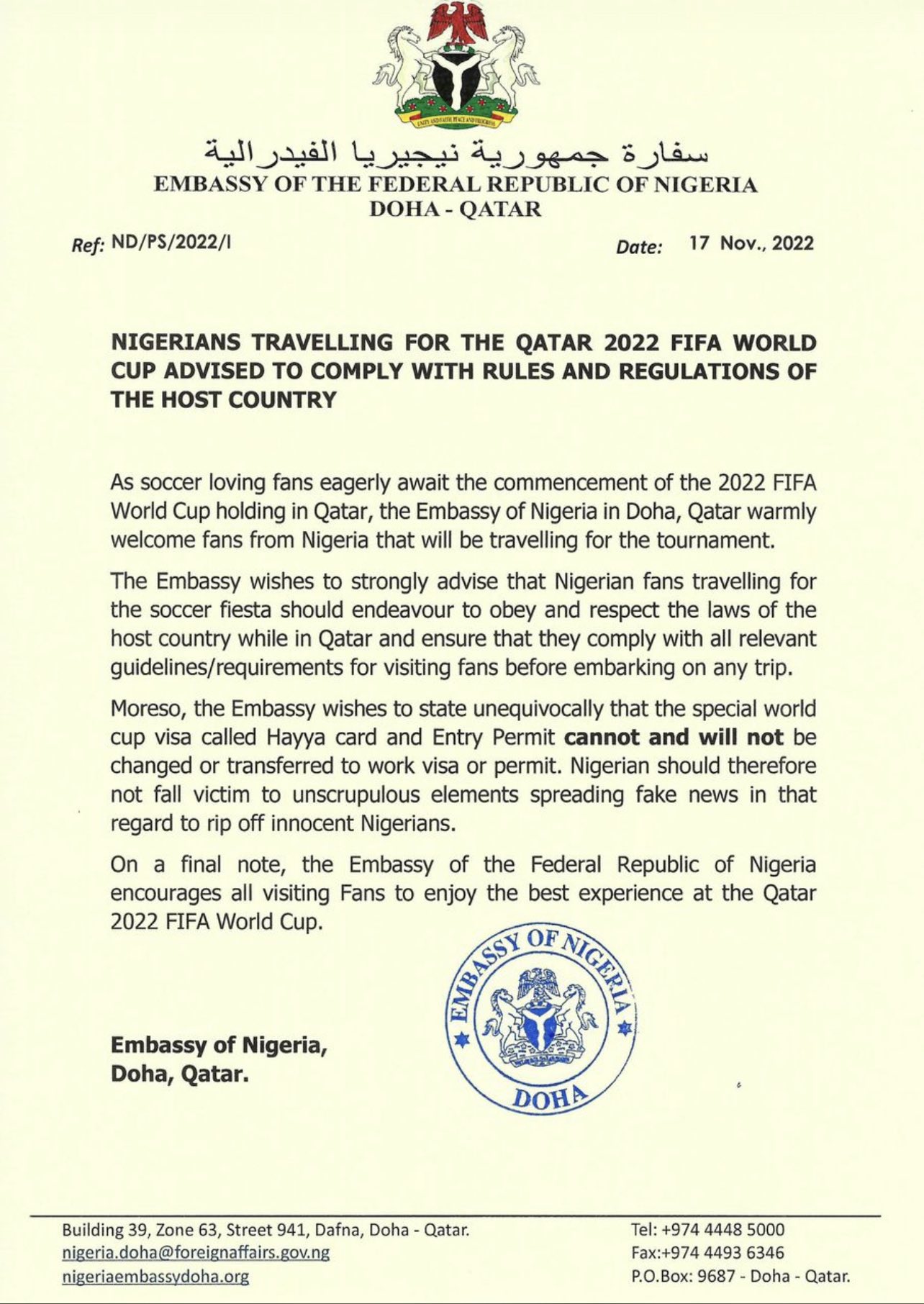
The Embassy of Nigeria in Qatar has advised Nigerians traveling for the World Cup to obey the rules and regulations of the host country.

The advice was contained in a statement signed by the embassy in Doha on Thursday.

“The Embassy wishes to strongly advise that Nigerians traveling for the soccer fiesta should endeavour to obey and respect the laws of the host country while in Qatar and ensure that they comply with all relevant guidelines/requirements for visiting fans before embarking on any trip” The statement read.

The statement further disabused the minds of Nigerians from any attempt to change the special world cup visa and entry permit to work visa. The embassy argued that it is not possible and Nigerians should not fall victims to unscrupulous elements.

“Moreso, the Embassy wishes to state unequivocally that the special world cup visa called Haya card and Entry permit cannot and will not be changed or transferred to work visa or permit. Nigerian should therefore not fall victim to unscrupulous elements spreading fake news in that regard to rip off innocent Nigerians” The statement further stated.

Nigeria did not qualify for the 2022 World Cup and will not be participating in the tournament.