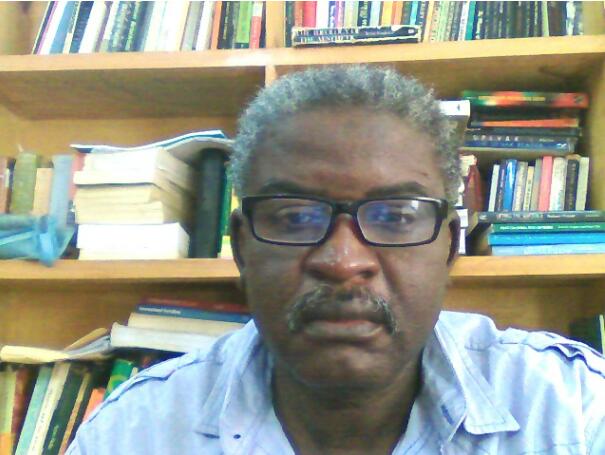
Prof. IBK

Tribute to Malam Mu’azu Muhammad Yusif

By Ibrahim Lawal Ahmed

On September 9th, 2023, friends, colleagues and students of Malam Mu’azu Muhammad Yusif, more popularly called M.M. Yusif, gathered to honour and celebrate his long academic service at the Centre for Information Technology and Development (CITAD), Kano, by remembering the old days and reflecting on the transformation the academia has been going through in Nigeria. Malam M.M. Yusif recently retired from the Department of Political Science, Bayero University, Kano, and the occasion was a kind of send-off party.

It was indeed a robust discussion that involved personalities such as Mal. Ibrahim Mu’azzam, Dr. Y.Z. Ya’u, Dr. Nasir Fagge, Prof. Ibrahim Bello-Kano (IBK), among others. As expected, the debate spiralled from eulogising the celebrant to discussion on the character of students and teachers in the universities in Nigeria, the current system of running the university, the struggles of and in the Academic Staff Union of Universities (ASUU), and the neoliberal world order and its effects in Nigeria, particularly on the universities. 

In short, the discussion is a dialectical cross-examination of factors within the university and how their interrelationship is influencing the university education in Nigeria; the relationship between the university and the society (town and gown relationship); and the relationship between the university and the state. The relationship between the university and the state is at the centre of the ASUU issue.

University has been the life of Malam, and as one of the longest-serving chairmen of ASUU, BUK Chapter, ASUU is a union very close to Malam. Therefore, I can imagine his feelings as he witnesses and reflects on the last two battles between ASUU and the government (2020 and 2022) that almost destroyed the public universities in Nigeria. The fundamental issue of ASUU-FGN conflict, in my view, is not the non-payment of allowances but the reductionist approach to governance by the government, which entails decreasing concern for the institutions that provide welfare to the people and total neglect of the idea of ‘public good.’ The result is the systematic collapse of the social contract (and compact) and rising political cleavages, a pre-bendel form of primitive accumulation and rentierism (or sycophancy) which results in the concentration of wealth in the hands of a few. 

Consequently, as the rich get richer and the poor get poorer in Nigeria, commodity fetishism becomes the defining feature of the social relations in Nigeria. In other words, money is now the moral compass in Nigeria. The needs and wants of the average Nigerian are reduced to his stomach – you have to eat for you to think, for when you speak to a hungry man, he answers you with his stomach – as such, ASUU is faced with an enormous challenge of mobilising the society to back its course on its battles with the state. 

Moreover, people are tired of the classical tactics of strikes always taken by ASUU, which, in the last two years, have hurt the university education system more than they have salvaged it. Thus, one key takeaway from the gathering is that ASUU needs to reinvent itself. While remaining steadfast to its goals that are of public interest, it has to change tactics.

Similarly, government at all levels has to pay more attention to the educational sector. To improve education, efforts should focus more on qualitative development rather than the current quantitative development, which prioritises establishing tertiary institutions in remote areas primarily due to trivial political reasons. This is not right. Situating schools and tertiary institutions has to take comprehensive cognisance of the environment. The questions such as how the town will support the gown at its embryonic stage and how the gown will support the city at maturity have to be asked. Answering these kinds of questions requires a comprehensive analysis of the infrastructure (both hard and soft), human and physical factors in the environment where the school or tertiary institution is to be situated. The late Sir Ahmadu Bello set a notable example in establishing Ahmadu Bello University in Zaria. He could have stayed in Sokoto or Maiduguri. However, considering several factors, Zaria is strategically better suited to host the university. Such was a good leader who has vision that transcends personal and primordial interest.

Indeed, the issue of education in Nigeria cannot be left to the government alone. It is a social issue; therefore, it requires an All-of-Society-Approach – from parents, to community leaders, traditional rulers, commercial and industrial enterprises, all have to be involved, especially regarding financing the education. The policy of student loans will not work because the socioeconomic condition of Nigeria is not prosperous enough to favour such a policy. In fact, in some advanced countries, the policy is problematic and an obstacle to social mobility, thereby facing harsh criticisms. The students need grants, not loans. And the wealthy Nigerians have to be philanthropic towards our educational institutions, especially the tertiary institutions. There is no more rewarding investment than investment in education,though it takes time to ripen. There is no better way to empower the youth in Nigeria than through education. The proper education enhances the ability of citizens to think. And unless one can think and understand the complexity of the present world, one can not address one’s personal problems, let alone those of society.

The courses taught by Malam M.M. Yusif aim to help students understand this complex world by interrogating the institutions that hold it up. To teach such courses requires a special personality. Therefore, as his recent student, the gathering was an opportunity for me to know more about my teacher. I listened attentively as his friends and colleagues kept mentioning his academic contribution to social issues that include gender studies, labour studies, and military studies, among many. But one standing quality and lasting legacy of Malam is mentorship. Malam put a lot of his energy into guiding his students. 

He utilised his resources to acquire high-quality materials and provide practical work for his students. He is a teacher who loves questioning and never penalises you for your inability to answer a question. For him, the most important thing is for the students to attempt to answer the question brilliantly. He always has time for his students. 

One day, I visited his office to discuss some concepts I didn’t understand. After explaining the concepts to him, I complained, “Sir, I am confused.” He responded, “Do not worry, Ibrahim. This means you are learning.” It was on that day that I learnt that learning is full of confusion. If you are finding learning easy, then you are probably not learning anything new.

It will take time to fill the gap that Malam M.M. Yusif is leaving in the academia, particularly in the Department of Political Science at Bayero University. I am glad and proud that he has had an accomplished academic career. We, his students, cherish the memory and are thankful for the way he has taught and mentored us. May it please Allah that Malam has a peaceful and happy retired life.

Revisiting the Barau-IBK responses to Kperogi’s critique of Emir Sanusi’s Lagos outburst

By Bashir Uba Ibrahim, Ph.D.

In my article “A Deconstructive Reading of Sunusi’s Remarks on Tinubu’s Economic Policies,” published by The Daily Reality on 19 January 2025, I noted that the Emir loses authority over his words when the media and the public interpret him as they wish. This provokes deconstructive readings of his remarks. The more his statements are rife with contradictions and aporia, the more they invite diverse interpretations. Prof. Kperogi presents one notable critique of the Emir’s outburst in Lagos.

Kperogi’s scathing deconstructive critique of Emir Sanusi’s Lagos outburst, “Emir Sanusi’s Quid Pro Quo for His Friends Turned Friends,” is simultaneously attracting national and international critical attention, indignation, and approval due to its epitomising use of language and skilful deployment of sarcastic symbolism to ridicule its target subject (Emir Sanusi).

The piece provokes sporadic responses and comments that seem to open a Pandora’s Box. Consequently, this write-up reviews notable responses and comments on Kperogi’s piece, primarily authored by Prof. Aliyu Barau and a remark by Prof. Ibrahim Bello-Kano (hereafter referred to as Barau-IBK comments). 

The piece revisits the epistemological challenges posed by such critique from the perspective of speculative criticism. Speculative criticism is a branch of theoretical criticism. As a philosophical approach to textual and non-textual studies, theoretical criticism focuses on the analysis and interpretation of spoken and written texts.

Prof. Barau, in a piece titled “Kperogi: A Captive of the Raw Emotions”, makes a scathing “scientific” deconstruction of Kperogi’s piece. In that article, he x-rays Kperogi’s write-up from scientific lenses. He argues that “Kperogi’s overloaded bags of insults towards Sanusi are unguided by science or descent knowledge”. Thus, Kperogi’s punch on Emir Sanusi should be predicated upon a scientific mode of inquiry by formulating research questions and hypotheses that would guide his critique as he succinctly puts that “writing on Sanusi Lagos outburst, I expect Kperogi to be deeply critical and analytical with scientific objectivity”. 

The above reference to systematic research questions and hypotheses provides an invariable allusion to Barau’s scientific method of criticism (critique). His astute exploitation of language, adeptly combined with an erudite excavation of symbolism (e.g., the Tower of Babel, Neo-Babel Tower, etc.), to register his caustic critique of Kperogi’s piece, remains a recurring feature in his write-up.

On the other hand, in his response to Barau’s deconstruction of Kperogi’s deconstruction of Sanusi titled “Science” or “Critique” in Reguting Malice, IBK refutes the scientific method of critique advanced by the latter. He contends that the best way to match Kperogi’s verbiage is through eclectic methods of criticism. Thus, his reason for deploying sizzling anger and vituperative language in his comment on the latter’s piece. 

Supporting this argument, Prof. IBK maintains that “only the concept of critique can meet head-on and devastate mere malicious criticism”. For that, he surmises that there is a problem with offering “a scientific critique of ideas” as Kperogi’s piece on Sanusi is “speculative ideas”. Thus, there cannot be a “scientific criticism”; science relies on facts, and there are no facts but only interpretations, as argued by IBK quoting Nietzsche. Since Kperogi’s article on Sanusi is a speculative idea, there cannot be a “scientific criticism”. 

Finally, IBK concedes that his comment is by no means a criticism of Barau’s magisterial write-up but rather his way of showing how a convergence of Philosophy, Social Theory, Psychoanalysis and Chaos Theory within analytical critique can or could be used to deconstruct any discourse. 

In conclusion, Barau’s write-up and the subsequent response by IBK are both deconstructions of the deconstructive critique of Kperogi’s earlier article on Emir Sanusi’s Lagos outburst. While the former advocates for a “scientific critique”, the latter espouses critical standpoints.

Dr Bashir Uba Ibrahim writes from the Department of English and Literary Studies, Sule Lamido University Kafin Hausa. He can also be reached via bashirubaibrahim@gmail.com.    

Pantami is a poor writer – IBK replies Pantami

By Halima Ibrahim

Sheikh Ali Isa Ibrahim, also known as Pantami, a former Nigerian minister, called for a debate over his books. In response, Ibrahim Bello-Kano, a Professor of English from Bayero University Kano, called Pantami a “poor writer”. The rejoinder, as obtained by The Daily Reality, reads:

Now, I have a few points to make about Mr Pantami wishing or asking to debate his critics. But before my first point, let me say this. If the forwarded message on this platform is really from, or written by, Pantami, then it’s clear that he’s a poor writer and a shoddy thinker to boot.

Look at the poorly written prose and the ample indicators of the writer’s low critical thinking acumen.

So, back to my first point: millions of books and papers by living authors are reviewed across the writing and publishing world daily, but I’ve never heard of any serious writer or author asking to debate his or her reviewers or commentators on his or her book. Pantami’s demand to debate his critics is pretty odd for any sound academic or scholar.

Second, Reviews have a world of their own and are not personal or personalised pieces or responses.

Third, Pantami can respond to his critics in writing. This is quite acceptable. His quip that his critics should rather write their own books is powerful evidence of his being an alien to academic culture.

Fourth, the debate on skills versus degree qualification is an old one, since the 1950s. It was an old credo of American Pragmatism from William James to John Dewey (see, on this, Richard Rorty’s “Consequences of Pragmatism”, 1989). So, Pantami isn’t saying anything new. He’s, again, not conversant with the topic in Education, Pedagogy, or Teacher Training.

Fifth, Pantami is the typical semi-educated person who’s pained by ASUU’s rejection of his illegal Professorship and is desperate to soothe his badly bruised ego.

Sixth, his or the claim that his book is being translated into many other languages is either a lie or just an attempt to pass off his questioned erudition. Let him or his defenders mention or give evidence as to the languages that his book has been translated into. Just how many? It’s rare to see an author literally begging to debate his critics or reviewers in the immediate moment.

Finally, Pantami can have his dubious “bragging rights”, but that’s where his case properly belongs — bragging rights for a man whose ego and scholarly claims have been badly and justifiably bruised.

Indeed, the whole debate on skills and not just degrees was misconceived. Richard Rory in his book, “Consequences of Pragmatism” shows how skills as such and theoretical understanding or epistemic capacity cannot ever be separated. Pantami’s book was a cowardly critique of University academics in general. As a person, Pantami has had deep inferiority complexes relative to his more intellectual colleagues. That became worse after his illegal Professorship debacle, which was heavily criticized by many groups. The Latinate word TECHNE says it all. You learn to root knowledge in the very act of doing.

Conceptual thinking is always present, even in the so-called skills. Take a mechanic who has had long years of learning by doing. Yet that mechanic cannot now know about changes in technology in which one has to follow diagrams, instructions, and manuals to install an electric circuit or new nozzle equipment in a new model car. The best doctors or mechanics are those who keep abreast of theoretical or conceptual developments in their field. Skills are not enough. Theoretical understanding prepares one to adapt to a situation. Pantami is just flogging a dead worse.

Again, he’s not well versed in the very philosophy of action that he wrongly thinks comes before the episteme. Finally, what would Pantami say about a cutting-edge science called THEORETICAL PHYSICS?

Nigerian universities are unproductive – Prof. IBK

By Uzair Adam Imam

A lecturer with Bayero University, Kano, Prof. Ibrahim Bello Kano (aka IBK), has described the Nigerian universities as entirely unsuccessful and unproductive, adding that both the lecturers and students are good plagiarists who solely depend on online resources.

Prof. IBK raised this argument on November 25, 2021, at the 3rd Social Sciences Public Lecture organized by the Faculty of Social Sciences, Bayero University, Kano.

However, the lecture generated responses, which eventually led to a debate among the audience. While some of the audience members agreed with Prof. IBK, others disagreed with him.

In response to the debate, IBK lamented, “Some professors never bother to read new information in their declared research field of interest. Only very few among our colleagues keep their head above the stagnant academic pool.”

He added that in Nigerian universities, some lecturers give lectures to the students, who pretend to take down notes. “When it is time for class tests, the assignment or examination, the students migrate en mass to online searches for relevant information,” he stated.

IBK, who seemed to have been speaking from his heart, described how sad he feels seeing lecturers and students openly plagiarising online academic materials.

“Students openly plagiarized online academic materials and pass them off as their own hard, independent research. Some of the lecturers are in relatively the same situation.” He lamented.

The lecture had many influential personalities both within and outside the university in attendance. Some of them included: The Vice-Chancellor of Bayero University, Prof. Sagir Adamu Abbas, represented by Dr Musa Auyo; Prof. Abdullah Uba Adam, former Vice-Chancellor, National Open University, Prof Ahmad M. Tsauni, among many others.