Plateau State

Reminiscence of 7th September Jos Crisis

By Mohammad DonHussy

Tuesday was exactly 20 years since the breakdown of peace among communities and the beginning of the so-called ethno-religious conflict in Jos. Since then, thousands of innocent lives have been mercilessly killed, properties worth billions of naira destroyed, and hatred has been deeply entrenched, more than ever before, in the minds of the younger generation; vengeance has become a mantra on their lips. Thus, 7th September was a dreadful day that shouldn’t have repeated itself. But, unfortunately, it became the beginning of an era of chaos, conflicts and incessant killings.

Two things led to these horrible events. Firstly, religious leaders from both sides of the aisle did much to spawn the conflict either by abstaining from condemnation and reprimanding their audiences or fanning the flame with hate preachings. Secondly, and more morally reprehensible, politicians agreeably encourage the clash by not stepping up to quell the prerequisites that lead to the unrest. As a result, the conflicts have become a potent political weapon exploited by the elite to either consolidate power or amass luxury. Thus, the masses became pawns who reap the harmful consequences of the seed they never sow.

The crises have been heaped around many myths—that the conflict is an ethno-religious conflict is not only a hoax but an absurd claim that seeks to cast an illusion on the minds of the masses. Again, that Hausa-Fulanis have any grand plan to take over the helm of affairs in Plateau State is false. And, conversely, that the Christians are collectively responsible for the destruction of Jos Main Market, which plunged the Hausa’s into economic hardship, is equally false.

Few cabal members engineer these unfounded narratives to swerve the attention of the masses from demanding accountability from their incompetent leaders and have paved the way for kleptomaniacs and opportunists to reach up and embezzle our funds. To understand this better, reflect on what Samuel Ortom, the governor of Benue State, said, and I quote, “As Jesus died on the cross for Christians, I am prepared to die for Benue people.” The same person has now refused to pay civil servants their salaries and remain negligent on development and infrastructure. Scenarios similar to this are countless. By the way, Shari’a was once exploited by northern governors to mislead gullible Muslims. So it is more about vested political interests and amassing of wealth than faith or ethnicity.

Luckily, the panacea to this menace is within reach of the masses; all they need is the necessary introspection to grasp the problem for what it is: class warfare. And it’s also to resist the temptation of acquiescing in the vile tactics of divide and rule. If one scrutinises the conflicts, the masses, not elites, are constantly the victims of the mayhem. What sort of a people will be so adamant about inflicting such untold suffering to each other?

Does the killing of fellow humans strengthen anyone’s determination or make anyone’s life better? Why then the insanity and the insensitivity towards each other while those vultures are relentlessly sucking the masses and plundering the state’s treasury? The masses must understand that they share a common enemy, whether Christians or Muslims and that their enemies are within their respective faith or ethnic group. Regardless of any differences, the elite are hellbent on enriching themselves; neither their children nor closed ones participate directly in any conflict for whatever reason.

It is time for the masses to reflect on their actions, grasp reality and tolerate one other. The series of events that unfolded from the onset of the first crisis to today have caused indescribable suffering to the people of Plateau. It has slowed development and clogged prosperity. However, peace has no alternative, and tolerance is the only rational covenant.

Mohammad DonHussy writes from Jos. He can be reached via donhussy95@gmail.com.

Insecurity and the guilt of the masses

By Ishaka Mohammed

From temporarily closing schools and markets to imposing curfews and postponing elections, from paying ransom to shutting down telecommunications, name it — Nigerian authorities have been governing based on the dictates of terrorists.

Observing their supposed protectors dance to the tune of their tormentors, many innocent Nigerians live in fear and hunger. It’s unfortunate that despite submitting their powers to the state, poor Nigerians can’t boast of adequate security. Undeniably, our leaders have failed us.

Nonetheless, can we continue to blame only the authorities? No. In fact, sometimes, I feel it’s more suitable to refer to our plights as self-harm. There are times I can’t help but agree with those who call us potential criminals. Lack of opportunities is the reason why some of us can claim to be innocent of some vices. We clamour for the rule of law, but we allow petty sentiments to set our society ablaze daily. 

Most of those who are terrorising our country have family members and friends who are law-abiding. A good citizen is expected to stand by the truth, regardless of who benefits or gets hurt. This is scarcely the case with our “law-abiding fellows”, who help their criminal children or relatives escape justice. When two men protect their respective criminal children today, each of the fathers might become a victim of the other’s child tomorrow. What goes around comes around.

Imagine what the residents of Zamfara State are going through today! In 2013, habitants of Borno, Yobe, and Adamawa had the same bitter taste. We’re social beings; we must communicate to survive. However, we choose whom to communicate with. Since some (or most) of our target audience are physically far from us, we have developed various means to communicate with them, and one of these is telecommunications.

Our ways of life are influenced by the technologies of the moment or those at our disposal. Mobile phones have changed the way we communicate. Even if our livelihoods are entirely outside the telecoms industry, it is almost impossible for a chain of distribution to be successful without telecoms services. From the manufacturer to the middlemen to the consumer, one way or another, a phone call or text message or the Internet will be utilised. Our lives are intertwined with the telecoms sector, especially the mobile network. Despite the necessity of telecoms, residents of Zamfara will be deprived of their services for two weeks.

The above picture is just one of the countless ramifications of insecurity, yet we’re keen on maintaining these ugly consequences because of our selfishness and narrow-minded emotions. We stand with criminals based on religious affinities, regional linkages, ethnic identities or family ties. This is why Governor Simon Lalong recently ordered the arrest of those who rush to police stations to bail murder suspects. Let’s allow family members and friends to answer police questions before we discuss bail. Aside from bail, let’s refrain from blindly defending or accusing people. For instance, in the case of DCP Abba Kyari, a staggering number of northern Muslims keep praying that he be vindicated (without adding “if he’s innocent”). As for many people from the South, the suspended officer is already guilty. Aw, bigotry is undoubtedly our arch enemy.

Our craving for peace should be backed up with sincere actions, no matter how painful such could be. Our sense of optimism should never make us dwell in unrealistic expectations. Nor can we solve our problems without our involvement. Faith doesn’t mean leaving one’s door open and expecting God to close it; one has to initiate the process by using the body parts granted by God.

Sooner or later, the fire we refuse to quench in a neighbour’s compound will gut our houses, and others will look the other way. This isn’t pessimism; it’s reality. Our tribulations can only begin to ease the day we (at least the majority of us) become ready to treat everyone based on the contents of their character. Let’s report close criminals to the authorities if indeed we’re lovers of peace.

By the way, concerning the shutdown of telecoms sites in Zamfara, I think it’s better to narrow the geographic scope. Although the terrorists (euphemistically called bandits) might be everywhere, limiting the shutdown to selected areas like forests might produce the desired effects while minimising the suffering of the innocent residents at the same time.

Ishaka Mohammed writes from Kaduna. He can be contacted via ishakamohammed39@gmail.com.

There was no attack on luxurious buses in Jos—Plateau gov’t

By Muhammad Sabiu

The Plateau State government has debunked reports making rounds that two luxurious buses had been set ablaze in Jos.

The report indicated that 2 luxurious buses conveying about 156 Igbo passengers had been set on fire.

This is coming a few days after violence erupted, which saw about thirty people killed.

The violence led to the imposition of a 24-hour curfew in the Plateau State capital, Jos.

Debunking the purported story, Mr Lalong, in a statement signed by his Director of Press and Public Affairs, Dr Makut Simon Macham, said it“is purely the handiwork of crises merchants mischief-makers who want to create panic and instigate violence and fear among the people.

He added: “For the avoidance of doubt, the security situation in Plateau State is very much under control as security personnel have been deployed to all parts of Jos to enforce the 24-hour curfew still in force, as well as to ensure compliance with the dusk to dawn curfew in Jos South and Bassa LGAs.”

30 people reportedly killed in fresh Plateau violence

By Muhammad Sabiu

Fresh violence has reportedly erupted in Yelwan Zangam community, Jos North Local Government Area of Plateau State.

A report by the Daily Trust and other sources has indicated that about thirty people have been killed.

Meanwhile, security personnel have been deployed in the affected area.

Recall that a few days ago, suspected Igwere youths butchered about 30 Muslim travellers who were on a religious visit from Bauchi to Ondo State.

As of the time of filing this report, no comment from the Police or any official of the Plateau State government has reached The Daily Reality.

Details shortly…

Justice for murdered innocent travellers in Jos

Nigerians woke up on Saturday last week with the bad news of the gruesome murder of innocent travellers returning from the annual national Zikr in Bauchi. They were intercepted along Rukuba, Gada-Biyu axis of Jos-North local government by suspected Irigwe ethnic militias who killed them and burned their buses. Every peace-loving Nigerian should condemn the atrocity.

The killing of these innocent travellers came at a time when Plateau State, the epicentre of ethno-religious crises, had started enjoying relative peace courtesy of Governor Simon Bako Lalong’s commitment to bring lasting peace. The militias who carefully selected their victims have a hidden or ulterior motive. Some of their reasons are to set the State on fire and fuel retaliation across the country. The victims came from other states of the country and were only on transit. What did they do?

Even before the unfortunate killings, there have been reported cases of innocent travellers being killed on some roads, which are considered no-go-areas for certain faith. If this crude way of life displayed by the mobs can be adopted in other states, one imagines the dire consequences it will bring to the peace, unity and development of the country.

I learnt that the Nigerian army apprehended some suspects. This is a good development. However, the problem is not whether the perpetrators of the heinous crime are arrested or not. The question remains, are the culprits going to face justice according to the laws of the land? So long as the government continues to temper justice with mercy on those who commit grave offences against humanity, we should rule out any possible end to the unnecessary carnage.

Ibrahim Mustapha, Pambegua, Kaduna State. He can be contacted via imustapha650@gmail.com.

Fulani attacks, Hausa-Muslims die

By Ishaq Habeeb 

The issue that allegedly triggered the recent violence in Jos was that a fortnight ago, men believed to be Fulani militia attacked the Irigwe community and killed 40 people, burnt down an unspecified number of houses and as is their style, vanished into thin air shortly after.

A fortnight later, the aggrieved Irigwe youth decided to block a road, stopped cars, cherry-picked Muslim passengers and slain them in cold blood in reprisal to the ‘Fulani attack’ on their community. 

Now one of the secondary dangers of this barbaric culture of reprisal that’s since become a norm, in Jos, southern Kaduna and other places, is that often, innocent Hausa Muslim travellers and remote village dwellers, where few Fulanis also reside (not the actual Fulani militia), end up as victims of such Fulani militia attacks on random villages at various times for whatever bad blood they must have against such places and also of the eventual reprisals by residents of the attacked communities.

The major reason for this silly idiosyncrasy isn’t far-fetched. For the ignorant, vicious, islamophobic residents of those villages, Fulanis and Hausa are mutually inclusive, since to them, the two appear culturally and religiously homogeneous. Hence, they must share the same agenda; the common denominator here is Islam. But, other than that, I don’t see how Hausa could strike any, as Fulani, physiologically and traditionally.

The shocker to this age-long madness of confusion has now added the Yoruba Muslims to the equation, seeing that as news has it, some of the slain motorists in the Irigwe community were Ondo Yoruba Muslims who were only in Jos for a quick visit.

The sick irony in all of this is that some Fulani pastoralists are only Muslim by birth and name. That aside, the only real religion they have is ‘Fulani’ itself and the real god they really worship and can kill and die for, any day, anytime, anywhere and whoever, is their cow (“nagge“). Their cattle is what they live for and the primary essence of their existence; mess with that and win yourself a lifelong enemy.

Now one easy way to put my theory to the test is to wait until any Hausa community dares to kill or rustle Fulani cattle the way some members of those attacked communities do sometimes – whether as revenge for having their farmlands devoured by the herd or simply for evil intent as is mainly cited. Then, you would see how the Fulani militia will unleash their wrath on such Hausa community in like fashion; the Islam identity you think we share becomes immaterial.

Thank God the Hausa people are not as half as vengeful as the Fulani and those other tribes could be. Otherwise, considering the numerical strength of the Hausa people, then Nigeria as we know it would have long been history by now.

May Nigerians have a sense,
May the Nigerian government grow a conscience,
May peace take over Africa and the world.

Ishaq Habeeb can be contacted via simplyishaqhabeeb@gmail.com.

Would Jos ever be peaceful again?

By Misbahu el-Hamza

What is the major setback for peace efforts in Jos? Is it negligence from the governments? Or the ineffective or unsustainable strategies of the security forces on the ground? Could it be that God has forsaken the city for the crime of spilling innocent blood for decades? What have we done wrong, and how can we make amends?

I think the worst thing that ever happened to Jos from September 2001 to date is the systematic and deliberate disappearance of the once cherished plural community settings into a more homogeneous cultural make-up. Even though this is a product of various influences over the historical line, the major one, inarguably, is the episodes of collective violence for two-decade now in the city.

If you’ve ever been there, the communities in the city of “Home of Peace and Tourism” are now separated based on ethno-religious identity. When a particular group began to dominate another in a place, the minority will sell or evacuate and abandon their houses to move further away to avoid being surprised during crises. Everyone now has their schools. There are few to no Muslim students in the famous schools of St. Murumba College Jos and Demonstration School Jos. There are no longer Christian students in GSS Gangare Jos (save those who come to register and sit for WAEC). Some government secondary schools, which used to house students from different cultural and religious backgrounds, are now left to no use or serve their neighbouring communities. The state authorities have (in)directly invigorated this problem: it has for long forsaken the structures;  allegedly, a Christian staff is only sent to a Muslim community as ‘punishment’ and vice versa.

The most frightening thing about this systematic separation of communities is anyone who deliberately, or by mistake, finds themselves in a neighbourhood other than theirs in times of unrest might likely not make it alive. This is happening in almost all the communities in Jos. I, for instance, escaped death in 2010 when I took a passenger from Terminus Market in the heart of Jos to Satellite Market in Rukuba Road. There wasn’t any crisis going on at the time; it was the ‘usual’ ambush on anyone who enters the ‘other’ territory. Okada/Achaba men like me and travellers who do not know the city well are the usual victims of such ambushes.

Ours isn’t like the Kaduna-Abuja highway disappearance where, if you don’t hear from your relative again, you will be praying and expecting a call from his abductees. No, in Jos, as a Muslim or Christian, you spray mats and begin to welcome people as you mourn the lost person in absentia. It’s this terrible.

The actors in all this? Mostly the youth. The youths who we always sing to be the “leaders” of tomorrow. The tomorrow that’s yet to come in Nigeria. Could one be right to ask how Jos could ever find peace if this is the path it has chosen for itself?

Despite all this sad reality, we all meet up in the marketplaces (basically the ones at the borderlines, which are easy to escape should the devil blow the horn) during the day. We enter the same busses to and from Bukuru. We meet and interact in the banks. Surprisingly, our boys and girls meet up during the weekends to party. In some instances, boys take girls home for further profligacy after partying. Somehow, we all agree to live like this. We only disagree with sleeping with our eyes closed as neighbours, devoid of any quarrel.

Posing the question of whether we truly need one another in Jos, earlier this morning, a school principal, Abubakar Nasiru, made the following point on his Facebook page:

“The mai ruwa, mai nama, mai gwanjo, etc., are hawking in areas like Gada Biyu, the Jentas, Rukuba Road, Apata, Busabuji, rendering their services to those communities every day – non-Hausa, non-Muslim communities. [On the other hand] The mai doya, mai atile, mai masara, mai tumatur, etc., carry out their petty businesses in places like Bauchi Road, Dilimi, Gangare. Rikkos, Nassarawa, and Anguwar Rogo – Muslim communities.” These people spend the whole day in those communities and cannot hesitate, if guaranteed safety, to spend their nights there.

In 2006 when I was in SS3, my community leaders recruited able youths, including myself, as Ƴan Sintiri (watchmen), to serve under the Banga (a mispronunciation of “Vanguard”) group, which has its history from the ‘70s and ‘80s. Our task then was to defend our four borders against any intruder during the night and to prevent the harassment of non-community members during the day. So we worked in batches to substitute other groups. This significantly helped, and in no time, other communities adopted the strategy. This gave birth to today’s form VGN in most districts of Jos. (VGN has been a registered semi-official citizen policing organisation with Nigeria’s Corporate Affairs Commission since 1999, though.)

But does the VGN give us the peace and courage to live under the same roof or as neighbours? Certainly no. The separation of communities based on ethno-religious identity will continue to hinder any peacebuilding effort in the tin city.

We cannot have peace until we tolerate each other. We cannot tolerate one another until we accept to live as neighbours. We need to respect our identities and use our diversity as strength just as we used to be 3 – 4 decades ago, to sleep with our eyes closed without an iota of fear that my neighbour will set my house on fire.

For years now, we’ve been deceiving ourselves with so-called programmes for peace, only to gather, quench our thirst for partying and separate back into the borderlines. This, too, must stop.

Plateau state government must be sincere in its dealings. It must engage honest stakeholders from all communities to drive its mission of restoring peace on the Plateau. Schools must be treated equally, so much as every perpetrator must face the consequences of their actions without consideration whatsoever. There must be sincere and rigorous campaigns to rebuild Jos to its past glories; Jos people must co-exist as neighbours irrespective of ethnicity or religion. Otherwise, Plateau is, in general, no doubt a failed state!

Misbahu el-Hamza is a freelance journalist based in Kano and can be reached via misbahulhamza@gmail.com.

Massacre of Muslim Travellers in Jos: the inside story

Barrister Lawal Ishaq is a resident of the area where Irigwe militias massacred scores of Muslim travellers. The Daily Reality (TDR) newspaper had an interview with him, thus:

TDR: Nigerian newspapers, blogs and so on have reported different figures as numbers of Muslim travellers massacre while passing through Jos, Plateau State. Can you tell us how many people were actually killed?

Barrister:  So far, the actual number is 26, and security operatives and good Samaritans rescued about 34 people.

TDR: Jos is known as a volatile state where religious crises have become a norm. Was this a sort of reprisal attack or what?

Barrister: Recently, there had been some misunderstanding and skirmishes between Fulani and Miyango tribe in Bassa Local Government. There have been attacks and counter-attacks between them for ages.  Recently, it was said that four people were killed, and their corpses were deposited at Plateau Special Hospital. They planned their funerals on Saturday. After they picked the bodies from the hospital, instead of conveying their corpses in the vehicle, they opted to come in large numbers and carried them on foot and were heard chanting war songs in their language. They were over two thousand. They trekked from Plateau hospital, passing “Operation Safe Haven” headquarter, but nobody said anything to them. Their large number was a warning signal, but fortunately, nobody cares.

As they were passing through Rukba Road, unfortunately, their victims were coming back from their annual Zikr event in Bauchi under the leadership of Sheikh Dahiru Usman Bauchi. The event takes place on the first Friday of every new year of the Islamic calendar. So, most of the people killed came from Ondo State. Most of them are Fulani, but they speak Yoruba more than even Fulfulde, and they were followers of the Tijjaniyya sect. They spent a night in Bauchi and left Bauchi early morning. The typical road for them to follow through Jos. They were in five buses, each containing eighteen passengers. So imagine the number.

TDR: You mean they attacked all those five buses?

Yes. All buses were attacked, killing 25 people instantly. One died later in the hospital.

TDR: How did they identify them?

Barrister: Unfortunately, their buses were all carrying the pictures of Sheikh Ibrahim Inyas to indicate that they were on a religious trip. And some of them were chanting Zikr. But there was nothing suspicious about them. It was apparent that they were only passing through Jos. And according to what they have told us, ordinarily, they would have passed Inuwa Nsunde (name of the street) peacefully. But because of the traffic gridlock caused by those people, that was how they met their death.

TDR How long did the attack last?

Barrister: It didn’t last long because already there was tension in that area. So the security operatives are always on high alert. And in this social media era, before you know it, some people were able to record and share images and videos on Facebook and WhatsApp groups.

TDR: Was there any gunshot in their bodies?

Barrister: No! No, any gunshot at all. They used machetes, knives and anything that can kill.

TDR: Any action from the state government?

Barrister:  The State Government had reacted promptly. The secretary to the state government came to the place immediately. The police commissioner was there, the director department of security service was there, and the Commandant of the Nigeria Security and Civil Defence Corps was also there. So we were together when they dispatched the security personnel team to the area. They retrieved the dead bodies and the injured, who were soon conveyed to the general hospital.

TDR: Was there any arrest?

Barrister: We stayed at the hospital until we were told to go and bury the bodies at 04:30 pm or thereabout. The burial took us more than an hour because we had to put them into a mass grave. We, later on, received information from the police command that about seven people were arrested. But the most important thing is that the resident of that area did not carry out the killing. Those people from Miyango village did this massacre.

TDR: What is the name of their tribe?

Barrister: Irigwe Tribe. They are predominantly Christians. That gives the whole thing a religious colouration because their victims were all Muslims. It took us a great deal to control the situation because some people were so agitated. That is why instead of burying them at the central burial ground, we took them to Dadin Kowa cemetery. That is about fifty kilometres from Jos.

TDR: Thank you, sir.

Barrister: You are welcome.

Plateau Massacre: Survivor recounts how Irigwe youths slain his 26 Muslim co-travelers

By Misbahu El-Hamza

When I was listening to the Annual Muhammadu Sanusi II Colloquium online at around noon on Saturday, a call from a Jos-based friend interrupted my network. His heart was panting as he told me about an attack on travellers in Jos. However, he said he had no additional information; he only added that corpses, drenched in blood, had been brought to the Jos Central Mosque.

I immediately began to make calls, hoping I could speak directly with some survivors if there were any. But, unfortunately, I could not get any until the early hours of Sunday when I received an SMS from my source in Jos with the phone number of one survivor named Haruna Muhammad.

Haruna, 36, was the only man from Ogun state who joined other 53 Ondo and Kogi states based Muslims to travel to Shaikh Dahiru Usman Bauchi, a renowned Islamic scholar of the Tijjaniya Sufi Order in his home in Bauchi state. The 54 Muslim faithful travelled in a convoy of 5 hummer busses from Ondo state through Jos and arrived at Bauchi in the early hours of Friday “for a Friday litany with the Shaikh,” said Haruna.

“We left Bauchi for Ondo at around 7 am through Jos.” The journey was peaceful until around 10 am when “we arrived at a place blocked by some youths searching every car passing by. And when it came to our turn, we were asked to all step down of the cars.”

The youths began asking the drivers questions about where the convoy was coming from and where they were heading. “It was obvious they didn’t trust us,” Haruna said, but above all, the youths were angry. Before Haruna or any of his brothers speaks, the youth began shouting, hitting them with sticks, and suddenly, all the convoy dispersed into the nooks of Rukuba for their lives. “None of us has any idea where he’s running to, but we had to try and save our lives,” Haruna recounted.

While in hiding, Haruna watched in dread how the youth used sticks and stones to massacre some of his co-travellers. A viral video shared online by an unknown perpetrator shows how they used to smash and shatter the victims’ heads on the road. Haruna also heard a gunshot but could not identify who was shot at the moment. Twenty-five people were butchered at the spot before the military came to rescue those in hiding, like Haruna and 25 others. One other sustained severe injuries and died later at Plateau Hospital, according to Haruna.

The State Director, Fityanul Islam of Nigeria, Mallam Adam Hamza, who supervised the preparation and burial of the deceased, confirmed that they buried 26 bodies at Dadin Kowa Cemetery of Jos South. The graveyard is a 19-minute drive from the Jos North Central Mosque. The other injured victims are still at the hospital receiving treatment.

I asked Haruna why they chose to follow Rukuba Road since that wasn’t the road they followed to Bauchi. “One of us proposed that Rukuba Road would be better,” he said, “and then one of the drivers said he too knows the road. So, he led the convoy.” None of the five drivers, however, sustained an injury. All 5 were non-Muslim Yorubas from Ondo state. Before the military arrived at the scene, Haruna confirmed that one of the cars was set on fire, and another driver luckily drove off his car to safety. As of this morning, that driver set off for Ondo. Haruna and other survivors are still in Plateau State, kept at a hotel under the protection of the state government. He assured me they are well taken care of under the supervision of Fityanul Islam of Nigeria.

All this appeared to come to the authorities with shock, according to Mallam Adam. Some government officials who attended the burial include Secretary to the state government, who was said to have represented the state governor, Simon Bako Lalong. Others include the state police commissioner, CP Edward Egbuka, and General Officer Commanding (GOC) of the Jos 3-Division, General Ibrahim Ali. The CP and GOC also visited the scene of the massacre on Saturday.

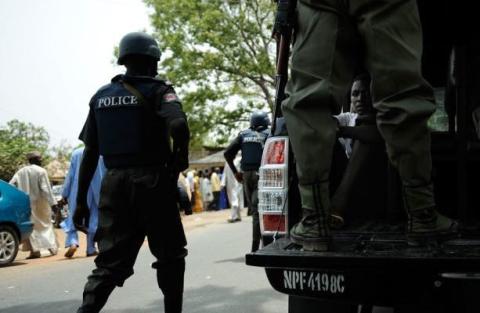
All efforts to speak with one of the government officials were not successful. However, in a press statement, the Plateau State Government, in response to the massacre and avoidance of counter-reprisal, imposed dusk-to-dawn (6 pm – 6 am) curfew in Bassa, Jos South and Jos North local governments at 3 am on Sunday. But unconfirmed reports coming from Jos North this morning indicate that the atmosphere is intense.

It’s no wonder that through its Director of Press, Dr Makut Simon Machan, the state government released another statement at exactly 11:02 am today that imposing a 24-hour curfew in Jos North “to contain further security threats”.

It could be recalled that on Wednesday, August 4, 2021, an attack on travellers was recorded where a truck full of animals was set ablaze at Gada Biyu, a trekking distance from Rukuba Road. That attack was said to be a reprisal as Fulanis were said to have attacked Irigwe houses and destroyed farms in other state villages.

Yesterday’s attack could also be a continuation of the previous reprisal. Survivors and locals call on the Plateau state government to look into the root cause of these killings as a matter of urgency and ensure justice is served. Any delay could return Jos North to its dark days when people get killed sporadically if they (mistakenly) entered territory belonging to another ethnicity or religion other than theirs.

Haruna Muhammad further urged the Federal and State government to ensure the arrest of all who were responsible for the merciless killings of his innocent brothers on August 14 2021. He said whatever misunderstanding is going on between the tribes in Plateau state, his brothers know nothing about it, and their killings shouldn’t be unchecked. The massacre yesterday left 26 people dead and 33 survivors, including the drivers.

Apex Muslim body, NSCIA, condemns butcher of Muslim travellers in Plateau, appeals for calm

By Muhammad Sabiu

The Nigerian Supreme Council for Islamic Affairs (NSCIA) on Sunday “unequivocally condemns” the attack and killing of over 22 Muslim travellers by a suspected Christian militia in Plateau State.

On Saturday, the Daily Reality newspaper reported the killing of the travellers who were returning from Bauchi to Ondo after attending a religious event.

In a statement, the NSCIA said, “The Nigerian Supreme Council for Islamic Affairs (NSCIA) under the leadership of its President-General Muhammad Sa’ad Abubakar, CFR, mni, unequivocally condemns the massacre of a group of innocent Muslims who were returning from Bauchi to Akure. Ondo State, on Saturday.”

The Muslim body appeals for calm and warns against reprisals, saying, “…the Council appeals to all Muslims to be calm and nobody should take laws into his or her hands. The Council re-emphasises that no human life deserves to be wasted on any ground, be it religious or ethnic.”

The Presidency also condemned the killing in a statement signed by the presidential spokesperson, Malam Garba Shehu.

Again, social media users took to their accounts to protest the killing by sharing photo and video content of the victims’ bodies and their funerals.