PDP

The political calculations of 2023

By Muhammad Sagir Bauchi

As the political atmosphere in the country started to get momentum, top political actors are back on the strategy board to put down action and execution plans for successful campaigns and elections victory. Overnight, some controversial politicians are now running away from their once arrogant and nonchalant attitudes to a born-again one, thereby looking away from whatever may dent their newly ‘customised integrity’. As a result, the usual campaign promises of provision of security, creating job opportunities, fighting against corruption, etc., now appears unsaleable talking points to the electorates as they once were.

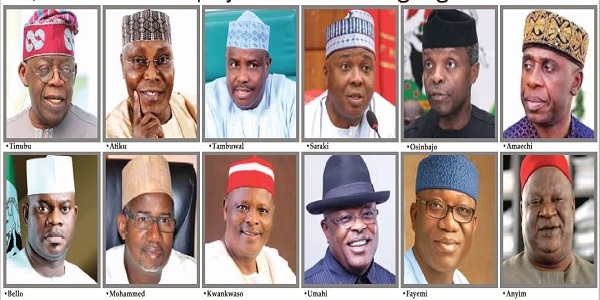
News of the inter-party crossover from some prominent politicians like former Speaker Hon. Yakubu Dogara (PDP-APC), Matawalle of Zamfara (PDP-APC), Kwankwaso (PDP-NNPP), etc., are making headlines.

Hon. Yakubu Dogara is one of the major political figures in Bauchi State politics. His role in ousting the previous governor of the state would never be neglected or underestimated. He played a vital role in his constituency and other spheres of the system.

When he decamped from PDP, the party that brought the present administration of Governor Bala Muhammad, several opinions were expressed in respect to that. To some, he joined the ruling party in anticipation of giving him the party leadership (i.e National Chairman of the party). While, to others, he was craving for the seat of Vice-President, in case the party ticket is won by a Southern Muslim. In present Nigeria, a Muslim-Muslim or Christian-Christian ticket at the presidential ticket is a non-starter, as it will polarise the country, create chaos and mistrust.

Of the two opinions surrounding the decamping of Dogara, none could totally be disregarded as they contain some elements of truth. For instance, If APC assigns Bola Ahmed Tinubu as its flag bearer, the party must pick a Northern Christian politician with popularity, high political experienced and wide acceptance among the regional religious, political and traditional leaders/institutions. The aim is to convince the electorates to go out and vote for the party on the election day. Dogara is one of those Northern Christians with broad appeal and political experience. But, can he win the confidence of his Northern block to vote for their ticket?

For that answer, we have to examine the current political doings and his image in his home state, Bauchi, to answer that question.

The present political situation in the state is a bit complicated. We all witnessed how his doings in his constituency influenced the emergence of the current governor of the state during the last gubernatorial elections. Still, events have overtaken the once-political comrades’ romance between him and the governor. His popularity has significantly dropped in 2/3 of the constituency he’s representing. And that could affect his future career in the state and beyond. Therefore, the Dogara factor alone cannot influence Northerners to vote for his party.

Now, away from Dogara to the party at large. Months ago, APC Governor’s Forum paid an unexpected visit to the former President, Dr Goodluck Ebele Jonathan. Of course, we did not know what was discussed during the visit. Still, looking at how the party is desperate to retain the president’s seat, it’ll be hard to disconnect it from what the Hausa people termed as “gaisuwa da ro’kon iri”. So they visited him, likely to ask for his blessing, sympathy and support to use his influence in the South-South to canvass support for their party flag bearer during elections. Or maybe, to lure him into accepting to contest for the presidency on the party ticket. 

If we take the party entirely and put it on a scale, we can see that the party is in a dilemma of who to be entrusted with the party ticket to retain the presidential seat. But looking at how the party zoned the national party executives, now it is clear that the flag of the party would come from the South.

Among the top Southern candidates that expressed interest in the presidency are Vice President Yemi Osibanjo and the party leader, Bola Tinubu. One of these two have every chance to win the party primaries. But, who among them can be an easy sale to all the regions of the country? Would the old rivalry between Igbos and Yorubas resurrect and allow Igbos to support anyone of them? Only time would tell.

But in the North, despite the significant drop in trust and popularity of President Muhammadu Buhari, there still exist those supporters that will go for whoever PMB anointed to succeed him at the polls. But many will be in a dilemma of choosing between one of their own, an outsider or may even decide not to vote.

After the country’s return to Democratic rule, PMB was among those with a desperate ambition to rule the country again. He contested three times but lost at general elections. Fortunately for him, he won at his fourth outing. Unfortunately, during his failed bids, his body language was that he only relied on the votes of his fellow Northerners.

By 2010, Buhari realised that that illusion wouldn’t give him the presidency. So, he aligned/merges his one-man party, CPC, with an umbrella forum of some rebellious and highly influential mainstream politicians from the ruling party, nPDP, ANPP and the Southwest’s AC to form the APC. This conglomeration of parties (merger) is what solely got him the presidency.

With all honesty, looking back at the significant contribution of the Southwest politicians, this is the right time for him to pay back those that helped him actualise his presidential ambition with the party ticket on a platter of gold, especially to a Southwestern candidate.

There’s not much tension within the PDP due to their discipline and expertise in handling intra-party conflict. However, the party must be careful with an emerging conflict from Wazirin Adamawa and governors’ overzealous ambitions. In addition, they must learn from their 2015 avoidable mistake that cost them the elections and government.

Sagir Ibrahim is a graduate of Economics from the Department of Economics, Bauchi State University Gadau. He can be reached via ibrahimsagir1227@gmail.com.

Zamfara deputy governor impeached

By Muhammad Sabiu

Reports coming from Gusau have it that Mahdi Aliyu Gusau, the state’s deputy governor, has been impeached by the Zamfara State House of Assembly.

The members ousted Mr Gusau from office on Wednesday during plenary after 20 out of 21 voted in favour of his removal.

Following the submission of a panel report by the state’s chief judge, Kulu Aliyu, to investigate alleged impeachable offences against the deputy governor, the parliamentarians quickly voted.

2023: Memo to APC, PDP on youths’ inclusion

By Ibraheem Abdullateef

Late last year, Nigerian media was awash with my statement of appeal to the two biggest political parties, All Progressives Congress (APC) and the Peoples Democratic Party (PDP), on the review of nomination form fees for office-seekers under 35 years old in the 2023 elections, to deepen inclusion, and strengthen national democracy. Weeks later, none of these parties has made any official statement on the matter. We must sustain the tempo until the cause is achieved. 

The review of nomination form fees by APC and PDP is urgent to strengthen our democracy, encourage diversity, and foster youths’ inclusion in politics and leadership. It is socially, economically, and politically unhealthy to retain the same table used in 2019 for the 2023 elections. 

In the 2019 elections, PDP sold their gubernatorial expression of interest and nomination forms for N1 million and N20 million, respectively.

Reports also show that PDP charged N12 million for both the expression of interest and nomination form for the Office of the President, N3.5million for Senate, N2.5million for House of Representatives, and N600,000 for the House of Assembly.

In a similar vein, the gubernatorial expression of interest and nomination form of the ruling APC attracted N2.5 million and N20 million, respectively. 

It also sold for N5 million the expression of interest and N40 million for nomination form for the Office of President, N7 million for Senate, N3.5million for House of Representatives, and N850,000, for the House of Assembly.

It is most worrisome that these political parties retained the fees in the recently held Anambra elections, Ekiti primaries, and others in 2022.

While I understand that funds accrued from the sale of forms remain a serious source of funding its operations, the decision of the parties to make young people pay the same fees as more established office-seekers is unfair and inconsistent with emerging realities in modern democracies. 

As it stands today, the exorbitant fees for nomination forms are mitigating against the legitimate ambition of over 65% of credible, capable young Nigerians to run for elective offices. It also encourages corruption and godfatherism; fuels the orgy for violent, do-or-die electoral practices while deepening the gap between the rich and have-nots in our society. No party must retain those crazy fees for the 2023 elections. 

Data about the 2019 elections released by YIAGA showed that only 8.6% (68 members) of 991 seats in the 36 State House of Assemblies and 6.8% of 360 members of the House of Representatives were under 35 and below.

Although youth candidacy in Nigeria’s elections rose from 21% to 34.2 % (13.5 per cent of the candidates vied for the Senate, and 27.4 per cent for the House of Representatives), the fact is that buoyed by the Age Reduction Act, Nigeria could have recorded better youths participation under a more favourable party system. This shows that the demography that constitutes over 60% of the registered voters in the country has literally had no place in Nigeria’s democracy. 

From 1999 to date, the abysmal record of youths participation in politics is a direct effect of our mega parties, PDP and APC’s weak commitment to youths inclusion agenda. Despite the notable efforts of #NotTooYoungToRun in improving eligibility, affordability of the political system reduction in nomination fees is key to unlocking the space for young Nigerians. This is why these parties need to decide now to show over 80 million Nigerian youths they genuinely believe in them and are the best platforms for the Nigeria Project. 

It no longer sells the stories about the non-participation of young people in politics. What is new is the understanding that there has been no space for them in the leadership. From communication to organising, and even campaigns, they have always been involved at different levels. But, with a lack of deliberate intra-party youths-friendly policies, Nigerian political parties are meant to attract seasonal voters, not future leaders.

Let me state that I am aware that the PDP and APC constitutions give women a 50% cut in regular fees for nomination forms and find that applaudable. But I cannot understand in 2022 why the same constitution would make no provision for the youths, especially after the #EndSARS struggle and the global youths renaissance, to encourage young Nigerians’ dreams and passion for the motherland. Nigerian youths deserve a 60% cut in fees. 

With our sheer numerical strength and globally acclaimed talent and industry, Nigerian youths do not deserve this strategic exclusion and alienation from democracy from the parties that average Nigerian youths consider as platforms of choice. The message this passes inadvertently is that they are not much wanted, accepted, and treasured, as is usually parroted. And seriously, this is a bad curve on our political values that must be reset immediately by the parties. It is time to match words with actions. 

When these constitutions are reviewed, I have absolute faith that they will positively change leadership selection, becoming instrumental to the clamour to ingest energy and innovation to national leadership. There is no doubt of Nigerian youths’ abilities to lead and make impacts to accelerate the growth and development of the nation. 

I appeal earnestly to the leadership of these parties to stop this alienation, review and reduce the fees for the nomination form for office-seekers below 35 years of age in the 2023 elections. It is the ultimate way to reciprocate the love and loyalty, maximise the talent and energy of the youths constituency, to promote inclusion, peace and development of Nigeria. 

Abdullateef is the Kwara Central Representative in the Nigerian Youth Parliament (NYP) 5th Assembly. He can be reached via ibraheemabdullateef09@gmail.com.

Kashim Shettima: Principles, courage, conviction cannot kill a man

By Lawan Bukar Maigana

“Cowards die many times before their deaths; the valiant never taste death but once.”

When arguably the all-time world’s greatest playwright, Williams Shakespeare, penned the above immortal lines in Act 2 Scene 2 of Julius Caesar, he must have had a long peep into the future of one of his country’s colonies. Moreover, he must have envisioned a special kind of man who exudes rare courage and sound, consistent principles in all he does and at all times.

He is a man who abandons the bandwagon and chooses to remain on the side of truth, fairness and justice even if that stance is unpopular and can cost him his safety and freedom.

Why do some people have sleeplessness over the courage and audacity of Senator Kashim Shettima, a former Governor of Borno State, over his recent opinions on democracy, politics and good governance in Nigeria? Surprisingly, subtle threats are being expressed to warn him to thread softly in some quarters and platforms.

Kashim Shettima is not your kind of everyday politician. His inspirational life story has been that of courage, conviction and consistency and remaining on the right path, on the side of the oppressed and the vulnerable, through thick and thin.

Charismatic, sound, brilliant and masses-oriented, the qualified agricultural economist has dedicated the better part of his adult life to the service of his beloved people of Borno state.

The above outstanding qualities earned him the highest office in the state in 2011 after he served with distinction in at least four different ministries as Commissioner.

After a brilliant career as a first-rate banker, he was Commissioner for Local Government and Chieftaincy Affairs (2008), Education (2009), Agriculture and Natural Resources, and finally, Health. He then contested the Governorship election in 2011 and defeated Muhammad Goni of the PDP.

His first term in office endeared him to the hearts of the people. He further proved himself to be a compassionate, responsible and responsive leader who was always there to meet Borno people at the point of their need. His emphasis was on youth and women empowerment and infrastructural upliftment of the state.

In one of his most quoted quotes, American civil rights icon, Martin Luther King Jr said: “The ultimate measure of a man is not where he stands in moments of comfort and convenience, but where he stands at times of challenge and controversy.”

The Boko Haram menace brought the rare leadership skills out of Shettima. He stood his ground to protect his people; he never ran away from the battle. Instead, he put his life on the line and confronted the monsters. He mobilized the police, rallied soldiers and established the Civilian JTF, which helped to stem the tide of the insurgency.

In September 2014, Maiduguri, the seat of government, became very vulnerable to being attacked and overran by insurgents. The fear was so intense that notable residents relocated their families to Abuja. However, Governor Shettima, who was out of the country for an official assignment, abandoned everything and returned to Maiduguri in a show of courage and patriotism. On his return, he mobilized residents towards rising in defence of their ancestry, and they succeeded in pushing the enemies back.

Based on the sleepless nights he endured in the latter part of his first tenure – moving from one shooting or bombing scene  to the other with countless bodies and a river flowing with blood and all the back and forth he did with Presidential Villa actors over whose responsibility it was to protect Borno people – most observers thought he would chicken out and not bother to seek the second term in office

He sought and won reelection in 2015 under the All Progressives Congress, APC, and was unanimously chosen as Chairman of the Northern States Governors’ Forum, an umbrella body of Governors in the 19 States in northern Nigeria.

Alongside sincere peacebuilding, Governor Shettima championed the Reconstruction, Rehabilitation and Resettlement of victims of insurgency. He focused so much attention on the expansion and remodelling of existing schools and building new boarding primary and junior secondary schools to cater for over 50000 unaccompanied orphans whose parents were killed by insurgents across the 27 local government areas of the state.

Shettima also identified and supported a fine, fantastic gentleman as successor so that the journey of good governance he started would not perish on the way. Since coming to power, Professor Babagana Zulum has elevated good governance to world-class. Zulum’s excellence is a massive credit to Shettima. Unlike others, the two great men complement each other a lot and have not been involved in any fight.

In February 2019, Shettima’s glittering political career entered a new chapter when he won the election to represent the people of Borno Central at the Senate. Since then, his voice has been one of the most audible and laudable in the fight for justice and rights for all Nigerians in the Senate.

Speaking truth to power is part of Shettima’s DNA, and no level of elite conspiracy or underhand, high-wire, discreet manipulations, schemings or threats would take that away.

A popular adage in street parlance says: “Something must kill a man.” It is often said to justify some risk-taking that could end a man’s life. But the good people of Borno and other Nigerians of good conscience will not sit by and watch any harm come to Shettima on account of his principled stand on justice, equity and fairness as we move towards 2023.

His political choices and comments are his entitlements. However, if some powerful, vested interests are so uncomfortable with the truth that they want to unleash ‘undesirable elements’ on him, the people are watching with keen eyes and vigilance.

The people of Borno and their allies outside the state will employ all legally permissible and legitimate means to protect Shettima from any form of harassment and intimidation. They will continue to support and protect him till he accomplishes his mission of doing what is just and fair to all and sundry in the polity, not only in Borno, North-East but Nigeria at large.

Lawan Bukar Maigana wrote from Wuye District Abuja and sent the article via Lawanbukarmaigana@gmail.com.

Sen. Lawal Yahaya Gumau: An epitome of fulfilling promises.

By Muwaffiq Fa’izu Saleh

Since the demise of Sen. Ali Wakili (RIP), many of us have taken an interest in who will succeed him, probably due to our admiration for the unique style in which he carried out the affairs of his constituency (as the then Chairman of the Senate Committee on Poverty Alleviation and member of various committees) to the numerous constituency and developmental projects. There came his replacement in the person of Sen. Lawal Yahaya Gumau, a.k.a. “Maliya”.

Many progressives doubted the ability and capability of Sen. Maliya to sustain the level of Wakili’s performance, not even surpass it. Therefore, all eyes were on him, whether he would deliver or not. Lo and behold, there came a silent achiever in him.

I, however, said “silent achiever” because of how it is being said. The achievements of Senator Gumau are too enormous to be silent, for they are conspicuous. From reviving long-abandoned boreholes to renovating and or constructing and reconstructing classrooms and providing essential reading and writing materials for primary and secondary schools, among other projects. These works cut across his constituencies.

The dividend of Democracy, they say, is the beneficial results of superficial investments made by the people to bring about a government to power. In Sen. Maliya, we have seen quite many of them. They can only be highlighted in the various empowerment programs in his constituents. These include distributing sewing machines, motorcycles, grinding machines, car washing machines, utility vehicles, and SUVs for his political associates, giving various gifts in cash and kind.

In today’s society, the importance of these laudable gestures cannot be overemphasised. As I heard him in one or two speeches where he made some promises, most or all that he focuses on are projects and developments that will directly touch people’s lives, and he made it clear that it always touches his heart to see people suffering. He rarely speaks, but he is a man that works the walk.

Furthermore, you have most likely heard once, twice, or even many times that Sen. Maliya has given an award, a scholarship, or an employment opportunity to a close associate or even a family member. I may not work with figures on these gestures, but some never come to the limelight until one circumstance or another brings them, and I believe some may never do so. I can tell you that of all the qualities of a distinguished senator, this particular one is the most fascinating to many of us. 

The religious institutions are not left out in the pools of the Senator’s good deeds as he extends his hands to them. Suppose you did not hear about him renovating and/or building this and that mosque. In that case, you must have heard about him giving one Imam/Sheikh/religious figure a big and luxurious car (s) or bus (es) for the smooth running of religious activities.

I cannot remember a week in the last couple of months that I didn’t see or hear about the Distinguished Senator fulfilling one promise or another and building on so many good works that he never even promised. It has now reached the extent that Gumau has a new slogan, “Maliya Mai Sati-Sati”. A few days ago, he did some of these stunts that became the talk of the town in a state whose government gives out “Akuya” as empowerment.

Bauchi may be a state where circumstances brought the PDP to govern. Still, with Senator Lawal Yahaya Gumau and many others in the APC making substantial positive impacts on their people, the PDP is already a standing-dead party only waiting to be buried come 2023.

Muwaffiq Fa’izu Saleh wrote from Bauchi State via muwaffiq005@gmail.com.

X-raying Hon. Usman Bello’s representation in Akko

By Kabiru Danladi Lawanti

In a liberal democracy, political representation is a straightforward concept. In Nigeria, every four years, there are elections where citizens pause and turn back to see what their political representatives did to them during their four-year tenure. In a defined geographic area or constituencies, the citizens choose from a range of candidates—themselves citizens living in (or near) that same area—and elect a few to sit in the national assembly as representatives of the people of these constituencies. Yet both theoretically and in practice, it is far more complicated.

While representative democracy is often poetically described as government ‘of the people, by the people, for the people,’ it is not only the people who are represented: political parties, ideologies (in this sense religious and ethnic), business, urban and rural people — to name but a few—are also represented. Furthermore, even the very notion of ‘the people’ is amorphous as a representative cannot possibly represent the full diversity of ‘the people’ and all their divergent and conflicting interests.

Since the return of democracy in Nigeria in 1999, many representatives have been sent to Abuja to represent their constituency at the national level. These constituencies comprise a group of local government areas in a particular state. In some states, the constituencies are formed of a single local government area. For example, in Gombe State, there are six federal constituencies: Akko, which covers the Akko LGA, Balanga/Billiri that covers Balanga and Billiri LGAs, Dukku/Nafada that comprises Dukku and Nafada LGAs. Others are Gombe/Kwami/Funakaye, which contains Gombe, Kwami and Funakaye LGAs; Kaltungo/Shongom, which covers Kaltungo and Shongom LGAs and lastly, the Yamaltu/Deba federal constituency that covers Yamaltu/Deba LGA. These constituencies have sent representatives since 1999. Of particular interest to me is the Akko Federal Constituency, where I came from.

Politics, they said, is a network of no permanent foes but only connected interests. In the last 22 years, the constituency has had six representatives. Of this six, two remained the longest-serving representatives – Bello Suleiman and Usman Bello Kumo. Bello Mohammed spent only one tenure in the National Assembly, from 199-2003. In contrast, Umaru Barambu and Samaila Mu’azu Kashere spent two years each in the hallowed chamber after a court sacked Umaru Barambu in 2017.

To be fair to the reps mentioned above, each tried to develop the area in his way. However, a careful analysis of what came to the constituency in the last three and a half years cannot be compared to any in the previous 22 years. The level of human and capital development witnessed is unprecedented in the entire northeast. The only representative that can match the level of human and capital development brought to the constituency by Usman Bello Kumo (UBK) is Mukhtar Betara. This is obvious, knowing that Betara is Chairman House Committee on Appropriation.

A consummate and highly experienced politician, Usman Bello Kumo has a deep commitment and unrivalled passion for grassroots development. For instance, in his second coming alone, 2019 to date in the National Assembly, he has attracted infrastructural development in many areas of human development like education, health, water, roads, electricity, youth and women empowerment all over the constituency for the betterment of their economy and improved standard of living.

As Chairman, House Committee on Police, Hon UBK was able to also send more than 100 youth into the Nigeria Police Force. One thing is clear, UBK has always stood out among other politicians of his calibre. He has never allowed the trappings and grandeur of office to stand between him and his avowed goals of lifting his people from the shackles of poverty, hunger, disease, homelessness and mass unemployment.

As 2023 approaches, we shall soon be inundated with a mix of the serious, the incredible and sprinkles of the comical as political parties jostle to promote candidates of varying capabilities. These include those who appear to have genuine intentions for service to the people and aspirants who seem pretty content with no more than having their faces splashed around on party banners. Already, we have seen some campaigns of calumny against his person when some rabble-rousers, fighting for recognition, working under the instruction of politicians are sponsoring political jobbers to say many things against the man. This, they do discredit him in the eyes of his teeming supporters. One thing is clear; it seems UBK is not even distracted with these political mudslingers.

Holding onto his mission – an intense zeal for total political, economic and social liberation of his people, Hon UBK has always seen his primary vocation in the political arena as being one of service, duty, benevolence and charity towards his constituents. In this regard, he has abided by his campaign promises of using elective office to improve a lot of his people. This is the direct opposite of what his detractors are doing. His opponent definition of representation is that of trying to use political office to feather their nest, irrespective of the economic fortunes of the electorate that voted for them in the first place.

Notwithstanding these outstanding credentials and track record of success, we must remind Hon UBK, as stakeholders and indigenes of this area, that rural areas need his attention. Most of us in the rural regions of Akko, especially villages like Lawanti, Malam Jamo, Gamadadi, Akko and surrounding towns, are currently facing an acute shortage of water never seen in more than thirty years. My last visit in December 2021 to my home town made me pity the dwellers of these areas. Most have to travel many kilometres to get drinking water. Others use water from streams, competing with their animals. It is a pitiful scenario.

There are also allegations that his empowerment programmes are not all-inclusive. Recently, some communities in Gona District have a cause to go to press to complain that his empowerment programmes were only targeted at Kumo, his hometown. 

As a political maestro, who can be taken literally for his words, Hon UBK needs to pause and turn his attention to these people and listen to their complaints, even if they come from a minority voice. We have no doubt, considering the excellent job he did to his constituency in his first coming 2011-2015 and now, his words, as the proverbial saying goes, can be taken to the bank.

As we approach 2023, politicians, including Hon UBK, understand the importance of an alliance. There is no better time to do this than now. And I am sure he needs the rural areas to launch his return to the National Assembly.

Kabiru Danladi Lawanti wrote from the Department of Mass Communication, Ahmadu Bello University, Zaria, via kblondon2003@yahoo.com.

Road to Aso Villa 2023

By Ahmad Murtala

Ever since Asiwaju Bola Ahmed Tinubu declared his ambition to succeed President Buhari earlier this month, the political sphere off and online stirred up debates in favour of Tinubu and the potholes along his way. People cite some irrelevant motifs that may hinder Tinubu’s success. However, these are not paramount of any buyable candidate at the moment, and of course, for the electorate.

The intrinsic status quo of our polity entertains those factors that undermine the democracy and the governance—rating region, tribe, religion, age, school attended, above competency and capacity going even further to dig up the ancestral root of a candidate. The result we are cultivating under this administration says a lot about the mistakes we’ve committed in the past – from  2015 to date—by using only those yardsticks to scrutinize a candidate. Can we still pelt with our intelligence to subscribe to the same mistake of the past come 2023, which appears new dawn to our country?

We imported the American presidential system of government, which is quite expensive and implemented its only cover page. It’s a multi-party system that compels too much spending which a saleable candidate capable of taking the lead is hindered from contesting by the processions. These include the ticket, the campaign, and the mobilization. In this context, two major parties are on the run, which the rest endorses the party that has the chance of winning in subterranean manoeuvre.

The Southeast has configured and domesticated PDP as its political party since 1999, while APC appears nascent in the region—the weakness of the ruling party and the deterioration of the security across the country under the watch of APC makes the nascent party lose its credibility far to the NE. If the president is to emerge from the region, two possibilities may arise.

First, northern people stereotype and characterize PDP as evil, callous and looters, which most of the states in the region are under. Second, APC has lost its shining plate before the people based on what appears on the ground since coming to power in 2015. Therefore, no matter the candidate’s credit from the SE, if APC deems it fit to give the flag bearer to the region to entertain zoning as postulated by some northern state governors, the chances are its success would be a bottleneck.

The polarization within the spheres of politics that SouthEast translates to secession if not given a chance to rule, it appears that PDP would have to play the same card of the last election, by choosing the running mate from the SouthEast, here the North would draw a line looking at the indices of the carnage their businesses faced in the region. Meanwhile, APC would play the South-West and the running mate from the North, perhaps a Muslim-Muslim ticket. The result would be determined by the primaries from the parties in a couple of weeks ahead.  

In those countries that have built the social establishments and have smooth working systems with literally little or no corruption, the age of presidential aspirants is not a matter of concern. We see Biden of US—unlike Nigeria when chunks of domestic battle are entangled yet to be addressed. The age of the candidate matters a lot in this context. Tinubu, who appears to be more robust so far from those who declared their aspiration, is brazenly feeble. If not a good diet and wealth make politicians appear strong, most of the politicians at the frontline ought to assume coach duties guiding the upcoming ones. We forbid the like we’ve seen in this administration by encasing the president in the Villa and plunging the country into anarchy.

From the view and the colour of the game, Atiku Abubakar, the former vice president, would swiftly take the PDP flag and Tinubu APC. Both have been dented by the people’s court to have maliciously accumulated wealth—having no other alternative polling box for the electorate. If history is to repeat itself, Buhari contested four times before he won. Now, Atiku is running on his fifth time is likely to have a smooth ride based on APC losing its credibility because of insecurity across the country. 

The extreme thirst for power to fulfil the ‘need hierarchy’ is not dangerous to the beholder alone. The motive is only to possess the authority without a sketched-architectural blueprint and clear manifestos which will coalesce with the national need. Buhari came on this platter, and the result is unbecoming.

So far, the two giants have not made it to the public the what-and-how to attend to the tangled problems agonizing every sector. The currently delicate security and imbalanced economy are at the top, strangling the country by the neck—finding it arduous to breathe. We, for now, don’t need the so-called ‘kingmakers’ who cannot heed or take advice from the public opinion but become foreign puppets—since, intrinsically, the presumption of superiority as the number-one citizen is established. 

Road to Villa 2023 must come from the parties and play the game card to sew the polarization across the region. The Villa in 2023 and beyond begs for a head that has both stick and carrot in his hands, the one who has a clear understanding of foreign policies and has immediate treatment to our problems, both short and long-term solutions. If to suggest best candidates, there are a multitude of them from SS, SW and NW, both fit in into position of President and Vice President, but for now, let’s see the outcome of the parties convention, which is the utmost decider.

Ahmad Murtala sent this article via ahmadmurtala@outlook.com.

As Tinubu commences the difficult and easy journey

By Zayyad I. Muhammad

The battle for the 2023 elections will be fascinating. Asiwaju Bola Ahmed Tinubu has commenced a challenging but exciting quest to be President of Nigeria in 2023. Tinubu would face five significant obstacles.

Firstly, his faith. Secondly, the choice of a running mate. Thirdly, the rugged politics the PDP would play – the PDP may present a northern presidential candidate and just ‘Siddon-look’, putting the APC on the defensive. And fourthly, how the North would vote relative to Omatekun and anti-Fulani sentiments in the southwest. And fifthly, Vice-President Yemi Osinbajo supporters are on the move, solely focused on the presidency with confidence.

Tinubu, a Muslim from the Southwest, might have a free sail at home because of the complex nature of the socio-political settings of the southwest. But to appeal to other zones in the country, he will be in a quandary regarding his choice of a running mate. If he picks a Christian from the North, the bulk of APC support in the North, particularly the Muslim North, will look the other way. If he chooses a Muslim from the North, the country will undoubtedly be against a presidential Muslim-Muslim ticket. However, if the PDP picks its presidential candidate from the North, he may get some ‘relief’ in the South

Operation Amotekun and Sunday Igboho’s January 2021 one-week ultimatum to Fulani herders to vacate the southwest, Tinubu’s old statement – ‘ I don’t believe in one Nigeria’ will be another weapon that will be used against him in the North.

Tinubu’s war chest is enormous. His political tactics are shrewd; his political structure is solid, widespread, and well-organized They recently ‘bombarded’ the North and scared their opponents. Tinubu is a good candidate but has a big dilemma, as mentioned above.

On the other hand, the 2023 presidential election battle will be exciting – PDP will be on the offensive, while the ruling APC will be on the defensive. The flag bearers of either political party will also have many political hurdles to cross.

Most people expect the 2023 presidential election finale to be an Atiku vs a Tinubu game. Atiku vs Tinubu will be an interesting big game, a very BIG one. Two similar people with similar public perceptions and similar game styles; “I-know-you, you-know-me” scenario will come to play. The two have well-established political structures that can easily scare an opponent. They pay their bills; the contest would be 100 per cent politics, politics, politics- even the choice of the running mates. It will be a fascinating zero-sum game. Both have similar advantages and disadvantages.

Zayyad I. Muhammad writes from Abuja via zaymohd@yahoo.com.

Political crisis rocks Gombe as thugs storm Atiku’s campaign office, set PDP secretariat ablaze

By Uzair Adam Imam 

Suspected political thugs have stormed the campaign office of former Vice-President Atiku Abubakar, situated some few kilometres away from the Gombe metropolis.

The Daily Reality gathered that the office had its windows broken by the thugs while taking away valuable items like air conditioners.

The thugs were also reported to have set the Gombe State Secretariat of the opposition Peoples Democratic Party (PDP) ablaze. 

Confirming the incident, an eyewitness said that men in the area extinguished the fire with the help of Fire Service personnel.

Addressing reporters, PDP Chairman General Audu Kwaskebe (Rtd) blamed Youth Leader of the All Progressives Congress (APC) in the state, Kawu Lero, saying he was the one who led youths to burn the secretariat.

He added that they had already written a petition to the state police command for the appropriate action.

Meanwhile, State PRO of the APC, Mr Moses Kyari, alleged that it was PDP members that set their office ablaze “due internal crisis over control of the party structure.”

Efforts made to speak to the Police Public Relations Officer (PPRO) in Gombe, SP Obed Mary Malum, were fruitless.

Zulum is an exceptional political player

By Abdulrahman Yunusa

Borno State Governor Prof. Babagana Umara Zulum’s dealings with the power are enough to prove that he is an exceptional political player. He is extra cautious when sensitive issues are involved regarding the people he leads. He stood for his armless people during the tough days of Boko Haram activities and succeeded.

Unlike any other politician, Zulum neither puts his personal interest above his people’s nor allows his sentiment to overshadow his rationality. On the contrary, he often puts his people first before anything else. Thus, this aptly depicts how he resembles a statesman rather than a politician.

To attest to this, look at how he confronted several tragedies in the past. He does everything to get his people out of the cave of fear. Meanwhile, his recent assertion that says, “I’m not a politician, it’s my destiny that made me governor”, is another point of contention.

Either he said this wittingly to make an endpoint for his political voyage because he figured out something despicable attached to his govt, and he can’t withstand it. Perhaps he gets compromised as other politicians do, or he isn’t satisfied with his performance as a leader. That’s what we anticipated from President Buhari and his cohorts. But, instead, they end up disappointing us.

However, I do not support Zulum quitting politics so soon because he is the only man I have utmost conviction and respect for. And with people of his likes out of this dirty game, I can say we will be at a loss till God knows when.

Though I don’t know what the future holds for us, I’m terrified of losing such a rare gem among Nigerian politicians, for they always stand unique and prove to be the best among the rest.

I pray to have a lot of people of his personality amidst these useless politicians of ours because no matter how awful things go, they will surely change the narratives.

May Allah protect our Zulum, amin.

Abdulrahman Yunusa is a political and public affairs analyst. He writes from Bauchi and can be reached via abdulrahmanyunusa10@gmail.com.