PDP

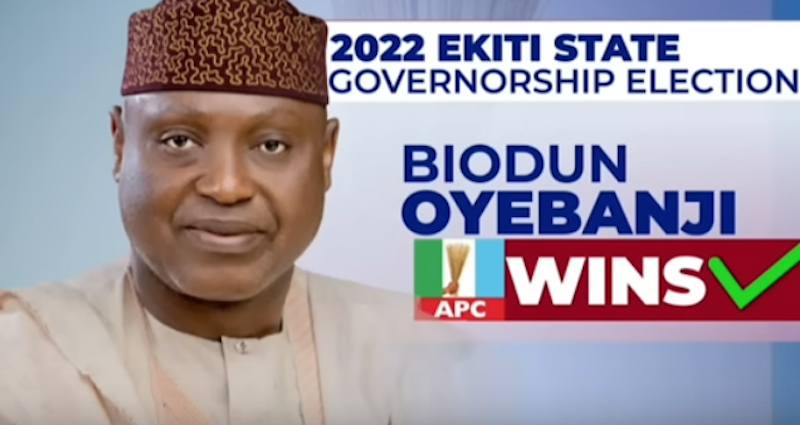
APC beats PDP, SDP, others to win Ekiti governorship election

B Muhammad Sabiu

In the early hours of today (Sunday), the All Progressives Congress in Ekiti State emerged triumphant after the results of Saturday’s governorship election indicated that the party’s candidate, Mr Biodun Oyebanji, defeated the 15 other contestants that took part in the race.

Oyebanji, the state’s immediate past Secretary to the Government, won in 15 of the state’s 16 Local Government Areas after receiving 187,057 votes in the election.

His nearest rival, Mr Segun Oni of the Social Democratic Party, polled 82,211 votes, while Bisi Kolawole of the Peoples Democratic Party received 67,457 votes.

Kolawole won his LGA, Efon, with a total of 6,303 votes, beating the APC’s 4,012 votes and the SDP’s 339 votes.

However, Chief Segun Oni, the Social Democratic Party’s candidate, who voted in his home town of Ifaki-Ward Ekiti’s 2, Unit 6, accused the other parties of vote-buying in Ado Ekiti and Oye Ekiti.

He was reported to have said, “I have been told that selling and buying of votes are going on in Ado and Oye. This is not allowed by the law. I want security agents to move in and stop those doing that.”

Vote buying isn’t an unusual practice in the Nigerian political space since the rebirth of democracy in 1999 when former President Olusegun Obasanjo took over power.

Bauchi polytechnic suspends staff for supporting Tinubu on social media 

By Muhammad Sabiu

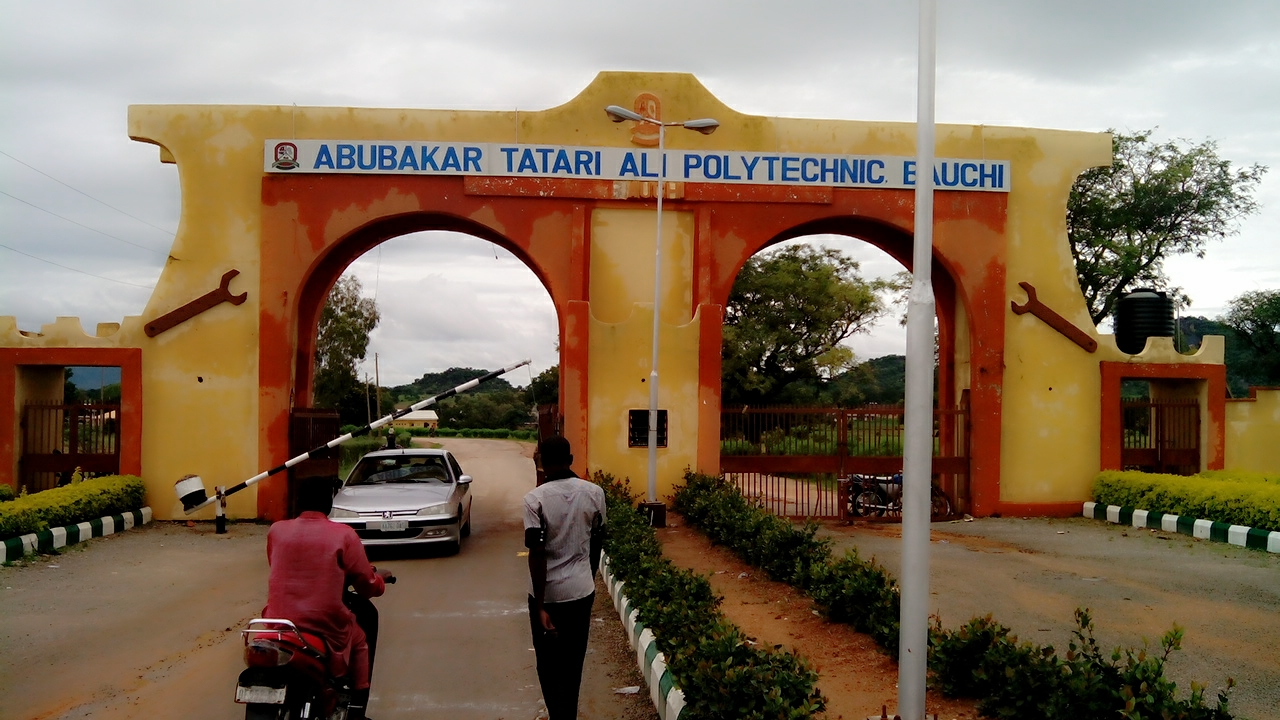
Raliya Kashim, a senior staff member of the Bauchi State-owned Abubakar Tatari Ali Polytechnic, has been suspended by the institution’s management for supporting All Progressive Congress (APC) presidential candidate Asiwaju Bola Tinubu.

Maimako Baraya, a spokesman for the polytechnic, signed the letter announcing the suspension.

The main opposition, the Peoples’s Democratic Party (PDP), is in charge of Bauchi State.

Kashim works as the polytechnic’s deputy general manager of consulting services.

She was aware of the state’s public service law prohibiting civil servants from participating in party politics, according to Mr Baraya’s letter.

Baraya was quoted to have said in the letter, “The employee recently posted videos containing campaign materials of the presidential and the governorship candidates of the All Progressives Congress (APC), which is a clear violation of the code of ethics for public servants.”

“We wish to assure the general public that there would be no sacred cow, and it will never be intimidated by the activities of political jobbers, fifth columnists and enemies of the state.”

More clarifications ahead of 2023

By Amir Abdulazeez

When President Obasanjo carelessly picked Goodluck Jonathan to serve as Umaru ‘Yaradua’s potential Vice President in 2007, little did we know that the politics of choosing running mates would later become complex and problematic. The death of Umaru, the ascension of Jonathan, the surprising emergence of Namadi Sambo and Patrick Yakowa becoming the first Christian Civilian Governor of Kaduna State would all combine to later add more relevance to the politics of running mate selection. In 2014, APC had more headaches picking a presidential running mate than the presidential candidate himself. It took them so much time and effort that one thought they would organize a new convention for that purpose.

Today, the Muslim-Muslim ticket debacle is the bane of Nigerian political discourse. While clamouring for fairness and balance, which are needed for a fragile system like Nigeria’s, we should also remember that from 1999 to date, no religion can claim any net gain from this Nigerian version of democracy. Ordinary followers of all faiths have been victims of bad governance, even pagans. We have suffered so much that if a pagan/pagan ticket will eradicate insecurity, fix the economy and bring development while being fair to all interests and affiliations, we should allow it. Therefore, the choice is between searching for solutions and satisfying sentiments; we seem to favour the latter.

A section of public commentators and spectators are already suggesting a walkover for Atiku Abubakar in the 2023 polls. That is the biggest complacency I have ever seen in contemporary Nigerian politics. How can you be facing a ruling party with almost 65% of political stakeholdership in the country and be expecting to have a walkover? Atiku is an institution, but his successes in the last two PDP primaries are more financial supremacy than political dominance. That aside, barring a Buhari-like scenario, Atiku will make a good president. He is perhaps the only fully independent candidate with a clear and accessible blueprint since 2007. In 2011, he had a better manifesto and approach than President Goodluck Jonathan; he only lost the PDP primaries to the power of incumbency. By the way, what happened to the Jonathan 2023 candidacy?

From 1992, this is Atiku’s 7th attempt at the Presidency, with 2019 being his closest to success. Many believe 2023 is his year, and so many apparent factors call for optimism in his camp. However, two fundamental things may haunt Waziri; (in)consistency and (un)popularity. Buhari and Tinubu are successfully reaping the harvests of consistency and perseverance; they stuck to opposition politics all their lives. Atiku should’ve remained in opposition when he decamped to Action Congress in 2007 or should’ve stayed in the ruling PDP when he decamped back in 2011. Ambition had kept him running from one place to another, making him neither establishment nor anti-establishment. The second question is whether there is a single state in Nigeria in which Atiku can secure one million votes or more in 2023? I hope we all remember Dr Rabi’u Kwankwaso’s 3-K States theory?

Tinubu’s boast in Ogun State over his role in the emergence of Buhari as President needs some revisiting and clarification. To avoid doubt, Muhammadu Buhari did not lose the 2003 presidential elections; it was brutally rigged to return Obasanjo for a second term. 2003 will easily enter the list of the worst elections in modern world history. In 2007, the results of the presidential election were simply written, so we can’t even call that election not to talk of who won or lost. I have never relied on 2003 and 2007 election figures for research or serious analysis because they are primarily fabricated. The 2011 elections were relatively fair, but at least 40% of the vote was rigged, written, or inflated, especially in the South-South and South-East.

In the circumstances like these, we cannot comfortably declare Buhari a loser of all the previous elections he contested and only became a winner when he met Tinubu. Although 2015 was indeed the weakest version of political Buhari, it was confirmed that he had lost hope and that the APC merger spearheaded by Tinubu was what brought him back to life. But it is also true that so many other factors other than Tinubu contributed crucially to Buhari’s victory. One major one was the abysmal performance of Goodluck Jonathan. One, however, is that, without Tinubu’s support, it would’ve been near impossible for Buhari to emerge APC flagbearer against the financial powerhouses in Kwankwaso and Atiku.

This brings us to the argument that access to public funds is why some candidates (not aspirants) are stronger than others. Supporters of a particular presidential candidate even claimed that if their man had equal access to public funds, he would be better than certain candidates. This is laughable; a debate like this will take us nowhere. Just campaign for your candidate and persuade people to vote for him. If we are talking about the abuse of people’s trust and the utilization of our commonwealth for personal political development, none of the prominent politicians in Nigeria will come out clean. So, let us not deceive ourselves and others.

Where are our smaller political parties who had spent most of their last four years fighting INEC over deregistration? This is a reasonable amount of time they would’ve spent coming together to form a strong bloc. In case we don’t know, 74 of them were deregistered for failing to meet the requirements to continue to exist as political parties. About 10 to 15 of the currently existing will be due for deregistration by this time next year. Instead of them to consider merging to form a decent alternative, they’ll rather hang on only to be fighting a legal survival battle with INEC next year. As the strongest and largest intellectual organization in West Africa, I don’t even know why ASUU is yet to form a political party or adopt any of the smaller parties to set up a path towards satisfying their own demands all by themselves instead of waiting and hoping for a hopeless Federal Government.

Why is nobody talking about the enormous task ahead of the next president, whom credible international reports suggest will have to use 100% of his revenue in servicing (not repaying) debts by 2024? To execute projects or even pay salaries, the next government may have to borrow further. Nigeria is in trouble. We are drowning in the ocean of foreign debts. Meanwhile, we are concerned over a presidential candidate’s religion more than his ability to bring us out of this mess. Buhari has failed because Jonathan had built a solid foundation for that failure. Now he has built a worse foundation for his successor. The possibility and danger of the next president, irrespective of his affiliation and preparedness to economically be worse than Buhari, is imminent. May God help us.

All of the political dynamics of today are closely related to 1999, some a bit earlier. Suppose you have not directly experienced Nigerian political development from 1999 with a mix of some pre-1999 historical knowledge. In that case, you will find it difficult, if not impossible, to connect specific dots that you see today. Extensive and intensive reading may help, but politely interacting with veterans will do better. Unfortunately, social media, where most of the political debates occur, is dominated by youths who knew little or nothing pre-2011 and don’t invest significant time in reading but trying to engage or even confront the same veterans that would’ve been their best opportunity at understanding the genesis of the current situation.

There are some visible changes in Nigeria’s socio-political spaces, although not new but have taken a different twist from the previous. The renewed order is the attempt to criminalize certain political choices against others. Between 2014 to 2018, discourses were dominated by hate, campaigns of calumny, fabrications and outright abuse. Today, political promoters are trying hard to make it appear that only their candidates are good enough, and any other choice is treason. This is extremism. Let’s be careful, everything is a matter of opinion, and everyone is entitled to his.

Twitter: @AmirAbdulazeez

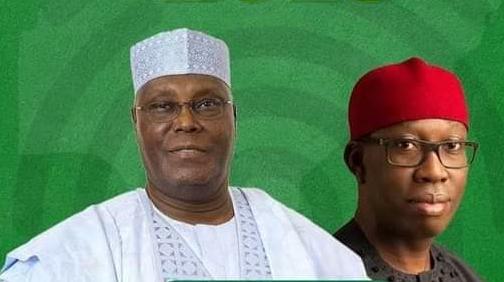
2023: Atiku names Okowa as running mate

By Sumayyah Auwal Usman

The Governor of Delta State, Ifeanyi Arthur Okowa, has been named as the vice presidential candidate of the Peoples Democratic Party for the 2023 presidential election.

Former Vice President Atiku Abubakar who emerged the presidential flag-bearer of the main opposition party made the announcement on Thursday at the party’s national secretariat.

Born 8th July, 1959, Okowa attended Edo College, Benin City (1970–1976), and later proceeded to the University of Ibadan where he studied Medicine and Surgery, graduating in 1981 with an MBBS degree. 

He served as a Commissioner in the Delta State government for Agriculture and Natural Resources (July 1999 – April 2001), Water Resources Development (April 2001 – May 2003) and Health (September 2003 – October 2006).

He resigned to contest in the 2007 Delta State PDP governorship primaries, but did not win the governorship primaries. In June 2007, Ifeanyi was appointed Secretary to the Delta state Government.

He was elected Delta North Senatorial candidate in the January 2011 PDP primaries and won the election. He clinched the ticket for the gubernatorial election in 2015, and won the Delta State Gubernatorial elections.

Votes Count! Take note, Nigerian youths

Tordue Simon Targema

One of the most disturbing illusions in the Nigerian political space is the age-long notion that “votes don’t count”. This notion is mainly responsible for wide-scale political apathy among the citizens, especially the youths who constitute the majority of the voting population. A striking irony with the notion, however, is that those who peddle and promote it are active voters who always make sure they vote at each poll- from the ward to national elections! This irony, therefore, exposes the folly of those who accept the notion and, thus, disenfranchise themselves.

Of course, it is no longer news that the Nigerian electoral process is enmeshed in malpractices – from vote-buying to actual duplication of ballot figures. Yes, the enormity of malpractices in the Nigerian electoral system is weighty and serves to sustain this ugly notion that has become a great source of worry today.

Notwithstanding these malpractices, a fact that cannot be contested remains that votes are still essential and determine who wins the election. Yes, this is a reality, and even a casual observation of the Nigerian electoral process justifies it. For example, have you ever wondered why electoral evils such as vote-buying, underage voting, ballot snatching and massive thumbprinting of ballot papers by thugs all thrive during elections? The answer is simple: it is because politicians understand that the final vote-tally matters most and would stop at nothing to ensure that more individuals vote for them!

As a Presiding Officer in one of Nigeria’s most keenly contested national elections- the 2015 general elections, and as a voter at several elections, both local and national, I have sufficient grounds to attest to the fact that votes do not just count, but that politicians also realise this fact and stop at nothing to get their supporters to vote for them. The desperation they usually demonstrate during election seasons to woo voters justifies this. You can, therefore, refuse to vote at your sole expense!

I served as a Presiding Officer in one of the most strategic elections in Nigeria’s Fourth Republic. A popular candidate with a wide fan margin- Muhammadu Buhari, contested against the then-incumbent President Goodluck Jonathan. Buhari and his kingmakers had convinced the masses that they had all the solutions to Nigeria’s numerous problems- which were, at that time, overwhelming like always. This narrative was supported by the fact that realities proved Jonathan to be a clueless weakling who lacked the strategy and tact to successfully navigate the country out of its numerous woes- endemic insecurity, pervasive corruption and deteriorating living standards.

Despite his limitations, Jonathan had a pool of supporters who still believed in his leadership philosophy, sympathised with him based on his developmental strides, tribe, region and religion, and also had the potent privilege of incumbency! Never underestimate the power of incumbency in Nigerian elections. This made the election one of the most highly contested, as the margin between the two top contenders eventually indicated.

But most striking is the fact that technology was introduced for the first time in the conduct of elections – the almighty card reader! This made almost all the difference and took the political class aback during the polls. The political class, sensing that it would no longer be business as usual, embarked on massive mobilisation and canvassing for votes. Money flew in the air- as it has become the custom with elections in the country, gifts and inducements of all kinds – clothes, foodstuffs, livestock etc., exchanged between the political class and the masses to woo them to vote.

I had an experience as a Presiding Officer that made me believe that politicians believe in voting as the surest way to win elections! Stakeholders in my polling unit tried their best to get me to manipulate the outcome of the presidential election but to no avail. I would tactically tell them that I had a template, and any manipulation of the outcome would go against my template. Although I had no problem with that, the results would be rejected at the collation centre! This would quickly disarm them, and I had my way through without any rancour. That way, I finished the presidential election without a hitch from any angle.

By the second election- gubernatorial and state assembly, I had to contend with yet another challenge! The elite had studied the workings of the card reader and decided on how to manipulate the election, but that could only still be possible if they got people to vote- even if they were illegal voters. A particular stakeholder insisted he would convey me on his bike from the collation centre to the polling unit- some several kilometres away from the ward collation centre, which was equally an interior rural area, far removed from the local government headquarters. I obliged.

On our way, he intimated to me of his ambition: he had hundreds of unclaimed voters cards belonging to his polling unit, which he wanted to use. He observed during the presidential election that voters whose cards were successfully authenticated by the card reader and those that the machine could not authenticate their cards due to one reason or the other were eligible to vote.

The card reader operates at two levels: accreditation, which confirms whether a given card belongs to a polling unit or not, and authentication, which verifies that a voter’s biometric records match those of the card they are carrying. Authentication is usually successful once the card confirms a voter’s thumbprint. Where it fails to confirm, authentication is deemed unsuccessful, but the voter can still vote – provided that the card is successfully accredited. The Presiding Officer then fills an incident report form for such a voter. At the end of the voting process, the total number of successfully authenticated cards and the unsuccessful ones is expected to tally with- or at least, be more than the total votes cast, not the other way round.

The stakeholder pleaded with me to allow him to use the cards he was carrying since both those whose biometric records are successfully authenticated and those whose records fail are eligible voters. When I consulted with my team at the polling unit, I discovered that they had already mobilised and were ready to disrupt the election should we reject the bid. As a confirmation, we had early reports from the neighbouring polling unit that the electoral officers were booted out of the village! The Supervisory Officer had to call all of us and seek our tactical cooperation in the interest of peace.

Stakeholders at our unit then embarked on aggressive canvassing for voters- because I categorically told them that I would not allow one person to vote twice, whatever happened! So they had to pay willing young men with no cards to the turn of N500 per voting to use the unclaimed cards and vote for their political parties. Funny enough, all political parties cooperated and brought their supporters to use the unclaimed cards and vote. We had a peaceful voting process afterwards.  

During the 2019 general elections, I had an amusing but similar experience, this time around as a voter and not an electoral staff. The stakeholders of my polling unit had hundreds of unclaimed voters cards belonging to the unit. They undertook to pay each available voter N500 to vote for their parties. My friend was into the game and had to vote as many as four times! In the fourth round, the Presiding Officer warned him to respect himself and not return.

Now tell me: if votes don’t count as purported – or say they don’t matter, why would politicians go that far to get people to vote for their parties? Have you ever observed how desperate political stakeholders are during voter registration? For example, in the first and only voter registration exercise I participated in as ad-hoc staff, I was posted to the village of a one-time Member, the House of Representatives, a very interior village that is hardly accessible.

The ex-Member solely undertook to take care of our welfare; provided our accommodation, a generator for our comfort at night, ensured that we had the best meals and all of that. Why would a man do that if he had known that votes are needless and all he needs to do is manipulate election results during elections?

By my analysis, winning an election in Nigeria today is the responsibility of two sets of individuals within a political party: the individual voters and the elite class. As a voter, your duty to your party and the preferred candidate is to vote – and get as many of your friends as possible to vote for him as well. Once you do that, you have fulfilled your responsibility as a party loyalist and patriotic citizen. Leave the rest to the elite; it does not concern you. Even if your party did not win in the end, the conviction that you played your part- as a patriotic citizen would- is enough consolation.

The greatest disservice many young men do to their favourite political parties and the country at large is to make all the noise on social media while they do not know what a voters card looks like, have never voted and have no intention to vote, after all, wallowing in the illusion that “votes don’t count in Nigeria after all”. This crop of individuals is the major problem we have in Nigeria.

A clarion call to all Nigerian youths as the 2023 election approaches is to disabuse your mindset of this counterproductive notion, register, get your voters card and vote. Votes actually count! Don’t be deceived.

Tordue Simon Targema is a doctoral student at the Department of Communication Arts, University of Uyo, and teaches in the department of Mass Communication, Taraba State University Jalingo. Email: torduesimon@gmail.com.

Letter to Bauchi State electorate

By Tajuddeen Ahmad Tijjani

All political parties’ primary elections have come and gone, leaving a slew of gladiators in the political arena plotting to sway the electorate into their camp to win the general elections.

From the return of democracy after a long military rule, Bauchi State had Adamu Mu’azu from 1999 to 2007. There was massive infrastructure in every nook and cranny of the state with little human development. However, many of these capital projects were concentrated in Bauchi, the state capital. When Isa Yuguda came on board from 2007 to 2015, he shifted to human development. Nevertheless, there was some infrastructure that would stand the test of time, like the Bauchi State University Gadau and the Abubakar Tafawa Balewa International Airport.

Indeed, there appears to be no better time when the good people of Bauchi State seek a governor who will serve them all than now. Certainly, there is a leadership vacuum regarding equal opportunities and the distribution of meagre resources. Not only that, I bet you, anything that leadership entails is comatose.

Nonetheless, there is still time for the current administration to make amends, and it is up to the people to decide their fate on who will take the mantle of leadership. As the election of 2023 approaches, who is the best candidate for the job?

What’s at stake is the ambiguity surrounding the payment of civil servants’ salaries. Unfortunately, no one on the state government payroll can be guaranteed that they will not be “deliberately omitted”. As a result, people have families under their control, and their only source of income is routinely squandered.

For instance, a credible report was that a particular ministry lodged their complaints to the state Accountant General. He bluntly told them it was beyond his power to make amends for the simple fact that the number one citizen is the architect of the lingering crisis. Shall we continue this way? It is left for the civil servants to seal their signatures if they are comfortable with the recent developments.

We’re not calling for people to vote based on primordial sentiments but rather to look for a competent hand who will never joke with workers and pensioners that have expended their energy on the development of Bauchi State. Yet, ironically, the end of their reward is to deny them their entitlements while the leadership is living flamboyantly with taxpayers’ money.

However, we will consider changing the narrative. The state is more significant than any individual to have a mindset of doing as he so wishes to the detriment of the larger society. Indeed, our people are waiting for the appropriate time to give him a dose of his own medicine.

Recall that Governor Muhammad Abdullahi Abubakar was unceremoniously voted out for the same offence that the current administration deliberately neglects or refuses to tackle.

There are insinuations that some power blocks or powerful forces are fighting the government of PDP in Bauchi. This fictitious or imaginary claim is far from the truth and can’t hold water. When a leader does the right thing, no one can stop or sabotage him. Therefore, I can boldly affirm that we are good at speaking the “language they understand”.

We hope that the good people of Bauchi will resolve to vote for a candidate who will treat all segments of the states as his constituency rather than focus on working for a single local government as if it were the only one that gave him votes. Even other sectors such as health and commerce are not receiving the attention they deserve. Thus, the internally generated revenue is not healthy, and our industries are left unattended. We need a governor who has the competence to address these issues head-on. The ball is in our court to take us out of the wounds or retrogress in the party of failure.

Tajuddeen Ahmad Tijjani writes from Galadima Mahmoud, Kasuwar Kaji, Azare, Bauchi state.

2023: The imperative of a Muslim-Muslim ticket for APC

By Prof. Abdussamad Umar Jibia

The All Progressive Congress (APC) is undoubtedly a party that brings together some of the most outstanding politicians in Nigeria. However, what makes the APC most attractive is the fact that it is in power. It seized this power from the People’s Democratic Party (PDP), a party that ruled Nigeria for 16 years and was also adjudged a failure by the majority of Nigerians. That is why many people do not see PDP as the solution despite all the shortcomings of the APC-led government and the economic and security challenges confronting Nigerians.

One manifestation of the interest Nigerians have in the APC is the occupation of social media discussions, radio and television programmes and interpersonal group discussions by the APC Presidential ticket. Last week, Asiwaju Bola Ahmad Tinubu, a devout Muslim from Lagos, won the APC Presidential primary election with a landslide to qualify as the party flag bearer in the 2023 presidential election. As is the tradition, Alhaji Tinubu, a southerner, is expected to pick a Northerner as his running mate.

But there is also another tradition. Christian flagbearers usually pick Muslim running mates, and Muslim flagbearers choose Christian running mates. The examples are many. In fact, since Nigeria’s return to party politics, that has been the case. First it was Obasanjo/Atiku, then Yaradua/Jonathan followed by Jonathan/Sambo and now Buhari/Osinbajo. But in all these examples, the Muslims are Northerners, and the Christians are southerners. There is no problem since it can be said with a reasonable degree of accuracy that Christians are the majority in the South and a negligible minority in the North.

Now, should Asiwaju pick a Northern Nigerian Christian as his running mate? I listened to many arguments. The Governor of Kaduna State, Mallam Nasiru El-Rufai, for example, said religion does not matter in the choice of a running mate. What matters, according to him, is competence. This argument is faulty because democracy is about the choice of the majority, a choice characteristically influenced by many factors, including ethnicity, religion, gratifications, etc., in our country. If it is just about merit, candidates would be selected based on their performance in a standard examination on governance organized by my colleagues in Political Sciences Department.

The position of the Christian Association of Nigeria (CAN) is the most uncouth and uncivilized. CAN thinks they have a monopoly for violence and always use threats instead of valid logic. Suppose their position was backed by sound logic. In that case, all they have to do is present their arguments to Nigerians including Christians and non-Christians like every other individual and group does. The rest shall be for Nigerians to judge. Again, in politics, threat is the language of someone who has no one to influence, and it is obvious that peace-loving Nigerian Christians have lost faith in CAN and are no longer controlled by its rantings.

The fact is, any step taken by a political party preparing for an election is carefully handled to attract majority votes from the electorates. This includes the choice of its flagbearer and their running mate, its manifesto, which, unfortunately, most Nigerian voters do not read, its campaign strategy, etc.

Now, who are the majority voters in Northern Nigeria and what is their relationship with the minority? What would happen to the chances of APC if this majority realizes that the party is succumbing to threats like that of CAN to select its running mate? Is it by force to vote for the ruling party after all? Can’t they look and vote for an alternative?

Religion was not captured in the 2006 census. Still, we can have a good idea of the Muslim: Christian ratio in the North by considering the ratio of elected politicians in the North. Of the 19 elected governors in the North, 16 are Muslims representing 84.2 %, while three are Christians representing 15.8 % in the North and 8 % nationwide. Of the 58 senators from the North, nine are Christians representing 15.5 % in the North and 9 % in the entire country. In the North Central geopolitical zones, there are more Muslims than Christians. Four of the North Central elected governors are Muslims, with the other two being Christians.

These figures mean Northern Christians are a tiny minority compared to their Northern Muslim compatriots. Their number is even smaller when the country is considered as a whole and much smaller if we remember that most Christians in the North would not vote for APC regardless of its flagbearer or his running mate. You may wish to look at the voting pattern of Benue, Taraba and Southern Kaduna.

Over the years, activities of groups like CAN have set the Northern Christian minority against the Muslim majority. It is so bad that in any Northern Nigerian community where Christians are the majority, the story is about hate and violence against Muslims. The examples are many.

For example, as I am writing this piece, there is no single Muslim left in Tafawa Balewa, the hometown of the first Nigerian prime minister. The few Muslims who have not been killed have migrated to Bauchi and other places. Incidentally, that is the constituency of Yakubu Dogara, one of the Northern Christians being mentioned in the selection of a running mate for the APC flagbearer. In the event Dogara becomes the running mate of Asiwaju, the question every Northern Nigerian Muslim would ask is, is it compulsory for me to vote for my killer?

Other examples of Christian communities known for their violence against Muslims are Plateau State and Southern Kaduna. Over the last several decades, whole Muslim communities have been attacked and nearly wiped out in these places. Yet, when commissions of enquiry are set up, the grievances of the Northern Christians have always been that emirs dominate them, their great grandparents were enslaved, they are not given opportunities, etc.

Muslims have made many overtures in states where they have the majority in order to take Christians along and make them feel at home. An example of this is Kaduna state. It has always been ensured that the Deputy Governor of Kaduna is a Christian even though a Muslim-Muslim ticket can win with a landslide, as demonstrated in 2019. In their efforts to give Christians maximum opportunity, Muslim politicians were once suppressed to allow a Christian to become the governor. Where in the whole of the Christian world has this ever happened?

Moreover, chiefdoms were created for them by the Ahmed Makarfi administration to address Christians’ complaints of being traditionally ruled by emirs. After all these overtures, the same people killed over 1000 Muslims on one day in Zonkwa. Those who are saying that appointing a Christian as the running mate of Asiwaju would bring Christians and Muslims closer are probably not aware of this.

Compare the case of Kaduna with that of Plateau. Plateau has a population of Muslims equivalent to the population of Christians in Kaduna State. Yet, a Muslim has never been a Deputy Governor, much less a Governor. Attacks on Muslim communities in Plateau and Southern Kaduna only ceased because of the Fulani herders who, unlike the Hausa, would always take revenge when attacked. When the intolerant Christians realized it was a war they could not win, they had to declare peace.

That does not mean Muslim travellers are not intercepted in Plateau and massacred. We are very much aware of the murder of General Idris Alkali by Lafendeg non-Muslims. Yet, somehow, all the suspects arrested have been released due to the influence of the Governor, Simon Bako Lalong. We saw how he was running up and down between the state house and the Defence Headquarters to ensure that the culprits were not punished. Today, not even a fly of Plateau state has been convicted due to the murder of General Idris, a high-profile Muslim Army General.

Those pushing for Lalong to become Asiwaju’s running mate are probably ignorant of this. Suppose Lalong, who is only a Governor can successfully follow up to ensure that murderers of Muslims are not punished. What would happen if, tomorrow, he sits as the Acting President with full control of the country’s security apparatus and a similar thing happens?

Now take Babachir Lawal and the more charismatic Boss Mustapha. Both are from Adamawa State and were appointed by President Muhammadu Buhari only because he is Buhari, the darling of Northerners. The only question I have here is whether they have the political strength to defeat Atiku in their state. Certainly no. Outside Adamawa, other rules apply.

This write-up is not meant to malign any politician. On the contrary, all the Christian politicians I have mentioned above have APC dear to their hearts and wouldn’t like to see it lose at the polls. That is also the intention here.

Northern Nigerian Christians have not adequately prepared themselves for elections at the National level due to unnecessary inferiority complex and hate towards their Muslim neighbours. Of course, there are outstanding ones among them as no rule exists without exception. However, the collective behaviour of a community is used to assess people anywhere.

For now, Northern Christians may wish to set their house in order and plan for the future. Elections are not won by threats but by careful planning and building bridges.

Professor Abdussamad Jibia can be contacted via aujibia@gmail.com.

Thugs restrain EFCC officials from arresting Rivers PDP guber candidate

By Uzair Adam Imam 

Armed thugs have assaulted and restrained officials of the Economic and Financial Crimes Commission (EFCC) from arresting the governorship candidate of the Peoples Democratic Party (PDP) in Rivers State in the 2023 general elections, Siminialayi Fubara.

The incident that surprised many took place Tuesday at the Port Harcourt International Airport when Fubara, alongside other PDP chieftains, arrived at the airport from Abuja.

The Daily Reality gathered that Fubara jetted to Abuja to receive his certificate of return alongside some of the PDP chieftains. 

The thugs, who were believed to be his supporters, reportedly thwarted the EFCC officials from arresting him.

The EFCC Head of Media and Publicity, Wilson Uwujaren, confirmed that the operatives of the Port Harcourt Zonal Command of the EFCC were restrained from arresting Fubara.

Uwujaren condemned the development, describing it as a blatant attempt to obstruct justice.

He, however, warned that the commission’s civility should not be taken for granted. 

The Daily Reality recalls that the EFCC had declared Fubara wanted over alleged N117 billion fraud.

2023 elections and religio-regional struggle

By Ali Tijjani Hassan

One would be amazed while looking at the similarities between the words “Religion and Region.” One will be even more amazed by how these twin factors play an unimaginable role in Nigerian politics.

Nigeria is divided into six geopolitical zones; North-central, Northwest, Northeast, Southeast, Southwest and South-South. In a nutshell, South and North. In terms of Religious diversity, we have only two major religions: Christianity and Islam. Subsequently, Christianity and Islam dominate South and North, respectively.

As the main opposition party, the People’s Democratic Party, PDP, elected Alhaji Atiku Abubakar as its flag-bearer in the forthcoming polls of 2023. On the other hand, the ruling party, the All Progressive Congress, has yet to choose their flag-bearer capable of winning the election against Atiku.

The APC has zoned their presidential quota to the South-West and Vice President to the Northeast. Their front-line aspirants (Tinubu, Osinbajo) are already from the Southwest. Alhaji Ahmad Bola Tinubu was a former governor of Lagos state. Prof. Yemi Osinbajo is currently on the echelon of his second-cum-two terms as Vice President of Nigeria.

Religion is another factor we have seen since the birth of Democracy in Nigeria in 1999. How religion plays a role in who would be President or Vice President, the candle of Muslim-Christian or Christian-Muslim tickets is still flaming. We witnessed Obasanjo/Atiku, Yar Adu’a/Jonathan, Jonathan/Namadi, and Buhari/Osinbajo.

The nightmare to the APC is how to relate their zoned system with the emergence of their candidates. Both Tinubu and Osinbajo are competent, but Tinubu, like his counterpart of PDP, is a gigantic gorilla that wouldn’t allow any candidate to win over them.

If Tinubu emerges as a flag-bearer, he has no option but to pick the former speaker of the house of representatives, Rt. Hon. Yakubu Dogara, since he is the only influential Christian of the party from the Northeast. Sequel of this, both North and South wouldn’t produce a candidate that is not condign to their religious interest.

Professor Yemi Osinbajo

Prof. Yemi Osinbajo is an influential Christian Southerner that was once seen as ready to serve in the eyes of Nigerians. Still, the disregard of the present Buhari-led administration tarnishes his striking image with red.

If Osinbajo gets the ticket, he must pick his running-mate from Northeast. Then Osinbajo’s running-mate must be an influential Muslim and northerner with integrity, accountability and competency. The qualities mentioned above would win the hearts of Northerners to revive the fallen hope that they put into the APC earlier.

It has been in the tradition of Northern politics since 2003, when president Muhammad Buhari stepped his foot into the presidential race arena. There is a constant twelve million votes that were captives in his favour. Therefore, whosoever would be Osinbajo’s running-mate must have the passkeys to open or conquer the twelve million vote bank.

Who will be Osinbajo’s running-mate?

Here in the Northeast, we have only two politically influential actors capable of running with Osinbajo and likely to conquer: The first is Prof. Babagana Umara Zulum, the governor of Borno State.

Prof. Zulum was a legend of fortune. Although he became the governor of Borno when the state was in the sorrow of insurgency, his braveness, doggedness, and justice with fairness made him the messiah of the Borno people then. That fortunate promotion paved Zulum’s way to be loved by many Nigerians.

The second influential Muslim northeasterner that could win the hearts of northerners and retain or succeed the Buhari’s twelve million votes is the minister of communication and digital economy, Prof. Isa Ali Ibrahim Pantami. Due to his Islamic religious sacerdotalism, the Sunnis sect fanatic would vote for him. Mainly, northern Muslims are Sunni. Therefore, a Pastor/Sheikh ticket is also possible.

Ipso-facto, we should say that the upcoming 2023 will be a “religion and region” war.

Ali Tijjani Hassan writes from Potiskum, Yobe state.

Battling financial insecurity in Nigeria

By Nusaiba Ibrahim Na’abba

It is indeed sickening and quite unfortunate to have been part of the Nigerians alive to witness the gruesome killing of Harira and her children and two others in Anambra State. We haven’t even been relieved of tensions that arose from the derogatory remarks on our beloved Rasul SAW. And amid these tensions, another heartless fellow has murdered his niece in Kano – a similar event as Hanifa’s.

Undoubtedly, these seven years since the administration of President Muhammadu Buhari kicked off have been the most unprecedented for many Nigerians. Stressful periods have made killings assume a state of normalcy, especially in the Northern part of the country, and many horrendous activities now don’t even get into the spotlight.

While we continue to deal with post traumas after witnessing more than enough horrifying stories of senseless murders and killings of innocent lives, we continue to fiercely battle financial uncertainties from different angles, coming in distinct shapes and sizes. There has never been a time when we have found ourselves at risk of losing our earnings. From a series of unfounded mobile messages to mysterious calls and emails from strangers, we have been bombarded with multiple ‘Yahoo! or 419’ daily. We think one step to securing our earnings while these ‘intellectuals’ are already a hundred miles ahead. Such is the cruel world we live in a while our leaders wander in a desultory fashion.

To begin with, are the ‘Yahoo intellectuals’. In this context, they have proven beyond any iota of doubt that they are efficient to prosper and have almost always never missed their targets by successfully outsmarting technologies our private financial institutions, alias banks, breaching secured accounts of innocent people in order thieve their hard-earned money – only God knows the kind of cumbersome efforts put in to get them. They are perfectly immune to any countermeasure provided by these banks. Only a few of them are being traced.

The height of this situation will not puzzle you until you hear a bank staff declaring that it is not the bank’s fault but ‘yours’ – the customers’ fault – who exposed your bank details to a ‘Yahoo Pro’ unknowingly. Ideally, banks are supposed to be substitutes for traditional means of saving assets, but the current situation shows that they’re becoming dangerous institutions. Filing a complaint is intensely laborious as your insignificant earnings do not matter so much to the banks. You’d spend hours in a queue to face your worst fear – they can do nothing to help you.

In a recent report published by FJI Nigeria, a student’s $2000 was stuck and only released after their report. Similarly, just on May 8, 2022, the same FJI Nigeria published how a nurse based in Ogun State lost her N95,000 after her ATM card got stuck in the ATM and after her communication with one of the GT bank’s staff. Millions of peoples’ earnings have continued to slip away through untraceable means as banks claim or through multiple deductions from the banks. In some southern states, you could be robbed with a gun when withdrawing cash from an ATM and others adopt POS machines for these fraudulent activities.

There is also another set of dubious humans that use religious covers to decorate their Yahoo strategies. For example, you’d receive calls from unknown fellows claiming to be in good spirits, giving references from the Holy Qur’an and directing you to a strange place where they want you to keep the money for them, and they help you in return. Sounds hilarious, though, but it still happens. Another way they opt for is by sending random text messages about a critical condition of their family member, and they’d threaten you to send a stipulated amount to them or fear the unthinkable happening to you.

Let me highlight that the current wave of rancorous political exchanges in the primary elections is also enshrouded by financial insecurity. We have all vividly seen the disparity in the offers presented to ‘delegates’; it all boils down to ‘money’. Of course, it unveils how deep-seated corruption is in our country, but it also paves the way for us to see that not only the ruled are financially unstable. As the delegates go for the highest bidder, so do the aspirants try to bid the highest amount or withdraw from the race and embrace the likely winner for basically financial and political advantages. For the aspirants, some are very calculative to either invest where they’ll win or save what they’ve pocketed.

I wouldn’t do justice to this discourse without reiterating the kidnap for ransom mishap that continues to flourish without any sign of slowing down. The ‘business’ has now reached a stage of maturity such that Nigerians are challenged to save for unwary expectations indirectly. You may not be directly involved, but your support would be needed when an outrageous amount of money is demanded from a person you know.

The dangerous convergence of economic hardship, lack of political will, and financial insecurity has placed Nigerians grievously. The damage done to widows, orphans, families, workers and students is unimaginable. Assets aren’t safe at home and are neither safe at the banks. And with the continuous devaluation of the Nigerian currency, the means of our sustenance has become an uneasy endeavour.

For now, the government is overwhelmed with so much politicking – divergences, convergences and calculations are taking a toll on virtually everything. So, since the major financial institutions that deal with the exchange of money are private, and the government has proven its incompetency to bring solace to our impediments being at the receiving end, we can offer solid suggestions on how best we can be treated with dignity by these banks.

Securing our dignity and finance at this point means banks must make a move to create codes that we can use to halt the operation of our accounts when necessary. It’s distressing how they have created codes for transfers and recharge card purchases without prioritising securing our accounts. This can be a gigantic step to counter our susceptibility to fraudsters as they are fully aware that their malicious intentions can only be crushed when the damage is done.

Then, it would be worthwhile for the government to equip its legal system to challenge these private financial institutions to ensure sanity in their operations. I firmly believe they aren’t above the law, and nobody is.

Nusaiba Ibrahim Na’abba is a master’s student from the Department of Mass Communication, BUK. She is a freelance writer and researcher. She can be reached via nusaibaibrahim66@gmail.com.