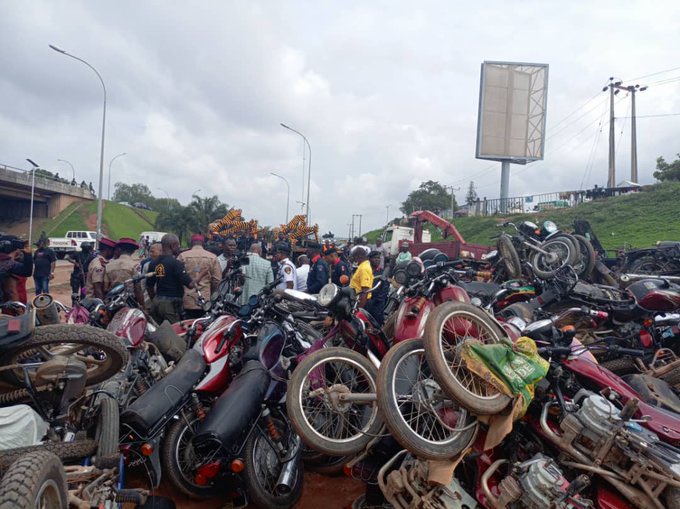
Ban on commercial motorcycles at BUK sparks outcry from students, business owners
By Kabiru Abdullahi Muhammad
The recent decision by the management of Bayero University, Kano (BUK), that bans commercial motorcycle operators (okada riders) from operating within the university community has triggered widespread outcry from both students and business owners.
For decades, motorcycles have been a lifeline for transportation and commerce in the university environment.
But since the ban, traders in the popular Coke Village market say their businesses have suffered unprecedented losses.
Malam Tasiu Hamisu, a foodstuff dealer who has operated in Coke Village for over 30 years, described the impact as devastating.
“I have never experienced such a huge downfall in my business until now when the school management stopped the bike men from working,” he lamented.
There were about 400 motorcycle riders in the university, with roughly 100 operating daily. Many of them were among my most reliable customers.
“Some bought foodstuffs worth ₦3,000 every day, while others bought occasionally. Now that they are gone, my business has been seriously affected. The only time we used to lose customers was during school holidays, but this is worse,” he added.
He also noted that students who previously sent riders to purchase goods on their behalf no longer have that option.
Malam Aliyu Sulaiman Ibrahim, another trader who sells palm oil, groundnut oil, and other household essentials, echoed the same concern.
“This issue has really affected me, and I have lost a lot of customers,” he said.
Similarly, Malam Umar, who operates a café, narrated how the ban has disrupted his daily routine.
“Sometimes when fuel finishes in the middle of work, I used to send a bike man to quickly get petrol. But now I can’t, and students won’t wait for me to go myself because there are many other shops they can turn to. This affects me badly,” he explained.
Students Struggle with Transport
Students are also struggling with the issue. The management introduced on-campus tricycles (adaidaita sahu) as an alternative, but there are only five to six tricycles available to serve thousands of students.
Every morning, long queues form at the university gate, with many students forced to trek long distances to their faculties.
Zainab Lawan, a student from the Faculty of Agriculture, shared her frustration.
“I nearly missed a test because I was waiting for a tricycle. In the end, I had to trek all the way from the gate to my faculty. It is really stressful, especially when you are in a hurry to attend lectures,” she said.
Both students and business owners said that the ban has created more hardship than solutions.
As Malam Tasiu put it: “The university is not just about classrooms; it is also a community. We all depend on one another to survive.”