Northern Nigeria

Addressing the menace of insecurity for a better Nigeria

By Yaseera Muhammad Bello 

Given the indisputable fact that Nigeria is currently trekking on the part of degeneration due to the menace of insecurity that grows daily, some questions have been scalding my tongue, seeking honest answers. What perpetuates insecurity in Nigeria? What machinery drives the brutal car of insecurity that has been killing innocent people in my fatherland? Who is to blame?

An undeniable, albeit unfortunate, fact about Nigeria today is that we read news of devastation on our national dailies for over seven years. The reports we hear on our radio stations and televisions revolve around the menace of terrorism. And it’s an inevitable fact that until we unearth the indices that hamper insecurity in Nigeria, we cannot live a life full of happiness and serenity. That being said, what are the factors that ignited the flame of insecurity in Nigeria?

Despite our portions of blame, our leaders are to be counted as the bedrock of igniting insecurity in the country. This is because we have long been electing incompetent leaders who cannot render their services effectively for the nation’s good. And this is because of the affinity we share with them when they are put into the offices. And at the end, when things fall apart, we’ll be barking like dogs seeking a peaceful society.

On the other hand, unemployment is another worrisome factor that vigorously plays a role in watering Nigeria’s black tree of insecurity. Most of our youths today in Nigeria have nothing to do but join groups that commit despicable acts. And this is mainly due to their state of unemployment perpetuated by the virulent animosity among our tribes. This is strictly said, having seen how tribalism has been hindering youths from getting job opportunities in the count. And at the end of the day, the youths have no choice but to join the horrific menace of insecurity that bedevilled our nation.

Furthermore, corruption in Nigeria, like all the other potent factors dittoed responsible for Nigeria’s insecurity, has its portions of blame. It’s now becoming rampant and our daily meal in the country. Corruption ignites numerous perplexities impeding us, including the threatening menace of insecurity. When leaders become corrupt, they fail to give security personnel adequate arms and support to fight terrorist groups and other factors that might threaten the safety of the citizens. 

Undoubtedly, until we put competent leaders into the offices irrespective of one’s tribe, religion or any affiliation, alleviate unemployment and stamp out corruption in the country, we will still wallow in the muddy water of insecurity. 

Yaseera Muhammad Bello writes from Gombe state is a student of Science Laboratory Technology (SLT), Gombe State University (GSU). She can be reached via misseerahbello@gmail.com.

A story of determination

By Muhammad Sulaiman

At this delicate time and cruel Nigeria that takes advantage of your laziness, incapabilities, lack of purchasing power and goal to actualize one’s dream, it will be hard for the less privileged and children born with a wooden spoon to attain a better by acquiring education. 


Umar Muhammad is a native of Jigawa state and lives in Dutse. A practical example of a downtrodden who may have given up and rejected every instinct that he might someday attain every possible accomplishment that life has to offer through education.


Umar has been consistent in his practical life to make ends meet since a tender age. He has built a definite guide that multiplies his efficiency to actualize his potentials and build his independence. 


Passionate about education, Umar started out and established his Cap-laundering business that has now metamorphosed into one of the most efficient and reliable persons in the town. He has funded his education up to the university level.


At an upheaval time of youthful exuberance, Umar’s story should inspire many people who unfortunately find themselves in similar life circumstances that there’s light at the end of the tunnel. With self-determination, visualization and internalization of self-worth, being less privileged cannot restrict one from actualizing his full potential. 

A whirlwind of fate

By Aeesha Abdullahi Alhaji

I winced while taking the journals I studied back into their bookshelf. Next, I rubbed my back slightly due to sitting in one place for so many hours. Then, I remembered I had a funeral to attend later in the day. So, I called Annabelle, my housekeeper, to prepare a light lunch for me to eat while I freshen up for the day’s businesses.

My junior colleague at the office lost his wife while giving birth. As I arrived at the venue, there was a commotion because Mr Andre, the bereaved, refused to allow his deceased wife’s body to be lowered into the grave. He was crying profusely. Looking at his unshaven face and unkempt beard, I knew he must have gone through a lot these past few days.

My eyes burned with unshed eyes, making me remember a fleeting memory of the worse day I pray never happens to any mortal on the face of the earth. I quickly shrugged off the bitter moment and walked over to the crowd gathered around Mr Andre. He was being consoled, but all was futile. He was devasted at the loss of his dear wife. After the burial, Mr Andre refused to leave his wife final resting place.

After an hour of waiting for him at his house to pay my final condolence, his older brother walked in, worries written over him. He attempted to explain to sympathizers how Andre refused to leave the cemetery. I smiled bitterly and told his family members I would get him.

I went back to the funeral ground, met him staring at her final abode, tears running down his cheek. I sat quietly behind him, asking him why he couldn’t accept destiny and let go of what had been ordained by the Creator. After all, death is a plane all of us will board.

He turned to look at me with a grief-stricken face saying, “Prof. Akin, you won’t understand. My wife and I have been through a lot. She had been through thin and thick of life trials and tribulations with me, but when my hard work is paying off today, she is no longer here with me. So what’s the essence of all I have endured getting if my loving wife is not here to enjoy it with me?”

I chuckled, swallowing a bitter taste that erupted in my mouth. I looked into his eyes. “Andrew, whatever has happened to you today, worse of it has happened to others, and I am one of them.”

My statement startled him. Yes, I nodded, adding: “Do you remember how often you asked me about my family, and I often shunned the topic? Let me tell you something today; I am the last of my kin.” Andre looked more surprised in disbelief.

Thinking about it, I started recollecting the sad memory.

“Darling, please, I have a senate meeting at the university. So I won’t be able to come with you to pick up our kids and their families at the airport but please, help me explain to them. But I will try to go home early enough for the family reunion dinner. Bye, my love,” I told my wife.

I hung up the phone with a big relief. I was not happy I could not pick up our kids coming home after a year abroad. But what could I do as official duty at times comes first?

An hour later, I received a call from an unknown number to come to a fatal crash scene involving a motorcade of cars. I ran out of the meeting; only God knew how I got to the accident scene with my sanity intact.

I could not believe my eyes until I saw the dead bodies of my wife, my three kids, daughters-in-law, seven grandchildren all lying dead. My world turned upside down. Though many people lost their lives in that accident, my loss was colossal. I lost my entire family that fateful day.

I later heard the cause of the accident was that they were in the traffic when, unfortunately, an oil tank lost brake and collided with many cars, going up in flames and affecting the other vehicles.

So you see, Mr Andre, your loss is nothing compared to mine. That tragic incident left me shattered. I go home every day from work with no family to welcome me. I have no family left, No kin to continue my lineage. I can no longer have kids talkless of remarrying because I am old now. My bones are crumbling, but what keeps me going is the sheer pleasure and smiles on my students’ faces. I take solace in them, seeing them as my kids.

So, be grateful at least you still have kids your late wife left behind. You better man up and start being a mother and a father to them. Please, don’t mourn for a lifetime because you have kids waiting for you to fill the vacuum of a mother and a father to them. Death is a whirlwind of fate that comes unannounced into our lives, but anyway, we are leaving the seasonal shade of life someday.

Mr Andre looked at me, dumbfounded. My life story numbed him. I patted his back and told him to go home. He stood up, smiling faintly grateful for my kind words and left. I stood watching the sunset in, a favourite pastime of my late wife.

Aeesha Abdullahi Alhaji is a student at the Ibrahim Badamasi Babangida University, Lapai, Niger State, Nigeria. She is also a member of the prestigious Hilltop Creative Art Foundation, Minna Literary Society, etc.

On exploitations at marriages

By Alkasim Harisu Alkasim

The challenges of marriage are common knowledge within and outside Nigeria. To sensible people, marriage is a keystone of luxury life. Yet, although marriage sometimes falls short of happiness and peace, personal uprightness and esteem still accompany and embellish those in the industry.

The marriage industry is chaotic. It is now commonplace to see overaged women competing for the love of a single male person alongside younger ladies. This explains how choked the industry is. Marriage, as an institution, demands a lot from us. To excel in this business, one has to school himself in patience, courage and determination. Otherwise, one will do a lousy job, and things will go south. 

In today’s materialistic world, what we call true love is lacking. Money buys love. A person can date a highborn woman even if he is lowborn. What allows him to do so is bucks. In cultures such as Indian, there is what they call a “caste system” that stratifies the society whereby one marries from within one’s caste. Interclass marriage is an abomination and, thus, a bad omen. Excessive expenses usher marriage.

In northern Nigeria today, to marry means a lot. One has to break the bank to afford marriage and multitask to afford to run a family. The trousseau he will gather robs him of too much money. If not loaded, one will feel like breathing his last while readying himself for this Sisyphean task.

Many a great family pressure prospective male spouses a lot to the extent they feel compelled to compensate their colossal expenditure by undertreating the girls they wed. The sight of the girls bores them; as a result, they start to mistreat them. This also purges them of the hate they hold for these exploitative families.

Poverty is raging, and the employment industry is becoming more competitive. Degree holders swarm places looking for well-paying jobs. As a result, some graduates are now resorting to low jobs that discredit scholarship and the status they are beginning to build. Some, willy nilly, accept works that break the back and pay low, thanks to the devastating nature of Nigeria’s economy.

Telling a greedy girlfriend that your wages or salary is not handsome implies losing her.  It once happened to my friend whose name I won’t mention here, for I feel that should be private. This happened when his family went to the girlfriend’s place. His father honestly told them about the level of income of his son. This bitter truth opened for my friend Pandora’s box. The relationship had since then staggered. In short, the two lovebirds have parted ways.

What hardens the issue of marriage in the North is our belittling the effort of even the hardworking people. We neither accept what our sons-in-law present nor study the situation on the ground. We need to wise up on this. But, unfortunately, some circumstances press people to do only those things that top their priorities.

It is worrisome that many families capitalise on their children’s beauty to milk boys of all their money. Such homes allow their daughters to tryst (zance) with more than a person at a time. In some houses, queues are made every day for a single girl. Boys take turns. Sometimes, some inpatient boyfriends cut in on the conversations of their co-suitors. What a world! The girl is seen as a moneymaking machine. Likely, after cashing in on her suitors, the girl will go out of fashion. Her beauty and charisma will decrease. As she puts on age, her boyfriends vanish, and the likelihood to marry a dream husband reduces. Now it is her younger sisters’ time. When it salaams at their home, the sendee will mention the name of her younger sisters instead. It will take time before she gets dated by somebody. Indeed life is a roller coaster. 

The social commerce between a girl and a boy worsens when the girl’s family pressure the boy for money. As he feels absolutely tired of lifting the girl’s responsibilities, he looks for a way to benefit from the dealing. The social intercourse between a girl and a boy does not stop at the former’s house as the duo rendezvous at their chosen spots. Now, the love glue between them starts to grow stronger. He will undeniably feel the urge to do the unlawful with her to the level he begins bedding her.

The groom has to pay dowry that a time costs him much. There is an amount which, if he pays below, he will have his money returned or hotly debated right at the place where the thing of the knot is occurring. In some instances, such disagreement plants in the groom’s family some disregard for the bride’s home. A bride needs to be lodged and fed. And if the groom doesn’t have his own house, he will have to find a place to sleep with his wife. Today’s brides come with vast furniture; the groom has to look for a house that sleeps like five people to contain his wife’s belongings. 

Believe it or not, the complexion of our societies has changed; we are not aiming at uprightness. We are after money and money-related things. If you are monied, you are everything. You can marry who you want. One can be immoral and still have a choice wife. That is why the deep-pocketed hire people to fake it as their parents/relatives. A bastard, in the world of today, betters a son borne in wedlock. Therefore, to be virtuous is to be well-endowed.

Allah Ka gyara ma na. Amin.

Alkasim Harisu Alkasim wrote from Kano. He can be reached via alkasabba10@gmail.com.

Governor Masari: Right decision, wrong approach

By Ahmadu Shehu, PhD.

The comments by the Governor of Katsina State, Rt. Hon. Aminu Bello Masari encouraging local populations to rise and defend themselves have mixed reactions. Governor Masari’s comments betray the frustration of state governments in curbing the incessant killings, kidnappings and wanton terrorism that has overtaken most parts of northern Nigeria, especially the northwest. This also portrays the disgustingly shameful inability of the current administration to secure the lives and properties of its citizens.  

In my opinion, Masari’s call to self-defence is the only option left for defenceless citizens who their governments leave at the mercy of terrorists. After many years of terror and horror, it is now apparent that Nigerians can no longer rely on the government for security and protection. As a result, Nigerians are in constant fear and uncertainty at home, on the road, in hotels, awake or asleep.

For one, the Nigerian police are grossly understaffed, ill-equipped and unmotivated to deal with the least of crimes in our society. Secondly, our last line of defence, the Nigerian armed forces, are overwhelmed. Despite its historical doggedness and glory, the Nigerian army has fallen victim to the Nigerian endemic corruption, nepotism and malfunction.

This, coupled with the fact that the country has been continuously militarized for decades, has oversaturated and weakened the numerical, financial and material strength of the armed forces. From Baga to Yenagoa, Seme to Mubi, Port Harcourt to Sokoto, the Nigerian military struggles with one threat or another within our borders.

Facing serious national threats such as IPOB and Oduduwa separatists, terrorist organizations such as Boko Haram, ISWAP, Ansaru, etc., rampant and rampaging bandits and kidnappers, have disorganized, disoriented and crippled the efficiency and efficacy of the Nigerian armed forces. There is certainly a limit to strength and power.

The Nigerian judiciary, which should have been a deterrent to criminals and the last resort for the masses and the poor, has been an easy, cheap tool for the wealthy. The weak, vulnerable citizens have mostly been on their own. They have resigned to fate and forsaken the course of justice, hoping only to get justice in the hereafter.

While the above is an absolute truth, Gov. Masari’s call is misplaced, ill-timed and counterproductive. My disagreement is not in the principle of what he said but in the approach and implementation. Masari is simply calling for absolute anarchy.

Now that the nation cannot deal with a few unorganized armed zealots, how do we imagine a situation where citizens are armed to the teeth? America, the world superpower, is consumed by this law of necessity. How much more of a country which cannot prosecute the smallest of its criminals?   

How would Gov. Masari deal with thousands of unemployed, illiterate, impoverished youth with arms and ammunition at their disposal? If all communities are armed as the Governor envisages, who will be the law in the state? Does Masari think that people with uncontrolled access to firepower equate to an organized police force? Does he understand that the only difference between the current bandits and yet-to-be-bandit youth is access to weapons and freedom from the law? 

I do not know who is responsible for educating our political leaders about the relationship between poverty, illiteracy and poor governance with the current situation in the north. But, still, whoever it is, they must be doing an awful job.

The simple truth is that most of our youth populations are idle, uneducated and miserably poor. Another fact is that the alternatives to gainful employment, hope and prosperity is despair, criminality and social crises.

There is still Katsina government house where the Governor lives in peace because the majority have no access to lethal weaponry. That scarcity is because of the restraint ensured by the law and order that is still in place.

While I disagree with Masari’s approach to this solution, I still believe that this is our only option to ending this madness in the short term. But, to succeed in this, there must be a workable framework.

First, the federal government must decentralize our police force. Secondly, each community must be led by the officials of our security forces to establish a community-based security outfit responsible for securing the immediate and broader community. Finally, all weapons must be registered and deployed through the security personnel in each community.

All participating community members must be registered with biometrics accessible to all Nigerian security agencies. In addition, all participating individuals must be given a short training on the use of firearms. The local and state authorities must provide ammunition, and all participating individuals must be assessed and be accessible to security and local authorities.

When this collaborative network of locals and state security forms a cohesive, functional security outfit, these devils will doubtlessly be defeated in no time.

However, the essential requirement for this to happen is a national leadership capable of mobilizing the citizens to confront local and national threats. Until this is achieved, all solutions are hanging on the balance. The Fulani say “hoore nastii hooraare, Allah yidoo gite”.

Dr Ahmadu Shehu is a herdsman, a social commentator, and passionate about the Nigerian project. He can be reached via ahmadsheehu@gmail.com.

From Proliferating Worship Places to Empowering Worshippers: A Reflection on Philanthropic Reprioritization in Nigeria (II)

By Abdullahi Abubakar Lamido

A person who sponsors and takes good care of a single orphan is assured of a mansion in the choicest quarters of Firdaus at the centre of the Prophet’s Estate, enjoying their eternal life as a neighbour to the Infallible Master (sallalahu alaihi wa sallam). In the Hadith of Bukhari, the Prophet says, “The caretaker of the orphan and I will enter paradise like this, raising (by way of illustration) his forefinger and middle finger jointly, leaving no space in-between.”

A community flooded with orphans and vulnerable children with no access to food, clothing, shelter, education, and medicare; orphans whose neglect aggravate their vulnerability to all sorts of socio-economic dangers; should prioritise taking care of them. If competing in building mosques even where there is less need is to get paradise, why not also invest in this sure way to Heaven?

And, why not consider endowments for fighting hunger also? When a person asked the Prophet, what is the best act in Islam, the Prophet mentioned two actions: “To feed (others) and to greet those whom you know and those whom you do not know” (Bukhari). And the Prophet also counted “feeding others” among the surest ways to paradise, alongside spreading salam, strengthening kinship ties and night prayers. Why not, then also emphasise in our society, making endowments for feeding the needy and the millions of the malnourished and unnourished children as a guaranteed path to paradise? 

My honest opinion is that rather than rebuilding or redecorating some mosques, we need to invest more in empowering our imams and their followers. We can all see how the “imamdom” is gradually being saturated with incapable scholars leading ignorant followers in prayers within well-decorated mosques. As if we have forgotten that giving quality education and “beneficial knowledge” to people is itself a sustainable afterlife investment, one that may even often have more multiplier effects and trickle-down effects in terms of fetching rewards perpetually and building the Muslim community progressively.

If one sponsors a young man to become an Islamic scholar and imam, anytime this trained scholar preaches and teaches, the sponsor has a reward commission. And when the students of the imam teach or use the knowledge, the sponsor is assured of a commission. It continues in that way till “the end of history”! So, if the search for reward is what makes us race in building worship places, then so should building qualitative worshipers. We should, in fact, see the creation of generations of qualitative Muslims as a “blue ocean”; a virgin and highly underexplored otherworldly investment opportunity.  

Some may remind us that the Prophet’s first thing after hijra was to build a mosque. True. But that was first because there was none. And secondly, this mosque, as a primary symbol of Islam, was built for companions who were well educated in Makkah before migration, plus the Medinan community that was also educated by no other scholar than the great Mus’ab bin ‘Umayr.

In any case, the Prophet built the mosque because it was a priority by all standards; there was a need. And so immediately after that, he also paid attention to other developmental matters, including socio-economic priorities like establishing the Medinan Market (Suq al-Madinah). He also immediately began calling companions to “purchase” homes in Jannah through addressing human needs. That was how Uthman got an edifice in Jannah by purchasing the well of Ruma and dedicating it as waqf. That was how Abu Talha got Paradise by committing a waqf of his garden to benefit the needy and his poor relatives.

In fact, as recorded, most rich companions got their direct entry admission to Jannah through spending on human needs; Uthman bought and did waqf of the Ruma well, Umar dedicated the Thamqh garden for the poor, wayfarers and the rest, and the list goes. Little did we remember that in addition to doing a waqf of his mosque, virtually all the other waqfs of the Prophet were for welfare and socio-economic empowerment. 

We need to discuss whether building the Muslims and making them self-sufficient should continue to receive our philanthropic priorities or building mansions in the name of mosques – even where there is less need – which would mostly be populated by undedicated, hungry, dirty and largely ill worshippers. Building worship places is undoubtedly required, guaranteed key to paradise, ceteris paribus. It is, however, one of many means to getting admission to paradise. Why, then, should we not start to amplify other keys to paradise, especially those in some contexts such as ours that may appear weightier on the scale of Muslim priorities?

It is not in the interest of Islam to have dirty looking Muslims attending multimillion naira mosques. Islam wants educated, neat, tranquil, self-sufficient, qualitative Muslims whose worship is knowledge-based. So, when some philanthropists focus on building worship places, others need to invest in other equally rewarding endeavours. Wherever we have no worship place, it is a collective duty upon the community members to initiate one. However, where we already have one, we must prioritise other joint obligations; taking care of the orphans, the poor and widows being one of them. We can do it through building revenue-generating waqfs that can perpetually help the poor and everlasting generate rewards to the donor.

Abdullahi Abubakar Lamido is the Chairman Zakah and Waqf Foundation Gombe, Nigeria. He can be reached via lamidomabudi@gmail.com.

From Proliferating Worship Places to Empowering Worshippers: A Reflection on Philanthropic Reprioritization in Nigeria (I)

By Abdullahi Abubakar Lamido

Alhaji Halilu is a popular, wealthy businessman. Famous for his continuous investment in constructing mosques, people in his town, surrounding villages and neighbouring states came to know him as Alhaji Mai-Masallatai (roughly, the Mosques Builder). His main motivation is the authentic hadith that promises a house in paradise for anyone who builds a mosque for Allah.

Thus, whenever Mai-Masallatai is approached with a request for mosque construction, he gives an automatic positive response. Alhaji dedicated all his philanthropic budget to building mosques, with virtually zero allocation to any other act of charity. He never says no to a mosque request. Within some time, he had constructed mosques for almost all the communities within his town and neighbouring villages. His ultimate goal is to own wonderful castles in heaven, and, Alhamdulillah, he has got a guarantee for that in constructing mosques from an infallible mouth. 

Now, three things happened. One, as there are not many communities lacking mosques, people started requesting him to repair the mosques he built for them last five, ten or seven years; to rebuild their mosque, repair it, or buy them new sound system, new carpet for the mosque, electricity generator, or “solar” and so on. Mai-Masallatai gradually transformed into Mai gyaran Masallatai, from building mosques to redecorating and making existing mosques “befitting” and ultramodern.

The second trend then followed. Since Mai-Masallatai is not the only aspirant for paradise, other wealthy persons joined the mosque construction endeavour. As a result, the number of mosques increases – two or more mosques in an unnecessarily close distance. A  community that needs one mosque would request a second one for flimsy reasons; we have Sheikh XYZ, who should be an imam and has no mosque; why not get one for him so the society would benefit from his imamship! And any rich man who builds a new house would ensure that a mosque is embedded from the inception of the architectural design. So, each neighbourhood or street, and almost each “big” house, has a mosque attachment built by a person who wants paradise. Soon the third issue began to arise; imams scarcity.

It is noteworthy that Mai-Masallatai and all his emulators live and do business within a Muslim community that has thousands of orphans who live in hunger, disease, illness and squalor. They coexist with hundreds of widows who survive in shabbiness, battling the spiritual ills, psychological traumas and socio-economic vulnerabilities associated with poverty, ignorance and starvation. They reside in neighbourhoods bedevilled with noise, air and dirt population, with zero consciousness of environmental challenges; where people often urinate and defecate in the open, at public passages and places as crucial as mosques and marketplaces and stadia. They live in communities that use firewood as an energy source but with near-zero interest in planting trees.

Mai-Masallatai builds mosques for communities where well above 80% of the people cannot correctly recite the Fatiha and are mostly ignorant of the basics of purification, ablution and prayer. The worship places are beautiful, “befitting”, and “ultra-modern”. But the worshippers are ultra-ignorant, extra-hungry and super-poor. While the mosques are decorated, the mosque attendants are neglected.

The community severely lacks qualified imams and doesn’t have a plan to train religious scholars or imams. Nearly all are accidental scholars and imams. Most imams are less qualified, semi-qualified, or simply unqualified. Those with minimum requirements have no access to any “on the job training” and retraining. They have no grounding in jurisprudence nor appreciation of the complexities of their time and place. They might know a little of actually elementary Islamic texts, but not of their context. They continue to recycle their khutbas, reading for their congregation – often with a lot of mistakes – imported sermons presented for the 20th-century audience in Egypt or Morocco or Saudi Arabia or Algeria (depending upon the inclination of the imams), which are compiled in a collection of sermons or al-khutab al-minbariyya. The sermons are in Arabic, reread for an audience dominated by over 90% of people who do not understand Arabic except, perhaps, “Allahu Akbar”!  

Dear reader, to what extent is your community better than Mai-Masallatai’s? Should building worship places take priority over building the worshippers? Should we continue to construct “befitting”, “ultramodern”, and “world-class” mosques for largely poor, ignorant and confused Muslim communities? Should we, while, of course, building mosques where they are truly needed, not also prioritize producing a Muslim population that is religiously educated, morally upright, intellectually sound, socio-economic dignified and religiously conscious. What better serves the essence of the mosque as an Islamic institution: a beautiful building or an educated congregation? Should building mosques be the only priority in a village where there is not even a single person learned in the Qur’an and the jurisprudence of purification, ablution, prayer, fasting, and other rituals?

More questions are begging for answers. For example, what will be more critical between saving people’s faith through addressing their basic needs of life, thereby shielding them from the onslaughts of evangelism and other anti-Islamic missions on the one hand, and mere building a mosque where there are no qualified imams and scholars to teach them creed and worship on the other? Should we continue to have “comfortable places” for ignorant and hungry worshippers rather than building conscious and educated worshippers? 

Given the current religious and socio-economic realities of Muslims in Nigeria, what should be the focus and priority areas of intervention in terms of philanthropy? Please don’t mistake my position. No Muslims will disagree regarding the centrality of mosques as Islamic symbol numero uno. Where there is no mosque, it is a collective responsibility upon the Muslims to build one to the best of their ability. What, however, may need reflection is the question of when, where and why building a mosque should take primacy vis-à-vis other Muslim priorities and when not. Is it not imperative, for instance, for us to begin to remind ourselves that much as we can get a shortcut to paradise through building mosques, there are other philanthropic acts that not only guarantee paradise but even assure of a choice area and unmatchable edifice in Jannah?

Abdullahi Abubakar Lamido is the Chairman Zakah and Waqf Foundation Gombe, Nigeria. He can be reached lamidomabudi@gmail.com.

US-based northern Nigerian group, Dangi, condemns bandits’ atrocities

By Uzair Adam Imam


The Dangi USA Association of Northern Nigerians has lambasted the atrocities of bandits in Nigeria, voicing a clarion call on the government to remember its cardinal responsibility of protecting lives and properties.


The association reiterated that since bandits had transgressed all common senses, they should therefore be treated as an existential threat that must be eliminated.


The call which was in a release signed Sunday by the Director Public Relations of the association, Kabir lsa Jikamshi, disclosed the grievance over the incessant killings of innocent souls.


They said that it is disheartening to witness the ongoing despicable acts of kidnapping, ransom collection and gruesome killing of innocent men, women and children especially in the North-Western part of the country.


The statement reads: “This banditry, presently constitutes a transgression that does not allow room for any negotiation. No previous grievances can justify the wanton destruction of lives and property. 


“Therefore, no one, neither the government nor private parties should negotiate in any form with the bandits.


“We call on the government to remember its cardinal responsibility of protecting life and property. Insecurity is persistent only in an ungovernable situation; Please do not abdicate your responsibilities. 


“The government should do more by taking the war to the bandits and enact the necessary legislation that will allow individuals to defend themselves without any reservation.


“This is a collective responsibility and all hands should be on deck. Thus, the general public must also remember that they have a very important role to play by supporting the efforts of the security agencies. “if you see something suspicious, say something”.


“Informants and any other individual or group enabling the activities of the bandits should be treated as one them.


“The catch and release of some of these criminals without trial is totally wrong and must stop,” the statement added.
Dangi Association also commiserated with the families of the victims of these atrocities.


“We pray the Almighty Allah will offer solace to the victims and their families. We feel the frustrations and anger of the Nigerian citizens.”


“We empathize with you for enduring these harsh conditions of insecurity and constrictions in the liberty of movement and performance of other daily activities,” they added.

Climate change is underreported in Northern Nigeria – Surge Africa laments

By Aisar Fagge

Surge Africa – a non-profit organization that advocates for policy implementation on climate change and resilience building laments how media in Northern Nigeria underreport climate change despite its apparent effect on agriculture which the North relies on as the major source for living for its people.

This was revealed on Thursday, December 23, 2021, at a workshop held at Chilla Luxury Suites, Kano. The workshop titled: “Media Workshop on Reporting Climate Change” brought Northern Nigerian journalists across print, broadcast, and online media to educate and sensitize them about the importance and necessity of climate change reporting in their respective media organizations.

In her presentation, Nasreen Al-Amin, the founder and Executive Director of Surge Africa, introduced participants to climate science and communication. She tasked them to spread knowledge on climate change, what causes it and its effect on the socio-economic activities of Northern Nigerians.

Another expert, Salihu Hamisu, who is researching how climate change is affecting the agricultural ecosystem in Nigeria, lamented, “Africa is not responsible for the climate change but suffers the most.” He recalled how in 1963, when Lake Chad was at its peak, over 30 million people from Cameroon, Niger, Chad and Nigeria depended on it. But now, as a result of climate change, the Lake has less than 10% of what it has, with over 70 million people earning a living from it. Hamisu added that with the current pace of drought and floods, Northern Nigeria faces an imminent food crisis.

Also, Adejumo Kabir, multiple award-winning journalists, presented papers on “Climate Reporting: Shaping Inclusive Narratives” and “Media for Climate Justice: Developing Stories for Social Change.”

Some participants spoke to The Daily Reality about what they learned at the Workshop. Mustapha Hodi, said:

“As a participant, I have learnt a lot about climate change, particularly the fact that Africa is the one bearing the brunt of emissions from developed countries. As a journalist, the workshop has helped me identify key areas to concentrate on reporting climate change.”

“By and large, the training has become a wake-up call to me to be reporting climate change frequently in a bid to create awareness to the general public about its dangers and even the opportunities it creates.”

Hannatu Sulaiman Abba was another participant from Arewa Media who said, “This workshop has shaped my mind on climate change. It develops my passion to advocate for climate change in our community, engage the government in policymaking and sensitize the public on the effect of climate change. This is indeed a big milestone in my journalism career.”

At the end of the workshop, participants were grouped into three to brainstorm and write a report on improving climate change reporting. Misbahu El-Hamza expressed his satisfaction saying: “My expectations were sufficiently achieved. What’s, even more, was how we worked as a group to brainstorm ideas that could be effective in steering social and policy change. Through this workshop, I now am equipped with the know-how to see the dangers as well as opportunities presented by climate change in my region of northern Nigeria and how to engage the public to mitigate and get the best out of it.”

DSS invites Kaduna activist, Buhari over protest against killings in the North

By Sumayya Auwal Ishaq

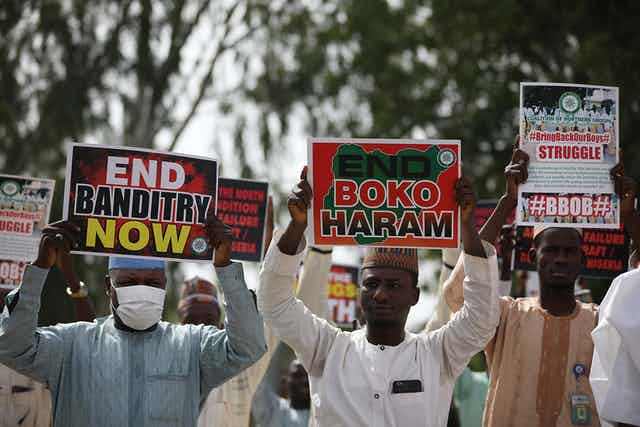
The Department of State Services (DSS) has invited another convener of the #NoreMoreBloodShed protests, which have enveloped Northern Nigerian states since the immolation of escaping travellers in Sokoto State last week.

The activist, Muhammad Bello Buhari, confirmed this on his verified Facebook handle: “I have just been invited by the DSS Kaduna State — to report at their office by 10 am tomorrow.”

Buhari further said that “I shall honour their invitation. This is our country. We have no any other place other than Nigeria. Our only offence is that we asked for the lives of Nigerians to be secured. We asked for the whereabouts of the few we elected to secure our lives and properties when we are being killed daily.”

So far, Muhammed Bello Buhari is not the first organiser to receive such an invitation from the nation’s secret police.

Zainab Nasir Ahmad, a Kano-based activist, was also grilled over the same protest she convened last week. She subsequently dissociated herself from future planned protests, citing security concerns.