NNPP

NNPP names Abiya acting Kano chairman as leadership crisis deepens

By Uzair Adam

The leadership crisis rocking the Kano State chapter of the New Nigeria Peoples Party (NNPP) has intensified following the appointment of Abdullahi Zubairu Abiya as Acting State Chairman after the removal of the former chairman, Hashimu Dungurawa.

The Daily Reality reports that the decision was announced after an emergency meeting of the NNPP State Executive Committee held at the party’s secretariat in Kano, where members endorsed Abiya’s appointment in line with the party’s constitution.

Speaking on the development, the party’s Assistant Legal Adviser, Barrister Yusuf Mukhtar, said the emergence of Abiya followed due process and was consistent with the provisions of the NNPP constitution.

He explained that the move came after Dungurawa was rejected and removed at the ward level.

Party sources disclosed that the action was based on a formal resolution submitted by the Dawakin Tofa Local Government Executive Committee, which recommended the sack and expulsion of Dungurawa over alleged anti-party activities.

It was gathered that the resolution originated from the Gargari Ward Executive Committee in Dawakin Tofa Local Government Area and was forwarded to the state leadership by the local government executive, led by Hon. Abdullahi Ali Uban Iya Dawanau.

The ward-level decision was reportedly adopted at the second executive meeting of the Gargari Ward, held about two weeks after the general election, where Dungurawa was accused of actions deemed inimical to the party’s interests.

After reviewing the report, the State Executive Committee ratified the resolution and approved Abiya’s emergence as Acting State Chairman, party officials said.

NNPP officials described the move as part of efforts to restore internal discipline, strengthen party unity and reposition the party for future political engagements in Kano State.

Reacting to his appointment, the Acting Chairman, Hon. Abdullahi Zubairu Abiya, said the party would ensure fairness and justice for all members.

He added that the Kano NNPP would remain loyal to the party’s national leader, Senator Rabiu Musa Kwankwaso, as well as the Kano State Governor, Engr. Abba Kabir Yusuf.

Kofa dumps NNPP, returns to APC

By Uzair Adam

Hon. Abdulmumin Jibrin Kofa, the House of Representatives member for Kiru/Bebeji Federal Constituency in Kano State, has officially returned to the All Progressives Congress (APC), pledging his support for President Bola Ahmed Tinubu’s 2027 re-election bid.

Kofa disclosed this in a statement he personally signed on Monday, noting that he received a warm reception from thousands of his supporters in his hometown of Kofa, Bebeji Local Government Area.

The gathering reportedly resolved to leave the NNPP/Kwankwasiyya movement and join the APC in solidarity with the president’s agenda.

According to him, the event was attended by approximately 2,000 Islamic clerics who offered special prayers for the president, as well as for peace, development, and progress in Kiru/Bebeji, Kano State, and Nigeria at large.

Kofa’s defection comes two months after his expulsion from the NNPP, which sources say was due to alleged anti-party activities and unpaid membership dues.

His departure underscores the ongoing internal challenges within the NNPP in Kano and marks a significant political realignment in the state.

A former APC member and ex-Director-General of the Tinubu Support Group, Kofa’s return to the ruling party strengthens the APC’s foothold in Kano ahead of the 2027 elections.

2027: NNPP open to alliances with Tinubu, others—Kwankwaso

By Uzair Adam

Senator Rabi’u Musa Kwankwaso, the New Nigeria People’s Party (NNPP) presidential candidate in the 2023 elections, has stated that his party is open to forming alliances with other political parties, including the All Progressives Congress (APC), ahead of the 2027 general elections.

In an interview with BBC Hausa, the former Kano State governor emphasised that the NNPP is willing to collaborate with any party that shares its commitment to improving the welfare of ordinary Nigerians.

Kwankwaso clarified that any potential alliance with the APC or other parties must come with clear, tangible benefits for the NNPP, highlighting the party’s nationwide structures and gubernatorial candidates in all states.

He said, “If you are asking us to join APC, you must tell us what NNPP will gain. We have gubernatorial candidates in all the states and full structures nationwide. What will you offer them if we join?”

The senator reiterated that alliances will be based on shared ideals that guarantee a better quality of life for Nigerians.

He described the 2027 elections as likely to be fiercely contested, noting that citizens are now more informed, concerned, and engaged than ever before.

“We’re ready for anyone, whether it is the APC, PDP, ADC, Jonathan, or Peter Obi. If we are satisfied with their competence, we will join forces to achieve success.

“The key thing is that whoever we ally with must be committed to the needs of Nigerians,” Kwankwaso said.

He also condemned the state of insecurity in parts of the country, including Sokoto, Kebbi, Zamfara, and Kaduna, noting that ordinary citizens are the main victims while political elites live in luxury in Abuja.

On the recent proposal by the National Assembly to amend the 2022 Electoral Act, which would schedule presidential and governorship elections six months before the expiration of incumbents’ tenures, Kwankwaso said he is ready for elections to be held at any time, provided there is adequate notice for mobilisation.

Addressing claims of undue influence over the Kano State government, Kwankwaso dismissed the allegations as baseless, insisting that the current administration is acting independently and that time will reveal who is truly in charge.

“Our position is simple: if he seeks our counsel, we will gladly offer it. But if we notice anything wrong or harmful, we will call his attention to it. “That is why people claim they will defeat us, but the truth is, the youths are more aware now,” he clarified.

The political identity crisis in a “horse” race for power

By Abdulrahman M. Abu-Yaman 

The title race is between two horses and a little horse that needs milk and needs to learn how to jump. –  Jose Mourinho

When the controversial Jose Mourinho made this statement above, it was about football and the race to the Premier League title in 2014, but we never knew a time would come when it would be more suitable to fit into the Nigerian political context as it relates to the switch and frequent change of allegiance from one political party to another.

THE FIRST HORSE

The first horse, being the All Progressives Congress (APC), is the current defending champion in political power and the acclaimed favourite to retain the presidential title going into 2027, based on the power and influence that come with being an incumbent leader in Nigeria. Only once has it occurred since the fourth republic that an incumbent was defeated, and even that took what some have tagged as a miracle when President Jonathan made the famous call to the late former President Muhammadu Buhari (of blessed memory) and conceded. 

This horse has taken on different forms over the years and has been given various names by the political power brokers who have bet on it to win. Part of its defunct origin was the All Nigeria Peoples Party (ANPP), formed in 1998, a year before the fourth republic general elections. However, its popularity was quite limited to the northern part of Nigeria, not as pronounced in other regions of the country. Former President Muhammadu Buhari had contested twice and lost under the ANPP in 2003 and 2007, respectively.

Another major segment of its primordial origins emerged from the Action Congress of Nigeria (ACN), which was formed in 2006. It was formerly known as the Action Congress, which in turn was formed from the merger of its factions with minor political parties, including the Alliance for Democracy (AD), the Justice Party (JP), and the Advanced Congress of Democrats (ACD), among others.

Then came the Congress for Progressive Change (CPC), founded in 2009. It gained significant influence due to the impact of late Muhammadu Buhari and his millions of supporters in the northern part of Nigeria, who contested under the party’s platform in the 2011 elections. 

In 2013, the progressives and congresses in some major political parties with these words present in their acronym merged into one; the Action Congress of Nigeria, Congress for Progressive Change (CPC), a faction of the All Progressive Grand Alliance and finally, the All Nigeria Peoples Party (ANPP) to form the All Progressives Congress (APC) – the most formidable opposition group as a party in Nigeria since the return to democracy in 1999 to unseat any incumbent President in power.

THE SECOND HORSE(S)

The second horse(s) in the race are obviously divided and sharing that position based on recent trajectories and events that had left one of the horses deemed as second favourite to crumble and hanging on a thin thread; speaking of the Peoples’ Democratic Party (PDP), as long as it still has time to regroup and put its house in order, it cannot be ruled out of the race based on its political structure long established that cuts across all states in Nigeria.

The PDP was formed in 1998, in the twilight leading up to the 1999 general elections, by a group of political bigwigs who adopted Chief Olusegun Obasanjo, a former military head of state and a prisoner released from the dungeon after the end of the Abacha era. Obasanjo, coming from the south-west region of the country, was seen by many as the best candidate to step into what would have been Chief MKO Abiola’s rightful position as winner of the annulled June 12 elections if he had lived up to 1999 but for his sad and shocking demise in 1998.

The PDP won the 1999 election by a majority of votes and held a majority of seats in the National Assembly. In 2003, the party continued to dominate the political space in Nigeria, growing in influence and power, albeit under some questionable electioneering processes in 2003, 2007 and 2011, respectively, having spent sixteen years in power as the ruling party. During that period, it became the largest party not only in Nigeria but also on the African continent.

However, unfortunately for the PDP, their dream of achieving the milestone of twenty years in power was cut short in 2015 when the APC, a new, formidable force energised and regrouped, ran them out of control. 

Since then, the PDP has contested twice as an opposition party and lost to the APC in 2019 and 2023, but edged them out in 2015. The PDP has also had to lose some of its members who have decamped to the APC and has since struggled to remain as firm and relevant as it once was. The only reason it occupies the second spot as a favourite is its longevity, structural base, and the influence of some stakeholders behind the corridors of power, who are still salvaging what is left to stand firm.

Moving away from the PDP, the other second favourite only came to fruition and gained traction a few months ago, orchestrated by one man, Mal. Nasir El-Rufai, who initiated the movement that led to the formation of a coalition that later evolved into the political party rebranded as the African Democratic Congress (ADC). The party had been in existence before its formation in 2005 as the Alliance for Democratic Change. 

The formation of the ADC elicited mixed reactions in the Nigerian political space. While some saw it as the long-awaited vibrant opposition to challenge the incumbent party in power, others viewed it as a selfish endeavour created by those who had been bruised and pushed out of the epicentre of power, seeking to make a comeback by any means necessary. This notion was proven to be more relevant when the ADC reached out to past or aggrieved members of the APC and PDP to form part of its board and core membership from the official flag-off. 

Nevertheless, it is still considered the second favourite in the race because if history is anything to go by, just as in the words of Jesse Jackson: 

“In politics, an organised minority is a political majority”

Just as in the case of the APC, which was formed two years short of the 2015 elections and later emerged as the winner, the regrouped ADC party and its influx of new members can’t be underestimated.  

Another reason the ADC could be frontrunners could be their ability to capitalise on the harsh economic realities in the country that have affected the masses and present the party as an alternative to better their welfare, just as the same members of the ADC did way back in 2015 when they were members of the APC, which they now want to substitute out of power. 

THE LITTLE HORSE IN THE RACE

The little horse that needs milk to learn how to jump is the Labour Party (LP). It was also driven and triggered to relevance in the 2023 general elections due to the influence of one man, specifically Peter Obi, who was spoken of as the party’s flag bearer. The LP not only defeated the APC in their own stronghold in Lagos but also defeated the ruling party in the Federal Capital Territory, Nigeria’s capital and centre of governance. It was unprecedented and sent a clear message that the LP did not just come to make up the numbers like some minority parties. 

But be that as it may, their numbers in Lagos and Abuja, coupled with the ones from the east and the Niger Delta region, were not enough to put them in second position in the race. This is why it needs to spread its wings to cover all political nooks and crannies in other regions, especially northern Nigeria, where it is yet to get a solid grip.

The recent involvement of Peter Obi with the ADC could lead to a compromise and weaken the party’s strength, as it revolves around him. One of the LP’s former spokesmen also lamented him for not doing enough as a leader and his inability to resolve the party’s internal crisis. He also raised concerns about his failure to build a strong party base to secure the mandate. 

Still, the only reason the LP is coming in third in the horse race is because of the unexpected stunt it pulled and its potential to do more if, and only if, it can capitalise on its momentum to leap ahead like other horses in the race.

THE EXODUS AND CONVENIENT SWITCH BETWEEN PARTIES 

Nigerian politics and politicians tend to switch sides to any political party that offers them a higher chance of winning. It occurred in 1999, when the PDP was formed and founded by members of various political parties. 

In 2003, as the PDP grew in strength and power, it received more members, and others had to decamp from their prior political platforms to join it. It was beginning to look like the only way to win an election was to join the party that was already winning. 

2007 and 2011 were no different as the PDP retained power in government. However, the only parties that managed to maintain some of their strongest and most popular members were the ANPP in 2003/2007, and the CPC in the 2011 general elections, when they fielded Muhammadu Buhari as their presidential candidate in the respective years.

In the buildup to the 2015 election, a massive exodus of politicians decamped from the ‘umbrella’ that had sheltered them in political office to the newly formed APC, which was gaining immense popularity, especially in the northern and western parts of Nigeria. The presidential flag bearer was a familiar figure who was contesting for the fourth and possibly his last attempt, having been persuaded to do so. The APC, like the PDP in the past, also welcomed all members from other parties, irrespective of their past reputation or allegations while in office. In the end, the party grew from being the strongest opposition to becoming the favourite to win the election, which they eventually did.

LOST OF POLITICAL IDEOLOGIES/IDENTITIES

When we start seeing political players decamping at will, it is time to question whether any of the political parties place a high premium on their criteria for membership in relation to their ideologies before accepting any candidate into their fold. Do politicians care any less if the party they join aligns with their manifestos and visionary blueprint for good governance and leadership?

It is beginning to look like a game of chess, with calculated moves aimed at checkmating the ultimate power in the political positions they crave. The only pawns in this game are the masses who have yet to figure out that changing their clothes to another has nothing to do with the real person behind those clothes. A stained reputation, especially in previous leadership positions, coupled with a proven track record of underperformance and incompetence, cannot be covered by new political platforms.

However, the interesting aspect of all this is the emergence of a solid opposition to keep the ruling parties on their toes. Previously, with the decline and crisis in the PDP, Nigeria was moving towards a single-party state due to the frequent switch of its members to joining the APC. It is well timed that the LED coalition, which has resolved to adopt the ADC as its political platform, includes big names like former Vice President Atiku Abubakar, who is also a former PDP presidential aspirant. Peter Obi, the Labour Party’s presidential candidate, has also been seen and involved in some of their meetings. And for the first time since the APC’s ascension to power, they seem concerned about the growing popularity of the ADC and the threat it may pose to their hold on power. Deja vu?

Conclusively, all the parties involved in the horse race have exhibited similar symptoms of identity and ideological crisis in their consistent switch of allegiance to suit their needs. The thin line between them is getting blurrier in their actions and adoptions. Everyone is welcome to any party at any time. No litmus test, exceptional integrity, or individual evaluation criteria needed. Once you are in, all sins are forgiven, and then you are baptised as a new member. 

The ADC is not only like the APC alphabetically, but also in the content of its members and its contextual existence. The primary concern here is whether some members of the ADC could potentially break away from the party in the future, particularly in the event of any unresolved disagreement or fallout within the party. Are we to brace ourselves for another hypothetical ‘ABC’ party if it comes to that? Time is the ultimate revealer. 

Kwankwaso engages NNPP stakeholders in Cross River, strategises for 2027

By Anwar Usman

Former presidential candidate of the New Nigeria People’s Party (NNPP), Engr. Rabiu Kwankwaso, on Tuesday met with party stakeholders in Cross River State to map out strategies ahead of the 2027 general elections.

Speaking in Calabar, Kwankwaso urged party members to prioritise unity and strengthen the party’s presence across the state.

He said, “I thank all the leaders and members of NNPP in Cross River State. I want to use this opportunity to thank you for receiving us. We are so happy with the leadership of the party in the state. I want to encourage you to work hard to ensure unity within the party.”

He stated that the party must work with “one mind” if it hopes to win both the state and national elections in 2027.

“Let me thank you for what you did during the last election in 2023. I urge you to work harder so that by the grace of God our party, the NNPP will win election in Cross River and Nigeria.”

He further stated that, “ensure unity within the party especially now that we have a new big office in Calabar and many local government areas across Cross River state. On behalf of members of my entourage, I want to say thank you and God bless you”.

The party chairman of the state, Barr. Tony Odey, described Kwankwaso’s visit as a morale booster.

Odey said, “We have assembled stakeholders from different walks of life to engage in meaningful discussion, share ideas and chart a new course for our collective progress. Your insight and guidance will undoubtedly enrich our capacity.”

Furthermore, he acknowledged the efforts and contributions of the Contact Committee led by Alhaji Ahmed Bichi, for providing office accommodation and donation of an official vehicle, which he described as “sources of envy to other Political Parties in the State”.

Earlier, the publicity secretary Odey Nyambi, while delivering vote of thanks, thanked the national leader for engaging stakeholders and supporters in the state, assuring that NNPP will win Cross River in the 2027 general elections.

NNPP declares Abdulmumin Jibrin’s expulsion invalid

By Sabiu Abdullahi

The New Nigeria People’s Party (NNPP) has dismissed the purported expulsion of Abdulmumin Jibrin, the lawmaker representing Kiru/Bebeji Federal Constituency of Kano State, describing the decision as null and void.

In a statement issued on Saturday, the party’s National Secretary, Oginni Sunday, said the announcement had no basis and was unauthorised.

He explained that the expulsion was announced by Hashim Dungurawa, a former state chairman who had earlier been removed from the party.

Describing the action as a “joke taken too far,” Sunday questioned how someone who is no longer a member could claim authority to expel a sitting legislator.

Citing an April 2, 2025 judgment of the Federal Capital Territory High Court and a ruling from an Abia State High Court, Sunday maintained that Senator Rabiu Kwankwaso, along with others including Dungurawa, had already been expelled from the NNPP and therefore lacked the legal standing to act on the party’s affairs.

According to him, Jibrin’s decision not to align with Kwankwaso’s faction provoked the Kwankwasiyya movement, which allegedly tried to weaken his political relevance in retaliation.

Sunday also cautioned that Governor Abba Yusuf’s loyalty to Kwankwaso could endanger the NNPP’s control of Kano State in the 2027 governorship election.

He said, “One of the smartest ways for Yusuf to secure a win in Kano in 2027 is to travel to Lagos and tender an apology to the party’s founder and leadership.”

Jibrin, who previously served as the Director-General of the Tinubu Support Group and played a significant role in fostering ties between the APC and the NNPP, was accused by the Kano State chapter of engaging in anti-party activities and defaulting on financial obligations.

Reacting in a statement on Saturday, Jibrin said he received the news of his removal as “a rude shock,” insisting that the interview he granted in English and Hausa, which the party cited as evidence, was in line with NNPP’s principles.

He added, “I strongly believe the contents of the interview should not warrant such a heavy penalty.

“No invitation was extended to me to defend myself before any organ of the party. Even under a military dictatorship, an accused is subjected to a court-martial.”

On the allegation that he had not paid his dues, the lawmaker rejected the claim and challenged the party to issue him an invoice, promising to pay once it is presented.

He further criticised the NNPP’s leadership, saying, “The party does not believe anybody has political value or deserves respect at various levels.”

NNPP expels lawmaker Abdulmumin Jibrin over alleged anti-party activities

By Sabiu Abdullahi

The Kano State chapter of the New Nigeria People’s Party (NNPP) has expelled Abdulmumin Jibrin Kofa, the lawmaker representing Kiru/Bebeji federal constituency, accusing him of working against the party’s interest and failing to fulfill his financial commitments.

The announcement was made on Saturday in Kano by the state chairman of the party, Hashim Sulaiman Dungurawa, during a press briefing. He explained that the decision followed Jibrin’s frequent public criticism of the NNPP and its leadership.

“This is coming barely 24 hours after the member said it shouldn’t come as a surprise if he dumps the party,” Dungurawa stated.

Earlier, Jibrin had hinted at the possibility of leaving the party.

According to him, “he is old enough to take a stand independently what is best for him politically.”

Between Senator Sumaila and Senator Kwankwaso

By Kamal  Alkasim

When Kawu Sumaila decamped from NNPP to APC, it showed that the issue isn’t about party loyalty but about choosing the best leader. Blind loyalty can hinder good governance in Nigerian politics. What matters most is effective representation, not party allegiance. Let’s prioritise good leadership over partisan loyalty and choose the best candidate for the benefit of Kano South.

When choosing between Rabiu Musa Kwankwaso, a prominent figure in Kano politics known for influencing political dynamics, and Kawu Sumaila, the decision leans towards Kawu due to his genuine service to the people of Kano South. Regardless of the political party Kawu affiliates with—whether APC, PDP, or ADC—his actions demonstrate a commitment to his constituents. 

People recognise Kawu’s efforts and intentions, making party affiliations secondary to his impact. Let’s prioritise choosing the best candidate based on their service and dedication, rather than party loyalty.”

Kwankwaso’s impact will be remembered. Let’s choose leaders based on merit, not loyalty to individuals. In politics, those who deliver tangible benefits to the people should be preferred over those who seek dominance. 

After 16 years of Kabiru Gaya’s tenure, which saw the Kano senatorial district abandoned for personal interests, it’s time for a change. Kawu Sumaila has emerged as a rescuer for our region, and let’s give him the support he deserves.

Let’s choose a leader who creates jobs, empowers youth, provides scholarships, and advocates for our interests in the Nigerian Senate. Prioritise your senatorial district’s needs and be vigilant. A leader who brings in multi-million dollar projects, generates employment opportunities for youth, and develops feeder roads in our communities deserves our support. 

Both Kwankwaso and Kawu Sumaila have legacies that will be remembered, but let’s focus on the one who delivers tangible benefits to our region.

Kamal Alkasim wrote via kamalalkasim17@gmail.com.

NNPP disowns Kwankwaso, says he can’t contest 2027 presidency on its platform

By Uzair Adam 

The New Nigeria Peoples Party (NNPP) has declared that its 2023 presidential candidate, Senator Rabiu Musa Kwankwaso, no longer has the party’s platform to contest against President Bola Tinubu or any other presidential hopeful in the upcoming 2027 elections.

This was announced in a statement on Saturday by the party’s National Chairman, Dr. Agbo Major, in response to comments made by Buba Galadima, who claimed that Kwankwaso would remain in the NNPP and contest the next presidential election on its ticket.

Galadima had dismissed speculations that Kwankwaso was defecting to the All Progressives Congress (APC), insisting the former governor would strategically stay in the NNPP until the 2027 political whistle is blown. He also urged Nigerians to support Kwankwaso’s presidential ambition.

However, Dr. Agbo refuted Galadima’s claims, stressing that both Kwankwaso and Galadima had long been expelled from the party for anti-party activities and therefore could not speak for or use the NNPP for any political ambition.

“Our Memorandum of Understanding with the Kwankwasiyya Movement, led by Kwankwaso, ended shortly after the 2023 elections. We cannot allow Kwankwaso back into the NNPP because of the internal crises and legal battles he caused,” Agbo stated.

He alleged that Kwankwaso attempted to hijack the party by changing its logo to reflect the Kwankwasiyya movement’s identity, which was later reversed through court intervention after a controversial convention in Abuja.

Agbo also dismissed the possibility of Kwankwaso receiving another automatic ticket from the NNPP, stating that such a privilege would not be granted again.

“Kwankwaso is known for joining only political parties where he can control leadership. But here, that era is gone. His ambition is dead on arrival,” Agbo added.

While affirming Kwankwaso’s constitutional right to contest any office, Agbo emphasised that the NNPP would not be involved in any antagonism against the President or other political parties.

He said the party is now considering fresh aspirants ahead of 2027 and will ensure due process and transparency in selecting its next presidential candidate.

“The NNPP has moved on. We will not be drawn into needless controversies. We advise Kwankwaso to form his own party if he still wants to pursue his ambitions,” Agbo concluded.

Group applauds massive turnout for Governor Yusuf’s welcome rally

By Uzair Adam 

The Kano State Governor, Abba Kabir Yusuf, witnessed a mammoth gathering on Thursday as thousands of supporters lined the streets to welcome him back from the Kingdom of Saudi Arabia, where he had gone for the Hajj pilgrimage.

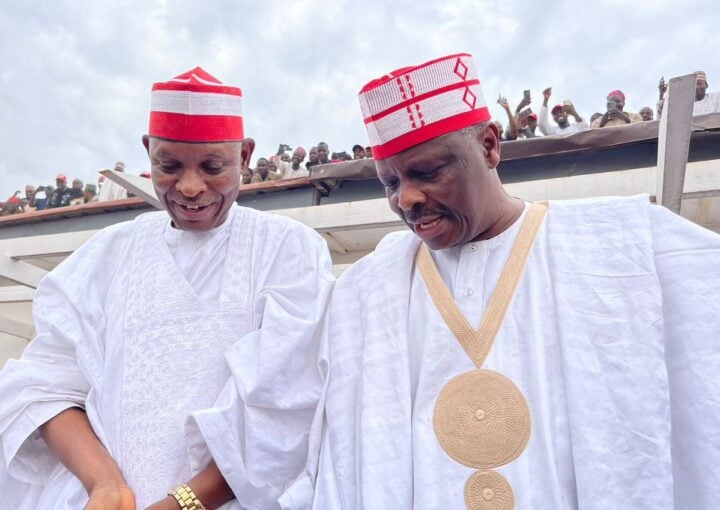
The Daily Reality gathered that what is ordinarily a 30-minute drive from the Mallam Aminu Kano International Airport to the Kano State Government House took several hours due to the massive turnout of well-wishers who accompanied the governor’s convoy amid chants, music, and the waving of red caps — the symbol of the Kwankwasiyya Movement.

Commending the solidarity and support shown to the governor, the AKY Go Again Movement, in a statement on Sunday, expressed deep appreciation to the people of Kano, political and non-political groups, and government officials for their overwhelming participation in the reception rally.

The statement, signed by Hon. Ramadan Yusuf on behalf of the group, described the turnout as a clear demonstration of loyalty and love for Governor Abba Kabir Yusuf and a reaffirmation of the strength of the Kwankwasiyya Movement under the visionary leadership of Senator Rabiu Musa Kwankwaso.

“We organised this grand reception to show appreciation for the impactful and transformative leadership of Governor Yusuf, and to publicly declare our unwavering support for his continuity in office beyond 2027,” the statement read in part.

The group said Governor Yusuf’s people-first leadership style, dedication to restoring dignity in governance, and delivery of key developmental projects have set Kano on a path of progress and prosperity.

It added that the AKY Go Again Movement will continue to serve as a strategic platform to mobilise grassroots support, highlight the administration’s achievements, and promote the ideals of progressive leadership espoused by the Kwankwasiyya philosophy.

The statement listed key members steering the movement, including Alhaji Tijjani Hussain Gandu (SSA Mawallafa), Hon. Sadeeq Kote (Chairman), Hon. Abdullahi Sarki Fulani (SSA, Kano State Censorship Board), Hon. Abubakar Muhammad Inuwa (SSA on Reformatory Institutes), Hon. Sulaiman Mukhtar Bichi, Hon. Ramadan Yusuf (SSA on Media Monitoring and Innovation), Hon. Aminu Yanmedi, Hon. Yakubu Kubaraci, and Hon. Shamsu Kura.

The movement prayed for Allah’s continued guidance and protection for Governor Yusuf as he continues to serve the people of Kano State.