NITDA

Kashifu Inuwa Abdullahi: The national asset powering Nigeria’s digital dream

By Umar Farouk

In a time when Nigeria faces complex challenges in its quest for economic growth, digital inclusion, and youth empowerment, one man has quietly and steadily emerged as a beacon of visionary leadership: Kashifu Inuwa Abdullahi, the Director-General of the National Information Technology Development Agency (NITDA). Appointed in August 2019, he has not only repositioned the agency but also redefined what leadership in the public sector should look like: effective, transparent, youth-focused, and transformative.

As Nigeria strives toward a diversified economy powered by innovation and technology, Kashifu Inuwa Abdullahi has been the chief architect, laying a strong digital foundation that could sustain the country for decades to come. His work has turned NITDA into a symbol of hope, especially for Nigeria’s millions of tech-savvy, ambitious youths who are eager to shape their future in the global digital economy.

Before Kashif took the reins, NITDA was largely known for its regulatory role. However, under his stewardship, the agency has evolved into a full-blown enabler of digital transformation and economic development. One of his most remarkable achievements is the Strategic Roadmap and Action Plan (SRAP 2021–2024), a bold vision designed to guide Nigeria’s digital aspirations across seven critical pillars, including policy, regulation, digital literacy, innovation, and stakeholder engagement.

As of 2023, over 64% of the goals outlined in the SRAP have been achieved. These include improved IT project clearance (which saved the government over N300 billion), robust cybersecurity policies, and the aggressive push toward digital literacy and inclusivity. By aligning NITDA’s operations with national priorities, such as the National Digital Economy Policy and Strategy (NDEPS), Kashifu has ensured that digital development is no longer a side project; it is now a central engine of governance and growth.

Perhaps one of the most commendable areas where Kashifu Inuwa Abdullahi has excelled is youth empowerment. Nigeria, with over 70% of its population under the age of 30, faces both a challenge and an opportunity. Kashifu saw the potential and acted. He launched multiple initiatives aimed at equipping millions of young Nigerians with the skills, tools, and platforms necessary for success.

Through NITDA’s various capacity-building programs, more than 3 million Nigerians have been trained in essential digital skills. The organisation also offers free online training for young Nigerians in areas such as coding, data science, AI, and cybersecurity. 

There is Tech4COVID, during the pandemic, Kashifu led efforts to upskill thousands of youths and develop local IT solutions to support education, healthcare, and e-commerce, while through ONDI and programs like iHatch and Technology Innovation and Entrepreneurship Support (TIES), hundreds of startups have received technical support, seed funding, and global exposure. These programs have helped thousands of young Nigerians gain employment, start businesses, and even attract international investment. 

Under his leadership, NITDA has taken infrastructure development seriously. He has overseen the establishment of over 600 Digital Economy Centres, including Innovation Hubs, Fab Labs, and IT Community Centres, across the country. Including the virtual Libraries and Smart Classrooms for schools in underserved areas.

Kashifu Inuwa is also an advocate for homegrown solutions. He has actively promoted the use of Made-in-Nigeria software and hardware, ensuring that local IT firms get the recognition and support they deserve.

Furthermore, through the enforcement of the Nigerian Data Protection Regulation (NDPR), NITDA has strengthened data security practices across industries. His tenure has seen the licensing of over 59 Data Protection Compliance Organisations (DPCOs), the creation of thousands of jobs, and the protection of millions of Nigerians’ data from misuse and breaches.

Today, NITDA, under the guidance of Kashifu Inuwa Abdullahi, has become a shining example of integrity and productivity in the government. In 2022, NITDA was awarded as the Most Productive Government Agency and became the first federal agency to earn ISO 27001 certification for information security management. Kashifu has represented Nigeria on global stages at GITEX, the World Summit on the Information Society, and the Smart Africa Alliance, consistently advocating for Nigeria’s place as a rising power in the digital world.

Hence, Kashifu’s vision goes beyond just setting up programs or delivering statistics. He is cultivating a digital culture in which innovation is encouraged, risk-taking is rewarded, and the government actively supports the next generation of builders, creators, and entrepreneurs. He often emphasises that Nigeria must move “from consumption to creation”, and everything he does at NITDA reflects this philosophy.

Kashifu Inuwa Abdullahi is more than just a Director-General; he is a national asset. His leadership at NITDA has ushered in a new era of innovation, digital transformation, and youth empowerment in Nigeria. By investing in people, building infrastructure, and promoting indigenous technology, he is laying the groundwork for a digital economy that benefits all Nigerians.

His story serves as a reminder that when leadership is grounded in vision, integrity, and action, it can truly transform lives and shape the destiny of a nation.

Umar Farouk writes from Abuja. 

NITDA commissions national cybersecurity centre at BUK to bolster digital security

By Uzair Adam

The National Information Technology Development Agency (NITDA) has commissioned a National Cybersecurity Centre at Bayero University, Kano (BUK), in a move to strengthen Nigeria’s cybersecurity capacity and digital resilience.

The commissioning ceremony, which took place on Tuesday, at the university’s New Campus, was performed on behalf of NITDA’s Director-General, Kashifu Inuwa Abdullahi, CCIE, by Dr. Jide Ajayi, Director of Zonal Coordination at the agency.

Speaking at the event, Dr. Ajayi described the centre as a strategic national asset that goes beyond infrastructure.

“It is the activation of a knowledge-driven platform designed to equip our nation with the tools, talent, and infrastructure required to safeguard our digital space,” he said.

He added that the project aligns with President Bola Ahmed Tinubu’s Renewed Hope Agenda and the Strategic Blueprint of the Honourable Minister of Communications, Innovation and Digital Economy, Dr. Bosun Tijani.

The newly commissioned facility is expected to support cybersecurity education, research, capacity building, and innovation.

Dr. Ajayi noted that cybersecurity has become an indispensable pillar for building trust in the digital economy, especially in an era of increasing cyber threats and vulnerabilities.

He announced that NITDA, in collaboration with the Office of the National Security Adviser (ONSA), will co-host the first National Cybersecurity Conference from July 9 to 10, 2025, in Abuja.

The event will bring together global experts, policymakers, and innovators to chart the future of AI-powered cybersecurity in Nigeria.

In his vote of thanks, the Vice-Chancellor of Bayero University, Professor Sagir Adamu Abbas, FMAN, expressed deep appreciation to NITDA and the Ministry of Communications for their commitment to technological advancement and education.

“This centre is a symbol of foresight and commitment. It will significantly improve the quality of teaching, research, and practical training in cybersecurity at our university,” he said.

Professor Abbas added that BUK already runs undergraduate and postgraduate programmes in cybersecurity and is prepared to launch a PhD programme soon, noting that the centre will enhance the university’s role as a national hub for cybersecurity excellence.

He also reaffirmed BUK’s readiness to collaborate with NITDA and the ministry in training, research, and policy development, stressing the university’s strategic position in Nigeria’s digital transformation journey.

The establishment of the National Cybersecurity Centre at BUK marks a major step in fortifying Nigeria’s digital ecosystem and promoting inclusive, region-based digital empowerment.

From despair to hope: How Kashifu Inuwa transformed my life

By Umar Jahun

As a young graduate emerging from university, I found myself adrift in a sea of uncertainty. Despite my academic achievements, the harsh realities of the job market left me feeling despondent and questioning my future. 

I grew up in a community where there is a glaring gap between the older and younger generations. Despite having somany individuals in positions of power and influence, they lack the willingness to mentor and guide the younger ones. This absence of mentorship has had far-reaching consequences, contributing to the high rate of unemployment among young people in our community.

Although I thought that the presence of numerous individuals from our town in high-ranking positions, both within and outside the state, should theoretically provide us with a wealth of opportunities, the reality is that many of these individuals seem disconnected, leaving us to navigate the challenges of career development and personal growth on our own.

Many young people in our community are struggling to find jobs, despite possessing the necessary qualifications and skills. This leaves them stuck in a cycle of unemployment, uncertainty, and self-doubt.

It was during this tumultuous period that I crossed paths with Kashifu Inuwa Abdullahi, a man whose intervention altered the course of my life. My encounter with him was serendipitous yet transformative.

Kashifu Inuwa Abdullahi, a prominent Nigerian technocrat, currently holds the position of Director-General of the National Information Technology Development Agency (NITDA). With over twenty years of experience in both the public and private sectors, Kashifu has played a key role in advancing Nigeria’s digital transformation.

But then, when DG Kashif Inuwa entered my life, everything changed. His kindness, guidance, and unwavering support not only secured me a job in one of Nigeria’s top agencies, but also instilled in me a sense of purpose and direction.

DG Kashifu’s impact on my life cannot be overstated. At a time when I had lost hope, he saw potential in me that I didn’t even recognize in myself. He took me under his wing and connected me with opportunities I wouldn’t have had access to otherwise. His influence helped shape me into the person I am today.

The job he secured for me was more than just a source of financial stability; it was a springboard for personal growth and development, exposing me to new challenges, skills, and experiences that have been invaluable in shaping my career. 

What I admire most about Kashif Inuwa is his selflessness and generosity. He didn’t have to help me, but he chose to. He invested time, effort, and resources in me. This kindness has left an indelible mark on my life. He is more than just a benefactor; he is a role model, a mentor, and a constant source of inspiration.

Reflecting on DG Kashifu’s transformative impact on my life, I am filled with gratitude and a deep sense of responsibility. I owe him a debt of gratitude that I can never fully repay.

His influence on me has been nothing short of profound. He gave me purpose, direction, and a chance to succeed. I will forever be grateful for his kindness, guidance, and support. Kashifu is a shining example of the impact one person can have on another’s life.

His selflessness, kindness, and dedication have inspired countless people. Unfortunately, individuals like him are rare, and I often think, “I truly wish we had more like him, or someone like him, in our midsts.”

This is not just a fleeting thought; it is a heartfelt desire that stems from the realization that exceptional individuals have the power to transform communities. When someone with a strong sense of social responsibility and a willingness to serve others is present, it can have a ripple effect, inspiring others to follow in their footsteps.

May Allah’s blessings be upon Kashifu Inuwa. I extend my heartfelt wishes for his continued success, growth, and prosperity.

Umar writes from Jigawa State via daddyjahun@gmail.com.

NITDA alerts Nigerians to new malware threat stealing banking details  

By Uzair Adam 

The National Information Technology Development Agency (NITDA) has warned Nigerians about new banking malware that targets users worldwide through advanced phishing campaigns.  

In a statement released on Monday, NITDA’s Computer Emergency Readiness and Response Team described the malware, known as Grandoreiro, as a significant threat. 

It uses sophisticated techniques, including screen overlay attacks and remote device control, to steal sensitive information such as banking credentials and personal data.  

The agency explained that the malware is primarily distributed through phishing emails and fraudulent websites that trick users into downloading malicious software disguised as legitimate updates or documents. 

Once installed, it bypasses security measures, giving attackers unauthorized access to victims’ devices.  

NITDA cautioned that the malware could lead to financial losses and identity theft. 

To prevent such outcomes, the agency advised Nigerians to avoid clicking on links or downloading attachments from unknown emails.  

Additionally, the public is urged to download software only from trusted sources. 

This precaution can reduce the risk of accidentally installing harmful programs disguised as legitimate files.  

The agency also emphasized the importance of enabling multifactor authentication for online banking and financial accounts. 

This measure provides an added layer of security to protect sensitive information.  

Keeping antivirus software updated is another critical step recommended by NITDA. 

The agency also advised against using public Wi-Fi for financial transactions, as these networks are often vulnerable to cyberattacks.  

Lastly, NITDA urged Nigerians to regularly monitor their bank accounts for unauthorized activities, which can help detect and promptly address suspicious transactions.  

“Cyber threats like Grandoreiro are evolving, and users need to stay vigilant and adopt robust security practices to protect their information,” NITDA said in its statement.  

The agency called on the public to adhere to these security measures to safeguard their financial and personal data.

The dangerous consequences of Nigeria’s tax reform bills on IT infrastructure and the race for Artificial Intelligence

By Haruna Chiroma

The tax reform bill is currently stirring controversy. It poses a severe threat to the growth of information and communication technology (ICT) in Nigeria, as it proposes to terminate funding for the National Information Technology Development Agency (NITDA) by 2027. When I first read this shocking news in the newspapers, I was compelled to investigate further. A section of the bill explicitly states, “National Information Technology Development Fund: 20% in 2025 and 2026 years of assessment, and 0% in 2027 and thereafter.” This provision indicates a progressive reduction of NITDA’s funding until complete withdrawal by 2027. At a time when nations worldwide are significantly increasing their investments in technology to drive innovation and economic growth, Nigeria’s decision to defund its premier ICT development agency is deeply concerning.

Globally, governments play a pivotal role in funding and coordinating computing technological advancements through agencies like NITDA. Leading examples include the U.S., where El Capitan, the most powerful supercomputer with over 11 million processors, is hosted at the Lawrence Livermore National Laboratory with government funding. Similarly, Japan’s Fugaku supercomputer, Italy’s Leonardo supercomputer at the Interuniversity Consortium for Automatic Computing of North-East Italy, and China’s Sunway Taihulight supercomputer at the National Supercomputing Center are all funded and maintained in millions of dollars by their respective governments. These centres drive artificial intelligence (AI), climate research, and national security breakthroughs.

Nigeria’s move to stop NITDA’s funding undermines its ability to establish comparable infrastructure, potentially sidelining the nation in the global race for technological leadership, especially in this era of AI boom. NITDA needs a significant increase in government funding, not a reduction or cessation of funding. This support is essential for transitioning from its current focus on providing basic systems with internet connectivity to delivering advanced computing infrastructure. 

The NITDA has been instrumental in providing IT infrastructure to tertiary institutions and centres across Nigeria, aiming to enhance hands-on experience with technology. While this initiative has made IT resources more accessible, its impact has been limited due to the basic nature of the infrastructure provided. NITDA often delivers facilities such as buildings with basic computing devices and internet connectivity.

Although helpful, this approach falls short of addressing the advanced needs of tertiary institutions, which should be hubs for high-impact research, innovation, and technological development. The computers provided in institutions should have at least one server with 4 GPUs, multi-GPU systems, Dual GPU Xeon W-2400, and advanced workstations capable of running 70 billion parameter models. Such limited interventions fail to prepare Nigeria to lead Africa in technological advancements and global IT competitiveness.

Tertiary institutions are critical for pioneering research and fostering innovations that drive national development. However, the resources provided by NITDA rarely go beyond basic systems, leaving institutions ill-equipped to conduct groundbreaking research or develop cutting-edge technologies. High-impact research requires advanced state-of-the-art computing infrastructure, advanced software tools, and specialized facilities, all of which are currently lacking. As the “Giant of Africa,” Nigeria should empower its higher education system with resources to catalyze technological breakthroughs, enabling the country to lead in global innovation. Unfortunately, the limited scope of NITDA’s current offerings restricts this potential.

Rather than addressing these shortcomings, the proposed tax reform bill aims to phase out budget allocations for NITDA by 2027. This move is a significant setback for a developing nation that aspires to secure a place on the global technology map. Eliminating funding for NITDA would exacerbate the already inadequate IT infrastructure in tertiary institutions, undermining efforts to equip students with the skills needed for the Fourth Industrial Revolution. It would also signal a lack of commitment to nurturing a robust ecosystem for research and innovation, essential for long-term economic growth.

Increasing funding for NITDA is crucial to ensure it can provide an infrastructure capable of supporting advanced research and development. By investing in high-performance computing clusters, research laboratories, and innovation hubs, NITDA could transform tertiary institutions into true centres of excellence. Such investments would enhance education quality, foster industry partnerships, and attract global attention to Nigeria’s technological capabilities. These steps are necessary to empower students and researchers to develop solutions that address local and global challenges.

The NITDA should refocus its efforts from constructing buildings to investing solely in advanced IT infrastructure and power solutions. Beneficiary institutions can provide the necessary physical space, allowing NITDA to channel its budget toward cutting-edge computing systems and robust power setups essential for research and development. This shift would maximize resources and provide institutions with tools to foster innovation, invention, and impactful research and development.

NITDA’s approach should prioritize building supercomputers with at least 400,000 processors (mostly accelerators) capable of handling complex computations and simulations required for high-impact research. Additionally, data centre storage units with capacities in petabytes should be established to support the growing demand for data-driven research and AI training models.

Cybersecurity infrastructure must be provided in the relevant institutions equipped to monitor Nigeria’s cyberspace, conduct advanced forensic investigations, innovate, research, and defend against cyber threats. This holistic approach would create a technological ecosystem capable of addressing the needs of both academia and the nation, bridging the gap between research, innovation, and real-world applications.

Rather than building and distributing basic computing devices across institutions, which provide limited value, NITDA should aim to establish at least one high-performance computing and cybersecurity centre in Nigeria’s six geopolitical regions. Establishing high-performance computing centres in each region is a strategic move that could transform the nation’s technological and research landscape. These centres would serve as centralized hubs for cutting-edge computation, enabling tertiary institutions and regional research bodies to access advanced resources essential for high-impact research, innovation, invention and technology development.

These centres would empower researchers and students to engage in frontier areas such as AI, climate modelling, biotechnology, and space exploration by providing access to supercomputers with thousands of processors, vast petabyte-scale data storage facilities, and state-of-the-art cybersecurity infrastructure.

To ensure sustainability and efficiency, these HPC centres should be supported by reliable power infrastructure, skilled personnel, and strategic funding models. Power-intensive facilities like these require an uninterrupted energy supply, which could be addressed through investments in renewable energy solutions such as solar farms or microgrids.

Haruna Chiroma, a University Professor of Artificial Intelligence, wrote from the University of Hafr Al Batin, Saudi Arabia, via freedonchi@yahoo.com.

Tax Reform: Presidency debunks claims of northern marginalization

By Uzair Adam

The Presidency has dismissed concerns that the proposed tax reform bills currently before the National Assembly will impoverish northern Nigeria or disproportionately favor Lagos and Rivers states.

In a statement issued on Monday, presidential spokesperson Bayo Onanuga emphasized that the reforms are designed to improve the quality of life for all Nigerians, particularly the disadvantaged, by simplifying tax administration and fostering a better business environment.

The statement addressed apprehensions raised by Borno State Governor Babagana Zulum, who had suggested that the proposed Value Added Tax (VAT) sharing formula could be skewed in favor of Lagos and Rivers states.

Onanuga, however, described these concerns as unfounded and based on misinformation.

“The tax reform bills will not make Lagos or Rivers states wealthier at the expense of other regions, nor will they lead to the economic marginalization of any part of the country,” Onanuga stated.

He urged Nigerians to reject any attempt to polarize the nation over the proposed legislation.

Onanuga also clarified that the bills do not seek to abolish key federal agencies such as the Tertiary Education Trust Fund (TETFUND), the National Agency for Science and Engineering Infrastructure (NASENI), or the National Information Technology Development Agency (NITDA), which will continue to receive funding through budgetary allocations.

The spokesperson reiterated that President Bola Tinubu’s fiscal policy reforms aim to ease the tax burden on businesses, streamline tax collection, and support national development.

Meanwhile, former Speaker of the House of Representatives Yakubu Dogara called on Northern leaders to approach the tax reform bills pragmatically rather than with ethnic or religious sentiments.

Speaking during a Channels Television town hall in Abuja on Monday, Dogara stressed the importance of prioritizing the region’s future development.

“We Northern leaders must set aside ethnicity and religious biases and focus on the realities these reforms will bring,” Dogara said.

He also criticized senators who claimed there was insufficient consultation on the bills, questioning their own legislative practices.

“How often do they consult the public when making laws? Some state laws are drafted in governors’ living rooms,” Dogara remarked, dismissing the argument that public opinion outweighs the potential impact of the reforms.

Taiwo Oyedele, Chairman of the Presidential Committee on Fiscal and Tax Reforms, explained that the bills aim to empower subnational governments to enhance revenue generation and achieve fiscal self-sufficiency.

Advocating for Tangible Change: Open letter to Prof Isa Ali Pantami

By Muhammad Sani Usman

I hope this letter finds you in good health. I want to express my sincere gratitude for your consistent advocacy stressing the significance of skills over degrees.

Your dedication to highlighting practical skills as crucial assets in today’s dynamic world resonates deeply with many, myself included.

While you are one of my favorite Islamic scholars, I’d like to bring to your attention some noteworthy and concerning aspects regarding this advocacy:

As a prominent minister under former President Muhammad Buhari, having risen through the ranks from NITDA, addressing the dilapidated state of Nigerian universities should have been a focus. Reforming the system to incorporate skills in every profession would have been invaluable.

Considering the fourth industrial revolution, your emphasis on ICT skills is commendable. However, collaboration with the Senate committee for Education and NUC during your tenure could have established mandatory digital laboratories and ensured graduates are equipped with essential skills before leaving university.

Sir, It’s disheartening to observe many IT and computer science graduates lacking basic coding and programming abilities due to a flawed educational system. While you aren’t the Minister of Education, a more vocal advocacy for change would have been impactful.

Most importantly, recognizing the importance of industrial-scale skills like Project Management and other hard skills is essential. This will ensure that people from the North benefit from the economy of scale and are not marginalized in organizations.

While NITDA introduced boot camps to train youths in ICT skills during your tenure, the exclusive focus on Abuja limited accessibility for the broader population down the North.

Sir, the introduction of blockchain and the recent three million digital skills initiative by your predecessor, Kashif, suggested limited inclusion to these valuable skills. There’s a need to practicality train our people beyond introduction and give the capital at the very end.

Thank you for your time and consideration Sir.

Muhammad Sani Usman, is a graduate of Industrial chemistry from Kaduna state. Can be reached via muhdusman1999@gmail.com.

Unlocking Nigeria’s innovation potential for economic growth and prosperity 

By Salisu Uba, FCIPS

I spoke on unlocking Nigeria’s innovation potential for economic growth and prosperity at the Digital Nigeria International Conference #DigitalNigeria2022 Innovation and Ecosystem Day in Abuja, held on the 28th of October, 2022. 

I focused on what innovation is in Tech and examined the top ten innovative countries; the difference is that they prioritise human capital development, infrastructure, and knowledge-based approaches to innovation. 

I emphasised Nigeria’s competitive landscape, which includes a youthful population, ICT-savvy people, low labour costs, the recent Startup Act, digital economy leadership, and internet access, as key drivers that can transform Nigeria into an innovative nation. 

I also stressed the importance of understanding how to diffuse innovation using the well-known Roger’s diffusion of innovation model. Surprisingly, despite technological advancements, the model remains applicable. 

I also discussed what young people could do to get to the point of developing and commercialising their ideas, emphasising the importance of equipping themselves with skills, networking, and openness. I consider these as factors that will propel one to success. 

More than 1000 people from all over the world attended the conference, which featured speakers from Europe, Asia, America, and the Middle East.

The full presentation and panel session can be found on the websites of Digital Nigeria and NITDA.

Salisu Uba, FCIPS, is a blockchain expert and supply chain and commercial leader from Glasgow, United Kingdom. He can be reached via salisuuba@ymail.com.

Change Begins with Engausa Hub: Breaking barriers to digital skill acquisition

By Haruna Muhammad Inuwa

Nigeria is a great country. A country with great potential and great people. A giant of Africa and, of course, the most populous black country in Africa. Foreigners from other parts of the time – well, for some that have not travelled well – sometimes confuse Africa and Nigeria. This is because they tend to generalise that every black individual coming from Africa is from Nigeria. This is how dominating our great country has been!

In 2018, on March 10, President Muhammadu Buhari launched a national orientation program tagged “Change Begins With Me”. In the speech, he challenged Nigerians to realise that the change they want to see begins with them and that personal and social reforms are not a theoretical exercise. So, he practically says that for a developing country like Nigeria, everyone must get to work and realise their potential for the needed change we have been seeking. This must be a national assignment from Kano to Calabar, Lagos to Maiduguri. 

Embarking on a sacred expedition of bringing change in any society requires one to be passionate about their ideals. They must first identify a problem within. They must be willing to walk the talk. They must be willing to sacrifice a lot of time and resources. They must be believers in the change they wish for. Change is brought about so ordinary people can do extraordinary things. Hence, an ordinary citizen called Engr. Mustapha Habu Ringim founded Engausa Global Tech Hub. 

The Engausa model emerged as a one-size-fits-all solution in a society with system-wide problems. However, the approach is more interesting because it is skill-driven. Engausa Hub aims to empower these youths with digital skills in a community with battalions of unemployed youths. Engausa advocates teaching digital skills using home-based languages for accessible communication and understanding. From the city of Kano, Engausa Global Tech Hub is becoming a focal point of attraction to many university graduates, undergrads, Almajiris, and even those with natural talent and innovative ideas to be developed, managed or commercialised.

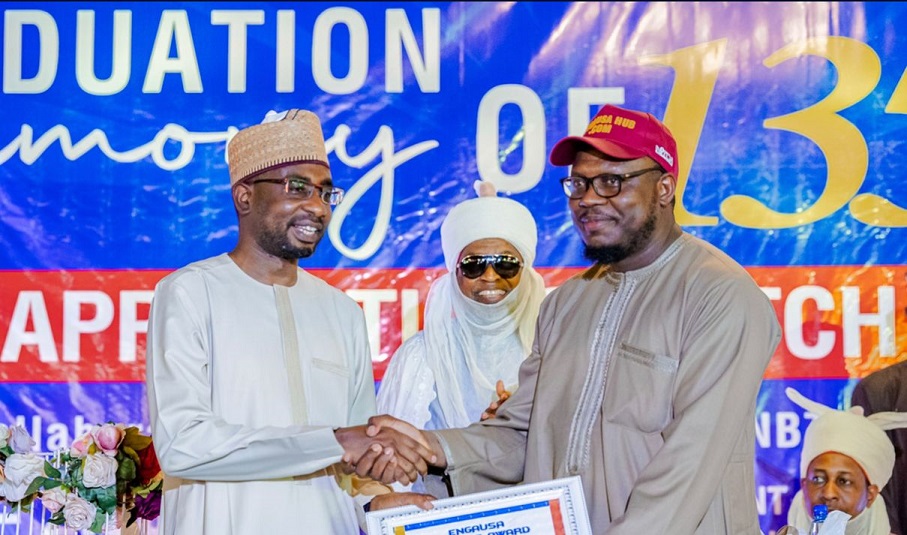
The Engausa story is inspiring because it centres on shaping the way things work and changing the narratives of our society. All thanks to the relevant authorities, who support the innovative activities of the Engausa Hub, the National Information Technology Development Agency (NITDA) and Technology Incubation Centre Kano. During the recent graduation of 1353 students who were rigorously trained in programming, video editing, blogging, graphics design and software development, social media literacy, and digital marketing, the DG of NITDA, Kashifu Inuwa, happily commended Engausa Global Tech Hub for this significant paradigm shift in the digital ecosystem.

Engausa Global Tech Hub thrives on breaking barriers and bridging gaps. So far, the hub has graduated over 1700 technology apprentices with over 50 innovation-driven enterprises owned and managed by the Engausa graduates. Statistically, the hub is turning into a school where you don’t need a college degree before earning a living. Many Engausa graduates are now managing their business; others work in private sectors or are independently freelancing.

Engausa Global Tech Hub seeks collaboration and partnership to expand its operations to other northern Nigerian states because a generational change can only be actualised.

Haruna Muhd Inuwa wrote from Lagos via diamondmuhd@yahoo.com.

Engausa Global Tech Hub trains 1353 youths in modern technical skills

By Muhammad Sabiu

A Nothern Nigerian technology firm, Engausa Global Tech Hub, has trained and certified 1353 persons, including men and women, in different modern technical skills in its effort to reduce the rate of the ravaging unemployment affecting the country.

In attendance at the certification event were the Director General of the National Information Technology Development Agency, Malam Kashifu Inuwa, and representatives of the Emir of Kano and Emir of Karaye, among other dignitaries.

Speaking on the purpose of establishing the firm and training the young people, the founder of the firm, Engr Mustapha Habu Ringim, said they had saddled themselves with the responsibility to train young people in digital technology in their mother tongue (Hausa).

He added that every human has the right to learn technology through his mother tongue, and “ENGAUSA is here to break barriers and bridge gaps” in teaching technology.

“We brought out those who speak Hausa, even if they understand Arabic or English, to train them,” according to Engr. Ringim.

While commending dignitaries on the high table, Mr Ringim said his firm wouldn’t have achieved all it achieved in the past three years without their collective efforts, stressing that he could not have done the work alone.

He noted that you mustn’t understand English before you begin to innovate, as there is what is called formal and informal education.

“Here in Northern Nigeria, we have this misperception that anybody who is not into formal education is not regarded as a literate person. This is a big mistake because the basis of this formal education you see was developed from non-formal education.

“One of our most significant efforts is getting these over 1000 young people we just concluded training. And it’s only for this year. In the year 2020, we trained over 300 people. This is proof that the knowledge of science and technology can be learned in one’s mother tongue because that was when we started featuring innovative young people, like Osama. Now, Osama owns a firm, and any is an employer.

“We also have Muhammad, who fabricated an excavator made from cartons and has now started fabricating a solar-powered generator. The BBC came here and covered what we were doing at Engausa. The news went viral. Afterwards, Muhammad is also now an employer.

“If these young people didn’t get to understand that we at Engausa teach in Hausa [mixed with English], they wouldn’t have come here to get trained,” Ringim is quoted as saying.

The firm’s founder further noted that by bridging the gap in the medium of imparting knowledge of technology, Engausa is in no way discouraging its learners from acquiring knowledge of the English language because efforts are underway to begin English, Arabic and French classes.

“We are doing all these because we have understood that the language barrier is one of the reasons that bar our people from understanding Mathematics, Physics and so on,” he said.

Another milestone achieved is that of those trained previously; about a hundred of them now own their own firms.