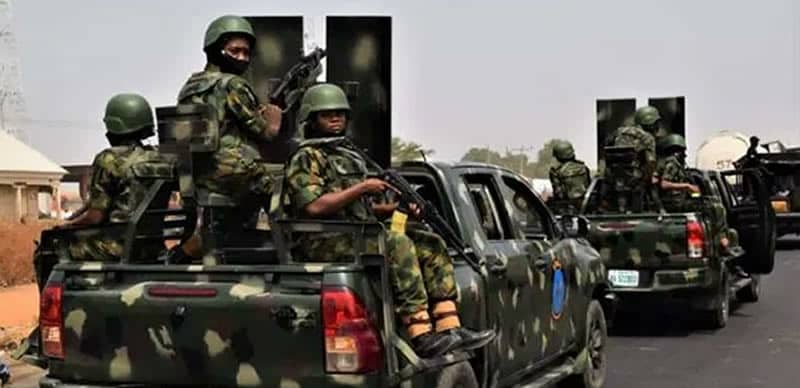
Nigerian Army

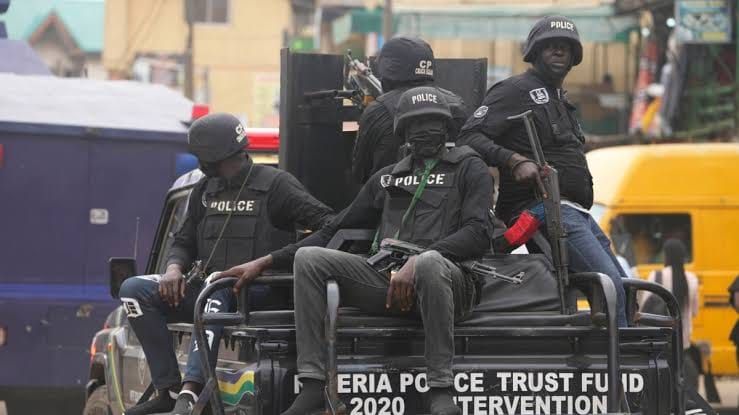
Two policemen fired for alleged murder of army officer, drug trafficking

By Muhammad Sabiu

Two Inspectors from the Nigerian Police Force in Borno have been fired for alleged unprofessional behaviour.

Tahir Ali and Saidu Nadabo, the two sacked Inspectors, are both assigned to the Borno-based 53 Force Mobile Unit.

Mr Abdu Umar, the Commissioner of Police (CP) in charge of Borno, told the News Agency of Nigeria (NAN) about the development in Maiduguri on Thursday.

According to Umar, Ali was fired for allegedly killing Army Warrant Officer Donatus Vokong, who was assigned to Operation Hadin Kai, while Nadabo was fired for allegedly trafficking 4.5 kilograms of cannabis sativa.

He added that the army officer was killed by the policeman, who was under the influence of alcohol.

“I have just directed senior officers of the command to arrest any personnel with riffle and is under the influence of alcohol or who engage in gross misconduct,” the Commissioner assured.

Terrorist bandits kill security officers in Katsina attack

By Muhammad Sabiu

Bandits raided a military base in the Shinfida community, Jibia Local Government Area, Katsina State, killing one soldier and an official of the Nigeria Security and Civil Defence Corps (NSCDC).


By 10 p.m. Tuesday, the bandits were said to have stormed the base, shooting indiscriminately.


During the attack, they set fire to two patrol vehicles and utilized another patrol vehicle to transport food from nearby villages.


DSC Muhammad Abdara, a spokeswoman for the NSCDC in the state, verified the attack and the number of people killed.


According to reports, the officers who were shot died instantaneously, while those who sustained gunshot wounds were being treated at an unidentified hospital.


“The terrorists attacked the military base located within Government Day Secondary School Shinfida last Tuesday. They killed one soldier and one NSCDC officer on the spot and left many others injured.


“They attacked the military base on their motorcycles. Despite the efforts of the military personnel, the terrorists killed the two victims and set ablaze two patrol vehicles and drove away one with food items stolen from neighbouring villages,” the source was quoted as saying.

Terrorist bandits kill 2 soldiers, one police officer, 13 civilians in Kebbi

By Muhammad Sabiu

At least 16 individuals were reported dead in a suspected bandits’ attack in Kebbi State’s Danko Wasagu Local Government Area on Friday.


Two soldiers, a police officer, and 13 people were murdered in the attack at Dankade village, according to the state’s police spokesperson, Nafi’u Abubakar.


The police spokeswoman further refuted reports on various news outlets that the incident resulted in 50 deaths.


Mr Abubakar, who confirmed the amount to the News Agency of Nigeria (NAN), said the incident happened on Friday at 3.00 p.m.


He claimed that suspected bandits from Zamfara infiltrated the community and terrorized civilians and security officers.


When the police patrol squads learned of the incursion, they mobilized to the village and engaged them in a gunfight, killing one of our officers and two army officers.


According to Mr Abubakar, the bandits also set fire to some homes.

January 15: The North will never forget

By Musa Kalim Gambo

January 15 marks 56 years since the gruesome murder of Prime Minister Sir Abubakar Tafawa Balewa and Sir Ahmadu Bello, the Sardauna of Sokoto and Premier of Northern Nigeria. To borrow a few words from Shakespeare, both were like Colossus under whose giant feet the North strode.

The description of that Saturday’s night events still haunts many of us here in the North. Though we sincerely believe that Allah must have predestined that these servants of His were not going to exceed that day on earth, and they would die from the bullets of Igbo-led soldiers. It is still a tragedy we will never forget.

On Tuesday, January 11, Daily Trust published an opinion piece written by my excellent friend Sa’adatu Aliyu titled “Igbos too deserve Nigeria’s presidency”. When I saw the title, at first, I thought it must have been written by an Igbo ethnic nationalist from South-Eastern Nigeria, for she is expressing an opinion that is utterly alien to Northern Nigeria’s political thought and discourse. One should expect this line of thinking to come from the Igbo because the Igbo elite has popularized this illusory notion of exclusion from Nigeria’s corridors of power, especially Aso Rock, as one of the major precursors for secessionist agitation in today’s Nigeria.

By the way, this is the ethnic group that produced Nigeria’s first civilian president, Nnamdi Azikiwe, in the 1960s. Then, again on the return of democracy in 1979, Chief Alex Ekwueme emerged as Nigeria’s Vice-President.

In 2019, Atiku Abubakar had Peter Obi, a former governor of an Igbo state, as a running-mate. Unfortunately, it was a wrong calculation, and we saw how it ended. One of Obi’s major sins that stained Atiku’s ticket is that as a governor in Anambra state, he reportedly came up with policies that frustrated Northern traders and artisans in his state. This sin is an expression of the general attitude towards the Northerner in the South-East region – where the Northerner is perceived with disdain and attacked in the event of any slight provocation.

Again we cannot forget Sardauna’s warning about the Igbo tendencies and quest for dominance in every little sphere of endeavour. This warning and the pain of Sardauna’s murder is still with many of us.

But it is important to understand that even without this fear of domination, the Igbo vote on its own is inconsequential in the making of a president in a democratic Nigeria. So even without January 15, which now resembles the Roman Ides of March, when power mongers assassinated Julius Caesar, the Igbo will not make it to the president.

However, suppose we have an Igbo man in the line of succession within the political equation. In that case, a natural tragedy as it happened to Umaru Musa Yar’adua may undeservedly promote an Igbo man to occupy the exalted seat of the president. And that will be a pure work of Providence that the North will pray for God to forbid.

Some people suspect that an average Northerner hates the Igbo man; that is a wrong assumption. No, the Northerner is comfortable doing business with the Igbo man, as can be seen by the presence of Igbo businesses in every village, town, and city in the North. However, in the political scene, the average Northerner is apprehensive about the Igbo man at the apex of political power. The Northerner does not want January 15 to repeat itself in terms of the elimination of our most revered political leaders.

In the end, I like to re-emphasize, as has been emphasized by many Northern political elites, we are in a democracy. An Igbo man is free to purchase a ticket on any political party’s platform to run for any political office, including the president. If he can generate the requisite number of votes to win the election, who will stand in his way?

Let it be known very well that the presidency of this country is not a baton in a relay race that would just be handed over to the next athlete standing. No, it is a tug of war with competing parties pulling against each other on opposing sides. So, no one should come here again with that sense of entitlement declaring that the Igbos deserve Nigeria’s presidency too. Instead, they should be advised to jump into the arena and fight for the seat with the full knowledge that the North’s deciding population will not clap for them. We study and honour history, its figures, and defining events in the North.

Now, on January 15, and every other day, let’s not forget to pray for Allah’s mercy and blessing upon the souls of Sirs Abubakar Tafawa Balewa and Ahmadu Bello, and all other departed heroes of ours who had the progress and development of our region and people at the centre of their hearts.

Gambo writes from Zaria, Kaduna State, via kalimatics@gmail.com

Military: Bandits should have no space to breathe

By Kabir Mukhtar Galadanchi

It gladdens our hearts how our brave military has been intensifying offensives and operations to root out bandits and banditry in the North-West, particularly in Zamfara and Sokoto, to bring back normalcy and peace to the banditry ravaged states and communities in northern Nigeria.

The military’s recent Ariel bombardments and ground offensive that resulted in the elimination of some bandits’ leaders have boosted the fight against banditry and the confidence of all the concerned stakeholders adamantly and consistently speaking about the rising level of banditry and general insecurity in the region.

In the past weeks, many notorious bandits’ leaders and other terrorists who specialised in kidnapping for ransom and killing innocent civilians were sent to their Maker. Thanks to the well-coordinated aerial bombardment by some section of the NAF launching successful aerial attacks and unleashing serious damage to the now jittery and fear-stricken bandits running for their lives to avoid the currently sustained military bombardments and offensives.

The elimination of notorious Alhaji Auta scared other bandits’ leaders to be on their heels, especially the ferocious Bello Turji, the de factor governor-cum-administrator in those areas. He collects taxes and imposes rules which all must obey to save their souls. This is an embarrassment to our leaders and our security forces, to say the least, and has become a usual trend that is still occurring unabated.

Bello Turji has continued to dare the authorities and positioned himself as a somewhat invincible and unchallengeable criminal that can do and undo whatever he so desires in the communities he’s unleashing his inhumane activities and savagery.

But the recent killing of Alhaji Auta has sent jittery and panic into his camp. He’s now coming to terms with the reality and shamelessly calling and appealing for dialogue and conciliation.

Our military must not in any way give this vermin a space to breathe and must not relent in sustaining those assaults until Bello Turji and his bloodthirsty lieutenants are eliminated. Instead, the military should give them their deserved justice with the barrel of their guns, aerial attacks or through whatever lethal way that will ensure their permanent neutralisation.

Nobody can deny that the unconditional release of some 52 captives by Turji resulted from the intensified military assaults. Eliminating him (Turji) will send fear to hundreds of notorious bandits leaders operating in Zamafara, Sokoto, and Katsina and reduce their activities.

Credible reports have it that Duna Baleri, Dogo Gide, and a host of other bandits leaders are now hiding and running from their devilish camps to avoid our military’s ongoing pressure and offensives. We pray that their nemesis will soon catch up with them in no distant time inshaAllah.

While saluting our military’s efforts, bravery and gallantry, we also pray that they should continue to be determined, persistent, and maintain doggedness in flushing and neutralising these enemies of the state that made life hellish and turbulent through their primitive violence and atavistic barbarism.

On our part as civilians, let us unite and confront this huge challenge collectively without sentiment or regard to religious, ethnic and political affiliations and underpinnings. Let us also cooperate with the military in providing credible information that will help them uncover and eliminate these evils once and for all.

Kabir Mukhtar Galadanchi wrote from Katsina. He can be contacted via kmgaladanchi20@gmail.com.

Governor Masari: Right decision, wrong approach

By Ahmadu Shehu, PhD.

The comments by the Governor of Katsina State, Rt. Hon. Aminu Bello Masari encouraging local populations to rise and defend themselves have mixed reactions. Governor Masari’s comments betray the frustration of state governments in curbing the incessant killings, kidnappings and wanton terrorism that has overtaken most parts of northern Nigeria, especially the northwest. This also portrays the disgustingly shameful inability of the current administration to secure the lives and properties of its citizens.  

In my opinion, Masari’s call to self-defence is the only option left for defenceless citizens who their governments leave at the mercy of terrorists. After many years of terror and horror, it is now apparent that Nigerians can no longer rely on the government for security and protection. As a result, Nigerians are in constant fear and uncertainty at home, on the road, in hotels, awake or asleep.

For one, the Nigerian police are grossly understaffed, ill-equipped and unmotivated to deal with the least of crimes in our society. Secondly, our last line of defence, the Nigerian armed forces, are overwhelmed. Despite its historical doggedness and glory, the Nigerian army has fallen victim to the Nigerian endemic corruption, nepotism and malfunction.

This, coupled with the fact that the country has been continuously militarized for decades, has oversaturated and weakened the numerical, financial and material strength of the armed forces. From Baga to Yenagoa, Seme to Mubi, Port Harcourt to Sokoto, the Nigerian military struggles with one threat or another within our borders.

Facing serious national threats such as IPOB and Oduduwa separatists, terrorist organizations such as Boko Haram, ISWAP, Ansaru, etc., rampant and rampaging bandits and kidnappers, have disorganized, disoriented and crippled the efficiency and efficacy of the Nigerian armed forces. There is certainly a limit to strength and power.

The Nigerian judiciary, which should have been a deterrent to criminals and the last resort for the masses and the poor, has been an easy, cheap tool for the wealthy. The weak, vulnerable citizens have mostly been on their own. They have resigned to fate and forsaken the course of justice, hoping only to get justice in the hereafter.

While the above is an absolute truth, Gov. Masari’s call is misplaced, ill-timed and counterproductive. My disagreement is not in the principle of what he said but in the approach and implementation. Masari is simply calling for absolute anarchy.

Now that the nation cannot deal with a few unorganized armed zealots, how do we imagine a situation where citizens are armed to the teeth? America, the world superpower, is consumed by this law of necessity. How much more of a country which cannot prosecute the smallest of its criminals?   

How would Gov. Masari deal with thousands of unemployed, illiterate, impoverished youth with arms and ammunition at their disposal? If all communities are armed as the Governor envisages, who will be the law in the state? Does Masari think that people with uncontrolled access to firepower equate to an organized police force? Does he understand that the only difference between the current bandits and yet-to-be-bandit youth is access to weapons and freedom from the law? 

I do not know who is responsible for educating our political leaders about the relationship between poverty, illiteracy and poor governance with the current situation in the north. But, still, whoever it is, they must be doing an awful job.

The simple truth is that most of our youth populations are idle, uneducated and miserably poor. Another fact is that the alternatives to gainful employment, hope and prosperity is despair, criminality and social crises.

There is still Katsina government house where the Governor lives in peace because the majority have no access to lethal weaponry. That scarcity is because of the restraint ensured by the law and order that is still in place.

While I disagree with Masari’s approach to this solution, I still believe that this is our only option to ending this madness in the short term. But, to succeed in this, there must be a workable framework.

First, the federal government must decentralize our police force. Secondly, each community must be led by the officials of our security forces to establish a community-based security outfit responsible for securing the immediate and broader community. Finally, all weapons must be registered and deployed through the security personnel in each community.

All participating community members must be registered with biometrics accessible to all Nigerian security agencies. In addition, all participating individuals must be given a short training on the use of firearms. The local and state authorities must provide ammunition, and all participating individuals must be assessed and be accessible to security and local authorities.

When this collaborative network of locals and state security forms a cohesive, functional security outfit, these devils will doubtlessly be defeated in no time.

However, the essential requirement for this to happen is a national leadership capable of mobilizing the citizens to confront local and national threats. Until this is achieved, all solutions are hanging on the balance. The Fulani say “hoore nastii hooraare, Allah yidoo gite”.

Dr Ahmadu Shehu is a herdsman, a social commentator, and passionate about the Nigerian project. He can be reached via ahmadsheehu@gmail.com.

ISWAP Commander Abou Maryam, other fighters killed in Nigerian military airstrikes

By Muhammad Sabiu

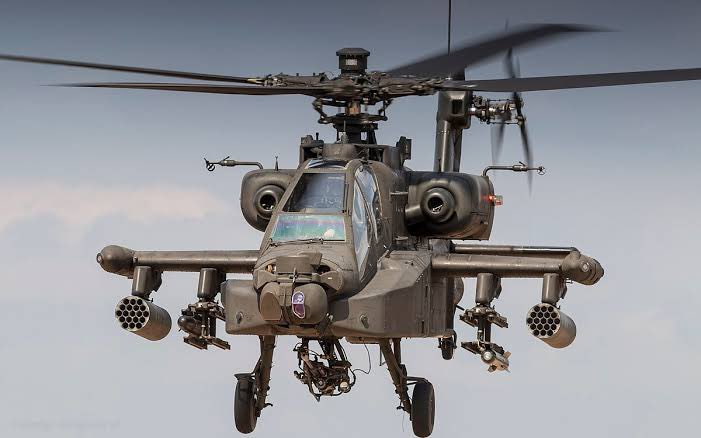
In airstrikes orchestrated around the shores of Lake Chad in Borno State, the Nigerian military killed an ISWAP Commander, Modu Kime, also known as Abou Maryam, and his militants, PRNigeria reports.

The senior ISWAP Commanding Officer met his death in airstrikes carried out on the river banks of Bisko and Tumbum Tawaye in the Abadam Local Government Area.

The operation was carried out after intelligence, surveillance, and reconnaissance (ISR) missions revealed the terror Kingpin’s position while coordinating strikes.

According to reports from the ground, scores of terrorists and the commander were killed due to the air interdiction.

An intelligence officer told PRNigeria that Abou Maryam, who has the phone number +22788036182, was on intelligence services’ radar.

The officer was quoted as saying, “For some times we had been intercepting his communication and his coordination of attacks by his terror group, mostly in Borno State.

“He had operated around the axis of Tumbum Tawaye, Bisko, Garere, Arkumma and Dumbawa, Zari and Gundumbali LGA.

“Abou Maryam coordinated attacks on military troops and soft-targets mostly around Damasak, Nganzai and Gajiram and sometimes on [the] outskirts of Maiduguri.”

Troops raid terrorist bandits’ den in Sokoto, scores killed

By Muhammad Sabiu

Reports from Sokoto State in the northwestern part of Nigeria have indicated that the Nigerian military has launched a series of attacks on the enclave of the terrorist bandits who operate in the region, ChannelsTV reports.

A number of the terrorists were said to have been killed, while many others were injured in the wake of the military attacks.

Recall that Satiru and Katanga, two villages in Isa LGA, were recently attacked by bandits, resulting in the deaths of numerous inhabitants.

On the other hand, the military claimed to have raided the marauders’ hideouts on Thursday and Friday, killing many of the gunmen.

According to sources, several of the bandits who escaped the raid were spotted attempting to leave around the fringes of Bafarawa hamlet, some on motorcycles.

All attempts to contact the division’s army spokesman in the division were fruitless as of the time of reporting this article. More information on the situation is expected in the coming hours.

Still seeking justice, six years after the Zaria massacre

By Najeeb Maigatari

It has been six years since the inhuman massacre of unarmed citizens in Zaria perpetrated by the Nigerian army under the guise of “alleged road blockade” to the then COAS, Tukur Buratai.

According to activists, civil organizations and analysts, the massacre is among the “notable human rights violation since the return to democracy” in Nigeria.

While the Nigerian army claimed that their personnel acted within laws of engagement, a finding by the Judicial Commission of Inquiry into the attack established by Kaduna State government in 2016 remarks, “The Nigerian army exerted disproportionate and excessive force against unarmed, defenceless civilians”.

The Commission further indicted top army officials for their role in the heinous crime and recommended that they be brought a book. Unfortunately, not one of them has been brought to justice to date, while the victims of the massacre and their grieving families still immeasurably suffer in silence.

In his testimony before the Judicial Commission of Inquiry, the then Secretary to Kaduna State Government noted that at least 347 people were killed and buried in mass graves. On its side, the Islamic Movement in Nigeria compiled a list of over 700 people missing since the incident.

During the attack, men, women, children and the elderly were mercilessly killed without regard for stipulated laws against such crime. For instance, the leader of the Islamic Movement, Sheikh Zakzaky (H), witnessed how his three sons, including a fifteen-year-old Humaid, were gunned down before his eyes.

The breadwinners of several families were killed, thus turning their wives into widows and children orphans. Some families were wiped out completely. For example, Dr. Bukari Jega, a lecturer at the University of Abuja, was killed alongside his wife and only daughter- a 6 months old Batoul; and several other families too numerous to mention.

Moreover, several hundred individuals were fatally shot at very close range during the attack, as a result of which some of them have become disabled, and others are still living with life-threatening injuries of great concern.

The release of the leader of the Islamic Movement in Nigeria and his wife from captivity after spending almost six years in illegal detention is commendable. It signifies a step forward to ensuring justice to the victims of the Zaria Massacre. We, therefore, hope that the President will live up to his words and ensure justice is also served to other families who have lost their loved ones in the incident.

There is no democracy without justice: irrespective of gender, tribe or religious inclination, it’s the pillar to peaceful coexistence in a society. The Zaria Massacre is amongst the recorded crimes against humanity in our time, and we, therefore, six years on, still demand justice for the victims and their families.

Maigatari writes from Jigawa State and could be reached via maigatari313@gmail.com.

Nigerian soldiers kill many insurgents in Yobe

By Muhammad Sabiu

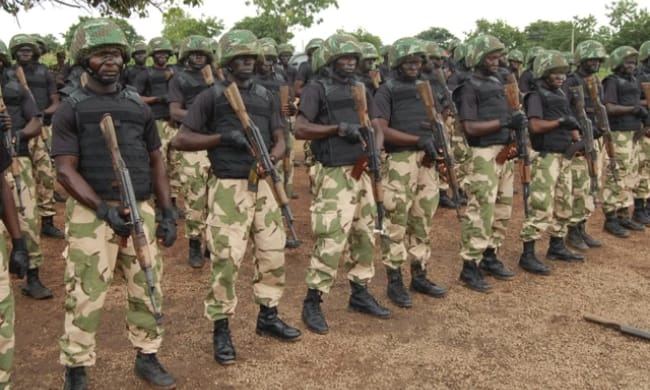
The Nigerian Army announced that its troops killed Boko Haram (BH) and Islamic State’s West Africa Province (ISWAP) terrorists in a fierce battle in Buni Yadi, Gujba Local Government Area of Yobe State, on Tuesday.

The terrorists were met with stiff resistance from troops of 27 Task Force Brigade and Nigerian Army Special Forces School, supported by the Nigerian Air Force Component and personnel of the Nigerian Police, according to Onyema Nwachukwu, Director, Army Public Relations, in a statement on Wednesday.

The fierce gun duel, he said, drove the criminals to flee in different directions after suffering huge losses while the troops took out numerous gun trucks and their occupants.

The accuracy with which Air and Land soldiers engaged the terrorists, destroying their gun trucks, was revealed in a preliminary battle damage assessment.

Troops are still using exploitation to take out fleeing terrorist remnants, he added.

Lieutenant General Faruk Yahaya, Chief of Army Staff, praised troops for their operational success and urged them to maintain the current operational pace in order to deny the insurgents from moving further.