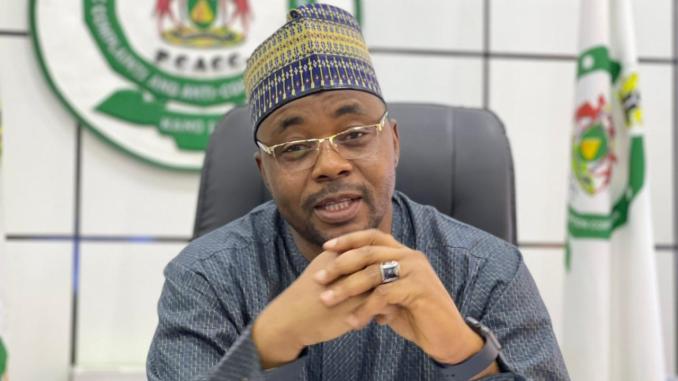
Muhuyi Magaji

Kano govt condemns arrest, transfer of former PCACC chairman Muhuyi Magaji

By Uzair Adam

The Kano State Government has expressed deep concern over the arrest and subsequent transfer of the former Chairman of the Public Complaints and Anti-Corruption Commission (PCACC), Muhuyi Magaji Rimin Gado, by operatives of the Nigeria Police Force.

This was disclosed in a statement signed by the Attorney General and Commissioner for Justice, Kano State, Abdulkarim Kabiru Maude, on Friday.

According to the state government, Magaji was arrested around 5:30 p.m. on Thursday at his law office along Zaria Road in Kano by heavily armed police officers who allegedly did not present any warrant of arrest or court order.

He was first taken to the Police Headquarters at Bompai before being moved to Abuja later that evening.

The statement noted that the development raises serious constitutional and legal concerns, particularly in relation to Sections 35, 36, and 46 of the 1999 Constitution, which guarantee personal liberty, fair hearing, and the right to seek enforcement of fundamental rights.

While acknowledging that the police have the authority to investigate and enforce the law, the Attorney General stressed that such powers must be exercised within the bounds of due process and respect for human dignity.

The government described the manner and timing of the arrest as worrisome, especially given the absence of any official notification to state authorities despite the sensitivity of the case.

It added that the operation appeared unnecessarily militarized, warning that the action could create tension, fear, and political misinterpretation within Kano State.

The government further alleged that some political actors outside the state might be attempting to exploit federal institutions in ways capable of destabilizing Kano and undermining the current environment of peace and good governance.

According to additional findings by the state government, Magaji’s arrest is believed to be connected to several ongoing investigations and prosecutions involving politically exposed persons in Kano.

The statement warned that the move could be aimed at obstructing or compromising these sensitive cases.

The government also described as alarming the alleged deployment of more than 40 armed police officers for the arrest despite a subsisting High Court order restraining security agencies from harassing or arresting Magaji.

It said the development raises concerns about abuse of power and misplaced security priorities at a time when the state and nation face significant security challenges.

The Kano State Government reaffirmed that the state remains peaceful and governed by the rule of law, stressing that any action capable of provoking public disorder or politicizing law enforcement must be firmly resisted.

It urged the police to publicly explain the legal basis for Magaji’s arrest and transfer to Abuja, while calling for full adherence to constitutional provisions and human rights standards.

The government reiterated its commitment to cooperating with all lawful security agencies but warned that it would take every constitutional step necessary to protect the rights of its citizens and safeguard public peace.

Residents were urged to remain calm and law-abiding as the situation continues to unfold.

Kano launches comprehensive anti-corruption strategies

By Uzair Adam

The Kano State Government has implemented a series of measures to strengthen its anti-corruption framework and improve governance.

Speaking during the commemoration of the 2024 International Anti-Corruption Day and Human Rights Day on Tuesday, Governor Abba Kabir Yusuf unveiled the Kano Integrated Governance Accountability System.

The system, to be implemented across all 44 local government areas, will utilize an e-portal to enhance transparency in contract awards and public administration.

Governor Yusuf highlighted the state’s progress in developing a Central Criminal Register Software designed to streamline the criminal justice process, ensure fairness, and combat corruption effectively.

“To bolster our anti-corruption efforts, we have proposed amendments to the Kano State Public Complaints and Anti-Corruption Law and are working on a Proceeds of Crime Bill to ensure transparent management of recovered assets,” Yusuf stated.

He described the significance of eradicating corruption as a “cancer that erodes trust and undermines institutions.”

He also linked anti-corruption efforts to protecting human rights, stressing the administration’s commitment to justice, equity, and accountability.

The event featured a symposium and an evening musical concert to engage stakeholders, particularly youth, in the fight against corruption, human rights abuses, and gender-based violence.

The Governor commended the Kano State Public Complaints and Anti-Corruption Commission, which is led by Barrister Muhuyi Magaji Rimingado, for its dedication to promoting transparency and accountability.

He also extended appreciation to federal anti-corruption agencies, including the EFCC, ICPC, and the National Human Rights Commission, as well as development partners like the MacArthur Foundation and ROLAC, for their collaborative efforts.

In his address, Barrister Rimingado reiterated the Commission’s commitment to tackling corruption and urged young Nigerians to participate in the fight actively.

The state’s Attorney General, Haruna Isa-Dederi, also praised the Governor for providing an enabling environment and revealed that the Ministry of Justice now has an Anti-Corruption Unit empowered to investigate and prosecute cases.

Representing the ICPC Chairman, Ibrahim Garba-Kagara highlighted the challenges of combating corruption, citing insufficient political will and public awareness as key obstacles.

However, he commended Kano State’s proactive approach and encouraged youth participation.

The symposium drew participants from various sectors, including representatives from primary, secondary, and tertiary institutions and officials from the EFCC, DSS, Code of Conduct Bureau, civil society organizations, and the Kano State Police Command.

The initiatives unveiled underscore the state’s commitment to fostering transparency, accountability, and inclusive governance.

Food Inflation: Prof. Mansur Sokoto examines recent government actions

By Ibrahiym A. El-Caleel

Muhammad Mansur Ibrahim Sokoto mni, a professor at Usmanu Danfodiyo University Sokoto (UDUS) and the Chief Imam of Abu Hurairah Mosque, has commented on recent initiatives by the Kano State Public Complaints and Anti-Corruption Commission (PCACC) and the Federal Competition & Consumer Protection Commission (FCCPC) aimed at addressing the escalating inflation nationwide. His remarks follow President Bola Tinubu’s commendation of PCACC’s efforts in scrutinizing the alleged hoarding of goods by businesspeople.

The President, who spoke through his Special Adviser on Information & Strategy, Bayo Onanuga, lauded the Kano government and urged other state governors to follow suit. Earlier on Friday, FCCPC also reportedly sealed Sahad Stores, a popular Abuja shopping mall, over “misleading pricing practices and lack of transparency”, later reopening it after reaching a mutual understanding with the store.

The actions of PCACC and FCCPC have triggered discussions on social media as Nigerians grapple with rising commodity prices. Under Barrister Muhuyi Magaji Rimingado’s leadership, Kano State PCACC has reportedly sealed over a dozen warehouses, accusing businessmen of hoarding grains and essential commodities.

A widely circulated video showed a warehouse owner explaining that the stored grains were intended for supply to NGOs like the United Nations and ECOWAS, engaged in aiding internally displaced persons (IDPs) in North-Eastern states.

Professor Mansur Sokoto mni weighed into the conversation in two separate posts on his Facebook profile, initially posing five critical questions:

  1. “Is the ongoing food inflation solely attributable to businessmen storing grains in warehouses?
  2. Without warehouses for grains, where will imported commodities be stored before distribution for purchase?
  3. Does the surge in prices affect only food, or are other commodities like steel, wood, gold, petrol, and clothing also impacted?
  4. Have commodity prices simply risen, or is the devaluation of the Naira a contributing factor? If Naira devaluation is the cause, who is responsible?
  5. Are the commodities stored in these warehouses completely unavailable in the market, indicating hoarding?

The Islamic scholar emphasized that leaders should be aware of the actual sources of the prevailing hardship and avoid actions that exacerbate challenges. Responding to a commenter’s question on Islam’s stance on hoarding, Professor Sokoto clarified the following six points on what is permissible (halal) and forbidden (haram):

1. It is permissible for an individual to cultivate food crops in any quantity, whether for personal consumption or for storage, with the intention of selling at a later time, provided that he/she has fulfilled the obligatory almsgiving, known as “Zakah”.

2. It is permissible for an individual in need of food to purchase, consume, and store it to prevent potential future cost increases.

3. It is permissible for a businessman to store food crops that he has ordered, intending to sell them later, periodically, according to market demand.

4. It is permissible for a businessman to purchase a food crop during its season, anticipating future value increases, with the intention of selling it for profit. This is permissible according to a valid opinion.

5. It is both permissible and even encouraged for financially capable individuals to buy what they and their families will consume- including items they will give as charity- for a long time, especially when food prices are rising without clear signs of decline. This perspective aligns with the viewpoint of Shaikh Ibn Uthaimeen.

6. What is NOT permissible is for businessmen to acquire food during periods of high prices and hoard it with the intention of causing hardship to the public. Similarly, it is forbidden for businessmen to accumulate and store food during scarcity periods, withholding it from the market until demand peaks. At this point, they sell it at exorbitant prices. In such instances, government authorities are authorized to compel the businessman to sell the stored food at the standard market price without imposing a loss on the sale.

Having outlined these positions, Professor Sokoto critiqued the recent actions of breaking into warehouses, deeming them inappropriate. He questioned whether the businessmen violated Nigerian laws, emphasizing that their practice is not against Islamic injunctions as they maintain inventory for trade and strategic partnerships.

He implored the government to investigate the actual causes of hardships, citing fuel subsidy removal, Naira floating, border closure, and taxation as contributors. Professor Sokoto cautioned against temporary solutions, advocating for sustainable measures and discouraging the use of the National Strategic Grain Reserve to artificially lower food prices. He drew lessons from past strategies and urged the government to avoid short-term approaches.

Muhyi Magaji leads the fight against corruption

By Abbas Datti

Let us take a deep sigh to reflect on the remarkable achievements Barrister Muhyi Magaji Rimingado made as the Chairman of the Kano State Public Complaints and Anti-Corruption Commission. Under Muhyi’s leadership, the fight against corruption and the promotion of public accountability has witnessed tremendous progress.

It is essential to highlight the proactive approaches, Barr. Muhyi Magaji adopted in addressing public complaints. Through establishing accessible and efficient complaint channels in various ministries, departments and agencies, Muhyi has provided a platform for Kano citizens to voice their concerns and grievances directly. This has increased public trust and facilitated prompt resolutions and the commission’s improved service delivery.

The chairman’s unwavering commitment to preventing corruption is genuinely commendable. In his steadfast commitment to fighting corruption, Muhyi has successfully implemented robust measures to ensure transparency, accountability, and integrity in government institutions. From implementing anti-corruption policies to strengthening internal control systems, his tireless efforts have significantly impacted reducing corrupt practices and enhancing good governance.

Furthermore, Mr. Rimingado has been instrumental in promoting awareness and educating the public about the detrimental effects of corruption. Through advocacy campaigns, workshops, and partnerships with civil society organisations and law enforcement agencies like immigration, Nigerian Security and Civil Defence Corps, Muhyi Magaji has fostered a zero-tolerance culture towards corruption. Such initiatives have been pivotal in creating public awareness and mobilising support for the commission’s anti-corruption efforts.

Additionally, the chairman’s strategic collaborations with law enforcement agencies have yielded positive results in prosecuting corrupt individuals. He has sent a strong message that corruption will not be tolerated by facilitating swift investigations and ensuring due process. This has brought unscrupulous individuals to justice and acted as a deterrent for potential offenders.

Lastly, the chairman’s visionary leadership and ability to inspire a dedicated team have contributed to the success of combating corruption and addressing public complaints. By fostering a culture of professionalism, ethics, and integrity within the Ministries, departments and agencies, Muhyi Magaji has created an environment conducive to achieving the set goals.

In conclusion, these giant strides are a testament to Mr. Rimingado’s exceptional leadership, unwavering dedication, and relentless pursuit of transparency and accountability. Magaji Rimingado’s contributions have undoubtedly profoundly impacted the overall socio-economic development of Kano State, and we must applaud and support Muhyi’s continuing efforts in building a corruption-free society.

Abbas Datti wrote from Kano State via abbasdatti448@gmail.com