Military

Democracy vs. Military Rule: No contest

By Abdullahi Muhammad Yalwa

Sometimes, intellectual masturbation makes people say despicable things. That’s how they say foolish things without actually knowing. If not intellectual premature ejaculation, what else would possibly make an educated person compare democracy with military rule? You can’t compare the two at all. In fact, it’s an insult to real thinking to mix them up without a strong reason as to why and how.

Yes, Nigerians are frustrated with democracy because we’ve suffered under it. Presumably, every Gen Zer born from 1999 to date has suffered, or is suffering, from the discontents of democracy. Corruption, poverty, and bad leaders all strangulate our growth. As such, it’s easy for someone who never lived through military rule — or never thoroughly read about it — to think it was better. Nevertheless, it’s inexcusable to make that comparison in the 21st century. With all the history and information one click away. This is lazy thinking.

Nigeria’s story explains the tension between Democracy and Autocracy. Since independence in 1960, Nigerians have swung between dreams of democracy and military high-handedness. The First Republic, which started in 1963, collapsed into coups by 1966. Then came 30 years of mostly military rule, with a short democratic break from 1979 to 1983.

Within this duration, Gowon fought the Biafran war from 1967 to 1970, which resulted in millions of deaths and the fangs of deadly hunger almost flung Nigeria into an abyss. After Gowon, Buhari came in the 80s with his “War Against Indiscipline” rhetoric. Though some changes were recorded only minimally, his government, too, was a failed experiment. Then, Babangida followed his coup and ruled Nigeria through military rule for almost 10 years. His scandalous cancellation of the 1993 election brought General Abacha, who also killed activists in a cold-blooded manner, abducted critics, and censured opposition. Under Abacha, Nigeria became a global pariah, an outcast because of misrule, corruption, and human rights abuses. So, the soldiers promised order but delivered fear, theft, and failure. Beyond the Gun tirade, a lot of them proved to be nothing but unscrupulous, self-centred, and avaricious.

When democracy returned in 1999, it wasn’t perfect — but it was progress. From Obasanjo to Yar’Adua, Jonathan, Buhari, and now Tinubu, we’ve seen peaceful transitions. That alone is a miracle compared to the blood and chaos of coups, which are primarily scathing and scary.

Democracy works and is better than military rule because it gives people a voice. Under democracy, leaders are elected. The constitution limits their powers, and Citizens can question, join them, or change the government. Nigeria’s record is full of incidents in which the people removed the government despite its resistance. Elections since 1999 have been taking place, even though with low turnout and many flaws.

Furthermore, democracy still allows movements and protests like that of #EndSARS in 2020. As such, people can protest against abuse without the nation collapsing. That’s democracy in action.

Equally, in a democracy, the law stands above all. Rights like speech, movement, and association are still protected despite shortcomings. The media and civic groups expose scandals and corruption. Dan Bello is our standard example here. Leaders feel pressure because they can be voted out. They are still afraid of the people’s might. Similarly, growth comes from debate, not decree. Policies get tested and refined before execution. Sometimes they are reversed after execution because of pressure. All these are happening because of the grace of Democracy.

Now, compare that with military rule. Under soldiers, power is seized by guns, not ballots. A few officers give orders. No dialogue, no accountability, only decrees that replace laws. The constitution goes silent. Many of its parts got scraped and unscripted. Rights become suspended, or mere names on papers. Dissent under the military is punished with the barrels of guns. Abacha’s regime proved it — hidden trials, executions, silence. Thus, there is no right to protest, no matter the height of injustice.

Nevertheless, some people may say the military will bring discipline, build roads, and promote infrastructure. But all of that without justice is short-term. Order without fairness is not peace; it’s fear, which eventually erupts into chaos in disguise. 

We have tested the military. And the reflex is there in history for the discerning minds. Under the generals, Nigeria’s economy sank, institutions died, and corruption deepened. Stability built on fear never lasts. Once soldiers take power, they rarely leave it peacefully. Hence, there is no rotation of government. You only get stuck with whatever you’ve got.

Although Democracy has its flaws, issues like bad elections, corruption, and insecurity remain rampant in our country; nevertheless, it is by far a better option. At least, it gives us freedom to protest, options for dialogue, and hope in change. By contrast, military rule gives us nothing but fear, silence, and graves.

The worst democracy is still better than the best dictatorship. Democracy lets us correct our mistakes. Military rule buries them.

So, all these comparisons and happiness over the aborted coup against Tinubu is nothing but nostalgia from frustrated people who refused to learn better. Democracy is not Nigeria’s problem. Nigeria’s main issue is bad leadership. If only we’d vote for responsible leaders, they’d fix the system, without destroying it. They’d strengthen our votes. Protect our rights. Hold leaders accountable. All these would happen only when democracy grows. Thus, democracy grows, Nigeria grows.

No gun can build what the people can build together.

Abdullahi Muhammad Yalwa, a Law graduate based in Azare, Bauchi State, can be reached at abdullahimuhammadyalwa02@gmail.com.
President Tinubu vows to crush terrorism, boosts military welfare 

By Abdullahi Mukhtar Algasgaini

President Bola Ahmed Tinubu has issued a strong charge to the Nigerian military, urging them to intensify efforts in ending terrorism and banditry while promising improved welfare for troops.  

Speaking to soldiers of the 17 Brigade in Katsina on Friday, Tinubu described the security crisis as a pivotal moment in Nigeria’s history. He called for unwavering resolve in defending the nation’s sovereignty and restoring peace.  

“This is a defining moment,” Tinubu declared. “Nigerians are counting on you to reclaim every inch of our territory. Let the enemies of Nigeria know—their time is up.”  

The President assured troops of better housing, healthcare, timely allowances, and family support. He praised their bravery in combating banditry in Katsina and beyond, stating, “You are the shields of Nigeria, standing between our people and terror.”  

Tinubu’s visit included inaugurating a 24km dual-carriage road and an agricultural mechanisation centre. His message was clear: Nigeria will not surrender to terrorists, and the military will receive full backing to end insecurity.  

“To those who seek to destabilise us,” he warned, “Nigeria will not bow.”

Troops arrest suspected kidnap kingpin, recover arms in Kano

By Uzair Adam 

Troops of the Joint Task Force have arrested a 55-year-old man suspected to be a notorious kidnapper during a security operation in Sumana village, Tundun Wada Local Government Area of Kano State.

The arrest was disclosed in a statement issued to journalists by Capt. Babatunde Zubairu, Assistant Director, Army Public Relations, 3 Brigade, on Tuesday. According to the statement, the suspect was apprehended on April 20.

He was later paraded before the Brigade Commander, Brig.-Gen. Ahmed Tukur, during the commander’s Easter visit to troops of the Forward Operating Base (FOB) in Falgore, Doguwa LGA.

The commander commended the troops for their courage and professionalism, describing the operation as a significant success in the ongoing campaign against criminality in the region.

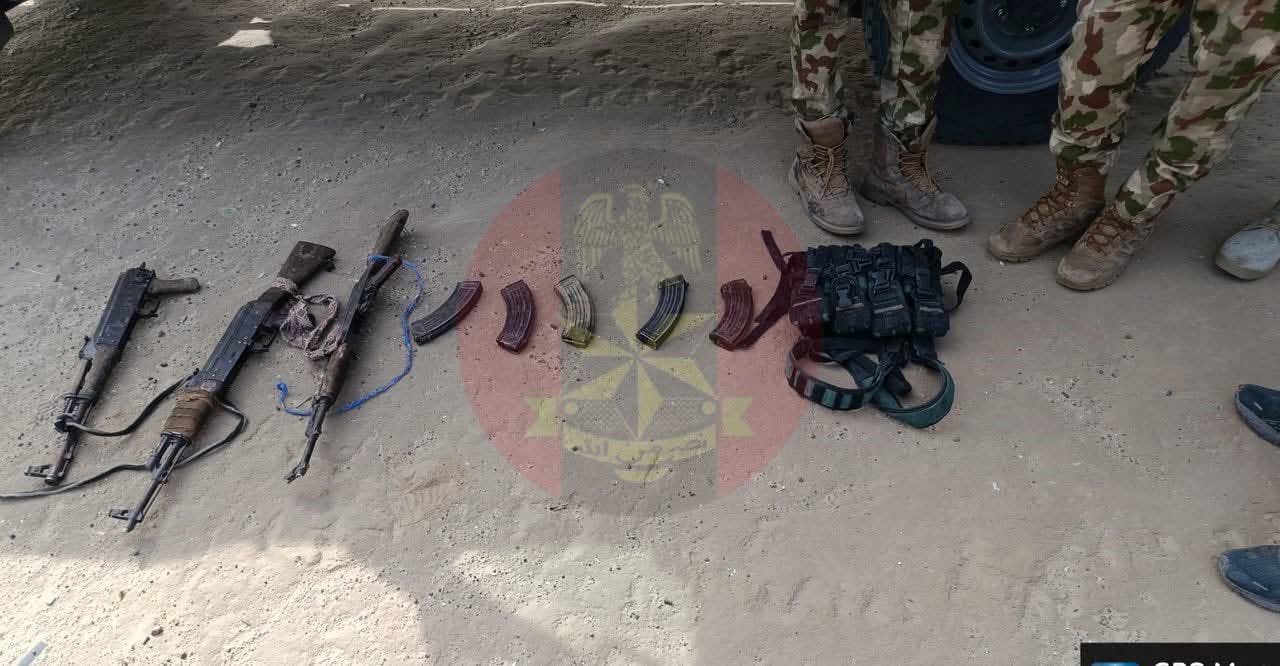
A cache of arms and other items were recovered during the operation. These include a fabricated AK-47 rifle, one Den gun, nine rounds of 9mm pistol ammunition, a woodland camouflage uniform, a desert camouflage outfit, a camouflage vest, and a Bajaj motorcycle seat suspected to be used for concealing weapons.

Brig.-Gen. Tukur reiterated the Nigerian Army’s commitment to working with other security agencies and local authorities to restore peace and order in troubled areas.

“The army remains dedicated to its mandate of safeguarding lives and properties. We will not relent in our efforts to bring perpetrators of criminal acts to justice,” the statement read.

The suspect is currently in custody and undergoing a preliminary investigation.

Amnesty International slams military over Sokoto airstrike, demands justice

By Uzair Adam

International human rights organization Amnesty International has accused the Nigerian military of attempting to conceal the deaths of civilians in two Sokoto State communities during a December 25 operation targeting Lakurawa terrorists.

The Daily Reality reports that the airstrike, conducted in Gidan Sama and Rumtuwa communities in the Silame Local Government Area, resulted in the deaths of at least 10 citizens.

The Defence Headquarters attributed the fatalities to a secondary explosion at a terrorist logistic base, but Vice President Kashim Shettima apologized to the victims’ families.

The incident adds to a troubling history of military airstrikes unintentionally killing civilians, with Amnesty International estimating a total of 436 civilian deaths over the past eight years.

Amnesty International’s Country Director, Isa Sanusi, condemned the Sokoto bombing and accused the military of disregarding human lives. He called on the Nigerian government to conduct an independent investigation.

“The Nigerian military must hand over all records related to the airstrike to the Attorney General’s office for an impartial investigation,” Sanusi stated. “Failure to hold the military accountable only perpetuates impunity and endangers more lives.”

Sanusi urged President Bola Tinubu to establish an independent inquiry into the incident, ensuring justice for the victims and their families.

He reiterated the need for fair trials and compensation for those affected. Amnesty International also highlighted previous airstrikes in various states, including Borno, Zamfara, and Kaduna, which have collectively claimed hundreds of civilian lives.

Despite repeated assurances to minimize civilian casualties, these incidents continue to occur, raising concerns about the military’s operational protocols and accountability.

Military junta in Mali appoints general to replace removed civilian PM

By Anwar Usman

The military junta in mali has appointed a military officer Major General Abdoulaye Maiga on Thursday as the new prime minister, a day after sacking civilian premier Choguel Kokalla Maiga following his criticism of the military leadership.

Abdoulaye Maiga previously served as spokesperson yo the government.

The West African nation, plagued by jihadist and separatist violence, has been under military rule since successive coups in 2020 and 2021.

“Major General Abdoulaye Maiga is appointed prime minister,” read a decree issued by junta leader General Assimi Goïta and announced by the presidency’s secretary-general on the state television station ORTM.

Although Abdoulaye Maiga was not part of the initial group of colonels who overthrew the civilian president in August 2020, he quickly related himself with them and has since been promoted to general.

His appointment to replace the civilian prime minister appears to strengthen the military’s grip on power.On Saturday, Choguel Kokalla Maiga publicly criticised the lack of transparency regarding the transition to civilian rule.

In June 2022, the junta pledged to hold elections and transfer power to a civilian government by the end of March 2024.

However, elections have since been postponed indefinitely.

NLC backs NUPENG’s nationwide strike threat over military involvement at oil rig

By Uzair Adam

The Nigeria Labour Congress (NLC) has expressed strong support for the Nigeria Union of Petroleum and Natural Gas Workers (NUPENG) in its decision to initiate a nationwide strike.

The strike threat follows allegations that military personnel were deployed to remove workers from the Oritsetimeyin oil rig, a move that has drawn widespread criticism.

In a statement issued on Friday, NLC President Joe Ajaero condemned the alleged military intervention, affirming the congress’s solidarity with NUPENG.

Ajaero warned of escalated actions from NLC if breaches of agreements and the use of security forces in industrial disputes persist.

This stance arises from a protracted dispute between NUPENG and the oil rig’s management, where agreements on employment terms reportedly remain unfulfilled.

Earlier in the week, NUPENG alerted the Federal Government, cautioning against military involvement and urging respect for previously established agreements.

On Thursday, however, a special naval unit allegedly arrived at the Oritsetimeyin rig to forcibly evict workers, prompting NUPENG’s strike warning.

Ajaero decried this development as an affront to worker rights, urging military and government officials to address the issue immediately.

“This unacceptable use of state security forces to intimidate workers undermines democratic values and workplace freedoms,” Ajaero’s statement read.

“The militarization of workplaces only harms our economy and violates the principles of industrial relations.”

NUPENG maintains that the eviction followed workers’ calls for adherence to agreements, including severance benefits discussed during prior meetings mediated by the Nigeria Upstream Petroleum Regulatory Commission (NUPRC) and the Department of State Services (DSS).

The NLC’s statement specifically called out companies Dutchford E&P and Selective Marine Services for failing to honor these commitments.

The NLC is urging the Nigerian military, the National Security Adviser, and other key government figures to intervene and prevent further confrontations.

Troops dismantle terrorist bombs, neutralize fighters

By Uzair Adam

The Nigerian Army reported yesterday that its troops have successfully carried out a series of impactful operations, significantly weakening terrorist groups and neutralizing several high-profile fighters.

These actions led to the recovery of dangerous weapons, including rocket bombs and a large stockpile of ammunition.

According to a statement from the Army headquarters, “These operations have further restricted the enemies’ ability to move freely across the country.”

On September 29, 2024, a major raid was launched on Boko Haram/ISWAP hideouts in Ajiri and Mastari villages, located in Bama Local Government Area of Borno State.

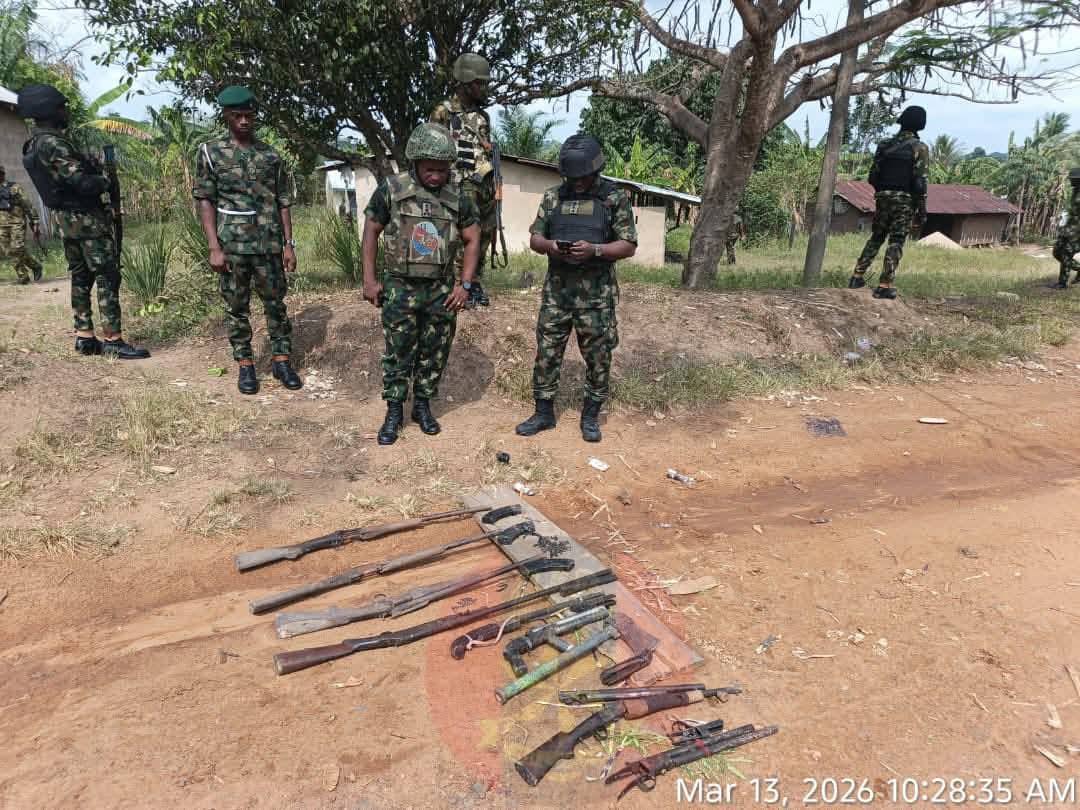
The troops, using superior firepower, eliminated four notorious fighters. A thorough search of the area uncovered two Rocket Propelled Grenade (RPG) bombs, two AK-47 magazines, 28 rounds of 7.62mm (special) ammunition, 25 rounds of 7.62x54mm light machine gun ammunition, and a light machine gun barrel.

Additionally, at Banki Junction in Bama Local Government, troops neutralized another terrorist.

In Plateau State, acting on accurate intelligence, troops raided a location in the forested mountains of Panyam and captured two notorious kidnappers, Isah Abdullahi (24) and Mujahid Musa (23), who had been involved in several violent attacks on villages in Mangu Local Government Area.

Items recovered during the operation included two motorcycles, three mobile phones, and other items of interest.

In a related mission, troops arrested a notorious arms dealer, Kabiru Zaki, in Bukuru town of Jos South Local Government Area, along with a suspect linked to a recent murder in Brazongo village, Bassa Local Government Area.

Meanwhile, in southeastern Nigeria, troops clashed with IPOB/ESN militants in a fierce gunfight in Lilu, Ihiala Local Government Area, Anambra State, after the militants attempted an ambush using an Improvised Explosive Device (IED).

Overwhelmed by the Army’s superior firepower, the militants fled into nearby forests, leaving behind a Closed Circuit Camera and IED components.

CDS Musa gifts N1m to troops for eliminating bandits’ leader in Zamfara

By Sabiu Abdullahi 

The Chief of Defence Staff, General Christopher Musa, has announced a cash reward of N1 million for the troops involved in a recent operation in Zamfara State that resulted in the elimination of notorious bandit leader Halilu Sububu Buzu. 

The operation, carried out by troops from the Joint Task Force Northwest Operation Hadarin Daji (OPHD), was a significant success, with the troops displaying bravery and precision in neutralizing Buzu and several of his fighters.

The operation also resulted in the recovery of weapons and motorcycles. General Musa praised the troops for their dedication and excellence, stating that the reward was a way to honor their service.

The operation is seen as a major blow to the bandit group’s operational capabilities and underscores the Nigerian military’s efforts to combat terrorism in the region. 

This success comes on the heels of a recent attack by the same group, which blocked the Gusau-Funtua highway in Zamfara State and abducted several travelers. The police are still working to determine the exact number of those kidnapped.

Senator Ndume calls for increased military efforts against insurgents in Sambisa

By Uzair Adam

Senator Mohammed Ali Ndume (APC, Borno South) has called on the military under the Theatre Command, North East ‘Operation Hadin Kai,’ to step up operations to eliminate Boko Haram remnants hiding in the Sambisa Forest, Mandara Mountains, and border areas between Gwoza and the Republic of Cameroon.

Speaking in Abuja on Thursday, Ndume expressed concern over recent terrorist attacks, which have negatively impacted farmers resettled in liberated communities such as Ngoshe, Kirawa, Warabe, Wala, Pulka, and Gwoza town.

The insurgents have been looting unmatured crops, further hindering the economic recovery of these areas.

Ndume urged the military and other security agencies to intensify efforts to clear the terrorists still present in the Sambisa Forest and other hideouts near the Cameroon-Nigeria border.

He also praised Borno State Governor Babagana Zulum for his significant contributions to the reconstruction of 10 Gwoza communities destroyed by the insurgents.

Additionally, the senator lauded the military for deploying a medical doctor to Ngoshe, providing free medical services to over 10,000 people in the area.

During a visit to his senatorial district, Ndume distributed agricultural inputs, including fertilizers, insecticides, and cash, to farmers.

He also provided solar streetlights and inspected land designated for the construction of 500 housing units to resettle displaced persons in Warabe, part of Governor Zulum’s rebuilding initiative.

Ndume expressed his gratitude to the community and urged for continued development, while acknowledging that Zulum’s efforts have surpassed expectations.

Insecurity triggers military to establish new commands in Kaduna

By Abdullahi Mukhtar Algasgaini 

The military high command has established new commands in Kaduna State to address insecurity. 

The three new commands are located in Samaru Zango-Kataf, Giwa, and Birnin-Gwari. Additionally, the Air Force will establish a base in Millennium City, in Chikun local government area. 

The Southern Kaduna Journalists’ Forum (SKJF) has praised the collaboration between the State governor, Uba Sani and the Chief of Defense Staff, General Christopher Musa, for their efforts in addressing insecurity in the State. 

In a statement issued by SKJF chairman, Ango Bally and Secretary, Lilian Silas, the forum expressed joy over the establishment of the military bases. 

The statement read in part: “These strategic moves will significantly help in addressing the protracted banditry, kidnapping and other security threats in the region and enhance agricultural activities in the State”. 

The Forum expressed optimism that the deployment of additional military personnel will significantly improve security and enable farmers to access their lands without fear, especially in communities like Maro-Kajuru, Kauru, Sanga, Giwa and Birnin-Gwari, which have been witnessing persistent banditry attacks.