LP

The political identity crisis in a “horse” race for power

By Abdulrahman M. Abu-Yaman 

The title race is between two horses and a little horse that needs milk and needs to learn how to jump. –  Jose Mourinho

When the controversial Jose Mourinho made this statement above, it was about football and the race to the Premier League title in 2014, but we never knew a time would come when it would be more suitable to fit into the Nigerian political context as it relates to the switch and frequent change of allegiance from one political party to another.

THE FIRST HORSE

The first horse, being the All Progressives Congress (APC), is the current defending champion in political power and the acclaimed favourite to retain the presidential title going into 2027, based on the power and influence that come with being an incumbent leader in Nigeria. Only once has it occurred since the fourth republic that an incumbent was defeated, and even that took what some have tagged as a miracle when President Jonathan made the famous call to the late former President Muhammadu Buhari (of blessed memory) and conceded. 

This horse has taken on different forms over the years and has been given various names by the political power brokers who have bet on it to win. Part of its defunct origin was the All Nigeria Peoples Party (ANPP), formed in 1998, a year before the fourth republic general elections. However, its popularity was quite limited to the northern part of Nigeria, not as pronounced in other regions of the country. Former President Muhammadu Buhari had contested twice and lost under the ANPP in 2003 and 2007, respectively.

Another major segment of its primordial origins emerged from the Action Congress of Nigeria (ACN), which was formed in 2006. It was formerly known as the Action Congress, which in turn was formed from the merger of its factions with minor political parties, including the Alliance for Democracy (AD), the Justice Party (JP), and the Advanced Congress of Democrats (ACD), among others.

Then came the Congress for Progressive Change (CPC), founded in 2009. It gained significant influence due to the impact of late Muhammadu Buhari and his millions of supporters in the northern part of Nigeria, who contested under the party’s platform in the 2011 elections. 

In 2013, the progressives and congresses in some major political parties with these words present in their acronym merged into one; the Action Congress of Nigeria, Congress for Progressive Change (CPC), a faction of the All Progressive Grand Alliance and finally, the All Nigeria Peoples Party (ANPP) to form the All Progressives Congress (APC) – the most formidable opposition group as a party in Nigeria since the return to democracy in 1999 to unseat any incumbent President in power.

THE SECOND HORSE(S)

The second horse(s) in the race are obviously divided and sharing that position based on recent trajectories and events that had left one of the horses deemed as second favourite to crumble and hanging on a thin thread; speaking of the Peoples’ Democratic Party (PDP), as long as it still has time to regroup and put its house in order, it cannot be ruled out of the race based on its political structure long established that cuts across all states in Nigeria.

The PDP was formed in 1998, in the twilight leading up to the 1999 general elections, by a group of political bigwigs who adopted Chief Olusegun Obasanjo, a former military head of state and a prisoner released from the dungeon after the end of the Abacha era. Obasanjo, coming from the south-west region of the country, was seen by many as the best candidate to step into what would have been Chief MKO Abiola’s rightful position as winner of the annulled June 12 elections if he had lived up to 1999 but for his sad and shocking demise in 1998.

The PDP won the 1999 election by a majority of votes and held a majority of seats in the National Assembly. In 2003, the party continued to dominate the political space in Nigeria, growing in influence and power, albeit under some questionable electioneering processes in 2003, 2007 and 2011, respectively, having spent sixteen years in power as the ruling party. During that period, it became the largest party not only in Nigeria but also on the African continent.

However, unfortunately for the PDP, their dream of achieving the milestone of twenty years in power was cut short in 2015 when the APC, a new, formidable force energised and regrouped, ran them out of control. 

Since then, the PDP has contested twice as an opposition party and lost to the APC in 2019 and 2023, but edged them out in 2015. The PDP has also had to lose some of its members who have decamped to the APC and has since struggled to remain as firm and relevant as it once was. The only reason it occupies the second spot as a favourite is its longevity, structural base, and the influence of some stakeholders behind the corridors of power, who are still salvaging what is left to stand firm.

Moving away from the PDP, the other second favourite only came to fruition and gained traction a few months ago, orchestrated by one man, Mal. Nasir El-Rufai, who initiated the movement that led to the formation of a coalition that later evolved into the political party rebranded as the African Democratic Congress (ADC). The party had been in existence before its formation in 2005 as the Alliance for Democratic Change. 

The formation of the ADC elicited mixed reactions in the Nigerian political space. While some saw it as the long-awaited vibrant opposition to challenge the incumbent party in power, others viewed it as a selfish endeavour created by those who had been bruised and pushed out of the epicentre of power, seeking to make a comeback by any means necessary. This notion was proven to be more relevant when the ADC reached out to past or aggrieved members of the APC and PDP to form part of its board and core membership from the official flag-off. 

Nevertheless, it is still considered the second favourite in the race because if history is anything to go by, just as in the words of Jesse Jackson: 

“In politics, an organised minority is a political majority”

Just as in the case of the APC, which was formed two years short of the 2015 elections and later emerged as the winner, the regrouped ADC party and its influx of new members can’t be underestimated.  

Another reason the ADC could be frontrunners could be their ability to capitalise on the harsh economic realities in the country that have affected the masses and present the party as an alternative to better their welfare, just as the same members of the ADC did way back in 2015 when they were members of the APC, which they now want to substitute out of power. 

THE LITTLE HORSE IN THE RACE

The little horse that needs milk to learn how to jump is the Labour Party (LP). It was also driven and triggered to relevance in the 2023 general elections due to the influence of one man, specifically Peter Obi, who was spoken of as the party’s flag bearer. The LP not only defeated the APC in their own stronghold in Lagos but also defeated the ruling party in the Federal Capital Territory, Nigeria’s capital and centre of governance. It was unprecedented and sent a clear message that the LP did not just come to make up the numbers like some minority parties. 

But be that as it may, their numbers in Lagos and Abuja, coupled with the ones from the east and the Niger Delta region, were not enough to put them in second position in the race. This is why it needs to spread its wings to cover all political nooks and crannies in other regions, especially northern Nigeria, where it is yet to get a solid grip.

The recent involvement of Peter Obi with the ADC could lead to a compromise and weaken the party’s strength, as it revolves around him. One of the LP’s former spokesmen also lamented him for not doing enough as a leader and his inability to resolve the party’s internal crisis. He also raised concerns about his failure to build a strong party base to secure the mandate. 

Still, the only reason the LP is coming in third in the horse race is because of the unexpected stunt it pulled and its potential to do more if, and only if, it can capitalise on its momentum to leap ahead like other horses in the race.

THE EXODUS AND CONVENIENT SWITCH BETWEEN PARTIES 

Nigerian politics and politicians tend to switch sides to any political party that offers them a higher chance of winning. It occurred in 1999, when the PDP was formed and founded by members of various political parties. 

In 2003, as the PDP grew in strength and power, it received more members, and others had to decamp from their prior political platforms to join it. It was beginning to look like the only way to win an election was to join the party that was already winning. 

2007 and 2011 were no different as the PDP retained power in government. However, the only parties that managed to maintain some of their strongest and most popular members were the ANPP in 2003/2007, and the CPC in the 2011 general elections, when they fielded Muhammadu Buhari as their presidential candidate in the respective years.

In the buildup to the 2015 election, a massive exodus of politicians decamped from the ‘umbrella’ that had sheltered them in political office to the newly formed APC, which was gaining immense popularity, especially in the northern and western parts of Nigeria. The presidential flag bearer was a familiar figure who was contesting for the fourth and possibly his last attempt, having been persuaded to do so. The APC, like the PDP in the past, also welcomed all members from other parties, irrespective of their past reputation or allegations while in office. In the end, the party grew from being the strongest opposition to becoming the favourite to win the election, which they eventually did.

LOST OF POLITICAL IDEOLOGIES/IDENTITIES

When we start seeing political players decamping at will, it is time to question whether any of the political parties place a high premium on their criteria for membership in relation to their ideologies before accepting any candidate into their fold. Do politicians care any less if the party they join aligns with their manifestos and visionary blueprint for good governance and leadership?

It is beginning to look like a game of chess, with calculated moves aimed at checkmating the ultimate power in the political positions they crave. The only pawns in this game are the masses who have yet to figure out that changing their clothes to another has nothing to do with the real person behind those clothes. A stained reputation, especially in previous leadership positions, coupled with a proven track record of underperformance and incompetence, cannot be covered by new political platforms.

However, the interesting aspect of all this is the emergence of a solid opposition to keep the ruling parties on their toes. Previously, with the decline and crisis in the PDP, Nigeria was moving towards a single-party state due to the frequent switch of its members to joining the APC. It is well timed that the LED coalition, which has resolved to adopt the ADC as its political platform, includes big names like former Vice President Atiku Abubakar, who is also a former PDP presidential aspirant. Peter Obi, the Labour Party’s presidential candidate, has also been seen and involved in some of their meetings. And for the first time since the APC’s ascension to power, they seem concerned about the growing popularity of the ADC and the threat it may pose to their hold on power. Deja vu?

Conclusively, all the parties involved in the horse race have exhibited similar symptoms of identity and ideological crisis in their consistent switch of allegiance to suit their needs. The thin line between them is getting blurrier in their actions and adoptions. Everyone is welcome to any party at any time. No litmus test, exceptional integrity, or individual evaluation criteria needed. Once you are in, all sins are forgiven, and then you are baptised as a new member. 

The ADC is not only like the APC alphabetically, but also in the content of its members and its contextual existence. The primary concern here is whether some members of the ADC could potentially break away from the party in the future, particularly in the event of any unresolved disagreement or fallout within the party. Are we to brace ourselves for another hypothetical ‘ABC’ party if it comes to that? Time is the ultimate revealer. 
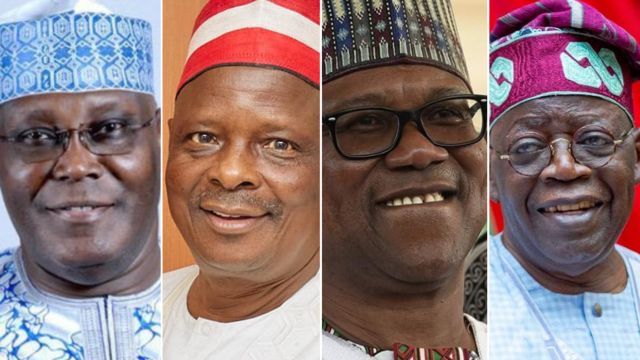
Kwankwaso denies rumours of power-sharing deal with Atiku, Obi

By Uzair Adam 

Senator Rabiu Musa Kwankwaso, former governor of Kano State and presidential candidate of the New Nigeria People’s Party (NNPP), has dismissed rumours suggesting he entered a power-sharing agreement with opposition candidates Atiku Abubakar of the Peoples Democratic Party (PDP) and Peter Obi of the Labour Party (LP).  

In an interview with the BBC, Kwankwaso expressed anger over the claims, describing them as baseless fabrications intended to mislead the public. 

He alleged that Atiku’s camp had met with regional leaders, including clerics, to promote the false narrative.  

“This issue deeply angers me—to hear that respected elders are spreading lies about something that never happened. 

“I was told that nearly 45 clerics were gathered and informed about this fabricated story. I did not appreciate this at all,” he said.  

Kwankwaso further clarified the alleged agreement, which claimed Atiku would serve as president for four years, followed by Kwankwaso for another four years, and Peter Obi for eight years, stating categorically, “This is completely false; such an agreement never existed.”  

Reflecting on his departure from the PDP to join the NNPP, Kwankwaso said he left the party to escape the “humiliation” he and his supporters faced. 

He emphasised that such incidents reinforced his decision to forge a new political path.  

“Such lies and deceit are precisely why we left. Myself, Peter Obi, Wike, and others all left. Now they are coming back, asking us to help those who humiliated us to achieve their goals,” he said.

Tinubu’s slots to opposition parties move for one Nigeria

By Uzair Adam Imam

The reservation of some slots to the opposition parties by President Bola Ahmed Tinubu could be seen as a move afoot to get a better Nigeria which was one of the things his administration promised Nigerians since his victory.

The Daily Reality recalls that Tinubu promised to run an inclusive government that would thrust Nigeria into greatness.

Speaking as the president-elect in March, Tinubu said he was seeking a better country not just for himself and his supporters but for all Nigerian people, regardless of their political affiliations.

The Kwara State Governor and Chairman of the Nigeria Governors Forum, Abdulrahman Abdulrazaq, relayed the news about the slots reservation to journalists at a meeting of the forum in Abuja on Tuesday.

He said that Tinubu reserved some appointments in the governing boards of agencies, parastatals, institutions and government-owned companies for members of the opposition Labour Party and the Peoples Democratic Party.

Abdulrazaq stated that the President asked the governors to nominate competent persons to serve on the boards and parastatals of Federal Government agencies which were dissolved last month.

According to him, Mr Tinubu dissolved the boards last month, which left no fewer than 2,000 vacant positions expected to be occupied by new nominees.

He added that “Among the agencies are the North-East Development Commission with 12 vacant board slots, Independent Corrupt Practices and Other Related Offences Commission with seven board seats; Joint Admissions and Matriculation Board, seven; Teachers Registration Council of Nigeria, 21.

“Nigeria Social Insurance Trust Fund, 12; National Universities Commission, 21 and Transmission Commission of Nigeria, 14; National Health Insurance Authority,12

“Others are the Nigerian Safety Investigation Bureau, 7; Nigerian Meteorological Agency, seven; Nigerian College of Aviation Technology,8; Nigerian Police Trust Fund, 8; Nigerian Natural Medicine Development Agency,10; Federal Institute of Industrial Research, 11 and National Centre for Technology Management, 11 among others,” he stated.

Political Campaign: The dos and don’ts

By Abdulrazak Iliyasu Sansani 

Ahead of the 2023 elections, the Independent National Electoral Commission, INEC, has set 28th September 2022 as the date of the kick-off of the campaign for Presidential and National Assembly elections, while that of Governorship and State Assembly is on 12th October 2022.  

You may be confused about one thing or two, especially when I said the political campaign’s dos and don’ts. Some people may not have understood it. This is highly likely. But, of course, there are limits, and there is a red line that shouldn’t be crossed. There are things that politicians shouldn’t do in the name of electioneering. 

Now that you know, there are things politicians should not do to sell their candidature to the electorate. You will like to know what those things are. Relax. In the course of this piece, I will attempt to treat it. As Nigerians, we are fully aware of what an average political campaign season looks like. It goes with so many things that some of us might have thought are normal everywhere. But it isn’t. Once again, what are they? Political thuggery, mudslinging, killings, hate speech, etc.

While electioneering isn’t a tea party, it doesn’t have to be as nasty as it is in this part of the world. It takes all of us to reduce the toxic messages: from our places of worship, markets, schools, offices, parks, halls, farms, etc. This is everyone’s business. We must be involved. We have to work collectively to help our dear states and the nation.  We can only build this country under this dispensation by encouraging democratic conventions and not unacceptable practices to win or rig the election. 

Rig the election? I think this horrible phenomenon continues to rear its ugly head because many of our institutions are so weak, especially the critical ones that can put a stop to it. Unfortunately, in so many instances, they abet it, leading to many terrible results over the years. 

You will be increasingly sought-after during the electoral campaign to hatch out different plans. This is the time when there will be a multitude of recruitment. No, not in the civil service. But the thriving political industries need the strength and pep of youth to propel them. It is saddening to note that many youths will be required not on the dignified and visionary side but at the disdainable and thuggish position, where their youthful energy will be wrongly channelled to the despicable social oddity of thuggery. This trend has led to the horrible end of countless youth over the years. 

It is discernible that politics is much maligned and detested owing to the celebration of thuggery, cultism, and immorality in many quarters. All these have discouraged many  Nigerians from joining politics or exercising their franchise without necessarily being card-carrying party members. This has, over the years, aided in robbing Nigeria of some of its best brains in politics, a large swathe of its patriotic citizens, and a considerable number of Nigerians who believe in this country. My compatriots, we must change the narrative. We have to stand up and fight against any negative energy that permeates the polity: for the sake of our country. 

Am I advocating against joining politics? Definitely, no. But join politics as a decent, respectable, and patriotic participator, no matter how ‘insignificant’ your position is. In this way, your wit and vigour will be put into effect. Draw a line once your only place is a thug or any role that diminishes you or any other person. 

Value yourself and do only what is legal and aids your personal growth and collective development of society. Do not allow yourself to be used as a tool to destroy your future for a meal ticket. Be wise. You are as good as anyone else when you work hard sufficiently. 

The campaign season has been known to be a tense moment worldwide. This is not peculiar to Taraba or even Nigeria. However, political campaigns are usually anxious for the right reasons in saner climes, with each candidate coming up with competing ideas and plans forming the fulcrum of their manifesto. Therefore, it is anticipated that heated discussion will be a standard feature. But in most instances, the issues take centre stage. Therefore, there will be no need to recruit an array of youth to be engaged in thuggery to win elections. 

Over the years, we have seen how the tone of the candidates’ political campaigns has played a significant role in the level of violence witnessed before or after elections. Therefore, we must be deliberate in deciding our fate by categorically saying no to election violence, whether as candidates or electorate.  

We need to suffocate the polity from getting the stimulus of violence from the youth that has kept it going. We are sure of sanitizing the system. As more people are interested in politics, much more good and patriotic Nigerians will line up. It is a win-win situation for Nigeria. This will give us a better opportunity to choose good leaders to build the Nigeria of our dreams. 

Abdulrazak Iliyasu Sansani wrote from Turaki B, Jalingo, Taraba State. He can be reached via abdulrazaksansani93@gmail.com.

Opponents spread fake news, attribute them to me – Peter Obi

By Uzair Adam Imam

The Labour Party Presidential Candidate, Peter Obi, has accused the way his opponents adopted a negative strategy of trolling and insinuating fake news and misinformation against him and his party.

Obi said this Thursday in his verified Tweeter handle, adding that his opponents create misinformation on social media and deliberately attribute them to him and his party.

The Daily Reality recalls that Obi and the APC Presidential Candidate, Bola Ahmed Tinubu, were engaged in a serious war of words last week.

Obi tweeted, “As we approach the official kick off of the 2023 election campaign, it has become evident that the opposition have adopted a negative strategy of trolling and insinuating fake news and misinformation in the social media space and blaming the Labour Party, its presidential candidate and their supporters of same.

“We remain resolute in our commitment to an issue-based and clean campaign. We will also rebuff all such ploys of deceit and calumny meant to create disaffection among Nigeria’s voting population, who desire credible leadership change. – PO,” he said.

On his part, Tinubu also blamed Obi supporters for mudslinging and spreading fake news against him and other candidates ahead the 2023 general election.

More clarifications ahead of 2023

By Amir Abdulazeez

When President Obasanjo carelessly picked Goodluck Jonathan to serve as Umaru ‘Yaradua’s potential Vice President in 2007, little did we know that the politics of choosing running mates would later become complex and problematic. The death of Umaru, the ascension of Jonathan, the surprising emergence of Namadi Sambo and Patrick Yakowa becoming the first Christian Civilian Governor of Kaduna State would all combine to later add more relevance to the politics of running mate selection. In 2014, APC had more headaches picking a presidential running mate than the presidential candidate himself. It took them so much time and effort that one thought they would organize a new convention for that purpose.

Today, the Muslim-Muslim ticket debacle is the bane of Nigerian political discourse. While clamouring for fairness and balance, which are needed for a fragile system like Nigeria’s, we should also remember that from 1999 to date, no religion can claim any net gain from this Nigerian version of democracy. Ordinary followers of all faiths have been victims of bad governance, even pagans. We have suffered so much that if a pagan/pagan ticket will eradicate insecurity, fix the economy and bring development while being fair to all interests and affiliations, we should allow it. Therefore, the choice is between searching for solutions and satisfying sentiments; we seem to favour the latter.

A section of public commentators and spectators are already suggesting a walkover for Atiku Abubakar in the 2023 polls. That is the biggest complacency I have ever seen in contemporary Nigerian politics. How can you be facing a ruling party with almost 65% of political stakeholdership in the country and be expecting to have a walkover? Atiku is an institution, but his successes in the last two PDP primaries are more financial supremacy than political dominance. That aside, barring a Buhari-like scenario, Atiku will make a good president. He is perhaps the only fully independent candidate with a clear and accessible blueprint since 2007. In 2011, he had a better manifesto and approach than President Goodluck Jonathan; he only lost the PDP primaries to the power of incumbency. By the way, what happened to the Jonathan 2023 candidacy?

From 1992, this is Atiku’s 7th attempt at the Presidency, with 2019 being his closest to success. Many believe 2023 is his year, and so many apparent factors call for optimism in his camp. However, two fundamental things may haunt Waziri; (in)consistency and (un)popularity. Buhari and Tinubu are successfully reaping the harvests of consistency and perseverance; they stuck to opposition politics all their lives. Atiku should’ve remained in opposition when he decamped to Action Congress in 2007 or should’ve stayed in the ruling PDP when he decamped back in 2011. Ambition had kept him running from one place to another, making him neither establishment nor anti-establishment. The second question is whether there is a single state in Nigeria in which Atiku can secure one million votes or more in 2023? I hope we all remember Dr Rabi’u Kwankwaso’s 3-K States theory?

Tinubu’s boast in Ogun State over his role in the emergence of Buhari as President needs some revisiting and clarification. To avoid doubt, Muhammadu Buhari did not lose the 2003 presidential elections; it was brutally rigged to return Obasanjo for a second term. 2003 will easily enter the list of the worst elections in modern world history. In 2007, the results of the presidential election were simply written, so we can’t even call that election not to talk of who won or lost. I have never relied on 2003 and 2007 election figures for research or serious analysis because they are primarily fabricated. The 2011 elections were relatively fair, but at least 40% of the vote was rigged, written, or inflated, especially in the South-South and South-East.

In the circumstances like these, we cannot comfortably declare Buhari a loser of all the previous elections he contested and only became a winner when he met Tinubu. Although 2015 was indeed the weakest version of political Buhari, it was confirmed that he had lost hope and that the APC merger spearheaded by Tinubu was what brought him back to life. But it is also true that so many other factors other than Tinubu contributed crucially to Buhari’s victory. One major one was the abysmal performance of Goodluck Jonathan. One, however, is that, without Tinubu’s support, it would’ve been near impossible for Buhari to emerge APC flagbearer against the financial powerhouses in Kwankwaso and Atiku.

This brings us to the argument that access to public funds is why some candidates (not aspirants) are stronger than others. Supporters of a particular presidential candidate even claimed that if their man had equal access to public funds, he would be better than certain candidates. This is laughable; a debate like this will take us nowhere. Just campaign for your candidate and persuade people to vote for him. If we are talking about the abuse of people’s trust and the utilization of our commonwealth for personal political development, none of the prominent politicians in Nigeria will come out clean. So, let us not deceive ourselves and others.

Where are our smaller political parties who had spent most of their last four years fighting INEC over deregistration? This is a reasonable amount of time they would’ve spent coming together to form a strong bloc. In case we don’t know, 74 of them were deregistered for failing to meet the requirements to continue to exist as political parties. About 10 to 15 of the currently existing will be due for deregistration by this time next year. Instead of them to consider merging to form a decent alternative, they’ll rather hang on only to be fighting a legal survival battle with INEC next year. As the strongest and largest intellectual organization in West Africa, I don’t even know why ASUU is yet to form a political party or adopt any of the smaller parties to set up a path towards satisfying their own demands all by themselves instead of waiting and hoping for a hopeless Federal Government.

Why is nobody talking about the enormous task ahead of the next president, whom credible international reports suggest will have to use 100% of his revenue in servicing (not repaying) debts by 2024? To execute projects or even pay salaries, the next government may have to borrow further. Nigeria is in trouble. We are drowning in the ocean of foreign debts. Meanwhile, we are concerned over a presidential candidate’s religion more than his ability to bring us out of this mess. Buhari has failed because Jonathan had built a solid foundation for that failure. Now he has built a worse foundation for his successor. The possibility and danger of the next president, irrespective of his affiliation and preparedness to economically be worse than Buhari, is imminent. May God help us.

All of the political dynamics of today are closely related to 1999, some a bit earlier. Suppose you have not directly experienced Nigerian political development from 1999 with a mix of some pre-1999 historical knowledge. In that case, you will find it difficult, if not impossible, to connect specific dots that you see today. Extensive and intensive reading may help, but politely interacting with veterans will do better. Unfortunately, social media, where most of the political debates occur, is dominated by youths who knew little or nothing pre-2011 and don’t invest significant time in reading but trying to engage or even confront the same veterans that would’ve been their best opportunity at understanding the genesis of the current situation.

There are some visible changes in Nigeria’s socio-political spaces, although not new but have taken a different twist from the previous. The renewed order is the attempt to criminalize certain political choices against others. Between 2014 to 2018, discourses were dominated by hate, campaigns of calumny, fabrications and outright abuse. Today, political promoters are trying hard to make it appear that only their candidates are good enough, and any other choice is treason. This is extremism. Let’s be careful, everything is a matter of opinion, and everyone is entitled to his.

Twitter: @AmirAbdulazeez