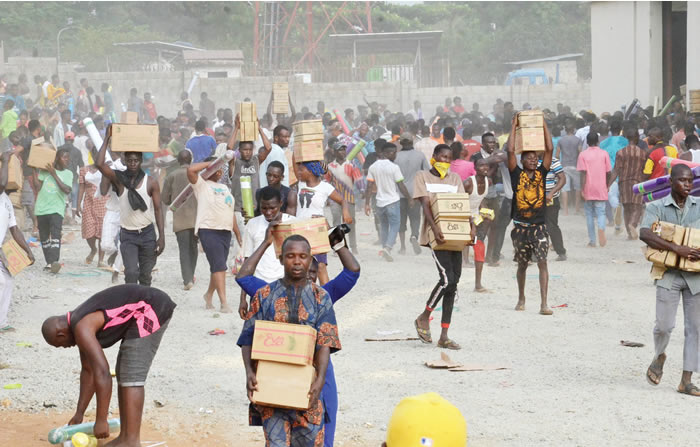
Looting under the guise of hunger must stop
By Tajuddeen Ahmad Tijjani
The country has sadly, in recent times, witnessed pockets of protests and widespread agitation over the rising cost of living and skyrocketing prices of foodstuffs.
“In the past few weeks, residents of Kano, Ogun, Niger, and Oyo States have taken to the streets to protest the high cost of living caused by spiralling inflation in the country.”
In times of desperation, especially when our leaders are too much for themselves and care less for those they govern, calling for them to sacrifice while at the same time living flamboyantly at the expense of society, however, when basic needs like food and shelter too often become scarce, individuals may resort to extreme measures to survive. Looting, particularly of public goods or food supplies, usually occurs under the guise of hunger, with perpetrators justifying their actions as necessary for survival.
While the act may stem from a genuine need, its consequences extend far beyond the immediate acquisition of goods. No one can deny the fact that we’re having a trying time as a country. However, this should not justify the unfortunate events happening in the country. It’s a crying shame people are taking laws into their own hands at a time when we need all hands on deck to surmount the pervasive insecurity in the land.
Firstly, we should remember that looting undermines social order and exacerbates existing societal inequalities. When individuals or groups resort to looting goods belonging to marketers or producers, they bypass established systems of fairness, creating unnecessary chaos and insecurity in society. This erodes trust in institutions and undermines the rule of law, leading to further social unrest and instability. No one can tell where we are headed as a country of diversity. Moreover, looting disproportionately affects the sense of reason, exacerbating social disorder and perpetuating cycles of poverty.
However, we all lamented the current economic hardship facing the country resulting from inflation caused by the federal government’s policies. However, the consensus among the average Nigerian is that the current administration deliberately inflicts misery and poverty on the citizens, though they keep telling us that tough decisions are necessary, which usually bring about good things in the future. But not in the case of Nigeria. Where reversed is the case in some instances.
Moreover, the psychological impact of looting cannot be overstated. Communities already reeling from the effects of poverty, conflict, or natural disasters are further traumatised by the breakdown of social order and the loss of trust in their fellow citizens. As a matter of urgency and necessity, the government, traditional rulers, and community leaders shouldcome out boldly condemning and discouraging the recent looting of people’s goods. Silence can lead to hopelessness and despair, exacerbating social tensions and hindering progress. We can’t continue this way as a civilised society that is expected to move forward in the community of the nation.
Furthermore, looting undermines efforts to build a resilient and sustainable nation by depleting public trust and damaging societal value.
While looting public goods under the guise of hunger may seem like a desperate act of survival, its consequences are far-reaching and detrimental to society. From undermining social order and exacerbating inequalities to hampering economic growth, however, I appeal to the government to stand by its responsibility in Addressing the root causes of poverty and inequality, strengthening social safety nets, and promoting sustainable development are essential steps in mitigating the desperation that drives individuals to resort to looting in times of crisis.
The widening gap between average Nigerians and those in government is too broad; policies that would make all Nigerians feel the impact of leadership should be implemented.
Therefore, I appeal to all those in authority and philosophies to educate society and allow them to understand their boundaries. The government should create an environment that offers the larger population a sense of belonging and shun all violent acts undermining constituted authority. After all, if Nigerians strive in various endeavours, the government will have a smooth way of implementing its policies to benefit all.
Tajuddeen Ahmad Tijjani Writes from Galadima Mahmoud Street, Kasuwar Kaji Azare, Bauchi State.