Kumbotso Local Government

Silent tragedy in Kumbotso: Diphtheria and the cost of delay

By Ibrahim Aisha

In the Chiranci ward of Kumbotso Local Government Area in Kano, the term “sore throat” has taken on a chilling significance. For Iya Yani, a mother of eight, it was the phrase that cost her daughter her life.

“She only said her throat was hurting,” Iya Yani recalled with tears. “Neighbours told me it was nothing, just harmattan. By the time I took her to the hospital, she could no longer breathe. She died before they could help her, and the doctor blamed my ignorance “.

Iya Yani’s heartbreaking loss is part of a broader tragedy unfolding far and wide in the Kumbotso Local Government Area, a tragedy that statistics and government reports can hardly mitigate. 

Diphtheria, a disease preventable by vaccine, continues to claim the lives of children in this community, some due to financial constraints, misleading rumours and even Ignorance.

Diphtheria is a highly contagious, vaccine-preventable disease caused by the exotoxin-producing bacterium Corynebacterium diphtheriae. While the disease can affect individuals of all age groups, Unimmunised children are particularly at risk. There is no World Health Organisation (WHO) region that is completely free of diphtheria globally.

The Facts Behind the Grief

According to the Nigeria Centre for Disease Control’s (CDC) situation report from May 2025, Nigeria recorded 30 confirmed cases and three deaths in the first few months of the year. By July 2025, Premium Times reported that Kano State alone had logged 18,284 confirmed infections and 860 deaths, making it the most affected state in Nigeria. 

According to the World Health Organisation, from 9th May 2022 to 25 October 2023, 15,569 suspected diphtheria cases have been reported across Nigeria, 547 of whom have died. 

As of October 2023, the World Health Organisation disbursed US$1.3 million for the response to enhance key outbreak control measures, including disease surveillance, laboratory testing, contact tracing, case investigation and treatment, training, as well as collaborating with communities to support the response efforts. 

With support from the WHO and the United Nations Children’s Fund, Kano State carried out three phases of reactive routine immunisation campaigns in February, April, and August 2023, using the combination tetanus-diphtheria and pentavalent vaccines.

Almost 75,000 zero-dose children under the age of two received the first dose of the pentavalent vaccine, while around 670,000 eligible children (4‒14 years) were vaccinated with the tetanus-diphtheria vaccine in 18 high-burden local government areas in Kano state.

 Health Reporters revealed in July 2025 that Chiranci of Kumbotso local government is one of the wards with the highest number of “zero-dose” children – those who have never received a single vaccine. In such a setting, diphtheria spreads rapidly, and misinformation intensifies the situation. According to the National Bureau of Statistics, Patients who were not vaccinated had more than double the likelihood of death compared to fully vaccinated individuals.

When rumours mislead and ignorance lies 

Many parents from different areas of Kumbotso Local Government Area admit they delayed immunisation due to prevalent rumours. 

When his seven-year-old brother, Jubrin, was diagnosed with diphtheria in July 2023, Aminu had never heard of the disease, the outbreak of which had claimed more than 500 lives in Nigeria.

Safiya Mohammed, a mother of two, residing in the Kumbotso Local Government Area, a hotspot for diphtheria in Kano State, ensured her children were vaccinated.

“I had never heard of diphtheria,” Safiya said. “I don’t want my children or those in the neighbourhood to fall sick or die from the disease. To protect my children, I also need to make sure the children they play with are protected.”

 Fatima Umar, a resident of Dan Maliki and a nursing mother, confessed, “I heard the injection would make my baby sick, so I waited. Then he fell ill. The hospital told us it was diphtheria. He died before I even understood what that word meant.”

Usman Sani, a husband and resident of Taku Mashi, shared a similar regret: “My wife complained of her throat and her not being able to swallow food properly. I thought it was just a sore throat”.He added that by the time his wife was taken to the hospital, it was already too late.

For Zainab Ibrahim, a mother at Chiranci Primary, the battle against diphtheria has been both long and personal. In early 2025, her daughter, Halima, nearly lost her life to the disease. “She could not breathe,” Zainab recalled. 

My daughter said she finds it difficult to yawn properly, and her throat hurts a lot when she swallows saliva. My neighbours kept saying I should use garlic to make tea for her. I started, but noticed there was no progress, as my daughter could not breathe one night. My husband was away, so I called him in the morning and told him I was going to the hospital. As soon as I arrived at the hospital, she was diagnosed and a file was opened for her. The doctor administered drugs and told us to return after two weeks for an operation.

Zainab further mentioned that her daughter survived. “But the scar on her neck serves as a constant reminder of how close I came to burying her.”

At a local Islamic school at Dorayi Chiranci primary, the head of the school, Malam Andullahi Abubakar Jabbi,informed that many of his students died during the outbreak of diphtheria. It started small, then it became alarming when 3 siblings died within the interval of not less than a week.

” Many students stopped coming, and parents phoned to know what was happening. We had to close down the school for some period of time to avoid the spread of the disease,” said Malam Abdullahi.

Bala Dahiru, a resident of Dorayi Yan Lalle, narrated that it was due to financial constraints that he almost lost his only daughter’s life to diphtheria.

What Kumbotso teaches Nigeria 

Diphtheria is preventable. The World Health Organisation affirms that vaccination offers nearly complete protection against the disease. Yet in many areas of Kumbotso, many mothers continue to rely on neighbours’ advice rather than the guidance of health officials. Health workers, such as Lawan Ibrahim Ahmad, the Primary Health Care Coordinator for Chiranchi Primary Health Care, have repeatedly stated that without a steady supply and consistent funding, “it is impossible to reach every child in every home.”

The tragedy of Kumbotso illustrates that diphtheria is not merely a medical issue; it reflects broken trust, inadequate systems, and misinformation that can kill as swiftly as the bacteria themselves.

A Call to Protect Children

The stories emerging serve as a dire warning. Unless vaccination coverage improves, more families will mourn children lost to a disease that the world already knows how to prevent.

Iya Yani’s daughter should not have died from what she thought was a mere sore throat. Halima should not bear the scar on her neck just to breathe. Fatima should not have lost her son to a disease that belongs in the past.

This grief mirrors our collective failure. Until we take action, every cough in this community will reverberate with fear: Could this be the next case of diphtheria?
An appeal to Governor Abba Kabir Yusuf

By Bilal Muhammad Bello

Sir, as a concerned indigenous person of the Kumbotso Local Government Area, I am writing this letter to remind you of a project that your administration has abandoned.

Your Excellency, I want to commend you for the unparalleled projects you have bequeathed in Kano State, especially in road construction in urban and rural areas. Not to mention other roads that are still under construction. The public, inhabitants of Kano State and visitors to the state can testify to your good work.

Today, the Kano metropolis has roads built with green verges, pedestrian walkways, drainage systems, street lights, and an underpass, all thanks to the development of your orientation.

Sir, the people of Zawachiki Diga, Yankusa, Rinjin Wanzamai, Gadama, and Kumbotso Township in Kumbotso Local Government Area want to draw your attention to the reconstruction of Kumbotso Road from Zawachiki Diga—Kumbotso Township to Zaria Road.

As we all know, the road network contributes immensely to Kano state taxation because of the Challawa Industrial area and the socio-economic development of the area.

It is also important to draw the governor’s attention to the silent neglect of the construction of Sabuwar Gandu—Danmaliki to Kumbotso Township Road, which has stopped. 

Therefore, I wish to appeal to the governor to do something about these roads so as to bring succour to our people whose economic activities, livelihoods, and related developmental issues have been hampered by their deplorable state.

I respectfully appeal to your administration to revive these projects and alleviate the hardships faced by our people.

Bilal Muhammad Bello (BMB) is a student of Mass Communication department, Bayero University Kano.

An open letter to the Chairman of Kumbotso local government

By Musa Idris Panshekara

Dear Sir,

I am Musa Idris, an ex-student of Government Secondary School (GSS) Panshekara.

Mr Chairman, news has been spreading like wildfire all over the town that you are planning to sell some parts of GSS Panshekara or build staff quarters on the land.

Mr Chairman, this news became a nightmare not only to the ex-students or the students but to the entire people of Panshekara.

Mr Chairman, I want to let you know that the school bear its name “GSS Panshekara” because it is located there, under Kumbotso local government. The people benefitting from it are not limited to the people of Panshekara or Kumbotso local government. Still, the school accommodates some students from some parts of Madobi and Gwale LGAs.

Mr Chairman, with your plan of selling or building staff quarters in the land, do you know the school has two sections, one in the morning and the other in the evening, senior and junior classes, respectively? This is happening not for style but because of the insufficient classes to accommodate all the students contemporaneously.

Moreover, the school does not have a friendly and conducive learning atmosphere, despite the overpopulation of students per class. As old as the school is, it has no more than four classes with sufficient seats for the students, not to mention the worn-out ceilings and floors which even you, you can not rear your animals inside one of it. The problems are not limited to that – some classes were previously used but are no longer in use now due to the lack of funds for upkeeping them. Nonetheless, about eight incompleted classes have been without cemented floors for over a decade.

Mr Chairman, there are countless problems the school has: liable scientific laboratory, biological garden, etcetera.

Therefore, no one asks you (if so) to rehabilitate the school from your pocket but the local government treasury. If there is no sufficient amount in the local government treasury, you can refer it to the state government. If the state cannot grant, nobody forces you to intervene in rehabilitation.

Mr Chairman, selling this land for the rehabilitation of the school is inept and inappropriate; moreover, it is a lack of priority if you think of building staff quarters on the land. There are previous chairmen before you who left without glancing at the school. So you are not the first and will not be the last. If you could/would not give your contribution, you can leave the school as it is.

In conclusion, Mr Chairman, do not be deceived by all these people parading behind you like a queen bee. They are parasites who would only suck your blood and throw you away. They will not be with you when you leave your position or with you when you go to your grave.

Mr Chairman, I urge you not to consider yourself or people like you. Instead, please consider the vulnerable children of poor masses coming in the 20, 30, 40 years, whose parents can not afford to take their children to private schools.

Mr Chairman, remember that Boko Haram use weapons to kill students, and teachers and destroy schools brutally. So please, you should not use your office to destroy our mother school in the name of reviving the school.

Yours,

Musa Idris Panshekara

The untold story of Kano’s special education school (I)

By Aminu Adamu Naganye

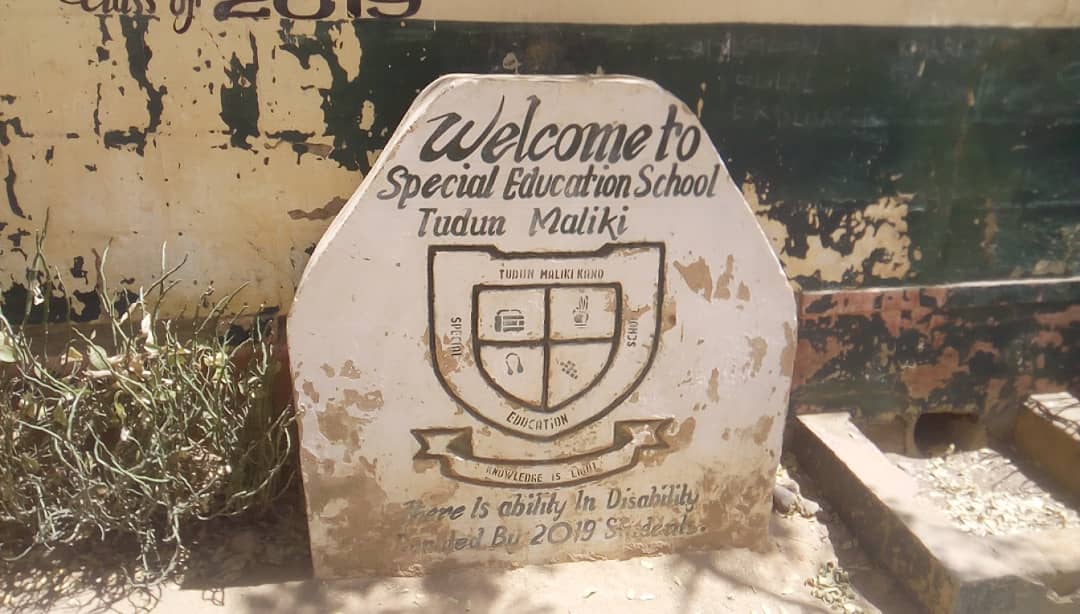
Established as the centre for juvenile delinquents in 1958 and later converted to Special Education School in 1977, it is Kano’s premier and most important school for Persons with Special Needs from Kano and beyond. In part one of this special report, the Daily Reality reporter, Aminu Adamu Naganye presents the general condition of school from classes, furniture to hostels. And how the shortage of learning materials hampers the learning process of the students.

PICTURE 1

Approaching of classrooms in the junior secondary school section of Kano Special Education School, Tudun Maliki, The Daily Reality observed how a teacher was trying hard to obviously settle a fight between two hearing-impaired students. “Judging and settling fights are a daily routine here,” said a smiling teacher who likened their work to that of judges.

Special Education School, Tudun Maliki, Kumbotso Local Government Area of Kano state is a combined boarding school with multiple sections or parts serving the educational needs of persons with special needs (disability) from different parts of Nigeria.

Established prior to Nigeria’s independence in 1958 as a centre for keeping juvenile delinquents, it was later transformed into a school for hearing and visually impaired pupils in 1977. At the inception, the special school “started with four (4) visually impaired students and seven (7) teachers.”

“There are currently about 1500 pupils and students comprising both male and female from different parts of Nigeria,” said our tour guide who teaches at the secondary section of the school. “It has a primary section, junior secondary and senior secondary sections” he added.

“Special Education School Tudun Maliki is a sort of a unity school because its students aren’t only from Kano state. It is a kind of unity school because we have students from all the neighbouring states such as Jigawa, Kaduna, Katsina, and Bauchi. We have students also from Yobe, Taraba, Abuja and even Lagos we have students from there… there are students from different places in this school” narrated a teacher while briefing an NGO team that distributed items to the students.

Although the school director and teachers do not entertain journalists in the school for apparent fear of possible backlash from the authorities who often deny or trivialise the problem, the school accepts NGOs who support the school with learning and teaching materials in addition to supporting the pupils with detergent and laundry stuff. TDR relied on an NGO’s visit to file this report.

It can be recalled that recently the school became a public sensation, especially on social media when some visitors posted dilapidated conditions of the students’ toilets which prompted the Kumbotso Local Government Chairman to come to their rescue by renovating one toilet and constructing another in the school; another philanthropist also built a toilet for the students as shown by a teacher. 

Although there are other special education schools at the primary level for the persons with special needs in Kano, this particular school is actually unique as it allows them to culminate into senior secondary school. “There are primary school sections of this type established by some metropolitan LGAs in Kano. So after their primary education there, they come here to continue to secondary school” said a teacher.

Dilapidated classrooms and hostels, in need of renovation

Considering the fact that there are few special education schools of this type that impart knowledge to persons with special needs in the state, it is expected that this very school should have standard classrooms and hostels for this unique breed of students. However, classrooms at the school were anything but befitting for learning and teaching. “It is not conducive for learning and teaching the state of the classrooms, especially the primary section,” said a teacher, “there are no seats in the classes, and the students sit on a bare floor. The windows and even the doors to the classes are all broken” narrated the teacher as he ushered our reporter into primary six class.

PICTURE 2

The sign language/gesture with which they greeted our reporter tells the fertile minds, hearts and brains eager to learn and expand frontiers of knowledge not just in the hearing impaired community but also in the larger society. With their complete white uniforms, the hearing-impaired pupils look dirty and untidy for obviously having constant contact with bare floor due to the absence of desks and chairs in the class. What is startling is the apparent joyous and smiling faces of these innocent souls full of hopes and dreams as they welcome us into their supposedly learning vicinity. In most of the primary school classes, there was no single chair or desk for the students’ learning convenience. In a class where few desks were available, they were broken and not convenient for sitting, writing and learning. “That is how all of us manage the situation. The teachers and pupils are doing their best in this environment,” said one teacher.

Passing through the students’ hostel blocks, the story is the same. The sorry condition of the dormitory is visible from any angle. Most of the windows are broken and the doors are not any better. “It is terrible when it is very cold because the windows as you can see are broken,” said the teacher in whose company our reporter moved around the school. Similarly, it is terrifying the condition of both the hostels and the beds for the students; the beds are grossly inadequate, leaving many students to sleep on the floor with mattresses alone due to a shortage of bunk. The teacher guide said they pity the students, especially in cold weather but there is nothing they could do personally to help the situation.

Despite our reporter’s inability to get into the hostels but peeping through the broken windows reveals their dilapidated conditions ranging from shattered windows, scratched and cracked walls to badly spoiled ceilings.

A teacher whose identity could not be revealed appealed thus “Government owns the school and it’s doing its best. But I still call on the government to do more. I also call on NGOs and affluent people to come and help, to support government efforts. There are a lot of things to do here. A lot of problems to solve especially in classrooms because you can’t learn in an unconducive learning environment. As you have seen in the primary section of the school, they sit and learn on a bare floor. There are no seats. The windows are broken”  

“We need additional hostels. There is a shortage of even beds. Some students are sleeping on the bare floor of course with either a mattress or mat. We have a lot of students but the accommodation isn’t enough. We need both bunks and a hostel block. Especially during cold weather. If you check the hostel, they need to be renovated. But as the saying goes a ‘single tree cannot make a forest.’ “We hope people and organisations should come and support the government,” he added.

Dearth of teaching and learning materials

The peculiarity of the kind of students of the Special Education School requires unique learning instruments to impart knowledge to them successfully. Although it was relatively easier to teach hearing-impaired students using sign language, a blackboard and chalk-like conventional students, it is more challenging to teach visually impaired students how to write and subsequently read their writings. A teacher corroborated this when he said, “Honestly, we don’t have the material for teaching and learning on the ground…if you take the hearing impaired students there is a little problem because they use learning materials like everyone such as chalk, blackboard, textbook etc. Even though we don’t have textbooks but their parents buy for them.” 

But for the visually impaired students, he explained that “That is where we have a very big problem. Previously, NGOs used to bring learning materials. Now they don’t bring such things. And their (visually impaired) learning materials are expensive, especially if you want to enrol them in primary school you have to buy what is called “slate and stylus” which currently cost around N10, 000. And this slate and stylus is a must if you want your child to study because it is the first learning instrument. So some parents because they cannot afford to buy such material, prefer to keep their children at home and refuse to enrol them in school.”  The teacher however acknowledges that the government supplies exercise books for the students.

TDI came to the rescue, donates hundreds of textbooks

As part of its effort to support and empower adolescents, a Kano-based NGO called Teens Development Initiative (TDI) made a commitment to addressing some of the challenges in the school, especially on learning materials.

Fadhila Nuraddeen Muhammad, Founder and Executive Director, of TDI, told the Daily Reality that they are currently working with the school authority to establish a library for the school. She said they discovered that science-based subjects were not taught in the school because of the absence of instructional materials but the students were eager to learn, hence their commitment to support with the necessary materials, especially textbooks.

She said TDI donated about one thousand books to the school that will be put to the library to make it functional.

“We have already delivered the books to the school. We are planning to raise some funds for the shelves in the library,” she noted.

Our students don’t starve, they have nutritious meals

Despite the challenges confronting the school, the students are not left to starve as one of the visually impaired students revealed. The student, Abdullahi Adamu, confirmed that: “They give us food in the morning, in the afternoon and at night.” In the same vein, a teacher in the school told our reporter that “They get good food here. Some of them cannot get what they get here in their parents’ houses. They are served three meals, three good meals a day. The government provide their breakfast, lunch and dinner. Some of us as their teachers cannot afford what they are being served in our houses.” Another teacher explained further: “In their breakfast, for instance, they are served bread, tea and egg. In the afternoon, they are given food with chicken. It is not everyone that can afford that nowadays. Every Wednesday, they eat a fish meal. In the past, after every two weeks, cows used to be slaughtered. They hardly eat food without meat.”

To be continued in part (II)