Kindness

The most important kindness: To yourself, for here, and hereafter

By Aisha Musa Auyo

I preach kindness every now and then—kindness to a spouse, kids, parents, relatives, and others in our lives. But today, I want to dwell on the most crucial kindness… kindness to oneself.

This is a kindness that goes beyond this dunya (this world); a kindness that rewards you with the best of here and the hereafter. Being kind to oneself has many faces, but I’ll discuss the most important ones here:

Prioritising the Akhirah Over the Dunya

This world is merely a temporary place. Try as much as you can to resist the temptation of indulging in sins. Strive to stop any act that you would not love to die doing. Stop procrastinating regarding good deeds. We do not know when our lives will end; no one gives us notice. We owe ourselves this profound kindness: preparing for the inevitable.

The Investment of Sadaqah (Charity)

Giving out sadaqah, even if it’s merely half a date, expiates sins and prevents tragedy. We often spend a great deal on ourselves without calculation, yet when it comes to giving to others, we hold back and start calculating. What we forget is that whatever we give out is multiplied and comes back to us many times over. Whatever we spend only on ourselves ends here.

But you see, when we make other people’s lives easier, lessen their burden, or make them feel better, Allah multiplies that, and the reward is for both here and the hereafter. Whenever we spend on ourselves, let’s try to include those who are less privileged. We are not only helping others; we are being incredibly kind to ourselves beyond this dunya.

The Perpetual Reward of Sadaqah Jariyah (Ongoing Charity)

Let’s discuss Sadaqah Jariyah—a charity, in which the reward continues to reach you even after your death. We can achieve this through various means, such as investing in raising pious children, teaching the Quran, performing good deeds, drilling a source of water, contributing to an Islamic school or any other worthy cause, even if we can’t afford to sponsor it entirely, planting trees, etc.

We benefit more from this benevolence than the people it was intended for. We truly owe it to ourselves to show this type of kindness.

Cultivating Great Relationships

Cultivating good relationships with others, elevating their mood and ranks, making them feel great about themselves, and improving the quality of their lives are powerful ways we can be kind to ourselves. These are the investments that make people miss us and sincerely pray for us after we are gone. We owe this kindness to ourselves—being able to invoke the feeling of longing, missing, and praying for us when we are no longer here.

Sustaining Spiritual Well-being; keeping our mouth moist with Zikr (remembrance of Allah), Istighfar (seeking forgiveness), and Salawat (blessings upon the Prophet); reading the Quran; and constantly upgrading our knowledge and practice of our Deen (religion) is a kindness to ourselves that we should never compromise.

Integrity and Truthfulness

Saying the truth, having integrity and decency, minding one’s business, and having a halal (lawful) source of income is a profound kindness we owe ourselves, for this will be a shield from the Hellfire.

Simple, multiplied deeds

You see, a simple gesture—smiling at strangers, a kind word, an encouraging nod, removing a harmful object from the road, helping or feeding animals, or watering a plant—will go a long way in benefiting us here and hereafter. Angels are praying to Allah that whoever gives out, may Allah increase his wealth, and whoever withholds his wealth, may Allah withhold His blessings from him. So we should never forget that whatever we do, small or big, we shall receive it in multiples.

Being Intentional

One crucial thing I’d like to remind us here is to be intentional about everything we do. Let’s always ensure that our deeds and actions, big or small, are motivated by the reward of our Creator. Let every action or inaction emanate from the craving for Allah’s Rahma (Mercy) and the fear of His punishment. This, indeed, is the biggest kindness we owe ourselves.

Lemme stop here..

Aisha Musa Auyo is a doctoral researcher in educational psychology. A wife, a mother, a homemaker, a caterer, a parenting, and a relationship coach. She can be reached via aishamuauyo@live.co.uk.

Don’t postpone kindness, you may never get another chance (2) 

By Aisha Musa Auyo

The second story that inspired this reflection is the death of an acquaintance. She was the HR of a company that once offered me a job as an editor. We had exchanged emails, and I went there in person to explain why I couldn’t take up the role. That first visit also turned out to be my last. The company’s owner is a friend, so it was easy to discuss things openly.

After hearing me out, she understood my situation as a young mother. She said she had once been in my shoes and offered some warm advice, assuring me that the company would always welcome me if I were ready in the future. As I was about to leave, she asked about the fragrance I was wearing. She said, “The whole office is filled with your scent. It’s so calming.”

I explained that it wasn’t a regular perfume but Turaren Wuta (incense) and humra. She smiled and said she was familiar with them but had never come across such heavenly scents before. I promised to send her some to try.

It was a casual conversation, but I took it to heart. I packed black and white humra with some incense and gave them to my driver for delivery, as I was travelling at the time. Days turned into weeks, with excuse after excuse from him. When I called her, she said she never got his call, and even if she wasn’t around, he could have left the package at the office.

Back from my trip, I retrieved the parcel and handed it to another driver. Again, excuses. Frustrated, I shared my ordeal with a family member. She dismissed my worry: “You’re overreacting. This woman has probably forgotten about the incense. She doesn’t owe you anything. Why stress yourself over this?”

But deep down, I couldn’t let it go. Something urged me on. I said, “Whatever it takes, I’ll do this delivery myself, I insisted. The family member teased me, calling me stubborn, “Aisha kina da naci wallahi, kin damu kowa a kan abin da ba shi da mahimmanci”. I said na ji. It felt as though everything, including the universe, was determined to stop me from sending that gift.

Finally, when I demanded the second driver return the parcel so I could deliver it personally, he apologised and promised to take it that week. Two days later, she sent me a message, thanking me warmly. She said, “It was worth the wait.” I apologised for the delay, and that was the last time we spoke.

This week, I received the news of her death. She had been battling a heart condition. I remembered how she once mentioned wanting to lose weight for health reasons. My heart sank. I prayed for her soul and felt profoundly grateful that I had managed to give her something she wanted before her passing. Suddenly, I understood why my instincts had been so insistent.

The lesson is clear: never postpone kindness. Please do it now, because tomorrow is never promised.

Aisha Musa Auyo is a doctoral researcher in educational psychology. A wife, a mother, a homemaker, a caterer, a parenting, and a relationship coach. She can be reached via aishamuauyo@live.co.uk.

Don’t postpone kindness, you may never get another chance (1)

By Aisha Musa Auyo

When you can be kind and helpful, do it immediately. Don’t procrastinate or wait for the “right time.” You may not live to see that time, or the person you want to help may not. The point of power is always now.

I’m inspired to share this because two recent incidents made me reflect deeply. One was the death of a close relative, the other, the passing of an acquaintance I only met once but stayed connected with through social media.

In the first incident, an aunt of mine came from another town for her monthly hospital appointment. She usually arrived a day before to avoid being late. That evening, after visiting some relatives, she spotted a shawarma shop and sighed: “Zan so na ci shawarma ko da sau ɗaya ne a rayuwata” (“I would love to taste shawarma at least once in my life”).

My cousin, who was driving, ignored her words and sped past. I pleaded with him to go back, but he insisted the shop was closed and wouldn’t open until 7 p.m., which is true. My aunt looked disappointed.

Later at home, I begged him again to get me shawarma bread so I could prepare it for her. He brushed it off, saying he was tired, and reminded me she’d be leaving early the next morning. “You can always make it for her next month,” he said. But my heart wouldn’t allow me to postpone it.

Eventually, he bought the bread, and I stayed up late preparing the fillings, finishing by midnight. I set my alarm for 4 a.m., woke up, rolled, and grilled the shawarma. By 5 a.m., it was ready. When I handed it to her, she was overjoyed. She couldn’t believe I went to such lengths to fulfil her simple wish. She prayed for me with a smile, and we said our goodbyes.

Later that day, she called to say she had arrived home safely and that my shawarma exceeded her expectations. She even saved some to take home. Though I joked, it must have been cold by then. She prayed again for me before hanging up the phone.

A few days later, she passed away.

I was in shock. Just last week, she was with us, longing for shawarma. I wept, but deep down, I thanked Allah that I didn’t delay. That shawarma became her first and last.

The lesson is clear: never delay an act of kindness. Tomorrow is not promised for you or for them.

Aisha Musa Auyo is a doctoral researcher in Educational Psychology. A wife, a mother, a homemaker, a caterer, a parenting and relationship coach. She can be reached via aishamuauyo@live.co.uk.
The ripple effects of small acts of kindness

By Usman Muhammad Salihu

In our busy lives, we often overlook a fundamental truth: sharing even the little we have can bring blessings, not only to others but also to ourselves. It does not require grand gestures; sometimes, small acts of generosity can profoundly impact lives and brighten the world.

Sharing fosters connections between people, whether with friends, family members, or strangers, reminding us of our shared humanity. Offering our time, food, or clothing creates a deep sense of joy and fulfilment, and the knowledge that you have made someone else’s day a little better is a reward in itself.

What may seem insignificant to you could mean the world to someone in need. An extra meal or a warm blanket could make the difference between hardship and comfort for someone less fortunate. Sharing eases others’ burdens, inspiring them and others to pay kindness forward, creating a cycle of compassion that can transform communities. It also fosters gratitude, helping us recognise and appreciate our blessings, however small.

Across cultures and beliefs, there’s a common understanding that generosity brings blessings. The universe rewards those who give, often in ways that go beyond material returns. By sharing, we also reduce waste and better use our planet’s resources, contributing to a more mindful and sustainable world.

Even the simplest act of kindness has a ripple effect, touching more lives than we can imagine. It’s not the size of the gift but the spirit in which it’s given. A warm smile, a meal, or a helping hand—each act of sharing has the power to uplift and transform. Never underestimate the profound impact of generosity. In giving, we receive life’s truest blessings.

Usman Muhammad Salihu was part of the pioneer cohort of the PRNigeria Young Communication Fellowship and wrote from Jos via muhammadu5363@gmail.com.

A remarkable story of a tea seller and his customer

By Elisha Bello

Yesterday, I embarked on a nostalgic journey to visit the son of the late Mallam Ahmadu, a kindhearted individual who had significantly impacted my life during my entrepreneurial venture in Buni Yadi, Gujba LGA, Yobe State.

I used to design and sell posters and stickers featuring Hausa Movie Kannywood actors, Bollywood actors, and football players. My business trips would take me to Kano, where I would purchase these posters and return to sell them in rural markets like Bumsa, Goniri, Kukuwa, Wagir, Buni Gari, and Tarmuwa.

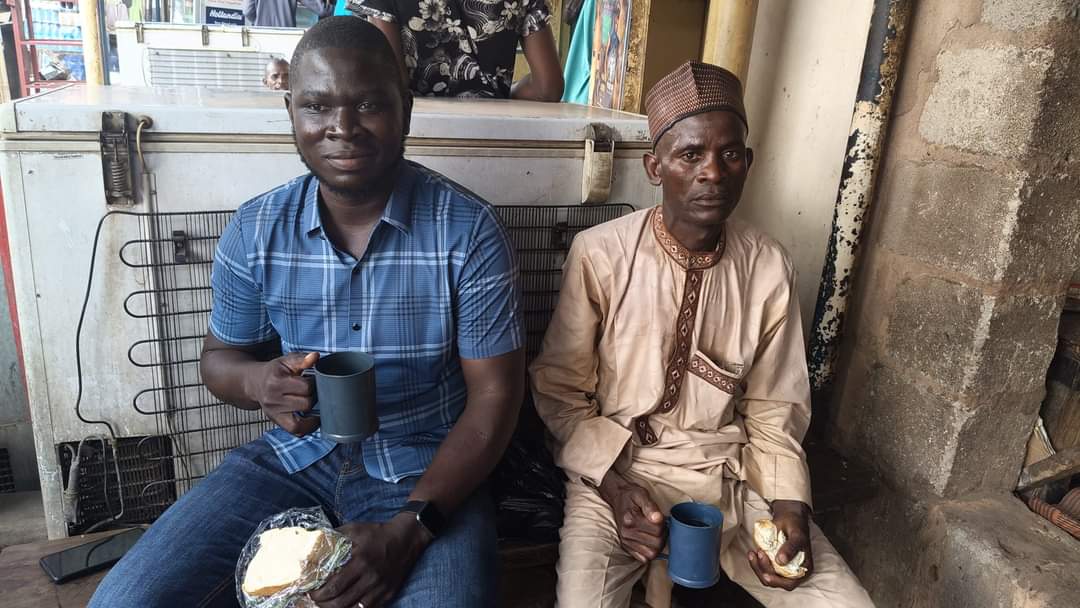
Mallam Ahmadu, may he rest in peace, was a constant source of encouragement and support. He would often welcome me with a warm smile and a refreshing African Tea, accompanied by bread and egg, all for just ₦450. I would make it a point to deposit some money with him in advance, ensuring I could enjoy his hospitality whenever I returned from the markets. On occasion, he would even offer me free tea, a gesture that meant the world to me.

One fateful day, I faced a significant setback when I lost my business capital due to unforeseen circumstances. With my SSS 3 school fees and WAEC/NECO exams looming, I was desperate for a solution. Despite pleading with those around me, I couldn’t gather the required ₦13,250. Feeling defeated, I considered abandoning my education to focus on my business. That’s when Mallam Ahmadu noticed my absence from school and inquired about the reason. I shared my predicament with him, and without hesitation, he asked me to return in the evening to collect the necessary funds.

True to his word, he handed me the exact amount from his wooden drawer, saying, “Allah ya ba da nasara, Doctor Elisha” (May God grant you success, Doctor Elisha). I was overwhelmed with gratitude and asked how I could repay him. He simply said, “Whenever God blesses you, come back and pay me back.” Mallam Ahmadu’s kindness and encouragement stayed with me, and he fondly referred to me as “Doctor Elisha” due to my ability to read and interpret both Hausa and English languages.

Fast-forward 20 years, and I recently had the opportunity to reunite with his eldest son, Salisu, who has continued his father’s legacy. As I shared this story with him, we both became emotional, reminiscing about the past. I treated myself to a cup of African tea, and the memories of Mallam Ahmadu came flooding back. I’ve since repaid the debt and purchased food items for the family. Moreover, I’ve committed to supporting Fatima, his daughter, with her school fees until she completes her university education.

As I parted ways with Salisu, I shared with him that I’ve finally become a Doctor, just as his father used to affectionately call me. He was overjoyed and offered his prayers for me. This heartwarming encounter serves as a poignant reminder of the power of kindness and the impact one person can have on another’s life.

Sunana Elisha Bello, Ph.D.

Editor’s note: The story was published on Dr Elisha Bello’s verified Facebook page.

On thanking others for their kindness

By Namadi Junior

For countless times, I used to write on this issue and later erased it from my notepad for reasons best known to me. But I will emphasize it today.

People need to understand that the phrase ‘Thank You’ must be pronounced to those who help you in any way and no matter little. Allah is my witness that I hate people to thank me for my kind gesture towards them. So I don’t get carried away by complimentary remarks.

Meanwhile, I say ‘Thank You’ to even those I pay for rendering services to me, not to talk of those who assist me. Again, it’s a virtue of humans; they want to be acknowledged for the good things they do. And I don’t see anything wrong with it.

Let me share my encounter with one young man (student) whom our driver picked on the road after we left the park. I was the one who insisted we start travelling because it’s late even though the car isn’t full. I was supposed to pay for the one seat vacant if we reached our destination without getting a passenger on our way.

Amidst reaching Zungeru, where the guy we picked on the way alighted, the driver asked him to bring his money even before fully entering the town. He gave him ₦400. The driver furiously rejected the amount by asking him to collect his money back. Instead of begging the driver to collect such an amount, he babbled that that is how they usually pay, which was a lie. So, the driver then agreed to go to the town’s park and ask how much they carry people from where we picked him up to there. If they say it is ₦400, he will collect it.

I was quiet, notwithstanding the rest of the passengers were asking the guy to beg the driver, for it appeared that’s all he had. He was too arrogant to beg him until we reached the park and asked, and they said it was ₦600. The driver then turned and looked at the guy sympathetically and said to him, you’re a student, free if I carry you, I didn’t lose. I also have children, but stop being haughty and well-mannered. He then collected the ₦400. Even with that, wallahi the boy didn’t say “Thank You”.

My question here is, why and how can people help someone with such a habit? I would’ve paid for his fare, but he proved that he was not from school through his behaviour. So let’s all learn to thank people!

Thank you.

Namadi Junior sent this article via namadijunior@gmail.com.