Kaduna Attack: Bandits flee to save their lives
By Tahir Ibrahim Tahir
It is no longer news that on December 7, 2021, 42 innocent travellers were gruesomely burnt in a bus as they moved through Gidan Bawa village of Sabon Birni local government of Sokoto state. Thirty-five died instantly, and seven survived with very severe burns. May Allah shower their souls with his mercy.
The attack is one of the most horrendous and inhumane acts of the bandits that have since visited Northwestern Nigeria with an orgy of violence. I believe this barbaric act accounts more for Sheikh Gumi excusing himself from speaking on behalf of the bandits than the reason he gave – citing their proclamation by law as terrorists. This heartless, baseless and demonic act of burning a fellow human being alive has laid bare the true nature of what Nigeria has been fighting for so many years.
Fighter jets bombarded many enclaves of the bandits, east of Dumburoum forest in Zurmi, Zamfara, and also in Sokoto and Kaduna states, as well as ISWAP locations in far away Borno state, a day before this inhuman slaughter at Gidan Bawa. It is evidently a reprisal attack and an inadvertent confirmation of the nexus between ISWAP, Boko haram and Bandits – the same hydra-headed terrorism monster.
It is no longer news that northerners are moaning beneath the anguish of the mayhem that these ‘organisations’ have visited upon their people – annihilating human lives like they were crickets. More lives are lost to terror, and there doesn’t seem to be a decline. A 100 lives are lost in a week sometimes. Northerners are increasingly livid over the fact that PMB is a northerner. As President, he ought to secure his northern constituency – letting their governors, legislators, service chiefs and other top government functionaries off the hook for the bizarre and profoundly depressing situation of the North.
It is no longer news that the FG has made massive investments in security, purchasing no less than 60 fighter jets (fighter helicopters, FJ-17s, Super-Tucano, M346 Italian jets) along with battle tanks, MWRAPS, TAVORS, Armored navy vessels, and sophisticated surveillance systems. Bases have been positioned throughout the length and breadth of the war theatre. More boots are on the ground than ever, most definitely more than the civil war. All air assets have been deployed in the North to fight terrorism. So what in God’s name could be the problem?
It is no longer news that the weaponisation of poverty, in the long term, especially in Northern Nigeria, is mainly responsible for the hell pit we’ve found ourselves in. We watched our leaders dig us in and did us in while we egged them on for as long as it favoured us. We genuflected before them, made them take bows, applauded them – and allowed them to go scot-free. The masses and the village dwellers suffered this weaponisation with years of untold hardship, weeping blood. In contrast, we, the elite and the city dwellers, enjoyed all the blood money and whatever elitist pleasures therein. Now the shoe shiner is wielding an AK-47, so is the Maiguard. The herdsman is a warlord, so is the Vectra driver an informant. One of the Northern universities’ security chiefs is a kidnap kingpin, and a Hajiya in the village is the supplier of thousands of rounds of ammunition to bandits. The questions bang your scalp like the heavy August rainfall; who is not a bandit, or a terrorist, or an informant, or a kingpin or some helper of a sort to these terrorists? The North is hardly an image of its once prestigious self, now hunched with woes and barely a shadow of its erstwhile esteem. The hypocrisy screams to the high heavens, muttering sulky and morose invectives at PMB alone as the bane of our problems. Indeed.
It is no longer news that a foreign journalist, in an article titled, “The bandit warlords of Nigeria”, navigated the nooks, crannies and alleyways of bandits in the North, unharmed by these demons; inadvertently betraying the conspiracy of banditry in the North. He waxed politics with the bandits, claiming OBJ and Jona are far better than PMB, who the bandits say stifles Islam! Lord have mercy on our souls. He also erroneously put Fulani bandits as conquest driven Islamic extremists. This faulty description only further lumps Boko haram and Bandits together.
The news headline that should be etched into our consciousness is the reality of Nigeria long being marked as a state for Balkanisation. A proxy war is being fought out with our homeland as the battlefield. Eastern merchants versus western warlords are slugging it out, punch for pound. Islamic North, its idealistic and archaic ways are a thorn in their meal. As they carve their diamonds clean, our population suffers the brunt of their steel.
What is left for us is the Sunna of the Prophet (SAW), backed by his hadith, describing the bigger Jihad as striving for one’s cleansing and towing the path of righteousness – backed by Q22:78. The strange situation in the North is the duty of every northerner to un-knot, un-tie, and crack. Prophet SAW was the last one, so we have to be messiahs unto ourselves.
We must encourage ourselves to eradicate this phenomenon that has become the new Yahoo or money bet of the North. We must expose ourselves and fight ourselves by ourselves. No war ends with a gunshot. It can only start it. So we must sit together, back-benchers, frontliners, warts and all, voodoo if you like – and do the needful. As our faith is in our hearts, so is our fate in our own hands.
Tahir is Talban Bauchi. He wrote from Bauchi via talbanbauchi@yahoo.com.
By Mukhtar Ya’u Madobi
The alarming rate of insurgency, banditry and kidnappings are rising across Nigeria without any sign of abating.
These myriads of insecurity challenges have been inflicting wanton damages on the country’s political, socio-economic, and educational institutions.
Initially, the prime targets of kidnappers are wealthy individuals who can afford a ransom of any sum to regain their freedom. But nowadays, the narrative has since dramatically changed, as individuals who live from hand to mouth have now become the targets of these blood-sucking demons.
Worse still, this heinous act has been extended to the education sector, looking at how mass abductions of students have become a norm. These students end up in the kidnappers’ den and get subjected to different forms of torture, leading to the premature death of some of them, while the lucky ones that survive usually go a long way battling with post-traumatic stress disorders (PTSD) due to the horrific experience they were exposed to.
According to the latest edition of Nigeria’s National Security Strategy (NNSS) 2019, a document released by the Office of the National Security Adviser (ONSA), retired Major General Babagana Monguno, it was emphasized that kidnapping, armed banditry and militia constituted about 40% incidences of national insecurity in Nigeria.
Reports have indicated that several schools have come under attack by bandits since late last year in which innocent students were horrifically abducted. Records have shown that 20 attacks had been carried out on some Nigerian schools in which about 1,436 children were kidnapped and 16 dead, while 200 children are still unaccounted for. It is with dismay that many schools were closed, thereby pushing the country’s education system on the cross.
Several schools in Northern Nigeria have been raided by bandits in which mass students were abducted. Notable among them are Government Science Secondary School Kankara, Katsina State, Government Girl Secondary School, Jangebe, Zamfara State and Government Science College, Kagara in Niger state. In addition, bandits have also stormed and kidnapped students from tertiary institutions in Nigeria, such as the Federal College of Forestry Mechanization, Afaka and Greenfield University, both in Kaduna State.
The continuous infiltration of Nigerian schools by bandits, especially in Northwestern Nigeria, is pervasive and disastrous. Currently, students of Bethel Baptist High School, Kujama in Kaduna State and Federal Government College, Yauri, in Kebbi State are still being held in bandits’ camps for more than four months with a slim hope of ever regaining freedom. Meanwhile, the abducted pupils of Salihu Tanko Islamiyyah School, Tegina, in Niger state, did regain their freedom in August after spending about 88days in bandits’ enclave.
UNICEF raised the alarm not long ago, saying that at least one million school children across more than 37 schools in Nigeria are afraid to return to school. According to the agency, the fears by the children were a result of insecurity in the country, especially abductions that had taken place in some schools across the country.
Reports indicated that Nigeria has the highest number of out-of-school children in the world. For every five children that are not attending school globally, one of them is Nigerian. And this is mainly attributed to the danger the students face in their school from the anti-educational forces.
However, the question that is still begging for an answer is, what are the necessary measures taken by the government towards preventing the recurrence of kidnappings in our schools?
Albeit, armed groups, have since proliferated and become more sophisticated over the years. Henceforth, enhanced coordination between state and federal governments will surely improve the response to banditry and general insecurity. Part of this strategy should involve the use of early warning and early response systems involving the federal government, state governments, local vigilantes and community leaders.
Honestly, it will be apt should the Federal Government return to the drawing board to invigorate the earlier established Safe School Initiative program. The Safe School Initiative was unveiled in 2014 in Abuja during the World Economic Forum on Africa (WEFA) by the Nigerian government in collaboration with the United Nations to rebuild, rehabilitate and restore normalcy in the education sector. It was launched in May 2014 after the abduction of more than 270 Chibok girls from their school in Borno State.
The program was established to build community security groups to promote safe education zones, consisting of teachers, parents, police, community leaders and young people. In the longer term, the program will further focus on bolstering the safety of schools by providing school guards and police in partnership with Nigerian authorities, training staff as school safety officers, and providing counsellors to schools at risk of attack.
Additionally, this initiative constituted a series of research, campaign and programmatic activities in collaboration between Theirworld and the Global Business Coalition for Education to raise the profile of safe schools and learning environments in times of conflict and emergencies.
The policy had been successfully launched and recorded tremendous successes in some countries such as Syria, Lebanon, Pakistan and Latin America. Safe School Initiative offers supervision, services and teaching in saving children’s lives in the short term and helping them develop in the long term.
Presently, it is heartwarming to learn that the Nigeria Security and Civil Defence Corps (NSCDC) has commissioned an all-female squad mandated to safeguard schools from any harm by either bandits or kidnappers. This is part of its efforts to promote the Safe School Initiative and provide full-proof security for schools as directed by the federal government.
However, the Senate President, Senator Ahmed Lawal, has lamented that the Safe School Initiative program in Nigeria was designed to fail. This is because the Education Ministry was not involved in the funding or application of funds for the program, as the Ministry of Finance handles all these activities entirely.
The time is long overdue to stem the tide of banditry and kidnappings, as Nigeria must be liberated from the hands of ‘aliens who have turned to blood-sucking demons.’ Otherwise, this will retard the bright future of our children and the country they tend to inherit.
Mukhtar wrote from Kano State via ymukhtar944@gmail.com.
By Hussaina Sufyan Ahmad
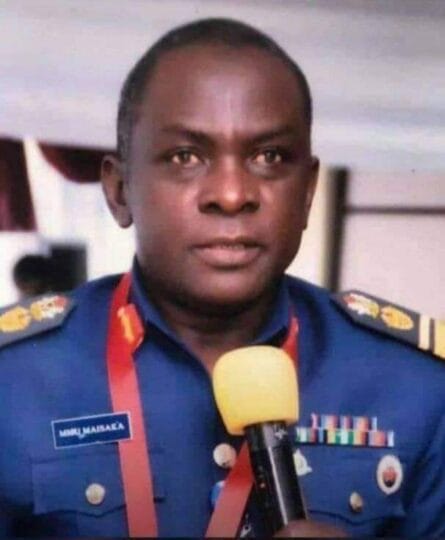
The Kaduna State Police Command has confirmed the killing of Air Vice Marshal Muhammad Maisaka (retd.) by unknown gunmen at his residence in Ragasi, Igabi Local Government Area of Kaduna, in the early hours of Tuesday, November 9, 2021.
Police spokesperson for Kaduna State Command, ASP Muhammad Jalige, confirmed the murder.
Jalige said: “The corpse has been evacuated to the hospital, and the gateman has since been rushed to the hospital for treatment.’
“The Commissioner of Police, Mr Mudassiru Abdullah, has since directed the Divisional Police Officer and the Area Commander to immediately proceed to the scene.”
By Mukhtar Ya’u Madobi
Subject to its wider ramifications, the burden of maintaining security is too cumbersome to be single-handedly by a solitary institution in a heterogeneous country like Nigeria.
Thus, the multi-stakeholders’ approach is often more necessary where there is a rise in security challenges. Therefore, security should be a collective effort of the government plus other state and non-state actors, including the private sectors.
The word ‘security’ simply implies the protection of the lives and properties of people from various forms of threat. It occupies the highest level of priority in the hierarchy of responsibility by the government as one of the core values that the state cherishes as non-negotiable and that does not admit compromise.
The contribution of private sectors in ensuring security can be rendered through various channels, including the construction of security facilities, donations of logistics to security services and providing equipment at their disposal during emergency response situations such as fire outbreaks, accidents, building collapse and natural disasters such as flooding, earthquake, etc.
Other alternatives include community participation in securing their locality in collaboration with police, i.e. the neighbourhood watch or vigilante group, involvement of religious and traditional leaders in disputes resolution among their followers and services provided by the business enterprises to their host communities through corporate social responsibility (CSR) initiatives.
To that effect, the role being played by the famous Civilian Joint Task Forces (Civilian JTF), through collaboration with the security agencies in countering the violent extremism of Boko Haram terrorists in the North-East (Borno), is very commendable. Such volunteer groups provided invaluable intelligence that led to the uncovering of many deadly terrorist cells and their subsequent elimination.
Now that the terrorists are surrendering, community leaders, civil society groups and NGOs have a greater job to embark on sensitizing the mindsets of the public in de-radicalization, rehabilitation and reintegration of the repentant terrorists into society. This will go a long way in maintaining the security of lives and properties of people.
It is noteworthy that the CSR initiatives of the Aliko Dangote Foundation donated 150 operational vehicles to the Nigeria Police Force in 2018, which was described as the single most significant gift ever by a private sector operator to the police.
In the Niger Delta region, where the problem of insecurity is mainly attributed to the feeling of anger and frustration by host communities due to negligence of CSR initiatives, the oil companies have turned a good leaf by changing the narratives.
Multinational corporations are now actively involved in providing infrastructural facilities such as schools, hospitals, roads, and water supply to their host communities. In the long run, they also designed a special scholarship scheme for the indigenes. They are provided with tuition fees and reading and learning materials to further enhance their educational careers. This initiative has undoubtedly contributed immensely to reducing the militants’ activities and other security tensions in the oil-rich Niger Delta region.
Moreover, several societal figures and organizations were known for their efforts in constructing and rehabilitating security outfits across the country. Recall that, immediately after the #EndSARS protests in which several lives of both civilians and security personnel were lost, many properties were destroyed, police stations looted, their firearms carted away and subsequently destroyed.
The giant private sector-led Coalition Against COVID-19 (CACOVID) procured new equipment for police officers and pledged to rebuild the burnt police stations destroyed during the civil unrest to restore security to the affected locations across the country.
Even the traditional institutions were not left out as Oba (Alhaji) Dauda Ajolola Adebimpe Akinfolabi of Ayedade Local Government Area of Osun State built a divisional police headquarters and the office for the Nigeria Security and Civil Defence Corps (NSCDC) office. The monarch noted that the gesture was necessary to protect his people and ensure safety in his community, considering the rising insecurity in the country.
In addition, private security companies are also part and parcel of the security architecture of every country. The responsibility of a private security guard is ‘securing the lives and properties of the client’. The client may be an individual, organization, private institution, government, etc. However, experience has shown that guards can perform additional functions other than just protecting the lives and properties of the client.
Their large number and widespread presence make them a critical part of the security system of the nation. The NSCDC is the ultimate regulator of all private guard companies in Nigeria and has so far licensed over 1000 companies. Almost all residences, offices, schools, shopping malls, parks etc., especially in the city, are staffed by private guards securing their location. To that effect, their number has even exceeded that of the entire Police Force in the country.
Therefore, the government and the security agencies can take advantage of this opportunity to collaborate with private guard companies, especially in areas of intelligence gathering and sharing, training and joint task operations towards securing the country from the activities of criminal forces.
Sequel to that, Nigeria’s Policy Framework and National Action Plan for Prevention and Countering Violent Extremism, produced by the Office of the National Security Adviser (ONSA), retired Major General Babagana Monguno have succinctly acknowledged the role of the prominent private sector in national security.
As they say, Emergency Management is everyone’s business.
Mukhtar sent this piece from Kano. He can be contacted via ymukhtar944@gmail.com.
By Adamu Ibrahim Jimeta
Adamawa State Police Command has announced the arrest of kidnapping syndicate that have been terrorizing Malabu/Belel axis in Adamawa State.
The statement signed Wednesday by the Police Public Relations Officer, DSP Sulieman Yahya Nguroje, disclosed.
The operatives of the command attached to State Intelligent Bureau (SIB) in colaboration with the Police in the state accomplished the mission successfully.
The arrest of the suspects was said to have followed the directives of the Commissioner of Police, Mohammed Ahmed Barde.
Reports disclosed that Malabu had complained after been kidnapped twice by the criminal gang in the state, where they collected one million naira cash as a ransom.
The statement reads in part: “The confession of the suspects revealed they abducted the complainant sometimes, January, 2019, and received one million Cash as ransom and subsequently re- kidnapped him on the 11th February, 2021. by the same syndicate, but he luckily escaped from the captivity when negotiation for ransom was ongoing.
“Assisted by members of Miyetti Allah cattle breeders Association of Nigeria, apprehended 3 out of 5 members of the gang were arrested.
“They are Ahmadu Abdu, 24 years, a resident of Mbilla Malabu village, Fufore LGA; Buba Yusufa, 28years, a resident of Mbilla Malabu village, Fufore LGA; Usman Idi, 18 years, a resident of Bamanga village, Fufore LGA,” the statement added.
However, the CP while commending the police officers and Chairman Miyetti Allah, Alh. Jaoji, also assured the members of the public that they are committed to working with law abiding citizens to secure the state and reduce crimes to the bearest minimum .
By Muhammad Sabiu
By Muhammad Sabiu
It is now one and a half months since the Nigerian Telecommunication Commission (NCC) issued an order to all telecommunication companies to shut down their telecommunication sites in Zamfara state. According to the information released by Nigeria’s telecommunication regulator, it did so at the instance of the Zamfara State Government. The shutdown, according to the NCC boss was necessary to “enable relevant security agencies to carry out the required activities towards addressing the security challenge in the state”.