Kennywood

Veteran Kannywood actor Baba Karkuzu passes away  

By Habibu Maaruf Abdu!

The Kannywood film industry has lost one of its most beloved pioneers. Veteran actor Abdullahi Shuaibu, widely known as ‘Baba Karkuzu,’ breathed his last on Tuesday, March 25, 2025, the 25th of Ramadan 1446.

He reportedly died at the University of Jos Teaching Hospital after a prolonged battle with illness. 

His demise comes nearly a year after the passing of the celebrated Kannywood actress Saratu Daso, who died on the 30th of Ramadan, 1445. 

A respected figure in the Hausa entertainment industry, Baba Karkuzu made his debut in the 1980s with his iconic drama ‘Karkuzu na Bodara,’ which earned him the stage name by which he became widely known. His unique acting style and contributions to the industry played a crucial role in shaping the early days of Kannywood.

However, Karkuzu had struggled with health complications for several years, which led to blindness before his death. Reports indicate that he had been facing significant hardship since 2018, prompting renowned Nigerian footballer Ahmed Musa to extend a helping hand by donating ₦5 million and gifting him a house.  

His funeral took place according to Islamic rites today, Wednesday, March 26, 2025, at his residence on Haruna Hadeija Street in Jos, Plateau State.

Karkuzu’s death signifies the end of an era in Kannywood, leaving a legacy that future generations will remember.

UNICEF launches ‘No More Zero Dose’ immunization song in Kano

By: Habibu Maaruf Abdu 

On Thursday, October 24, 2024, coinciding with World Polio Day, UNICEF launched the ‘No More Zero Dose’ immunisation song across Nigeria and other West and Central African countries. 

The Kano state launch took place at Tahir Guest Palace, attended by government officials, Kannywood members, social media influencers, and journalists from Jigawa and Katsina states.

According to Mr. Rahama R.M. Farah, chief of UNICEF’s Kano field office, the event aimed to raise awareness about the importance of immunisation, especially for children under five. 

“We have gathered this morning to raise awareness on the importance of Immunization, which remains the most cost-effective intervention to confront vaccine-preventable diseases, especially in children under 5 years of age…”

“Thank you for joining us this morning to launch the Immunization Song aptly entitled, No More Zero Dose!” He added 

The No More Zero Dose song highlights the urgent need to boost immunisation coverage in West and Central Africa, a region with the lowest vaccination rates in the world. This reality has led to multiple outbreaks of preventable diseases such as diphtheria, measles, polio, yellow fever, and cerebrospinal meningitis in the region.

The song features Spyro, Ali Nuhu, other top music stars, and UNICEF Champions from Mali, Chad, Cameroon, and Guinea. 

A media dialogue on immunisation followed the song’s launch. UNICEF Communication specialist Samuel Kaalu then mobilised caregivers for the upcoming immunisation campaign in November, encouraging them to amplify the message.

If they won’t read, let them watch

By Ado Magaji Mansur

As the saying goes, “We are the books we read.” Therefore, we should all thank our writers, past and present, for depriving themselves just to share their ideas and experiences with us through books. 

Although I am not a writer, I believe that writing books is both painful and rewarding. Without these books, our world would’ve been a totally different place. 

However, as the world is moving from script to screen, coupled with the gradual death of the reading culture and rise in the “watching” culture, especially among our people. I hereby ask the question: Can’t our intellectuals use film to transmit their great ideas to the people?

We have already made the mistake of entrusting our films to the people we all know who can’t be relied upon as the sole custodians of our culture and the psyche of our younger generation. Therefore, instead of observing and criticising the films, their makers and producers from a distance, why can’t some of the great minds among us think up some appropriate ways of putting their ideas to improve the powerful Kannywood, especially now that it’s been confirmed that they can’t live up to our didactic and moralistic expectations? And since no one can moderate (read: censor) their movies before they reach our homes, we must help them improve.

Very soon, we will start alleging or complaining that foreign countries and organisations are sponsoring and producing films like “Dadin Kowa” to intentionally misrepresent us or to sustain the stereotypical image of us that has already been created. 

Like books, films have the capacity to convey a wide range of ideas, making them a versatile tool for people from all disciplines. If handled with care, films can have a profound impact on the audience, much like books do for readers. 

Finally, I must confess that, some years back, when our friend Muhsin Ibrahim defected from Literary Studies to Theater/Film/Television studies, I secretly doubted the sagacity of his choice because I then wrongly thought that, as a promising writer and critic, he would contribute to his society better as a literary guru than a film scholar. But now we can all see his great job for Kannywood. We can all take some cues from our friend and see how we can contribute.

Tinubu appoints Ali Nuhu MD Nigerian Film Corporation

By Uzair Adam Imam

The appointment was disclosed in a statement Friday by the Special Adviser to the President ( Media & Publicity), Chief Ajuri Ngelale.

President Bola Tinubu has given his nod to the appointment of Ali Nuhu, aka the King of Kannywood, and ten other distinguished individuals to spearhead various agencies under the Federal Ministry of Art, Culture, and Creative Economy.

The appointments could be seen as a strategic move to foster growth and innovation in the arts, culture, and creative economy sector.

The recently appointed Chief Executive Officers are set to bring a fresh wave of leadership and expertise to their respective roles:

1. Tola Akerele: Takes the helm as the Director-General of the National Theatre.

2. Dr. Shaibu Husseini: Assumes the role of Director-General at the National Films and Censors Board.

3. Mr. Obi Asika: Appointed Director-General of the National Council for Arts and Culture.

4. Aisha Adamu Augie: Steps into the position of Director-General at the Centre for Black and African Arts and Culture.

5. Ekpolador-Ebi Koinyan: Appointed Chief Conservator of the National War Museum.

6. Ahmed Sodangi: Assumes the responsibility of Director-General at the National Gallery of Art.

7. Chaliya Shagaya: Takes on the role of Director-General at the National Institute of Archeology and Museums Studies.

8. Hajiya Khaltume Bulama Gana: Appointed Artistic Director of the National Troupe of Nigeria.

9. Otunba Biodun Ajiboye: Assumes the position of Director-General at the National Institute for Cultural Orientation.

10. Ali Nuhu: Takes charge as the Managing Director of the Nigerian Film Corporation.

11. Ramatu Abonbo Mohammed: Assumes the pivotal role of Director-General at the National Commission for Museums and Monuments.

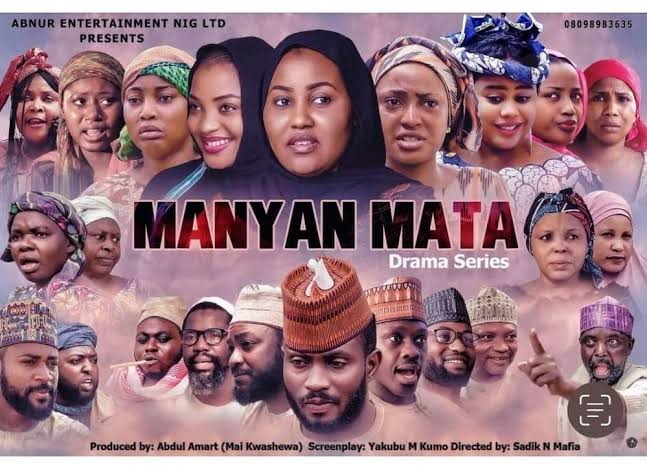
Notes on “Manyan Mata” series

By Abdullahi Haruna Kandash

In my opinion, Mayan Mata is one of the best series, if not the best movie ever produced in Kannywood. The movie portrays the vicious circle of poverty, a retinue of marriages, the mutilation of pregnant women and how children in society are raised with no regard for their futures.

Sadik Sani Sadik thinks nothing a man should be ashamed of if he bullies his wife. In the series, his pregnant wife faces a crisis despite her pregnancy. Unfortunately, they lost the child by miscarriage. Jamila Nagudu experiences petty humiliation after her one and only child is taken to Almajiranci. Daso’s son is a nasty disciple, too, a spoiled one. He was taken to Almajiranci when he was a child. He follows the gang and gets spoiled.

The movie portrays what really sabotages relationships, couples and children’s futures. The best part of this movie tells us that there are people in society with more clout who show no concern for other children and other women whose lives have been shattered by the cruelty of their spouses. I became truly interested in the movie after I watched some episodes. And I have seen many things that happen in real life portrayed in the movie. The director has done a wonderful job.

Kannywood should continue to bring cultural identities into its movies. The director also depicts literature, art and culture in the movie, and all these can be vividly seen in the different scenes of the film. Literature, art and culture are not something we can simply despise. They are like the air we breathe. And If we cut them off, the whole world will suffer.

Literature has enormously helped so many movies to gather an audience because of its literariness. Manyan Mata pictures exactly what is happening in our communities nowadays. It shows how parents treat their children with contempt. The director shows us how our societies are sliding backwards and experiencing immaturity.

But the best part of it, however, is that it teaches us how to understand the beauty of humanity, that everyone’s life matters.

Fati Washa experiences a worst-case scenario with her deceased mother’s co-wife. After watching the scene where her mother’s co-wife was trying to burn her schoolbooks rudely, I sensed that the movie is trying to tell us that societies that achieve better prosperities are those where huge investments are made in education. These are societies where every child is allowed to go to school to learn. This part also attempts to show us that every child should have access to education so that just and egalitarian societies can be built.

I hope the director will continue to fight inequality and bring sameness because that is what brings safety, security and a sense of belonging among people.