Katsina State

Al-Qalam University holds its 2nd combined convocation

By Abdulrazak Iliyasu Sansani

Barring any last-minute changes, Al-Qalam University will hold its 2nd Combined Convocation on Nov. 25, 2023. The day is what everyone associated with the university eagerly looks forward to seeing. 

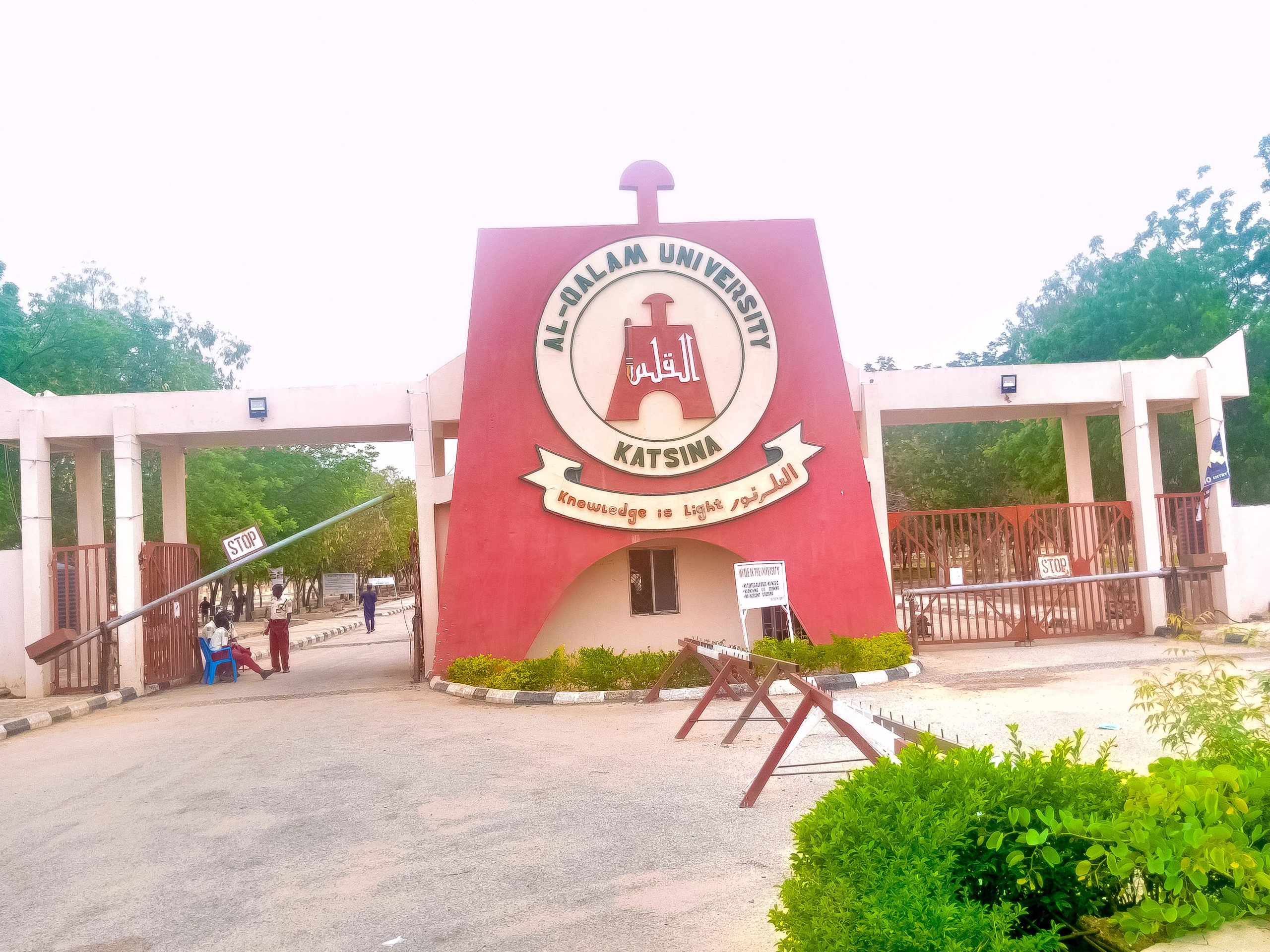
Al-Qalam University, Katsina (AUK), hitherto known as Katsina University, Katsina (KUK), is located in Dutsinma Road, Katsina State, and known for the academic aspiration of those who seek knowledge deeply rooted in sound morals. Al-Qalam University was established in 2005 as Nigeria’s first private Islamic university.

The university has gone from strength to strength since its establishment 18 years ago. It presently runs six schools/colleges, which offer assortments of options for the students: The College of Social and Management Sciences, College of Natural and Applied Sciences, College of Education, College of Humanities, College of Post Graduate Studies, and School of Basic and Remedial Studies. It awards 22 undergraduate degrees (among which five courses offer both full-time and part-time programs), 11 master’s programs, and nine PhD programmes, all accredited by the National Universities Commission (NUC) in line with the laws governing university education in Nigeria. 

Recently, some new courses were accredited by the NUC, which brings the total number of programmes to 36 for the 2023/2024 academic session. Despite being a non-profit institution and the difficult economic situation in Nigeria today, the university continues to flourish. However, this is not far-fetched as it is run by an exemplary governing council and administratively headed by an astute academic, economic luminary, and open-minded scholar, Professor Nasiru Musa Yauri, who has not only built on what his predecessors had achieved but also devised different means to take the university forward. He is equally supported by the hard-working team across the various faculties and colleges to actualise the founders’ dreams of the first Islamic University in Nigeria. 

The Programme of the 2nd Combined Convocation is quite extensive. Therefore, I will highlight some of the events for want of space.  The Vice  Chancellor of Al-Qalam University, Professor Nasiru Musa Yauri, disclosed some of the events scheduled for the imminent second combined convocation while briefing journalists in Katsina on Nov. 19, 2023.  

According to the information, 139 postgraduates will be conferred with different honours during the convocation ceremony, including seven Doctor of Philosophy (Ph. D), 125 Masters, and seven postgraduate diplomas (PGD). 

“We are going to honour and celebrate graduates from the 2016 to 2023 sessions, which means on Nov. 25, we are going to confer degrees on graduates for eight sessions. 

“This is to say specifically that we are preparing to ensure that graduates of this 2022/2023 session are also going to be celebrated at the convocation ceremony,” the VC said. 

Apart from this, there is also a Qur’an recitation contest for all interested university students to participate.  This is one of the major events scheduled for the convocation. Winners of the Qur’anic recitation competition, both the female and the male categories, will receive N1 million each. 

A pre-vocation lecture will be delivered on Nov. 24, 2023, by a distinguished scholar, Dr Usman Muhammad Bugaje, on the topic: “The out-of-school-children and the  Conscience of the Nation: A Discourse on the Genesis, Prognosis and Solutions of the Almajirci Phenomenon.” 

A novelty football match between Al-University students (AUK All stars) and its alumni (AUK Legends) is part of the programme, emphasising that all domains of learning: cognitive, affective, and psychomotor are given priority. 

To cap it all, four eminent personalities who have made a tremendous difference in various fields of human endeavour will be conferred with honorary doctorate degrees: including the Emir of Katsina, Alhaji Abdulmumin Kabir Usman; Emir of Kazaure, Alhaji Najib Hussaini Adamu; Alhaji Sani Zangon Daura, and Alhaji Abdulsamad Isiyaka Rabiu. 

Al-Qalam University Katsina is where it is today because of the leadership, who have remained steadfast to the ideals of the founding fathers and have employed transparent methods. The Vice-Chancellor, for example, is accessible, and every Thursday has been set aside for any student with a suggestion or problem to meet the Vice-Chancellor and iron out the issue amicably. This is good leadership and highly remarkable.

I am not writing this piece to pretend we have a flawless system. There is no system without flaws. All systems have their shortcomings in one way or the other. This may not be apparent without meticulous observation. But this we understand as we explore the system or rather utilise the services of the system. Hence, I do not claim a perfect system exists here or advance anything error-free for the public. 

To buttress my points, I was personally affected by one of such fallibilities when I was wrongly accused of committing an offence I didn’t and have always stood against. Herein, Al-Qalam University, especially its College of Education, exercised due diligence by using all the legal instruments to get to the root of the matter and ensure justice was done. In my opinion, the greatness of any system or institution should be measured not by the duration it exists but by how effectively its services are rendered to those in need. This proves where the institution belongs. 

Prof. Nasiru Musa Yauri’s giant strides are evident, from academics and sports to other equally important sectors of this citadel of learning. With time, Insha Allah, this institution can reach the heights its illustrious founding fathers envisioned when they established this university in 2005. May Allah (SWT) help Al-Qalam University to reach its rightful destination for the benefit of Nigeria. 

Abdulrazak Iliyasu Sansani is a student of Al-Qalam University Katsina.

Governor Dikko deprives local government pensioners of their benefits

By Muhammad Malumfashi

It is no longer intriguing to discuss with the victims of withheld pension payments under the current administration in Katsina State. The pensioners are experiencing severe hunger, their children are unable to attend school, and as a result, their families are vulnerable to social problems for which the governor of Katsina is responsible.

How can a rational government extend the screening process until salary time, knowing that their screening team is not mature and time-conscious enough to complete their work before the start of the salary period? This government, which claims to be ‘intelligent’, is creating unnecessary chaos.

I have listened to the accounts of the victims. Regrettably, this government is not taking significant steps to address the issue. These unpaid pensioners dedicated their lives to serving our state. Some could have found lucrative jobs elsewhere but chose to remain in Katsina and serve their home state until retirement. And now, the government is rewarding them with starvation. What an ungrateful government!

If Governor Dikko Umar Radda (PhD) indeed possesses a doctorate, he should not have merely stated it through words, but instead, he should have demonstrated it through his actions. Unfortunately, his actions don’t even match those of someone who has never had the opportunity to attend elementary school. A PhD, in my opinion, should be characterised by excellence, compassion, promptness, and exceptional decision-making. However, the current government, led by Dikko, is the complete opposite of what we expected.

Dikko should not give us the impression that we are moving from frying pan to fire under the APC’s administration in Katsina. We have long to witness a significant distinction between educated leaders and those lacking education. But Dikko demonstrates, through his actions, that the only difference lies in whether they attain power. They are all birds of the same feather.

Dikko started impudently with a fervent religious overtone and resolute vigour regarding his esteemed doctorate. Katsina’s initial expectations were that a transformation would ensue, surpassing the advancements of neighbouring states in infrastructure development, educational excellence, scholarly interventions, agricultural sustainability, and unexplored approaches to security intelligence. However, to our dismay, we regret electing this incapable and uninspiring PhD holder to lead our state affairs.

We earnestly implore Governor Dikko to take compassionate action, whether motivated by his moral duty or the preservation of his scholarly prestige and promptly provide the pensioners with their long-overdue pensions. Their current living conditions have reached an unacceptable state, bordering on the unimaginable, and if not addressed promptly, dire consequences may unfold.

It is disconcerting to witness the sight of workers and pensioners protesting on the streets, exemplifying the government’s ill-treatment towards them. Should our esteemed governor not execute the necessary actions, it would mark an unfortunate first during his tenure and harm the state’s harmonious relationship with its workforce.

A thorough assessment of his achievements thus far has made it evident that a degree or doctorate certificate is not a prerequisite for government appointments or the ability to govern effectively. Dikko’s PhD has not set him apart from his predecessors; instead, he merely builds upon their legacies. The sole accomplishment I can attribute to his tenure is the establishment of the ‘Katsina State Security Watch Corps,’ which emerged as a product of his government initiative. Unfortunately, there seem to be no further substantial achievements to highlight.

Nonetheless, our followers are responsible for recognising that even the constitution does not require a specific educational qualification, such as a degree or PhD, for individuals seeking governance. We should disregard excessive education and prioritise transparency, credibility, competence, experience, past performance, and a candidate’s track record to determine their eligibility for our vote. This is because having a PhD has not translated into tangible benefits for our society, such as improved living conditions or economic prosperity.

Initially, I believed that with the grandiose claims made by Dikko and his supporters about his PhD degree, Katsina would have transformed into a modern metropolis like Dubai or Qatar by now. However, disappointingly, we have yet to surpass the standards set by even neighbouring states in the northwest, let alone compete with the more developed southern states.

We have now realised that all the hype and celebration surrounding Dikko’s qualifications were falsehoods (duk karya ne). He has failed to deliver on his promises, and the role of the governor surpasses that of the Director-General of Smedan. Furthermore, Katsina is not simply a local government like Charanchi.

Muhammad Malumfashi wrote via muhammadisyakumalumfashi@gmail.com.

Governor Radda appoints 32-year-old Naufal Ahmed as DG ICT Directorate

By Isah Miqdad

The Executive Governor of Katsina State, Malam Dikko Umaru Radda, PhD, has approved the appointment of Naufal Ahmed as Director General (ICT Directorate).

The appointment, which is with effect from 14th August 2023, is based on the conviction that Mr Naufal will serve faithfully, diligently, and in the best interest of the service.

As the visionary founder of the esteemed Kirkira Innovation Hub, Naufal has pioneered the establishment of the first-ever technology hub in the region. This groundbreaking initiative has served as a transformative force, equipping countless young individuals with vital technological skills and providing them with a platform to thrive.

Naufal’s remarkable career as a tech ecosystem builder has been nothing short of extraordinary. With an unwavering passion for innovation and youth empowerment, his impact on the tech landscape of Katsina and Nigeria at large is undeniable.

He has been a sought-after speaker and organiser at numerous conferences across Katsina and the country, sharing his insights and inspiring others to embrace innovation.

In recognition of his outstanding achievements, Naufal has received numerous accolades, including being named among the Opportunities Hub’s 100 Most Influential Youths for his significant contributions to youth development and entrepreneurship.

Drama as man divorces wife for allowing male doctor to attend her during delivery

By Uzair Adam Imam

A frustrated husband in Katsina State has reportedly divorced his 14-year-old wife after realising that she was attended by the male medical practitioner while giving birth.

It was gathered that the woman was rushed to the hospital for medical care because of the complications she had during her labour.

However, as there was no female medical practioner on ground to attend to her, the woman was attended by the only male medical practioner available.

Dr. Fatima Adamu, the Executive Director of Nana Women and Girls Empowerment Initiative, disclosed this on Thursday while speaking as a keynote speaker at the Human Resources for Health Production Dialogue in Abuja.

She appealed to governments, especially state governments, to ensure there was equity in the recruitment and deployment of medical personnel to rural communities.

“A 14- year old Fulani girl in Katsina State,she delivered and had difficulty with delivery, so we had to take her to the hospital and after the delivery, the husband divorced her because she was attended by a man. This young girl was divorced all because she was attended by a man during delivery,”she lamented.

Are Nigerians fair to Buhari?

By Prof. Abdussamad Umar Jibia

Many years ago, when I was a young lecturer at Kaduna Polytechnic, I had a discussion with a senior colleague of mine. I have always disliked having disagreements with my seniors because I easily admit defeat as I don’t want to appear disrespectful. 

My discussion with the Chief Lecturer was around General Muhammadu Buhari’s achievement as PTF Chairman. The senior colleague, who bitterly disliked Buhari, was of the opinion that PTF under Buhari “did nothing except for some roads he constructed around Katsina”. When he was reminded that the road he followed daily to work was constructed by Buhari’s PTF, the man vehemently denied it even though it was well known to all the people around the Tudun Wada area of Kaduna, and he could easily find out in case he forgot. But his mind was beclouded by hatred. Hatred stinks, and it blinds.

My discussion with my senior colleague came to my mind this week while I was travelling back to Kano from Kaduna. For two decades before Buhari assumed office as a civilian President, this road had become one of the most dilapidated in the country, and Nigerians, including myself, wrote to call the attention of President Buhari to it while his administration was still taking off. These calls did not fall on deaf ears, and even Buhari’s enemy cannot deny that the quality of work done in the renovation is high.

Of course, more work is needed on the Kaduna-Abuja side, and although it is ongoing, it is clear that the project will outlive the Buhari administration, which has less than three weeks to go. His is, however, much better than PDP governments that were more interested in politics than service.

Two other projects attracted my attention while on the same journey. They are the Kaduna-Kano-Maradi rail line and the famous AKK gas pipeline project. The speed at which the two projects are being pursued is high, but the completion date can obviously be no earlier than May 29, 2023.

On December 25, 2018, while travelling along the Kano-Katsina highway, I stopped at Tsanyawa to take a picture of an accident caused by Rabiu Musa Kwankwaso’s five-kilometre project. The five-kilometre project was a failed project of the Kano State Government under Engr. Dr Rabiu Musa Kwankwaso, in which a five-kilometre length of the expressway was supposed to be built in each local Government headquarters.

For local government headquarters on major federal highways like Tsanyawa, Bichi, Rimin Gado, etc., the state government only succeeded in spoiling Federal roads on which partitions were made without increasing the widths of the roads. I displayed the picture on my Facebook page with a call to Kano State Government to correct the mistake it made. 

Two years later, on 24th October 2020, I stopped at the same spot in Tsanyawa and took another picture of the road after Buhari’s dualization project. The dualization solved the problem in both Bichi and Tsanyawa, the two local government headquarters on that road. I am personally happy that the dualization of the Katsina-Kano road was embarked upon by the Buhari administration because it is the road I ply more than any other in my life.

So why are we only looking at the mistakes? Were our expectations from Buhari too high? Did his mistakes overshadow his achievements? Or are we simply difficult to satisfy?

A fair answer is to say, “All of the above”. You may not be happy to hear that, but it is my opinion.

I have never seen people more expectant than Nigerians. When they love a person, he is fault-free and infallible. Anyone who disagrees with him must be insulted and disgraced. He will solve all their problems. I think that is why when they eventually hate the same person, they go to another extreme of not seeing anything good with them. Buhari is a victim of this, unfortunately. Examples of other objects of extreme blind love by their supporters are Peter Obi and Rabiu Kwankwaso.

What about the mistakes? Are they too many or too grave, or both? Are all of them mistakes or blunders? Or are they simply contempt for Nigerians or some groups thereof by President Buhari?

I sometimes wish Buhari did not accept to become the President. Many people are at a loss about how he simply allowed innocent people to continuously be killed in his home state while speaking about defeating Boko Haram in the faraway North East. By the time he leaves at the end of this month, President Buhari will leave Katsina more insecure than he met it. Last week, a major national daily reported the migration of dreaded bandits in large numbers from Zamfara to Katsina state. 

On several occasions, when Buhari was asked about banditry in the North West, he dismissed it as a fight between people of the same culture and tradition. This can mean farmers/herders or Hausa/Fulani communal clash. Many victims like me are not happy with this kind of response and see it as the reason why well-known bandits’ kingpins are operating freely in our state, kidnapping, enslaving, killing, raping, etc. 

The least corrupt Nigerian politician I know will leave Nigerians in a more difficult economic hardship than he met them. I observed Nigerians taking a long time comparing their income and prices of foodstuffs (yes, food, not any luxury item) in 2015 when Buhari came and in 2023 when he is leaving. Nigerians are suffering.

What about Education? Buhari kept poor people’s children at home for eight months last year and many months in 2020 while his children were schooling in Europe is an indication of the contempt he has for the poor people of Nigeria who formed his support base. The number of out-of-school children is rising. The Almajiri Education Commission should have come earlier, but it is still a welcome development which we hope the incoming President should implement with the seriousness it deserves.

Finally, Nigerians are also difficult and unfair. When they love a politician, they don’t consider him a human being with strengths and weaknesses. If they do that at the beginning, they will certainly be fair to him at the end. But like some binary machines, they only have two states; absolute love and absolute hate.   

Prof. Abdussamad Umar Jibia wrote from Bayero University, Kano. He can be contacted via aujibia@gmail.com.

Fatima Dikko Radda: An inspiration to women and youths

By Amir Sa’ad Ribadu

The 2023 election cycle has introduced quite a handful of female politicians ranging from the candidates themselves to the wives of candidates. Some female politicians have garnered massive publicity and relevance within their states, while others have become national figures and inspirations to women all over Nigeria.

One such woman is the wife of Katsina state Governor-elect Hajiya Fatima Dikko Radda, whose sudden emergence in the Katsina state political scene has made her an inspiration to women and a political force to reckon with in Katsina.

Before her emergence into the scene as a result of her husband’s success at the Katsina APC primaries sometime in May 2022, Hajiya Fatima, fondly known in Katsina as Zinariya is only known for her philanthropy, passion for educating the girl-child and healthcare delivery by a few beneficiaries of her foundation, PAC-F. PAC-F, which she founded a few years back, has kept her busy. In a recent interview, Hajiya Fatima attributed her passion for philanthropy, which birthed PAC-F, to her late mother.

In another interview in December, she told reporters how she intends to support her husband’s policy, especially in eradicating poverty and improving the healthcare and educational environment for the Katsina girl child.

It is therefore not surprising when she was seen campaigning so vigorously that she is said to have taken her husband’s message personally to 146 wards out of the 361 wards in Katsina, which is unprecedented for the wife of any guber candidate in any state in the North.

Her campaigns mainly centred around her husband’s policy document. Also, they focused on her passion for helping the girl child and supporting her husband in making healthcare delivery accessible to all in Katsina, especially women.

She seems to have been accepted by women and young people in Kastina because most can relate with her, owing to her age, ability to understand and proffer solutions, and natural propensity for generosity. Her acceptance is evident through the crowd she gathers every time she’s at a campaign rally or even in her house when she’s around Katsina.

Her Batagarawa low-cost home has become a popular destination for many who need assistance for medical purposes or daily needs. Her humility, they say, is akin to that of the carpenter of Nazareth.

Her youthful determination and willingness to contribute to her husband, Dr Dikko Radda’s campaign, could be seen in how passionately she reached out to the electorates in Katsina villages. She travelled through the length and breadth of Katsina’s Funtua Zone, a zone marred by insecurity and violence, and on many occasions, some members of her entourage have opted to stay back, but not Zinariya. This is because she was determined to witness first-hand the situation of the typical Katsina family in the villages where insecurity and poverty are rife.

It is, therefore, not surprising to see youth and women rally around her, chanting slogans of hers and her husband’s whenever she is around. This and many more reasons are why Katsina is said to be lucky to have a youthful, energetic, and passionate Governor in Dr Dikko Radda, who shares precisely the same qualities as his wife, Zinariya Fatima Dikko Radda.

Amir Sa’ad Ribadu writes from Libreville Crescent, Wuse 2, Abuja. He can be contacted via mrribadu@gmail.com.

A letter to Dr Dikko Radda, the Governor-elect of Katsina State

By Yusuf Murtala

With great delight, pleasure and excitement, I write to congratulate you on this marathon achievement of being elected Governor of Katsina State in the recently concluded election. Your success is a sign that Katsina state is on the verge of becoming a greater state again. I pray you to achieve your plans for Katsina state in sha Allah.

I write to inform or remind you about the current or sorry state of my dear town, Maska, which I believe is part of your plans to restore the good image of rural areas and carry them all along in your administration, which you stated in your blueprint that they could also contribute to the development of our dear State.

With a population of over 50,000, Maska is left behind by previous administrations/governments because they’re not informed about the abundant natural resources. It has, which can if carefully managed, generated a handsome amount of revenue for the state.

I Would not hesitate to remind you about the dirty Condition of our (Maska Community Comprehensive Hospital) which was built a long time ago by a patriotic citizen to save the town and its environs from the suffering they experience in an attempt to carry their patients to the local Government near them for treatment. It’s in a dirty condition as inadequate or lacking infrastructural development to treat patients. Female and male wards are left shattered that even animals will suffer to live therein. Toilets and maternity wards where our parents ( Pregnant women ) are received is also a thing to cry out for. I hope his excellency will consider us on this too.

Our local market (Maska Monday Market) is undoubtedly a hub of the economy, where millions of transactions are carried out every Monday. Thus, reconstructing it by providing or building newly constructed shops or stores will ensure much attendance, especially in the rainy season. This will also encourage investors or businessmen from and around the town to participate actively and hugely contribute to the economy of my dear state and the country at large.

I will not forget to remind you again about the Dam in my town which, if also given a concern, will save several unemployed youths from roaming the street. Moreover, reconstructing it will also create jobs for the teeming populace as it will be used to enhance dry season farming, popularly known as (Noman Rani) and encourage fishing farming which is also a means of generating income for the state.

Security issues of the state are among the top priorities you highly placed in your blueprint, and we firmly believe they will be drastically eradicated quickly.

Finally, your excellency, we hope and pray that this letter will reach you in good and sound health. We also pray that your administration will be smoothly carried out.

Yusuf Murtala can be reach via yusufmurtala595@gmail.com

Rarara’s Invective Barbs: innuendoes, body shaming, and Kano politics

By Prof. Abdalla Uba Adamu

For the past 43 years that I have been a researcher, there were two areas I stay clear of: politics and religion. If you see my hand in any of these two, then the entry point is popular or media culture. For instance, I have recorded a lot of Kano Qadiriyya’s Anfasu zikr, not as a devotee, but as an ethnomusicologist – focusing on the body percussion and movements (after studying the wonderful works of Margaret Kartomi on body percussion while in Morocco). Similarly – and to balance things somewhat – I recorded Tijjaniyya zikr sessions at Chiranci in the city of Kano as part of a larger study on religious performances. All my recordings were uploaded to a dedicated YouTube public channel. I was, therefore, amused when people try to pigeonhole me either as Qadri or Tijjani. I am neither.

Politically, I am apolitical, meaning I really don’t care who rules the country. I don’t even vote, having done once a long time ago (at the insistence of a dear friend), and promised never to do it again. But performance arts brought my attention to protest songs and the prosecution of singers in Kano. The end product was a paper, “Poetic Barbs: Invective Political Poetry in Kano Popular Culture” which I am sure is floating somewhere in a modified form. And I thought that was it.

In 2014 I came across a song that I found amusing. I was playing it on my laptop when someone exhibited surprised that I was listening to the songs of Dauda Adamu Abdullahi Kahutu, with a stage name of Rarara. That was the first time I even heard the name. The song was “Zuwan Maimalafa Kano.” It attracted my attention in two ways. First, its lyrical construction, as well as its delivery, was just amazing. Rapid fire. He should have been a rapper, a genre of music I am totally besotted on (old school DMX, 2Pac, Snoop Dogg, Ice Cube, Queen “The Equalizer” Latifah, y’all). It was clear Rarara was singing off the cuff, not reading from a setlist or lyrical sheet. Second, it was the most detailed invective song I have heard in the Hausa Afropop music genre. I started digging and latched on to him and his songs. So, for the last seven years or so, I have been following every song he released using the invective matrix.

So, what is an invective song? Invective is the literary device in which one attacks or insults a person or thing through the use of abusive language and tone. If you like, “zambo/shaguɓe”. Invective is often accompanied by negative emotion. Invective can be divided into two types: high and low invective. High invective requires the use of formal and creative language, while Low invective, on the other hand, makes use of rude and offensive images. From 2010, Rarara became a master of popular Hausa invective oral poetry. He used his skills to abuse, insult and body shame anyone he was paid to insult. Including former masters and associates.

A pattern evolved. His switchbacks. Chronologically, his earliest non-invective song was “Saraki Sai Allah” (in honour of then Governor Ibrahim Shekarau’s turbaning as Sardaunan Kano in 2010 by the late Emir of Kano, Alhaji Ado Bayero). In 2011 – barely a year later – when Shekarau failed to anoint Rarara’s ‘master’, Deputy Governor Abdullahi T. Gwarzo, to succeed him, Rarara became ballistically invective – and established a career in body shaming, abuses and innuendoes against various previous masters. Shekarau bore the blunt of colorist abuses – often a case of the kettle calling the pot black. No one was spared his invective barbs. Deeply cut. Insulting. Spread over 39 songs, from 2014’s “Malam Ya Yi Rawa Da Alkyabba”, to 2023’s “Tangal-Tangal.”

I have seen social media calling Rarara out on his not being a Kano indigene, getting rich in Kano through his songs, and yet insulting Kano’s leaders. This is all true. However, ‘da ɗan gari a kan ci gari’ (enemy within). Only about three songs in my analytical corpus by Rarara were free-standing (i.e., unsponsored). All the others were commissioned and paid for – by politicians from Kano, to abuse other politicians from Kano. Rarara always acknowledges his sponsors in the opening doxology of his performances.

Rarara was a highly unprincipled and unethical businessman. Show him the money, and he will praise his closest friend and abuse the friend’s enemy. Show him more money, and he will insult the same friend he praised, and heap praises on the enemy he insulted. Does anyone remember that the glorified “Ɗan Ƙaramin Sauro” (irritating mote) was part of the demeaned “Banza Bakwai” (Bastard Seven)? The bromance did not end well, did it? Business unusual.

In any event, Rarara’s invective braggadocio came back to hit him hard on 5th April 2023 when his opponents used his mother’s picture in unflattering terms and splattered it all over social media and gave her a feminine variation of an insulting name he used against one of his targets. Apparently when the shoe is on the other foot, it pinches.

Thus, instead of focusing on political ideology and promises of creating a better life for the electorate, often politicians in Kano (and I think Kano, as usual, is the only state that uniquely does this) would pay more attention to denigrating, shaming, and condemning opposing candidates, creating an unfavorable imagery of the politician to prevent his being voted. Rarara was a perfect malleable puppet in this process. He has the same emotional value to Kano politicians as an alien from Saturn. Despite his lyrical brilliance and acerbic wit, he was expendable. How many singers from Kano can you recall doing the same invective insults as Rarara to Kano politicians? Two? Three? Their corpus is not as extensive as that of Rarara. Conversely, how many politicians from Katsina pay Rarara money to insult other Katsina politicians? I can only remember one.

Wary of possible legal action against direct defamatory speeches, politicians often find it easier to engage what I call ‘political drones’ to communicate their defamatory messages through the popular medium of singing. In this way, when push comes to shove, it is the singer who would face legal – or in some cases, physical – wrath in one way or other. Unethical singers like Rarara – who was arrested, but not charged in 2014 over “Zuwan Maimalafa Kano” – were willing to pay the price in exchange for the stupendous amount of money they will receive. At least they will have enough for medical care when their houses were wrecked, assaulted and incapacitated to continue singing.

And the politician who caused it all? He can’t even remember the song that made him popular, having moved on to greener political pastures. Until the next election cycle when he will latch on another expendable drone to help him heat up the polity through more invective songs using campaign words he does not have the guts to utter himself.

Rarara’s defense of not uttering specific names in his invective taunts and body shaming do not stand up to scrutiny under Nigeria’s defamation laws, and demonstrates that while he was a brilliant lyricist, he needs to understand the law. This is because his invective defamation in the form of his songs is publicly available (indeed, he made them so), created a narrative about individuals that are easily identifiable either by their physical appearance or public behavior, created a negative impression on the person being so targeted, and was not misquoted as Rarara’s utterances (from his songs) were publicly available and subject to an only interpretation as intended. A clever prosecutor would have enough to jail Rarara on listening to any of his invective songs, if someone complained hard enough.

Invective songs can often have their positive sides in the sense of making politicians – or their targets – aware of public perception of their misdemeanors, or at most, errant behaviors. Rarara’s invective narrative in the selected songs I analyzed, however, do not demonstrate their oversight functions in public accountability for politicians. Regardless of whether explicit names were uttered or not, their narrative was focused on kicking them when they are down, and subjecting them to public ridicule. This questions the artistry of Rarara as a purveyor of aesthetic values of the Hausa oral arts.

Academicians ignore Rarara and his art – and I think that’s a mistake. True, some would argue that his songs have no aesthetic, intellectual or ideological value. On the contrary, they do. In their own way. They are beautiful as lyrical discourses. His delivery is truly artistic, even if the content is inelegant. Unlike other songs in the repertoire of political communication, his are not protest songs, and thus lack ideological focus. They neither educate, illuminate or illustrate any aspect of political culture. They only entertain – at the expense of the dignity of the people he attacks. His songs synthesize Hausa rural lexicon overlayered with abusive, often self-constructed urban jargon to enhance general appeal – and act as rabble rousers for politicians who think like him. It is a unique, if unadmirable business model in the performing arts.

Subsequently, Rarara’s songs cannot be compared, by any stretch of imagination, with the classical Hausa protest poets such as Sa’adu Zungur, Mudi Sipikin, Aƙilu Aliyu, Abba Maiƙwaru and Aminu Kano, whose artforms were fueled by educative political ideology, certainly not profit. Mudi Sipikin, for instance. used his poetry to attack the system of colonial rule. Aƙilu Aliyu wrote poems directly attacking the NPC. Abba Maiƙwaru wrote a 10-line NEPU poem for which he and Aminu Kano were arrested in the mid-1950s.

Zungur used his poetry originally to warn the emirs of the north of the necessity for reform, as illustrated in his central work, Jumhuriya ko Mulukiya [Republic or Monarchy]. In this work, he called for political and social problems to be solved on the basis of the existing Islamic institutions, rejecting alien political concepts. He later used his poetry to appeal directly to the common people. In a similar vein, one of the earliest poems written for a northern political party was by Aminu Kano, and called ‘Waƙar Ƴancin NEPU-Sawaba’ [Freedom poem for NEPU-Sawaba], and published in 1953 and put in the final form by Isa Wali. It was one of the earliest statements of Nigerian nationalism.

Despite all these, I argue that as researchers we can’t afford to ignore a current of knowledge flowing right at our feet. But the cold shoulder given to Rarara by our community, opposed to Aminu Ladan Abubakar (ALAN Waƙa) who is a toast to the academic and intellectual community, merely emphasizes the expendable and ephemeral nature of Rarara’s art. Ten years after the release of any ALA song, it will still have relevance. The relevance of Rarara’s songs rarely last to the next song release. Instantly forgettable.

Nevertheless, just as we struggled for the recognition and documentation (if not acceptance) of the Kano Market Literature in the 1990s when everyone was denigrating it, we need also to document the stream of popular culture, including Rarara – warts and all – flowing around us at all times. As far as I can see, only Maikuɗi Zukogi has focused attention on two of Rarara’s songs. More needs to be done.

As soon as I tell myself that I will wrap up the research, he will release a song insulting a former master or associate. Subsequently, I delayed publishing the research until he insulted two people, and true to expectations, he did. These were President Muhammadu Buhari (Matsalar Tsaro) and Governor Abdullahi Umar Ganduje (Lema ta sha ƙwaya). With the ‘Hankaka’ barb against Ganduje in the Lema song, my fieldwork became almost complete. His destruction of “ɗan ƙaramin sauro” leaves only the references to be completed. As I argued, based on his corpus, Rarara sells to the highest bidder with neither conscience nor ideology. The huge profit he makes serves as insurance against future loss of earnings when Kano politicians become mature enough to stop patronizing him to insult each other (and themselves) and utilize his skills in more constructive ways.

My thanks to a team of eager research assistants, headed by my ever-faithful and close companion, Hassan Auwalu Muhammad – a former songwriter and lyricist himself. He was the one who mainly, patiently, transcribed the songs, which I wove into a narrative going to almost 40 pages! I plan to upload the lot during my Summer break when the children are all here on holiday! By then, the threatened wobbling ‘Tangal-Tangal’ had stopped and probably settled for a four-year legal battle.

Professor Abdalla Uba Adamu can be contacted via auadamu@yahoo.com.

Katsina: One burned to death as hoodlums attempted to disrupt election

By Muhammadu Sabiu 

Reports from Katsina in northwest Nigeria indicate that bandits had attempted to sabotage elections in the state, in which one person was allegedly burned to death.

According to a report by Channels TV, the person who was set on fire was a member of the bandits who arrived to sow chaos.

The incident happened at a polling unit along the General Hospital Road in the Batsari Local Government District of Katsina State.

According to witnesses, a squad of security forces intercepted the suspected bandit and a member of his gang.

There was no more information about the incident when this report was filed.

How Naira redesign, cashless policy, affect prices of farm produce in Katsina

By Aliyu Ya’u Baraje

I have consistently written against the greediness of Nigerian agricultural produce suppliers since the implementation of the cashless policy. I am now fully convinced that a typical Nigerian is potentially greedy and corrupt, especially when presented with the opportunity.

There is no doubt about the scarcity of Naira, which economics has taught is a characteristic of money. This scarcity has created hardships for Nigerians, particularly for rural dwellers whose voices are hardly heard. This is partly due to a lack of modern education, IT literacy, and little or complete absence of media coverage. When visited, rural areas now seem like mourning grounds, faces barely smile, just silence, and black faces.

As a farmer and rural dweller, I feel it’s my duty to bring to light the ongoing exploitation of local farmers by produce suppliers. These suppliers are taking advantage of the cashless policy to profit at the expense of farmers whose main source of income is selling produce or livestock.

The prices of produce and livestock have plummeted dramatically. For example, the price of maize per 100kg has fallen from 22,000 to 13,000, rice from 26,000 to 15,000, beans from 42,000 to 25,000, and soybeans from 32,000 to 18,000. This trend is also seen in other produce such as millet, groundnuts, sesame, sugarcane, yams and cassava.

Farmers are offered two prices, one for a cash-and-carry deal and another for bank transfers. Those who need cash are given the lowest price, while those who require a transfer receive an increase of about 3,000 to 4,000.

This exploitation is unacceptable, especially since prices of other commodities have skyrocketed. I stand against this mistreatment of farmers and the erosion of their livelihoods.

I am from the southern part of Katsina State, which includes the local government areas of Sabuwa, Dandume, Funtua, Faskari, Danja, Qafur, and Malumfashi. This region is renowned as an agricultural hub not only in Katsina State but throughout northern Nigeria. This is due to the fertile land and extensive use of industrial

fertilizers and manure. The local government areas are rivaled only by the Saminaka, and neighboring local government areas.

Those who are familiar with this region will attest to the fact that its inhabitants are engaged in farming activities, not just subsistence farming but also what could be described as mechanized farming. In this region, farmers producing hundreds of tons or thousands of bags of the listed produce can easily be found. If one is a resident of this region, he is either a farmer or from a farming family. Even those who have switched to other businesses or occupations, most of their extended families are still farmers.

Given this, it should not be surprising that the exploitation of farmers by suppliers is a source of concern for those in the region.

2) In today’s Nigeria, the prices of processed and refined commodities have risen dramatically, with some even doubling, tripling, or quadrupling. The price increase for some commodities is so significant that it’s difficult to describe. So, why are farmers the only target for this exploitation?

3) In southern Katsina State, farming is done on a large scale, making it more of a business. This leads to the excessive use of agricultural chemicals, the prices of which have skyrocketed multiple times. For example, NPK fertilizer is sold for 32,000 Naira, Urea is sold for 22,000 to 23,000 Naira, Moroccan OCP (mixed fertilizer) is sold for 15,000 to 17,000 Naira, and the locally made Dan-Buhari fertilizer made from Kankara Local Government is sold for 10,000 to 15,000 Naira. Given these high prices, it’s understandable why a farmer would not be happy with selling their produce for less than 15,000 Naira.

Moreover, the use of tractors and other heavy engines for farming activities such as harrowing, tilling, harvesting, and transportation requires diesel, which now costs over 900 Naira per liter. The use of small equipment for dry-season farming, mobilization, pesticides, and herbicide spraying also requires petroleum, which now costs between 350 and 400 Naira. The prices of other chemicals such as pesticides, herbicides, and preservatives have not only doubled but have tripled or even worse.

This means that when a farmer who needs cash takes their produce or livestock to local markets, they feel like they are being shortchanged or receiving only a fraction of what they spent months or years nurturing. As a result, many farmers go home feeling like they have been robbed and have nowhere to turn for help

4) I seek to draw public attention to the exploitation of farmers in Southern Katsina state. The rise in prices of agricultural chemicals and equipment, along with the exploitation of farmers by produce suppliers, have led to a situation where farmers are not able to make a fair profit from their hard work. I categorizes those who are happy with the situation into two groups: those who are exploiting the farmers for their own gain (like suppliers) and those who are not involved in farming and only care about purchasing cheaper produce for domestic consumption (the consumers).

5) It is unfortunate that the farmers who work hard to produce the commodities are being exploited by the suppliers, hoarders, and processing industries. The lack of government price control mechanisms, excessive taxes and restrictions on foreign goods, and competitors. The selling of finished products at high prices, even higher than those imported from other countries has shown that farmers are intentionally targeted. This creates a situation where the farmers receive low prices for their produce while the final products are sold at high prices, leaving the farmers with little profit and often feeling exploited. It is important to address this issue and find ways to support and protect the livelihoods of local farmers

6) The exploitation of farmers in Nigeria has become a major concern as they are being targeted by suppliers, hoarders, and companies. The prices of agricultural chemicals and equipment used in farming have skyrocketed, making it difficult for farmers to make a profit from their produce. The lack of government price control and foreign competition, as well as excessive tax charges, have added to the farmers’ burden. Despite the high prices of commodities, the owners of processing, refining and packaging factories have not reduced their prices (per kg from suppliers), and instead sell the finished products at exorbitant prices. This has made life in rural areas even tougher, as the local farmers are unable to compete with foreign imports and are being forced to sell their produce at low prices. The suppliers have also adopted a cashless policy, which has made it difficult for farmers in rural areas to receive payment for their produce. The lack of recognition of wired transfers and poor network and electricity coverage in rural areas has further complicated the situation.

It’s important for the government to consider all factors and individuals, including rural settlers, when making decisions on the cashless policy. The government should strive to ensure that all citizens have equal access to financial services, regardless of their location.

Aliyu Yau Baraje, Dandume Local government area Katsina. He can be reached via: aliyuyau900@gmail.com fb: Aliyu Baraje