Kano

Kano police seize hard drugs worth N82.7m, arrest 19-year-old suspect

By Uzair Adam

The Kano State Police Command has seized illicit drugs valued at more than N82 million and arrested a teenage suspect during an operation in the state capital.

Police spokesperson, SP Abdullahi Haruna Kiyawa, confirmed the development in a statement issued on Saturday.

He said the operation was carried out on September 20, 2025, after intelligence reports indicated that a suspicious vehicle was conveying cartons of intoxicants to Rimin Auzinawa Quarters in Kano.

“Acting on the directive of the Commissioner of Police, our operatives cordoned off the premises where the vehicle was parked and arrested a 19-year-old suspect, Usman Umar,” Kiyawa explained.

He said a search of the house led to the recovery of 603 packets of suspected Tramadol tablets containing 60,300 pieces, estimated at N60.3 million, and 299 packets of suspected Pregabalin capsules with 44,850 pieces, valued at N22.4 million.

The total worth of the seized drugs, he noted, stood at N82.7 million.

Kiyawa added that the suspect is in custody and is assisting detectives with information to track down other members of the drug trafficking network.

The Commissioner of Police in Kano, CP Ibrahim Adamu Bakori, while reacting to the breakthrough, commended residents for their cooperation.

“This success would not have been possible without the vigilance and timely information from the good people of Kano,” he said.

Bakori assured that the Command will sustain the fight against drug abuse and trafficking, urging the public to continue sharing credible information.

He stressed that such intelligence would always be treated with confidentiality and prompt action.

APC plots Kano comeback for Tinubu in 2027

By Abdullahi Mukhtar Algasgaini

Ahead of the 2027 general elections, top figures of the All Progressives Congress (APC) in Kano State have declared their intention to reclaim the state from the New Nigeria Peoples Party (NNPP) and secure the re-election of President Bola Tinubu.

The pledge was made on Thursday in Abuja following a strategic meeting of party stakeholders.

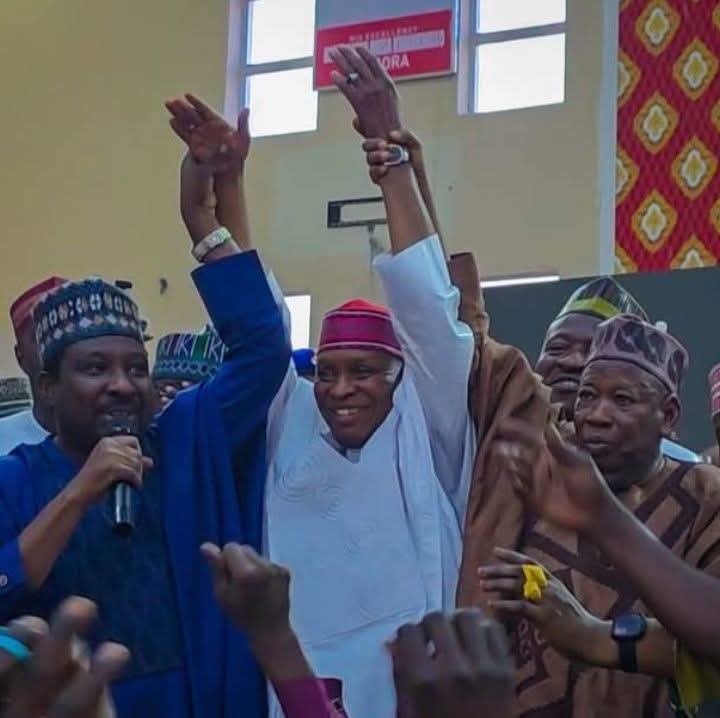
The meeting was led by former APC national chairman Abdullahi Ganduje, Deputy Senate President Barau Jibrin, and House of Representatives member Abubakar Bichi.

Addressing journalists, Dr. Ganduje, a former governor of Kano, stated that the meeting was held to assess the party’s progress and affirm its unwavering support for President Tinubu.

He expressed confidence in the APC’s growing strength in the state, despite its loss in the 2023 polls.

“We have resolved that we will continue to work very hard to ensure that we succeed in the next gubernatorial election in Kano State,” Ganduje said.

He added that part of their strategy includes mobilizing supporters for the ongoing voter registration exercise.

Echoing this sentiment, Senator Barau Jibrin cited President Tinubu’s “giant strides” and developmental projects in Kano and the wider northern region as the reason for their solid backing.

He pledged that stakeholders would intensify efforts to publicize the administration’s achievements.

Similarly, Hon. Abubakar Bichi dismissed claims that Tinubu lacks support in the north, labeling such insinuations as “cheap politics.”

He affirmed that the APC in Kano is united and determined to deliver victory for the party in the 2027 elections.

Nigeria Customs Service declares open 2025 PRO Workshop in Kano, urges officers to uphold integrity

By Sabiu Abdullahi

The Nigeria Customs Service (NCS) on Monday, September 22, 2025, officially flagged off its 2025 Public Relations Officers Workshop in Kano, charging officers to demonstrate professionalism, resilience, and innovation in sustaining the Service’s image and public trust.

The Comptroller-General of Customs, Adewale Adeniyi, was represented by Acting Deputy Comptroller-General in charge of Enforcement, Inspection, and Investigation, Timi Bomodi, at the opening ceremony held at the Centre of Excellence, Twin Theatres, Bayero University, Kano.

Delivering the CGC’s keynote address, Ag. DCG Bomodi highlighted the Service’s critical role at the “confluence of revenue generation, trade facilitation, and national security,” noting that every decision made by Customs affects citizens, the business community, and international partners.

He stressed that communication in such a sensitive environment must be more than ceremonial.

According to him, public relations officers serve as policy interpreters, dispute mediators, crisis managers, and custodians of the Service’s corporate image.

“Our actions may speak, but it is the voice of public relations that interprets, contextualises, and gives meaning to these actions. That is why this workshop is not just a routine exercise, but a strategic investment in the future of the Service,” he said.

Speaking on the workshop’s theme, “Beyond Masters of Ceremony: The Strategic Role of Public Relations Officers for Institutional Growth and Stakeholder Trust,” the CGC described it as timely and transformative, as it redefines the role of PROs from mere event announcers to key players in policy and stakeholder engagement.

He called on participants to embrace new technologies and crisis response tools, explaining that the rise of artificial intelligence and the risks of misinformation demand higher communication standards.

According to him, “The work of a PRO is not without its challenges. You will face crises that test your judgment, criticism that questions your integrity, and moments where silence may seem safer than speaking. But it is in these moments that your professionalism is most needed.”

Bomodi further assured that the leadership of the Service regards public relations as a vital component of its reform agenda, adding that its partnership with Bayero University represents “a bridge between scholarship and practice.”

He also welcomed BUK students present at the session, noting that their interaction with officers would enrich their academic exposure.

Declaring the workshop open, he urged participants to recommit to integrity and innovation, remarking: “The legacy you leave will not be measured by the number of events you anchored, but by the trust you built, the narratives you shaped, and the credibility you sustained for the Service.”

Governor Abba Yusuf of Kano State, represented by his Director-General of Media, Sanusi Bature, commended the Customs Service for its role in national security, trade facilitation, and revenue generation. He described integrity and fairness as the backbone of effective public relations, stressing that the Service’s National PRO had set a standard for building public confidence.

He added that artificial intelligence, digital analytics, and social media engagement have become new frontiers for PR professionals.

However, he cautioned that “no technology can replace human values of honesty, empathy, and responsibility in communication.”

The Vice Chancellor of Bayero University, Professor Haruna Musa, also welcomed participants and reaffirmed the institution’s readiness to support the Service through training and research.

He described the workshop as a platform that “blends theory with practice in preparing officers for the demands of modern communication.”

In his presentation, President of the Nigerian Institute of Public Relations (NIPR), Ike Neliaku, emphasised that strategic communication is central to nation-building, urging officers to evolve from “managing perception to actively shaping the credibility and trust upon which governance thrives.”

Also speaking, Professor Abdalla Uba Adamu, former Vice Chancellor of the National Open University of Nigeria, underlined the importance of social media as a tool for transparency and accountability.

He advised officers to deploy digital platforms effectively while guarding against disinformation.

Other experts at the event expressed optimism that the four-day workshop would enhance officers’ communication capacity, strengthen their stakeholder engagement, and further solidify the Service’s reputation as a forward-looking institution.

Kano clerics trained on fact-checking to combat misinformation in sermons

By Uzair Adam

Some Islamic clerics in Kano State have received training on fact-checking and media literacy to help them counter false narratives and disinformation in their sermons and public engagements.

The two-day training, organised by Alkalanci, a fact-checking platform, brought together members of the Council of Ulamas and other religious leaders across the state.

The Daily Reality reports that the programme focused on equipping clerics with tools to identify, verify and dispel fake news, particularly on social media.

Speaking at the session, the Chairman of the Council of Ulamas in Kano, Sheikh Ibrahim Khalil, emphasised that religious leaders carry the responsibility of upholding truth and preventing the spread of falsehood.

He noted that misinformation has contributed to social tension and division, urging clerics to lead by example in promoting accuracy and fairness.

“Millions of people listen to you. Whatever you tell them carries weight,” Khalil said, adding that Islam condemns lies and encourages verification before passing information to followers.

Similarly, the 16th Emir of Kano, Muhammadu Sanusi II, represented by Bauren Kano, Alhaji Abbas Dalhatu, Managing Director of Freedom Radio Group, highlighted the impact of social media on shaping public opinion.

“Freedom Radio reaches over 230 million people. The impact of fake news is delicate and dangerous,” he said.

He also cited Surah An-Naml, where Prophet Suleiman instructed his servant and a bird to verify reports about Queen Bilqis, describing it as an Islamic precedent for fact-checking.

Earlier, the founder of Alkalanci, Alhasan Bala, said the workshop targeted religious leaders because of their central role in shaping public opinion.

“We live in a time where information travels faster than ever. A single message, video, or image can reach thousands in seconds, and much of it is inaccurate,” Bala said.

He warned that misinformation threatens peace, unity, and trust in society, stressing that clerics must ensure what they share is true, informed, and beneficial.

Bala added that Alkalanci, established in October 2024, is committed to promoting media literacy and countering disinformation in Hausa-speaking communities.

The training included practical methods of verifying information both online and offline. Bala expressed appreciation to the emir, the Council of Ulamas, and other facilitators for their support.

Hisbah disrupts human trafficking attempt in Kano

By Uzair Adam

The Kano State Hisbah Board says it has stopped a human trafficking attempt involving four women who were to be moved from Kano to Lagos, Benin Republic, Togo, and Ghana before being smuggled to Saudi Arabia.

Deputy Commander-General of Hisbah, Dr. Mujahideen Aminudeen, confirmed the operation in a statement on Monday.

He said Hisbah operatives intercepted the traffickers on Sunday along Zaria Road.

The prime suspect, Bashir Sani Ibrahim, was arrested by Hisbah personnel, Muhammadul Bashir.

The victims include Harira Muhammad, 30, from Jigawa; Sailuba Ibrahim, 30, and Rakiya Umar, 30, both from Kano; and Hadiza Muhammad, 35, from Yobe.

According to Dr. Aminudeen, each of the women had already paid N2 million, with an agreement to pay another N1.5 million when their visas were processed.

“Altogether, each one was expected to pay 3.5 million,” he said.

He warned Nigerians against falling for such schemes.

“People are deceived and their money is taken. When they arrive abroad, they don’t know whose hands they will fall into.

“Some are forced into prostitution, others into drug trafficking. Many regret the decision for the rest of their lives,” he cautioned.

Dr. Aminudeen advised that such huge sums could be used to start businesses at home. “If you have N2 million or N3.5 million, that is enough capital for a legitimate trade,” he said.

He added that Hisbah has handed over the suspects and the victims’ documents to the National Agency for the Prohibition of Trafficking in Persons (NAPTIP) for further investigation.

Police capture two suspects in Kano over Lagos armed robbery

By Sabiu Abdullahi

The Kano State Police Command has apprehended two men linked to a case of armed robbery and attempted murder that took place in Lagos State.

The Command’s Public Relations Officer, SP Abdullahi Haruna, confirmed the arrest in a statement released on Saturday.

According to him, “The Kano State Police Command has achieved a significant breakthrough in a recent case of armed robbery and attempted murder, thanks to its robust intelligence and community collaboration.

“On September 11, 2025, the command’s tactical operatives, acting on intelligence, arrested two suspects at Na’ibawa Quarters, Kano. They are: Mathew Adewole, 25, of Na’ibawa Quarters, and Mukhtar Muhammad, 31, of Unguwa Uku Quarters, Kano.”

Haruna explained that during questioning, one of the suspects, Adewole, admitted to attacking a Lagos resident identified as Lil-Kesh at Bera Estate, Chevron, on August 19, 2025. The victim reportedly suffered severe injuries, including a deep cut on the neck.

“The suspect forced the victim to transfer N2,120,000 from his account via mobile phone to Mukhtar Muhammad’s account,” the police spokesman added.

He further stated that in compliance with directives from the Inspector-General of Police, Kayode Egbetokun, the Command had been intensifying its intelligence operations while also strengthening community policing and security partnerships to counter criminal groups.

The suspects have since been transferred to the Lagos State Police Command for further investigation and possible prosecution.

Kano State Commissioner of Police, Ibrahim Bakori, praised the officers for their professionalism and acknowledged the support of residents.

He assured the public that the police would continue to work with other security agencies to sustain safety across the state.

“The command remains committed to maintaining law and order, working closely with other security agencies and stakeholders to ensure a coordinated approach to combating crime,” the statement noted.

Armed robbery has continued to pose a major security challenge in Nigeria, often cutting across state borders.

The Kano Command had earlier reported the arrest of three suspected robbers linked to a case in Abuja where a stolen vehicle was recovered.

Why I wrote A Glimpse of Takai in the History of Kano

By Salihi Adamu


Writing A Glimpse of Takai in the History of Kano has been a personal journey for me. Growing up, I have read stories about Takai’s rich history and its impact on the Kano emirate. However, I noticed that there wasn’t a single book that told the story of Takai in a way that was easy to understand. This book is my attempt to fill that gap.

As I researched Takai’s history, I discovered many interesting stories and facts. I learned about the town’s founding, its role in the Kano Civil War, and its cultural heritage. I also met with people from Takai who shared their experiences and insights with me. Through these interactions, I gained a deeper understanding of the town’s history and its people. This book is a reflection of what I have learned, and I hope it will be a valuable resource for anyone interested in learning more about Takai.

This book is not a complete history of Takai. Instead, it’s a collection of stories and facts that give readers a glimpse into the town’s past. I have endeavoured to make the book accessible to a diverse range of readers, from those interested in history to those seeking to learn more about Takai.

One of the challenges I faced while writing this book was deciding what to include and what to leave out. Takai’s history is complex and multifaceted, with many stories that could be told. I have tried to focus on the most important events and themes, while also leaving room for further research and exploration.

I hope that A Glimpse of Takai in the History of Kano will inspire readers to learn more about Takai and its people. I also hope that it will contribute to a greater understanding and appreciation of the town’s history and culture.

I would like to thank everyone who contributed to this book, from the people of Takai who shared their stories with me to my family and friends who supported me throughout the writing process. Ultimately, this book is a labour of love, and I am proud to share it with readers. 

Kano bans Islamic singers’ debates without approval

By Uzair Adam The Kano State Censorship Board has placed an immediate ban on all Islamic singers’ debates across the state unless prior approval is obtained from the board.

According to the board, the move is aimed at ensuring peace, harmony, and compliance among stakeholders in the entertainment and religious sectors.

In a statement signed by the spokesman, Abdullahi Sani Sulaiman, on Tuesday, the board said the decision followed a recent unapproved debate between Usman Maidubun Isa and Shehi Mai Tajul’izzi, describing it as a violation of its operational guidelines.

While inaugurating a fact-finding investigation committee chaired by Malam Isha Abdullahi, Director of Special Duties, the Executive Secretary, Alhaji Abba El-Mustapha, gave a 24-hour ultimatum to the two singers and their moderators to appear before the committee.

The board warned that organizing such debates without official consent contravenes the Kano State Censorship Law and may attract legal consequences.

El-Mustapha reaffirmed the board’s commitment to regulating and supervising the activities of Islamic singers and performers in the state.

He urged the public to remain calm and to support the board by providing useful information that would enhance peace, understanding, and cultural development across Kano State.

Hula: A symbol of cultural, religious, and social status in Hausaland

By Umar Aboki

The traditional Hausa cap, also known as “Hula,” is recognised for its intricate embroidery and is often worn with traditional Hausa attire. It has a long history in Hausa land, originating as a common and traditional male garment and later evolving into a symbol of cultural, religious, social, and even political status.

Many people associate any man they see wearing a Hula with being a Muslim or Hausa or both. Yusuf Ahmad, a traditional Hausa cap seller, believes that wearing a Hausa cap is a sign that indicates someone is a Hausa man and a Muslim, and that wearing a Hausa cap is what completes a man’s decency. 

Yusuf added that the older generation of Hausa men like to wear tall Hausa caps, while the new generation prefersshorter ones. And when people come to buy caps, they mostly ask for the cheaper and lighter ones; it is the rich men who usually ask for the Zanna-Bukar and other heavier ones.

There are various types of traditional Hausa caps, including “Zanna-Bukar”, “Damanga”, “Zita”, “Maropiyya”, “Zulum” and “mu-haɗu-a-banki”. They are distinguished by factors such as the materials used to make them, their place of origin, the wearers, and their purposes, among other considerations. However, the most popular and widely worn is the “Zanna-Bukar”. Overall, the hula has evolved from being merely a piece of headwear to a symbol of cultural identity and belonging within the Hausa community and beyond. 

Malam Khamilu, a resident of Yahaya Gusau Road, Kano, claims that he wears Hausa caps frequently, especially the Zanna-Bukar. He says it is very special to him and he got his own tailor-made, specially for himself. He also considers his cap a part of his identity as a Hausa-Fulani man and a Muslim.

The Hula is not limited to being worn only within Hausa communities. It is worn by men in many populations in North Africa, East Africa, West Africa, South Asia, and the Middle East.

Zulyadaini Abdullahi Adamu, a Hausa cap knitter and seller, says he wears his Zanna-Bukar or Damanga daily, and he knits the Zanna-Bukar, Damanga and PTF, then sells them at prices ranging from eight thousand to thirty thousand Naira, and that people come to buy them from Jigawa, Maiduguri and other states and places.

Men throughout the African diaspora also wear it. Within the United States and other foreign countries, it has become primarily identified with persons of West African heritage, who wear it to show pride in their culture, history, and religion. Dauda Ibrahim Dachia, a Northern Nigerian staying in Tirana, Albania, claims to wear his traditional Hausa cap overseas, but not all the time. He usually wears it on Fridays, during Eid celebrations, or during cultural events.

It was written in an article by the Centre de l’ldentité et de la culture Africanes titled ‘The Khada Habar: A traditional hat in a Hausa environment’ that “wearing a hat is a mark of respect for oneself, above all, according to Mr. Adéyèmi “when you don’t wear a hat, traditional dress is not complete”, he insists, “it reflects a disconnect between man and his own culture”.

Muhammadu Sa’idu, another resident of Kano, claims to wear the Zanna-Bukar frequently, usually to events. He says that anytime he wears it, people respect him a lot. He also has a ‘Damanga’ but prefers wearing the Zanna-Bukar. In his case, he doesn’t usually associate Hula with the Hausa tradition or Islam.

 Sa’id Salisu Muhammad, a Hausa cap washer at Gaɗon ƙaya, says he wears traditional Hausa caps a lot, especially the Zanna-Bukar. He says that a typical Hausa man always wears the Hula to work, events and other places, so they have to always bring them in for washing. He also notes that people bring in Zanna-Bukar the most, followed by the lighter ones such as the “Maropiyya” and “Zita”.

The Hula also serves as a means for people to fit into Hausa communities, as they are seen as a symbol of identity, and provide a sense of belonging. Musa Abdulrazaq, a young man from Kaduna who studies in Kano, says anytime he is in Kano, a place where the Hausa culture is evident and vibrant, wearing the traditional Hausa cap is very important to him. Although he doesn’t wear it much back at home, he understands that it is a vital part of the culture in Kano, so he regularly wears his Hula to fit in with the people of Kano and feel at home.

However, not everyone from outside the Hausa community feels the need to identify with the Hausa people. Umar Ahmad, a Fulani man who visits Kano but has been staying here for about two years, says he doesn’t wear the traditional Hausa caps. Instead, he maintains his Fulani cap. And when asked, he said he does indeed associate the Hula with Islam and Hausa tradition.

Umar Aboki wrote via umaraboki97@gmail.com.

When watchdogs turned politicians: The slow death of Kano’s civic space

By Muhammad Dan Kano

I have watched Kano’s civil space rise and fall over the years, and I must confess—what we are living through today is one of the saddest chapters. The silence we now see did not come from bans, threats, or crackdowns. It came from within. Our loudest voices, those who once stood before us as defenders of the people, were in fact working behind the scenes for the then-opposition party that now holds the seat of power.

On the surface, these men and women spoke the language of civil society: accountability, transparency, justice. They attended our town halls, drafted our communiqués, and stood at our press conferences. But as events have now shown, they were playing a double game—working for the citizens in daylight, but aligning their loyalties with politicians in the dark.

Take, for instance, the Kano Civil Society Platform. For years, it was the face of civil society in Kano, leading civil platforms and presenting itself as an independent voice of the people. But what many of us did not see then was that its activism tilted toward the opposition, quietly laying the groundwork for its current role. Today, the head is no longer the watchdog—but a Commissioner, the very voice of government. How can citizens trust that same platform to ever return to the civic space as an independent advocate?

Community Health Research Platform is another example. Highly respected in health advocacy and governance circles, it was perceived as fighting for the welfare of citizens. Yet, its alignment with political interests has now been made clear by its place in the system. The independence we once admired was, in truth, compromised long before official appointment.

And then there is another, Executive Director KAJA (KAYA) KAJA, who once represented the fiercest face of accountability in Kano, known for exposing governance lapses and demanding transparency. Many of us believed it was a shining example of what a watchdog should be. However, today, with KAJA appointed to the government, the fire has been extinguished. The once-vibrant KAJA is quiet, and the citizens who trusted it have been left disillusioned.

Even the Open Government Platform has not been spared. Its co-chair on the civil society side has been appointed to a government committee. This effectively blunts the citizens’ voice in Open Governance Platform processes. The very platform designed to guarantee equal partnership between government and citizens is now lopsided, tilted in favour of those in power.

Networks like Education For All, which once campaigned vigorously for education reforms, now spend their time attending government meetings, collecting transport allowances, and receiving awards from the governor. Independence is gone, credibility eroded.

The tragedy here is not just that these individuals accepted appointments—it is that for years, they masqueraded as neutral actors while quietly serving political interests. Unlike One Commissioner, who publicly and honourably resigned from the civic space before joining politics, these others chose to corrupt the system from within. They played both sides—civil society by day, politics by night.

That is why I ask: how will they return after their tenures? How will they look citizens in the eye and claim once again to be “independent voices”? How will their organisations reclaim trust when their leaders have already betrayed it? For me, and for many others, that trust has been broken.

I do not deny that bringing civic actors into government can strengthen delivery. But when watchdogs pretend to be neutral while secretly serving politicians, it is not inclusion—it is manipulation. The cost is the death of independent scrutiny.

Today, only a few brave individuals, like two Marxists, remain outside the government’s orbit. They continue to speak up, but without funding, their voices are faint. The vibrant, united civic space we once had during the days of SFTAS and FCDO’s PERL and ARC project is gone, fractured by appointments and rewards.

The lesson is clear. Civic leaders who wish to join politics must do so openly, as One Commissioner did. But those who exploit the civic space as a stepping stone to political office only betray the citizens who trusted them. They may enjoy power today, but the day they return to claim the mantle of “civil society” again, the people will not forget.

For me, that is the most tremendous loss—not just of voices, but of trust. And once trust is broken, can the civic space in Kano ever be the same again?