Journalism practice

Journalism is beyond sitting behind a microphone…

By Nasir Yusuf Jibril Kufa

It is a common misconception, especially among those with low literacy levels, that the difference between professional practitioners and assistants or technicians is not understood. Professional fields require specialised training and proper qualifications before a person can be recognised as a professional. Examples of such fields include Medicine, Law, Engineering, Journalism, etc.

However, many people often confuse professionals with assistants. For instance, in Law, some people believe that studying Law automatically makes someone a lawyer, without knowing that Law School is also required. In Medicine, many people believe that all healthcare workers are doctors, even though nurses, laboratory technicians, and pharmacists are distinct from physicians. 

The same misunderstanding also exists in Engineering, where people sometimes call anyone who repairs electrical appliances or vehicles an engineer. 

Sadly, this misunderstanding also affects Journalism, which is the main focus of my piece. 

Many people believe that journalism simply means sitting behind a microphone, reading the news, or talking on the radio. This misconception has made some assume that anyone who can speak confidently or operate studio equipment is automatically a journalist. In reality, journalism goes far beyond studio presentation. It is a professional field that requires training, ethical responsibility, critical thinking, and commitment.

 A professional, well-trained journalist is someone who has acquired formal education or structured training in journalism or mass communication. Such a journalist understands news values, reporting techniques, media ethics, and the laws guiding the profession. Their work begins long before they appear behind a microphone or camera. They research issues, verify facts, interview credible sources, cross-check information, and ensure balance and fairness in their reports. Because Journalism is about truth, accuracy, and accountability, not just voice delivery or public appearance.

Professional journalists are guided by ethical principles such as objectivity, accuracy, fairness, and responsibility. They know the consequences of misinformation, malinformation, and disinformation and are trained to avoid sensationalism, hate speech, and unverified reports. 

Their role is to inform, educate, and, at times, challenge society responsibly, and to hold power to account. This means protecting sources, respecting privacy, and understanding the social impact of every story they publish or broadcast.

What truly surprised and saddened me is that even someone I consider intelligent has this incorrect understanding. A friend of mine recently started anchoring a program on an online TV channel, and he now believes he is a professional journalist. Unfortunately, he failed to distinguish between a program presenter, a producer, and a journalist, which deeply concerned me. If educated individuals still fail to understand what journalism truly means, what should we expect from the general public? This shows how widespread this misunderstanding has become.

I wrote this piece not to criticise anyone, but to raise awareness and promote knowledge. Journalism is not just about speaking on camera or presenting a program;  it is a profession built on training, ethics, and responsibility. Understanding this will help society respect the profession and those who practice it properly.

Not everyone working in a radio station is a journalist. Radio stations employ technicians, presenters, producers, marketers, and program assistants. A presenter may have an attractive voice and strong communication skills, but may not be trained in news reporting, investigative journalism, or media ethics. Sitting behind a microphone or hosting a program does not automatically make one a journalist. 

Journalism is defined by the process of gathering, analysing, and presenting verified information in the public interest, not by physical presence in a studio. It is important to understand that journalism involves fieldwork, research, critical questioning, and responsibility to society. So,  journalism is far beyond sitting behind a microphone. It is a serious profession that demands training, discipline, ethical conduct, and a strong sense of responsibility.

I hope this message helps readers understand what a real journalist is and why journalistic professionalism should be respected.

Nasir Yusuf Jibril Kufa wrote via nasirjibril2018@gmail.com.

The frequency of my story: How BBC Hausa shaped my path to journalism

By Alhassan Hassan Salihu

How BBC Hausa shaped my journey into journalism, from childhood mornings filled with the voices of BBC Hausa to my first day inside a studio, radio has been more than just background noise; it has been my teacher, my guide, and my inspiration.

This is the story of how listening turned into learning, and how learning shaped my journey into journalism.

Becoming a journalist was a natural progression for me, sparked by a lifelong habit of listening, reading, and watching the news. For as long as I can remember, news has been a daily ritual to me, something that felt less like a choice and more like a tradition I inherited from my father.

Growing up, our mornings and evenings were defined by the voices on the radio. We would start the day by tuning in to Voice of America at 6:30 AM, then switch to the BBC Hausa Service at 7:00 AM, followed by DW Hausa at 7:30 AM, and return to the BBC Hausa Service at 8:30 AM. And at night, the whole family would gather again, this time before television, to watch NTA Network News at 9:00 PM sharp.

These routines were more than just ways of staying informed; they became a profound part of my upbringing. The sound of the BBC Hausa and Radio Nigeria Kaduna, in particular, was not just a broadcast; they were a culture. 

They shaped entire generations in northern Nigeria, creating shared experiences and anchoring people to both local and global realities. For many of us, storytelling comes naturally, but the absolute obsession with stories and even the dream of becoming journalists often started with our parents’ love for radio. 

Families gathered around to listen, not only to know what was happening in the world, but also to feel a sense of belonging to a broader conversation.

But here lies a challenge; unlike the generations before us, today’s families are not always gathering around radios or televisions at fixed hours. 

Instead, parents are glued to smartphones, and children often consume fragmented bits of information through digital media. 

This shift raises an important question: what will become of the younger ones if they grow up without the discipline, focus, and collective culture that radio once provided?

The beauty of the radio era was its structure. Programs are aired at specific times, forcing families to pause their lives and share a common moment of learning. 

I later realised how insightful and educational this exposure had been, especially when I began studying mass communication at the university. 

During my first and second years, I took courses like Media English I & II, which helped me connect the dots and apply what I had unconsciously been absorbing for years.

While many struggled with the art of broadcasting, I found it surprisingly simple. It felt effortless, like second nature, because I had been learning by listening to experts all along. News isn’t merely about headlines; it is about understanding context, undercurrents, and implications. 

Critical engagement with news empowers people to navigate the world’s complexities and contribute meaningfully to conversations that shape positive change.

In today’s fast-evolving environment, staying informed should not be seen as a casual habit but as a necessity for growth, development, and societal progress.

I still remember my first day in the studio. My coach, Hajarah Bala Sidi, was impressed by my performance and asked if I had previously worked at a radio station. In truth, I had done nothing more than to follow her simple guidance, yet I was able to compile and voice an excellent report. 

That moment confirmed what years of exposure had quietly built in me: a confidence with words, rhythm, and storytelling.

It was not just news, it was an education in patience, attention, and dialogue. Digital media, while faster and broader, often lacks this collective discipline. Stories are consumed in isolation, and context is sometimes lost in the flood of content.

Along the way, I also developed a deeper appreciation for language mastery, particularly in Hausa. Radio programs were filled with proverbs, metaphors, and eloquence that enriched my communication skills.

This influence even stretched back to my secondary school days; subjects like Government, History, Current Affairs, and English Literature became easier for me because the insights I picked from the radio gave me a head start.

This makes it even more important for parents, educators, and journalists to rethink how news is introduced to children today.  This background provided me with the basic tools to analyse and judge the world around me. Those early lessons still influence the way I view society today.

This background provided me with the basic tools to analyse and judge the world around me. Those early lessons still influence the way I view society today. 

Journalism, for me, isn’t just a profession; it reflects how I was raised: constantly aware, always questioning, and always learning.

News sharpens critical thinking and broadens worldview. It provides insights into emerging trends, global challenges, and innovative solutions.

If BBC Hausa and Radio Nigeria Kaduna once shaped generations through the power of sound, then perhaps the task now is to find new ways of shaping generations through the power of both sound and screen. 

Whether through radio, television, or digital platforms, one truth stands out: societies thrive when their citizens are informed. 

Staying informed is not passive consumption; it requires active engagement: reading thoroughly, listening carefully, and watching with intent. 

As a journalist, I hold to this principle: the newsrooms of my childhood might have changed, but the lesson remains the same.

The world may no longer gather around a radio at dawn or a television at night, but the responsibility to stay informed remains timeless, and if we can pass this culture on to our younger ones, they too will learn that news is not just about headlines; it is about understanding the world, questioning it, and striving to make it better.

Alhassan Hassan Salihu wrote via hassanalhassan8785@gmail.com.

AI and the uncertain tomorrow of journalism

By Rabi Ummi Umar

Technology has always been transformative, easing burdens, accelerating processes, and reducing the burden of human effort. The emergence of artificial intelligence (AI) is no exception. 

According to the International Data Corporation (IDC), AI is projected to add $19.9 trillion to the global economy by 2030, representing 3.5% of global GDP. Small wonder nations are scrambling to embrace its promise, racing to uncover new applications and transformative capabilities across industries.

AI has simplified nearly everything, from routine office work to academic research. Yet, it embodies the very phrase “double-edged sword”. Like every innovation before it, it carries both promise and peril. Social media once dazzled with its vast resources for learning, but soon revealed its darker influence, with studies linking its overuse to declining academic performance. 

Could AI be following the same path? The questions now hang heavy: What is the result of excessive reliance on AI in journalism and communication? What happens to our collective intellect when we let machines think for us? Will AI make man redundant, or will it sharpen our creativity?

Already, teachers in secondary schools and universities lament students’ overdependence on AI. Before this wave, young learners combed through pages of books and libraries, piecing together assignments and research with sweat and patience. 

That very process gave them a broader horizon of knowledge. Now, the temptation is to let AI provide shortcuts. Is it truly an aid or a crutch? For journalism, the stakes are even higher. AI now creates deepfakes, fabricates news, disseminates disinformation, and facilitates copyright theft at an alarming rate. 

Fake content often passes for truth, staining reputations and distracting journalists from developmental reporting as they are forced instead into endless fact-checking.

Yes, using AI to polish grammar, punctuation, and spelling is helpful. But handing over the soul of reporting—the storytelling itself—to machines erodes accuracy, credibility, and that irreplaceable human touch. Readers can sense when a piece lacks heartbeat. 

Journalism, at its core, thrives on ethics, context, and empathy. AI cannot carry those values. The danger is clear: unchecked dependence on AI undermines the profession of communication. Anyone can now generate a passable article and publish it online, blurring the line between trained journalists and casual content creators. 

The profession risks losing its gatekeeping role if carelessly diluted. So, what does the future hold? Are we surrendering decades of built expertise to algorithms? Will there be a conscious regulation of AI use? How far are we willing to go to defend the integrity of journalism?

What is certain is that AI brings challenges but also opportunities. With discipline, ethical restraint, and wisdom, journalists can harness AI for richer storytelling without compromising their responsibility to the truth. 

The future of journalism in the AI era depends not on machines, but on the choices of those who hold the pen.

Rabi Ummi Umar can be reached via rabiumar058@gmail.com.

The powerless power of the Nigerian journalist

By Zekeri Idakwo Laruba 

‎In every thriving democracy, journalists are the soul of public accountability, the guardians of truth, and the voice of the voiceless. In Nigeria, the people won independence without a single bullet being fired. 

‎But decades later, the same pens have become symbols of struggle, silence, and survival. The Nigerian journalist today is overworked, underpaid, and largely forgotten.

‎From the courage of Dele Giwa to the frontline sacrifices made during military regimes, Nigerian journalists have risked, and even lost, their lives in service to the nation. But rather than being celebrated, many of them now live in poverty, working without insurance, health care, decent pay, or professional protection.

‎The profession that once produced national heroes is now filled with invisible men and women, reporters who go out daily with no transport allowance, editors who cannot afford basic medication, and photojournalists who cover events on empty stomachs. 

‎At some press events, journalists are reduced to scrambling for food or transport stipends. The humiliation is not just individual; it is institutional. In 2020, the nation witnessed the public verbal assault of Eyo Charles, a Daily Trust journalist, by a former minister, Femi Fani-Kayode. 

‎His only crime? Asking a legitimate question. That moment, broadcast across the country, exposed the vulnerability of journalists and how little value some political elites attach to press freedom. Many media professionals now survive on meagre and inconsistent pay. 

‎In some private media organisations, reporters work for months without a salary and still carry personal costs to cover assignments. Few private media organisations provide welfare and accommodation for their staff, despite struggling to maintain steady revenue streams. Government-owned outlets, while slightly better, still offer limited welfare support in the face of inflation and economic downturns.

‎The Nigeria Union of Journalists (NUJ), Nigerian Guild of Editors (NGE), and other professional bodies have become mainly toothless. While they occasionally issue press statements in moments of outrage, their long-term effectiveness remains questionable. 

‎Advocacy is weak, reforms are slow, and protection is minimal. Journalists are left to fend for themselves in a system that no longer honours them. What is even more tragic is that many journalists report every day on injustice and neglect, yet rarely report their own. 

‎The irony is cruel. And so is the silence. Yet, the survival of Nigeria’s democracy depends on the survival of journalism. If journalists are weak, the truth is endangered. If they are compromised, the nation drifts into ignorance. 

‎It is not enough to speak about press freedom; we must act to protect the people behind the stories. To restore dignity and professionalism in the Nigerian media space, urgent reforms must be pursued. First, the Federal Government, in collaboration with media owners and unions, must establish a National Media Welfare Fund. 

‎This fund should provide emergency support, health insurance, and affordable housing for journalists. It will serve as a safety net for media workers in distress. Second, there must be legislative protection through the passage of a Journalist Protection and Welfare Bill, which will address workplace rights, ethical standards, job security, and compensation for risks undertaken in the line of duty.

‎Third, an independent Press Freedom and Redress Commission should be established to investigate harassment, unlawful detention, and abuse of journalists. This commission will serve as a watchdog against both state and private offenders.

‎Fourth, support for independent media startups and community-based journalism should be expanded. Through grants, training, and infrastructure, we can nurture new media platforms that prioritise public interest over politics or profit.

‎Lastly, the NUJ and NGE must reform themselves. They must earn back the trust of their members by becoming more transparent, democratic, and responsive. The time for docile leadership in journalism is over.

‎Of course, journalists must also hold themselves accountable. Ethical journalism is not optional. They must resist the temptation of brown envelopes, fact-check relentlessly, and report with clarity, compassion, and courage. The profession must regain its honour by defending the truth, not selling it.

‎The pen that once won our independence still holds the power to shape our future. But only if it is wielded with integrity, and supported with justice. Until we build a media system where journalists can live with dignity, we remain a country that praises democracy while neglecting those who protect it. 

‎A free press without empowered journalists is an illusion. And Nigeria deserves better.

‎‎Zekeri Idakwo Laruba is the Assistant Editor of PRNigeria and Economic Confidential. He can be reached via idakwozekeri93@gmail.com.

Partisanship undermines trust in Nigerian journalism

By Yakubu Nasiru Khalid

Still, addressing the public’s issues remains challenging in northern Nigeria. Media outlets favour partisanship over accuracy or truth, and the Nigerian media requires a controlling apparatus. 

Media outlets are considered a room where the underprivileged can address their problems to the government or private individuals who breach their rights. However, media outlets are now mainly sponsored and do not act independently or impartially when telling the truth. 

When I was young, I saw journalists as saviours who worked as architects or social engineers to prioritise public interests and solutions over personal or government interests, but now I see the opposite.

This results in the loss of hope that the electronic or printing media cannot serve as a messianic approach to standing against the breaching of the rights of ordinary citizens.

Even though media and journalistic standards attest to and measure a report’s accuracy and truthfulness, the ongoing challenge for media outlets remains their preference for partisanship over impartiality and independence.

For this reason, fact-checking media and journalists are mostly needed in electronic media (online Newspapers). Most media companies are owned and managed by people not equipped with journalism etiquette; they do it for a passion. 

While passion in journalism can often render one unprofessional, incompetent, or unethical in reporting, investigating, or addressing issues, it is essential for those who have not studied media to understand its etiquette, even if it means obtaining a certificate in the field.

It’s known that Nigerian media companies are owned by private individuals and deprived of government-approved control mechanisms or apparatus. They aim to generate income, which leads to sparks of misinformation from various media outlets. 

Lastly, I suggest media companies refrain from favouring personal or political interests over factual or truthful reportingor addressing public issues. I also advise those passionate about journalism to learn its etiquette formally.

Yakubu Nasiru Khalid wrote via yakubunasirukhalid@gmail.com.

Challenges facing journalists and shrinking civic spaces

By Rabi Ummi Umar

Journalism is a global profession of significance, recognised and protected by constitutional statutes. In Nigeria, it is the only profession explicitly acknowledged in the 1999 Constitution.

Chapter 2, Section 22, titled Obligation of the Mass Media, mandates that “The press, radio, television, and other agencies of the mass media shall at all times be free to uphold the fundamental objectives contained in this Chapter and uphold the responsibility and accountability of the Government to the people.”

Similarly, Chapter 4, Section 39 guarantees “freedom of expression and the press,” ensuring every citizen’s right to hold opinions and share information freely.

With these constitutional provisions, journalists are tasked with informing the public and bridging the gap between government and citizens. They serve as vital agents of transparency and accountability, reinforcing democracy by fostering open communication and trust.

However, the path of a journalist is fraught with challenges. While the profession is often romanticised as noble, those outside the field frequently underestimate its complexities.

In today’s digital era, citizen journalism has blurred the lines between professional journalism and unverified information shared on social media. The advent of blogs and platforms has given rise to individuals claiming to be journalists without formal training, undermining the profession’s credibility.

Real journalists with specialised training adhere to high verification and reporting standards. However, distinguishing them from impostors is becoming increasingly tricky, primarily online.

For instance, the recent case of Hamdiyya Sidi Shariff, who published unverified claims about the Sokoto State government, highlights the consequences of misinformation. Although she eventually apologised, her actions emphasised the need for professionalism and ethical standards in journalism.

Untrained influencers and bloggers often disseminate half-truths or outright falsehoods before verified news reaches the public. Their fame and large followings make it harder for audiences to discern fact from fiction.

This misleads the public and makes it challenging for trained journalists to correct narratives. Professional journalists face immense personal and professional pressures.

They contend with fatigue, low motivation, and depression but must persevere for the sake of public service. On the streets, they endure insults and harassment while gathering stories, often risking their safety and personal relationships.

Investigative journalists, in particular, face the highest risks, with some losing their lives in pursuit of the truth. Police harassment is another recurring issue. Journalists are frequently detained or obstructed while on assignments despite their role as allies serving the public interest.

Such hostility erodes trust between security agencies and the press, undermining collaboration.

Misinformation poses one of the greatest threats to journalism. Nigerians and citizen journalists must understand that setting the nation on a better path requires a civil, constructive approach. Publicly disparaging the government or amplifying unverified claims online worsens problems without offering meaningful solutions.

Journalists must be empowered to tackle these challenges effectively. This begins with creating an environment where journalists feel safe and valued. Providing resources for unhindered reporting, ensuring mental and physical well-being, and recognising exceptional contributions through awards can significantly boost morale.

Collaboration is also essential. Journalists should partner with lawyers, security agencies, and other stakeholders to form coalitions that uphold ethical practices and safeguard the profession’s integrity.

Finally, journalists must advocate for safe civic spaces where everyone can share information without fear. Upholding constitutional protections is crucial, but building trust, professionalism, and resilience is equally essential for journalism to thrive. Only then can the press fulfil its role as the cornerstone of democracy and accountability.

Rabi Ummi Umar is a student at Al-Hikmah University, and she can be reached via rabiumar058@gmail.com.

IPC trains journalists in combating information disorder

By Umar Namadi

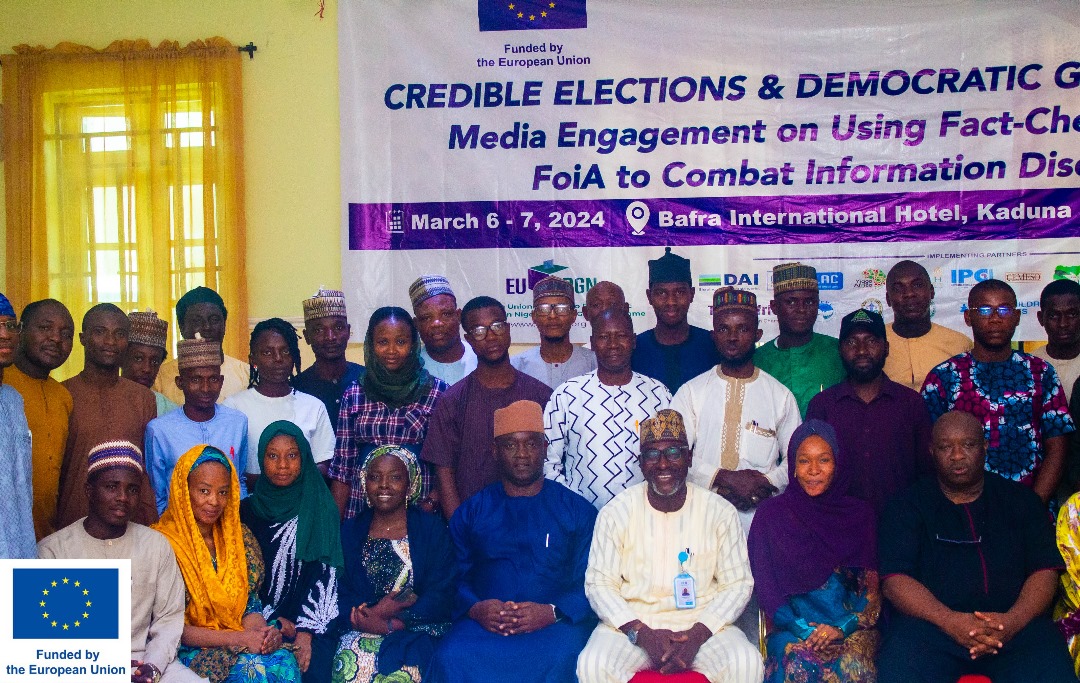
International Press Centre (IPC) held a two-day capacity-building workshop on combatting information disorder in democratic governance reporting using fact-checking and FOI tools. 

The workshop is being held as part of the activities under Component 4 (Support to Media) of the European Union Support to Democratic Governance in Nigeria (EUSDGN II) project. IPC is the lead implementing partner. 

The two-day workshop held at Bafra International Hotel in Kaduna had in attendance 40 participants across nine (9) states of Northern Nigeria (Abuja, Kaduna, Kastina, Niger, Bauchi, Jigawa, Kano, Jos, Benue) who are new/mid-level journalists, community journalists, freelance journalists, etc. 

Participants were introduced to the rudiments of fact-checking using a tool and how to hold government and public institutions accountable for their activities using the FOIA (2011). 

As the program manager, Mrs Stella Nwofia, stated in her welcome address at the Sardauna Hall in the hotel, “The training program seeks to address a critical aspect highlighted in the EU-EOM final report on the 2023 general elections, which underlines that online social platforms played a significant role in both campaigning and public oversight of the electoral process. 

However, there were instances where these platforms were misused, either for campaigning lacking transparency or for creating misleading impressions of widespread support. 

Despite repeated warnings from government officials about the dangers of misinformation, various entities, including individuals associated with major political parties, disseminated false information online. 

Additionally, the report notes that major parties utilised paid advertising on online platforms. However, the full extent of this practice remained obscured due to a lack of transparency within these platforms.” 

She added that “The training program, which commenced in Ondo State as the initial phase and was followed by Port-Harcourt, is designed as a three-part series. Its primary goal is to provide journalists nationwide with essential tools, skills, and knowledge. The program aims to empower journalists to adeptly navigate the challenges of the digital era while maintaining standards of responsibility and ethical behaviour.

“Our goal is to empower journalists to uphold truth, advocate for integrity, and safeguard democracy by promoting a culture of critical thinking, fact verification, and media literacy.”

Nigerian media industry proposes new regulation to enhance professionalism

By Ahmad Deedat Zakari

The Nigerian media industry has adopted a new mechanism to address ethical and professional problems in the industry.

The decision was an aftermath of a media roundtable organized on Monday, 21st November, 2022.

The amalgam of the Newspapers Proprietors Association of Nigeria (NPAN), Nigerian Guild of Editors (NGE), Nigerian Union of Journalists (NUJ), Broadcasting Association of Nigeria ( BON) and the Guild of Corporate Online Publishers (GOCOP) came together to arrive at the resolution.

Media leaders and operators at the roundtable noted that the success of the co-regulation would be attainable via a workable enforcement mechanism.

According to them, co-regulation is attainable when the Nigeria Press Organization (NPO), comprising NPAN, NGE, NUJ and BON work together to make the co-regulation system effective. This will be done through the establishment of the ombudsman at local and central levels.

This is contained in a communique issued at the end of the media roundtable convened within the context of the imperative of a strategic response to the challenge of institutionalizing self-regulatory mechanisms by the media for the media.

The communique was jointly signed by the president, NPAN/NPO, Mal. Kabiru A. Yusuf, FNGE, president, NGE, Mustapha Isah, president, NUJ, Chief Chris Isiguzo, MFR, president, GOCOP, Maureen Chigbo and the executive secretary, BON, Dr. Yemisi Bamgbose

The communique noted that measures must be put in place to avoid the creation of bureaucratic structures that may have high-cost implications and hinders the efficient operation of the ombudsman.

The communique reads in part:

“That sanctions for the violation of ethical codes and professional standards shall be determined by the Ombudsman, guided by the regulation.

“That media professional bodies and associations shall partner with media organisations to give wide publicity to the decisions of the Ombudsman,” the communique stated.

On the revised Code of Ethics of Journalists in Nigeria, the communique noted that a bill of rights would be incorporated into the revised code to address concerns over some industry practices that tend to undermine the welfare and safety of journalists.

The communique also said: “That the revised code shall protect investigative journalism by making the public interest exception to instances where undercover methods may be used to obtain information.

“That the revised code shall distinguish between paid content and editorial content to preserve editorial integrity; and a new clause would be inserted to obligate journalists to promote the right of the people to know, freedom of the press and responsibility.”