Israel

Protection of persons Hors de combat: Perspective on Israeli-Palestine crises

By Yusuf Idris

The Israel-Palestine conflict is one of the most complex and long-standing disputes in modern history. Rooted in deep historical, religious, and political tensions, the conflict has resulted in a series of wars, uprisings, and ongoing violence between Israelis and Palestinians.

The origins of the conflict can be traced back to the late 19th century when Jewish and Arab nationalist movements emerged in the region, claiming their right to self-determination. After World War I, the League of Nations granted Britain a mandate to govern Palestine, facilitating Jewish immigration and settlement. However, this sparked resistance from the Arab population, who feared displacement and loss of their homeland.

Following the horrors of the Holocaust during World War II, international sympathy for the establishment of a Jewish homeland grew. In 1947, the United Nations proposed a partition plan to divide Palestine into separate Israeli and Palestinian states, but the Arab countries and Palestinian leadership rejected this plan.

The protection of persons, including both combatants and civilians, is a crucial aspect to consider in any conflict. From the perspective of the Israeli-Palestinian crisis, this issue carries significant weight as the conflict has led to the loss of countless lives and resulted in widespread suffering on both sides.

One of the key aspects to examine regarding the protection of persons in the Israeli-Palestinian conflict is the nature of the conflict itself. The conflict has been marked by a series of military confrontations, uprisings, and acts of terrorism, which have had severe humanitarian consequences. Both Israelis and Palestinians have been subjected to violence, displacement, and the violation of their fundamental human rights.

From the Israeli perspective, the protection of persons, particularly Israeli citizens, is a paramount concern. Israel, as a sovereign state, has the responsibility to safeguard the lives and security of its population, which various Palestinian militant groups have consistently targeted. 

The causes and origins of the Israel-Palestine crisis are complex and deeply rooted in historical, political, and religious factors. 

The Israel-Palestine conflict dates back to the late 19th and early 20th centuries when Zionist Jews sought to establish a Jewish homeland in historic Palestine, which was under Ottoman rule at the time. This intensified with the Balfour Declaration in 1917, in which Britain supported establishing a Jewish homeland in Palestine.

Partition and Creation of Israel: Following World War I and the collapse of the Ottoman Empire, Britain was granted the mandate to administer Palestine. Rising tensions between Jewish immigrants and the Arab local population led to conflicts. In 1947, the United Nations proposed a partition plan, recommending the creation of separate Jewish and Arab states in Palestine. 

 The term “protection of civilians” refers to the measures taken to ensure the safety and security of civilians during armed conflicts. This can include various actions such as providing humanitarian assistance, establishing safe zones or protected areas, and enforcing international human rights and humanitarian laws.

“Hors de combat” is a French term that translates to “combat horse” in English. It refers to horses used in military operations, particularly in combat roles.

 The phrase “protection of civilians horse de combat” does not inherently have a specific meaning as it combines two distinct concepts. However, one possible interpretation could be using combat horses in military operations, specifically focusing on protecting civilians.

Combat horses may be employed in a conflict situation for various purposes like transportation, reconnaissance, or combat roles. If the emphasis is on protecting civilians, combat horses could be trained to rescue civilians in dangerous situations, evacuate them from conflict zones, or provide a deterrent against attacks on civilians.

There is no specific international instrument called “Words de combat” to protect civilians. However, several international legal frameworks and instruments address the protection of civilians during armed conflicts.

1. Geneva Conventions and Additional Protocols: The Geneva Conventions of 1949 and their Additional Protocols provide the foundation for protecting civilians during armed conflicts. They outline rules for the humane treatment of civilians, prohibit attacks against them, and provide for the establishment of protections such as safe zones and medical facilities.

2. United Nations Security Council Resolutions: The UN Security Council has issued several resolutions to protect civilians in armed conflicts. For example, Resolution 1894 (2009) reaffirms the responsibility of all parties to an armed conflict to protect civilians and calls for accountability for those who violate these obligations.

3. International Humanitarian Law: This body of law includes principles and rules that regulate the conduct of armed conflicts and aim to minimise civilian harm. 

Several international humanitarian principles, protocols, and provisions of the Geneva Conventions govern the protection of civilians in armed conflict situations. These frameworks aim to ensure that civilians are protected from the effects of armed conflict and that their human rights and dignity are preserved. 

 Key principles, protocols, and provisions related to the protection of civilians:

1. Principle of Distinction: This principle, enshrined in the Geneva Conventions, requires parties to distinguish between civilians and combatants and between civilian objects and military objectives. It prohibits direct attacks on civilians and civilian objects.

2. Principle of Proportionality: Under this principle, parties to the conflict must ensure that the anticipated military advantage from an attack is not outweighed by the expected harm to civilians or civilian objects. The excessive use of force that could cause disproportionate civilian casualties is prohibited.

3. Principle of Precautions in Attack: This principle obliges parties to take all feasible precautions to avoid or minimise harm to civilians and civilians.

The Israel-Palestine conflict falls within the scope of international humanitarian law, and the principle of protecting civilians applies to both parties. International humanitarian law, including the Geneva Conventions, stipulates that parties must take all necessary measures to protect civilians from the effects of hostilities in armed conflict situations.

This means that parties to the conflict, including Israel and Palestine, are obligated to:

1. Respect the distinction between civilians and combatants and between civilian objects and military targets. Deliberate attacks on civilians or civilian objects are prohibited.

2. Uphold the principle of proportionality by ensuring that the anticipated military advantage does not outweigh the expected harm to civilians or civilian infrastructure.

3. Take precautions in attacks to minimise harm to civilians. Parties should give effective warning of attacks that may affect the civilian population and take all feasible measures to avoid or minimise civilian casualties.

4. Provide medical care and humanitarian assistance to civilians affected by the conflict without discrimination.

Conclusively, the Israel-Palestine crisis is a complex and ongoing conflict with deep-rooted historical, political, and religious dimensions. A few general suggestions that various international actors have highlighted:

1. Dialogue and Negotiations: A peaceful and lasting resolution to the conflict can only be achieved through a comprehensive, inclusive, and sustained dialogue between the parties involved. This should be based on mutual recognition, understanding, and respect to reach a mutually acceptable solution.

2. Two-State Solution: The international community, including the United Nations, has long supported the idea of a two-state solution where Israel and Palestine exist side by side in peace and security. This solution typically involves the establishment of an independent and sovereign Palestinian state alongside Israel, with agreed-upon borders and mutually acceptable arrangements for Jerusalem, refugees, and security.

3. Respect for International Law: All parties should uphold and abide by international humanitarian law

Resolving the Israel-Palestine conflict is a complex and multifaceted issue that requires the commitment and cooperation of all parties involved. While there is no one-size-fits-all solution, several proposals have been put forward. Here are some potential solutions that have been discussed:

4. Two-State Solution: This solution involves the establishment of an independent and sovereign Palestinian state alongside Israel, based on the pre-1967 borders, with mutually agreed upon land swaps and a negotiated resolution to the status of Jerusalem. This solution has been endorsed by the international community, including the United Nations, as a means to address the aspirations of both Israelis and Palestinians for self-determination and security.

Yusuf Idris writes from  Lagos and can be reached via yusufibnadamu@gmail.com.

Gaza hospital bombing: Will this open your eyes now?

By Ismail Obansa Nimah

Moments before the deadly Israeli strike on the Al Ahli Baptist Christian National Hospital, an official Israeli government page posted the following on X (formerly Twitter):  “Due to the lack of medical equipment and the lack of medical staff, it was decided to bomb the Baptist hospital in Gaza and give them euthanasia death”.  

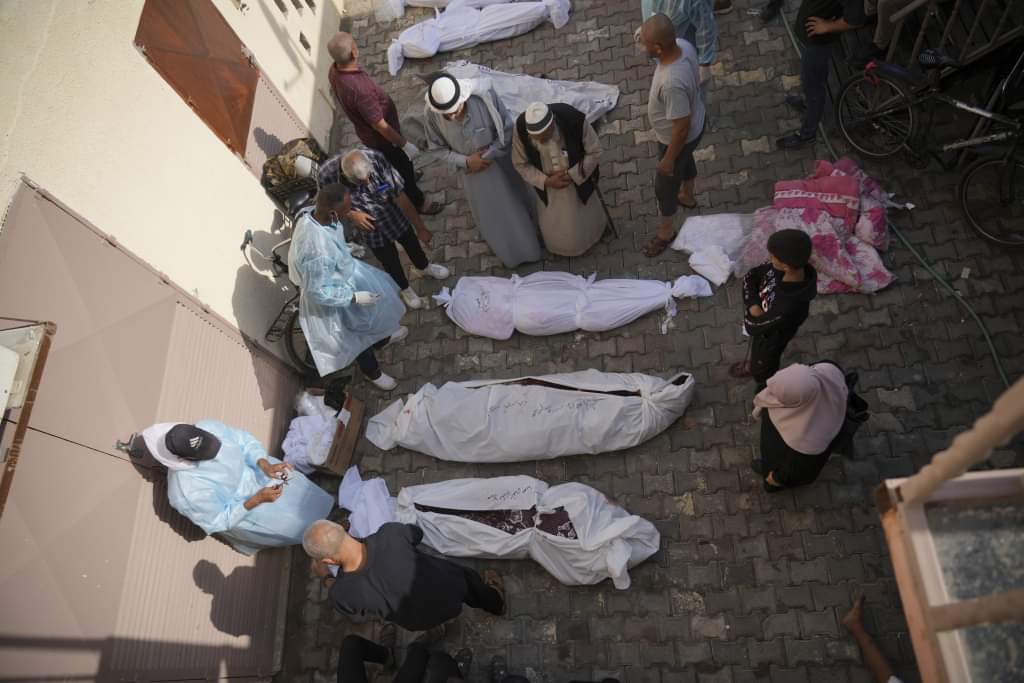
The attack is the worst to hit a hospital since World War II. It has so far killed more than 500 people, with many still under the rubble. The tweet has been deleted, and as usual, Israeli and mainstream Western media have begun damage control to embellish the ignominy with half-truths and outright falsehood.

There is no sitting on the fence in this conflict. You are either here or there. You either stand for the Palestinians against the monstrous apartheid regime of Israel, or you are with the Israelis, of whom a significant majority, save just a few, are so inhumane.

And when I say Palestinians or Israeli, it does not just equate pitting Muslims against Jews. If you must know, Bethlehem, the birthplace of Jesus himself, is amongst Palestine’s illegally occupied and besieged regions and has been under constant attack and bombardment by Israel for the past seven decades.

I hope our Christian counterparts also realise that cheering Israel on and being sympathetic to their cause on whatever basis or allusion, scriptural or not,  erodes the very humanity in us and is tantamount to aiding the systematic tyranny and barbarism that entity represents – the same barbarism we all spoke against and condemned when it occurred in South Africa.  We are all targets. This is a war on our collective humanity. Upon deeper reflection, we will find examples of similar demagoguery against Jesus and his Mother, Mary, in the scripture.

Ask yourself, is it not insane and malevolent to think that the Just and Merciful Creator will choose a group of people as his beloved or ‘chosen’ and help them commit atrocities of this scale to fulfil some prophecy?

We, Muslims, are not your enemy. We are not what the propagandists of the West and Israel propagate. We have an entire chapter in the Qur’an named after Mary in deference to her honour. We have numerous verses exalting her status in the sight of God, away from what the Jews still assert. No Muslim is a Muslim until he/she loves, respects and honours Jesus Christ as one of the mightiest messengers of God. We do not call his name, except we add “peace be upon him” to it. We make no distinction between him and other great messengers of God. Yet you somehow think we are your enemy? And help the Jews who curse Mary and Jesus further their evil plot, particularly against us?

For more than One thousand years, the Muslims ruled Palestine, with Jerusalem as its capital. During these years,  Muslims, Jews and Christians coexisted together in goodness, peace, justice and prosperity. Every Muslim was obligated to respect and ensure the human rights of those living under the Islamic Caliphate, no matter who they were and what they worshipped. It was and still is a huge sin and a punishable offence for any Muslim to trespass on the rights of a non-Muslim living under the protection of a Muslim government. No non-Muslim blood was allowed to be illegally spilt without justice. No one was made to unduly suffer on account of being different in any regard.

And even when the European Christian crusaders sacked Jerusalem and massacred hundreds of thousands of its inhabitants in the 11th century, the  Muslims under Salahudeen Al-Ayub did not spill a single innocent blood when they took the city back from the crusader occupation some 88 years later. Not even the blood of many cruel crusaders who had massacred Muslims in their thousands.

It may be that history is repeating itself all over again. But I am sure Palestine will again survive this cruel attempt at extermination and targeted ethnic cleansing. And I know that it will be soon, very soon. Until then, hang in there, brethren, for the help of our Creator is near.

I hope this opens your eyes and we all see more clearly away from sentiments and propaganda.

Ismail Obansa Nimah wrote via nimah013@gmail.com.

Saudi Arabia, Iran discuss Gaza conflict for first time

By Sabiu Abdullahi

Media reports from Iran and Saudi Arabia stated that the leaders of the two countries discussed the issue of the Israeli-Palestinian conflict in a telephone conversation for the first time since the restoration of diplomatic relations between them. 

They said that President Ebrahim Raisi and Crown Prince of Saudi Arabia Mohammed bin Salman discussed the need to end what Raisi described as war crimes committed by Israel in Gaza. 

The Saudi Press Agency said that Riyadh emphasized its support for the Palestinians and the need to overcome the situation through diplomatic means. 

The Saudi prince confirmed that the Kingdom is doing its best to negotiate with international and Middle Eastern countries to stop this raging war, as quoted by the Saudi Press Agency. 

The company reported that the Prince stressed that Saudi Arabia rejects any plans to attack civilians anywhere. 

The United Nations says 340,000 people have been forced to flee their homes as Israel continues its offensive in response to Saturday’s attack by Hamas. 

Israel has prevented people from leaving anywhere, although some residents have managed to cross from Gaza Strip. 

However, countries and organizations continue to call for the creation of conditions for aid in Gaza and for refugees to leave. 

Ulama Forum in Nigeria condemns Israeli terror in Palestine

By Sabiu Abdullahi 

The Ulama Forum in Nigeria has condemned the recent brutal massacre of innocent lives in Palestine by the Zionist state of Israel. 

The Forum, based in Kano, expressed outrage at the ongoing illegal occupation and usurpation of Palestinian lands, calling on global institutions including the United Nations, the Organisation of Islamic Conference, and the World Islamic League to intervene and put a permanent halt to the barbaric attacks on defenceless civilians. 

The Ulama Forum highlighted the hypocrisy of powerful nations that condemned certain conflicts while endorsing Israeli atrocities.

It noted the urgent need for Arab and Middle Eastern countries to unite against Zionist brutality, cautioning against any form of appeasement with Israel, which it deemed to be sacrificing the Palestinian cause.

The Forum urged Muslim countries to impose economic sanctions on Israel and rally international support for the victims of Israeli attacks. 

Commending countries like Saudi Arabia, Turkey, Jordan, and Kuwait for their stern condemnations of Israel’s actions, the Ulama Forum called on Muslims and peace-loving people worldwide to unite in condemning the Zionist provocations and cruelty against the oppressed people of Palestine.

It emphasised the importance of working towards a just, peaceful, and progressive world order. 

Hamas did not start this war, Israel did

By Ismail Obansa Nimah

Theodor Herzl must be restless in his tomb for what is happening in Palestine. He must have forgotten to remember that even though he succeeded in creating Zionism to champion his vision for a Jewish state in the heart of Palestine, the territory he uprooted people from and where he currently rests was never really his. In it were millions of good-hearted people, living a beautiful life in their homes, farms, families, freedom, peace and prosperity. Until all they had was brutally taken away by the entity Herzl created, the state of Israel.

The Jewish homeland chanted by Herzl since the first worldwide Jewish conference in 1897 and seen by thousands of Jews as their God-given right and as “a land with no people for a people without land”, is for the first time since its creation up in an unprecedented amount of flames.

The West championed the Balfour Declaration after the First World War. It gave the territory of Palestine to a foreign occupation to establish the apartheid state of Israel in total injustice and disregard for the basic human rights of the indigenous people of Palestine.

After the Balfour Declaration,  the Zionist movement gained momentum and confidence. Jews worldwide, particularly in Europe, began to migrate and seek refuge in Palestine. The Palestinians welcomed and gave refuge to the Jews escaping persecution, particularly during the second world war and the Holocaust by Nazi Germany. But to the Palestinian’s dismay, their kind gestures were met with a very painful backstabbing.

 Following the Second World War, the Israeli Declaration of Independence, formally the Declaration of the Establishment of the State of Israel, was proclaimed on 14 May 1948. That declaration triggered resistance from the Palestinian and neighbouring Arab states. It questioned how people’s lands and homes could be stolen from them that easily.

The resistance led to the first armed confrontation between Palestinians and the newly founded state of Israel, together with their allies, resulting in the 1948 Nakbah, which not only saw  78% of Mandatory Palestine become illegally occupied by Israel but also saw the expulsion and flight of 700,000 Palestinians, the subsequent depopulation and destruction of over 500 Palestinian village and geographic erasure, the denial of the Palestinian right of return, the creation of permanent Palestinian refugees in their lands, and the “tyrannical destruction of the Palestinian society, all of which has continued till date.

The events of 1948 uncovered fierce resistance across occupied Palestinian territories and other Muslim nations—one that gave birth to the likes of Hamas, Hezbollah, and the Palestinian resistance fighters.

Since 1948, Israel has continued expanding its occupation and settlements in the Palestinian Territories. It thrashed the two-state solution and violated almost every international law in its systemic oppression, tyranny and ethnic cleansing of the Palestinians. It has carried out numerous indiscriminate attacks and killings of innocent Palestinians. The apartheid regime in Israel has illegally demolished thousands of Palestinian homes, destroyed heritages, desecrated religious sanctuaries, particularly Al-Aqsa Mosque, murdered countless unarmed civilians, including numerous children, women and the elderly and denied Palestinians basic human rights, including their freedom.

At the heart of the Palestinian resistance is the Gaza Strip (the headquarters of Hamas), which has endured decades of Israeli terror, bombardments and siege. The Gaza Strip is a densely populated area with a land, sea and air blockade by Israel since 2007. It is basically a prison.  Israel has carried out countless inhumane, unprovoked attacks across the strip, with the most deadly being in 2014 and the most recent occurring just five months ago. On average this year, 2 Palestinians have been killed daily by Israel across its occupied territories.

The hypocrisy of the Western powers fuelling the Israeli regime for decades has allowed successive generations of Palestinians to take bold and brave initiatives, like what is currently unfolding, to defend and resist the Israeli apartheid occupation. And it appears that the more fight they put to resist, the better they get at it. One may ask, what makes the Palestinians so different from the Ukrainians?

 With the seeming cowardice stance of the Arab Nations in their pursuit of a normalisation agenda at the expense of the Palestinians, it became increasingly clear that if the Palestinians would achieve anything at all, then they would either have to fight bravely and indeed as they currently are or die trying but retaining their honour and dignity with them.

This recent attack has sent a clear message to the world that if peace and stability must be achieved, then attention must be paid to the oppressed and not the oppressor. A man who has already lost so much would not mind throwing all that is left to defend his honour and dignity. The Palestinians have been stretched too thin, and they, more than anyone, have all the right to defend themselves in this war that the creation of Israel started.

Ismail Obansa Nimah wrote via nimah013@gmail.com.

Hamas: The faith triumphant

By Bala Muhammad

Every Israeli Prime Minister makes it an article of faith to attack Palestine – both the West Bank and the Gaza Strip. But as the West Bank is usually led by the compliant and complacent so-called Palestinian Administration of PLO inheritors, it is mainly spared the fury of Israel. But Gaza, the home of HAMAS and Islamic Jihad, always takes the brunt whenever an Israeli leader wants to flex muscle and show ‘manhood’.

With each passing day of the Israeli aggression against the Palestinians, with each additional death of a child or mother, Muslims worldwide are becoming more militant, more fundamentalist, and more jihadic. This is very ominous for the West, on whose behalf Israel is doing what it is doing.

Samuel Huntington, who died not too long ago, wrote Clash of Civilisations. Now, more than ever before, this Clash is at hand. If there is any cause that unites Muslims today, it is the Palestinian Question; if there is any future war that Muslim youth would gladly join and wage, it would be the Jihad to liberate Al Aqsa, Al Quds and Palestine. But for the Western-propped-up Arab regimes encircling Gaza, many young people would have gone into the Strip to join the martyred army of Hamas and Islamic Jihad.

In the matter of HAMAS, Faith will always be Triumphant. Incidentally, The Faith Triumphant is the title of Chapter Eleven in one of the most important books of the Islamic Movement, Ma’alim fit Tariq (Milestones), written by the Movement’s leading intellectual and Martyr, Sayyid Qutb (1906-1966) of the Muslim Brotherhood, Ikhwan al Muslimun.

In Milestones, Qutb wrote: “Allah says, ‘Do not be dejected or grieve. You shall be the uppermost if you are Believers’ (3:139). The first thought which comes to mind on reading this verse is that it relates to the form of Jihad, which is actual fighting, but the spirit of this message and its application with its manifold implications is greater and broader than this particular aspect. Indeed, it describes that eternal state of mind that should inspire the believer’s consciousness. It describes a triumphant state which should remain fixed in the believer’s heart in the face of everything, every condition, every standard and every person; the superiority of the Faith.

“It means to be above all the powers of the earth which have deviated from the way of the Faith, above all the values of the earth not derived from the source of faith, above all the customs of the earth not coloured with the colouring of the faith, above all the laws of the earth not sanctioned by the Faith, and above all traditions not originating in the Faith. It means to feel superior to others when weak, few and poor, as well as when strong, many and rich. It means the sense of supremacy which does not give in before any rebellious force.

“Steadfastness and strength on the battlefield are but one expression among many of the triumphant spirit which is included in this statement of Almighty God. The superiority through faith is not a mere single act of will nor a passing euphoria or a momentary passion but is a sense of superiority based on permanent Truth centred on the very nature of existence.

“The person who takes a stand against the direction of the society – its governing logic, its common mode, its values and standards, its ideas and concepts, its error and deviations – will find himself a stranger, as well as helpless, unless his authority comes from a source which is more powerful than the people, more permanent than the earth, and nobler than life.

“Conditions change, the Muslim loses his physical power and is conquered; yet the consciousness does not depart from him that he is most superior. If he remains a Believer, he looks upon his conqueror from a superior position. He remains certain that this is a temporary condition which will pass away and that faith will turn the tide from which there is no escape. Even if death is his potion, he will never bow his head. Death comes to all, but for him, there is martyrdom. He will proceed to the garden while his conquerors go to the fire. What a difference!”

So wrote Sayyid Qutb. Let us now end today’s treatise with the following story on Challenge, the type the Palestinians are facing: “The Japanese love fresh fish. However, the waters close to Japan have not held many fish for decades. So to feed the Japanese population, fishing boats got bigger and went farther. The farther the fishermen went, the longer it took to bring in the catch. If the return trip took more than a few days, the fish were not fresh. The Japanese did not like the taste.

“To solve this problem, fishing companies installed freezers on their boats. They would catch the fish and freeze them at sea. However, the Japanese could taste the difference between fresh and frozen, and they did not like frozen fish. So fishing companies installed fish tanks. They would catch the fish and stuff them in the tanks, fin to fin. After a little thrashing around, the fish stopped moving. They were tired and dull but alive. Unfortunately, the Japanese could still taste the difference. Because the fish did not move for days, they lost their fresh-fish taste. The Japanese preferred the lively taste of fresh fish, not sluggish fish. So how did Japanese fishing companies solve this problem?

“To keep the fish tasting fresh, the Japanese fishing companies still put the fish in the tanks. But now, they add a small shark to each tank. The shark eats a few fish, but most of the fish arrive in a very lively state. Because they are challenged, they kick and protest and ultimately arrive fresh. Or martyred.”

Allah has put a tiny shark (Israel) in the Arab tank. Only some fish called Hamas, Islamic Jihad and Hezbollah are kicking. The others are frozen stiff. RIP. After all, L. Ron Hubbard once wrote: “Man thrives, oddly enough, only in the presence of a challenging environment.”

May Allah help the Palestinians.

Dr Bala Muhammad wrote from Kano, Nigeria. He can be reached via balamuhammad@hotmail.com.

Shireen Abu Akleh, prominent Palestinian-American Aljazeerah journalist, assassinated by Israel forces

Aljazeera said Wednesday that Shireen Abu Akleh, a veteran journalist for the news network, was fatally shot by Israeli troops in the West Bank refugee camp of Jenin.

According to the Washington Post, Steve Hendrix reported that in JENIN, West Bank — Israeli forces killed a Palestinian American journalist for the Al Jazeera news network in the West Bank early Wednesday, according to the network and the Palestinian Health Ministry. Israel said the journalist, Shireen Abu Akleh, was killed in an exchange of gunfire and called for an investigation.

Abu Akleh, 51, a longtime Al Jazeera correspondent, was shot in the head while covering Israeli raids in the Jenin refugee camp, according to the network and the ministry. She was taken to a hospital before dying from her wounds.

In a statement, Al Jazeera accused Israeli forces of killing Abu Akleh “in cold blood” and said she had been “clearly wearing a press jacket that identifies her as a journalist.” Two journalists who were standing next to Abu Akleh said in interviews that the area had been relatively calm before she was shot.

“It was dead quiet,” one of the journalists, Ali al-Samudi, who was also injured by gunfire, said in an interview from his hospital bed.

In a statement, Prime Minister Naftali Bennett said the shooting occurred while the Israel Defense Forces were conducting counterterrorism operations in Jenin, after a spate of deadly attacks over the past few weeks in Israeli cities. During the operation, he said, “armed Palestinians shot in an inaccurate, indiscriminate and uncontrolled manner.”

“Our forces from the IDF returned fire as accurately, carefully and responsibly as possible. Sadly, Al Jazeera journalist Shireen Abu Akleh was killed in the exchange,” he said. “To uncover the truth, there must be a real investigation, and the Palestinians are currently preventing that. Without a serious investigation, we will not reach the truth.”

Brig. Gen. Ran Kochav, an IDF spokesperson, told Israel’s Army Radio that “all of the data indicate with a high degree of probability” that Abu Akleh was killed by Palestinian fire. “But I say that cautiously,” he added.

A senior Israeli official, in a statement sent to reporters, said that the army’s assessment was based on evidence that included video footage in which a gunman is heard saying in Arabic, “We hit a soldier, he’s on the ground.” The Israeli military said that no Israeli soldiers were injured during clashes in Jenin on Wednesday and that the Palestinians in the video may have been referring to Abu Akleh.

It was not clear when the video, which was published on the Israeli foreign ministry’s Twitter account Wednesday, was recorded, or where the incident depicted in the video occurred. A Jenin field researcher from B’tselem, an Israeli human rights organization, shared a map with reporters marking the location of Abu Akleh’s killing and the location of events depicted in the video distributed by Israelis.

The map locations, determined by GPS coordinates and aerial shots, were nearly 950 feet apart.

In a message posted on Twitter, Israeli Foreign Minister Yair Lapid wrote: “We have offered the Palestinians a joint pathological investigation into the sad death of journalist Shireen Abu Akleh. Journalists must be protected in conflict zones, and we all have a responsibility to get to the truth.”

Palestinian Authority President Mahmoud Abbas said in a statement that he “condemns the crime of the execution Shireen Abu Akleh” and holds Israel “fully responsible.”

U.S. Ambassador to Israel Tom Nides said in a message posted on Twitter: “Very sad to learn of the death of American and Palestinian journalist Shireen Abu Akleh.”

A spokeswoman for the U.S. Embassy in Jerusalem said “The United States encourages a swift, thorough, and transparent investigation into the circumstances of her death.”

“We understand the Israel Defense Forces have already stated that they will be investigating this incident. As we have said numerous times, the United States supports press freedoms and the protection of journalists in carrying out their work,” she said.

Samudi, who works for the Jerusalem-based Al-Quds newspaper, said Wednesday that he and Abu Akleh had been standing several hundred meters from a house where Israeli soldiers were carrying out an arrest. His shoulder was wrapped in a bandage, and dark blood stains were visible on a bullet-resistent vest marked “PRESS” on the table beside him. He had been working with Abu Akleh on Wednesday as a producer, he said.

“The house was at the top of the camp; we were far below,” he said, referring to the Jenin refugee camp. They were alone with four or five other Palestinian journalists, all wearing protective gear marking them as such. They had not yet set up to film, he said.

They were near Israeli military vehicles, he said, and they moved slowly to make sure the soldiers could identify them as reporters. There were no other Palestinian civilians or fighters in the area that he could see, he said.

Suddenly, a single shot rang out, Samudi said, close enough for him to hear the whiz of a bullet. He said he turned and ran and was immediately hit in the upper left back. He said he knew he had been hit, but he also remembers his colleague’s reaction.

“I heard Shireen scream, ‘Ali has been shot! Ali has been shot!’ ” he said. “Then they shot Shireen. She dropped dead immediately.“ He was adamant that the group was not caught in a crossfire between soldiers and militants, as the Israeli government has suggested.

“There were no fighters where we were, none at all,” he said. “We don’t put ourselves in the line of fire. Whatever the Israeli army says for us to do, we do. They shot at us directly and deliberately.”

Another journalist, Shatha Hanaysha, 29, said the group stood in an open area “for about 10 minutes to make sure the Israeli army can identify us as journalists.”

“We were told by people there were Israeli snipers on the roofs, but I didn’t see any,” she said. “It was very quiet. There was no danger in our area.

She said there was no fire fight happening in the area — just the sudden individual shots. “At the shots, everyone ran toward a wall. But Shireen and I weren’t able to climb it,” she said. “Shireen was screaming ‘Ali is shot!’ Then she fell. I tried to help her up, but I couldn’t.”

“She was shot,” she said, pointing at her own neck.

Atah Abu-Rumeleh, a doctor in Jenin who said he witnessed the shooting, also said there had been no exchange of fire before the journalists were shot. “It was a clear day, and the sun was shining,” he said in a telephone interview. “A sniper from somewhere shot Shireen in the head. And Ali al-Samudi was also hit.”

Abu Akleh was among the most high-profile Palestinian journalists and a veteran of covering the Israeli-Palestinian conflict. She joined Al Jazeera in 1997 as one of the network’s first field correspondents. In the over two decades since, her voice, face and reportage became a mainstay for Palestinian audiences.

“Shireen was a brave, kind, & high-integrity journalist that I and millions of Palestinians grew up watching,” tweeted Ramallah-based Palestinian activist Fadi Quran. “A devastating tragedy.”

Husam Zomlot, head of the Palestinian Mission to the United Kingdom, called Abu Akleh the “most prominent Palestinian journalist and a close friend.”

“Now we will hear the ‘concerns’ of the UK govt & the international community,” he wrote on Twitter.