
HND

FG moves to end HND–B.Sc divide, grants polytechnics degree-awarding powers

By Uzair Adam

The Federal Government has announced plans to abolish the long-standing dichotomy between Higher National Diploma (HND) and university degrees by empowering polytechnics to award degrees, a reform aimed at repositioning technical and vocational education as a key driver of national development.

The Minister of Education, Dr. Tunji Alausa, disclosed this on Wednesday in Abuja while addressing a high-level retreat of council chairmen, commissioners of education, rectors, registrars and bursars of polytechnics across the country.

Describing the move as a landmark policy shift, the minister said the reform would end decades of discrimination against polytechnic graduates and reposition the institutions as centres of excellence within Nigeria’s higher education system.

He explained that the initiative would strengthen polytechnic education while preserving its core advantage of hands-on, industry-oriented training.

According to Dr. Alausa, Nigeria’s future competitiveness depends largely on a workforce capable of creating, building and solving real-world problems.

He added that the policy was in line with President Bola Ahmed Tinubu’s Renewed Hope Agenda, which prioritises job creation, industrial growth and human capital development.

With the new degree-awarding status, polytechnics are expected to attract stronger industry partnerships, improved funding opportunities and increased public confidence.

The minister assured stakeholders that the transition would be guided by clear standards, strong regulation and robust quality assurance mechanisms to ensure global competitiveness.

Speaking on the theme, “Transforming Polytechnic Education in Nigeria: Innovation, Good Governance and Sustainability for National Development,” Dr. Alausa noted that polytechnics remain critical to building a skills-driven economy.

He said the ministry had placed priority on Technical and Vocational Education and Training (TVET) to ensure graduates are industry-ready, innovative and capable of driving economic growth.

He urged polytechnic leaders to promote innovation through entrepreneurship centres, research hubs and strong industry linkages, identifying renewable energy, agri-technology, digital manufacturing and climate-resilient solutions as key priority areas.

On governance, the minister warned that transparency, accountability and ethical leadership must define the new era of polytechnic administration.

He called for fiscal discipline, timely audits, prudent management of resources and zero tolerance for corruption.

Dr. Alausa also emphasised sustainability, encouraging institutions to boost internally generated revenue through production and services, develop eco-friendly campuses and build resilient infrastructure.

Polytechnics, he said, should aim to produce what they consume and contribute to reducing Nigeria’s dependence on imports.While acknowledging challenges such as funding gaps, outdated facilities and societal bias in favour of university degrees, the minister maintained that the opportunities ahead were far greater.

He reaffirmed the federal government’s commitment to supporting polytechnics through policy reforms, infrastructure upgrades and strategic partnerships.

He further announced a special TETFund intervention this year to upgrade engineering schools in polytechnics with modern equipment, following a similar intervention for 12 medical colleges last year.

Charging participants to return to their institutions as agents of change, Dr. Alausa said, “The future of our youth, our economy and our nation depends on the transformation we ignite here today.”

Education experts at the retreat described the announcement as a turning point, noting that it would boost enrolment, motivate students and staff, and enhance the contribution of polytechnics to sectors such as manufacturing, technology, agriculture and renewable energy.

Neo-liberalism and Cotonou degree alternative

By Dr Kabiru Danladi Lawanti

The whole Cotonou degree is criminal and all those involved need to be fished out and punished. Some people might see us as harsh or maybe insensitive for saying this. 

There are things we cannot say in public, but one needs not to be prophet of doom to predict that Nigeria cannot withstand this onslaught and will eventually crash. 

Our desperate quest for certification through whatever means led us to this situation. Parents are desperate to have their kids in the university, some even underage (we saw 15, 16 and 17 year olds being pushed to universities), whose mental capacity is too elementary to grasp or cope with challenges of university education.

The crises in higher education and the adoption of neo-liberal policies that have no place in a developing country like ours also contributed to this confusion. Consequences of commodification of knowledge is enormous in a country with no strong institutions to checkmate excesses and greed of capitalists. The results is the proliferation of degree mills all over.

Adoption of neo-liberal policies means cutting funding for public services like education, health and sanitation. Nigerian public universities suffer from these policies. Funding was cut, citing many reasons. The results is restrictions in admissions. When you have many applying to enter university and the slots are few, universities have to admit based on quota. Therefore, few can be admitted.

Parents, in their desperate efforts to get their children into universities, started sending their kids to some African countries for bachelor’s degrees – Uganda, Benin Togo, Ghana, Sudan, Niger Republic, etc. 

Another reason is the dichotomy between degree and HND. Many people affected by stagnation in their places of work because of HND opted for a way to have a degree that can help them get promoted. Many went for the Cotonou degree. Since it is acceptable by MDAs or they made it acceptable, most of them started trooping to these mushroom universities to obtain these degrees to get promoted.

Then we have people who can’t cope with rigorous nature of our public university system. I know a lot who not only failed exams, but are withdrawn from diploma programmes, but appear after 6 months with a degree from these degre milling centres. Others could not pass UTME therefore unqualified to enter public universities. Cotonou degree provide an alternative.

The last, in my opinion, are those running from ASUU strike. Many parents justify purchasing the Cotonou degree because of the unending industrial disputes in the public universities.

I don’t want to talk about the “motor park gang” led by former minister of education Adamu Adamu and his National Universities Commission (NUC) executive secretary, who bastardised the university system for only God knows why. They have killed what remained of our public university system.

Lastly, some of our private universities are not any different from the “Cotonou universities”.

President Bola Tinubu needs to do a lot more to rescue the situation. I like how the Minister of Education, Prof. Tahir Mamman, handles the situation. But sincerely, the students of these dubious universities, their agents, officials from Federal Ministry of Education, NUC and the other places need to be rounded up, arrested and punished according to our laws.

Kabiru Danladi Lawanti, PhD, wrote from the Department of Mass Communication, ABU Zaria, via kblondon2003@yahoo.com.

Kaduna Poly expels 85 students, suspends 8 others

By Sumayyah Auwal Usman

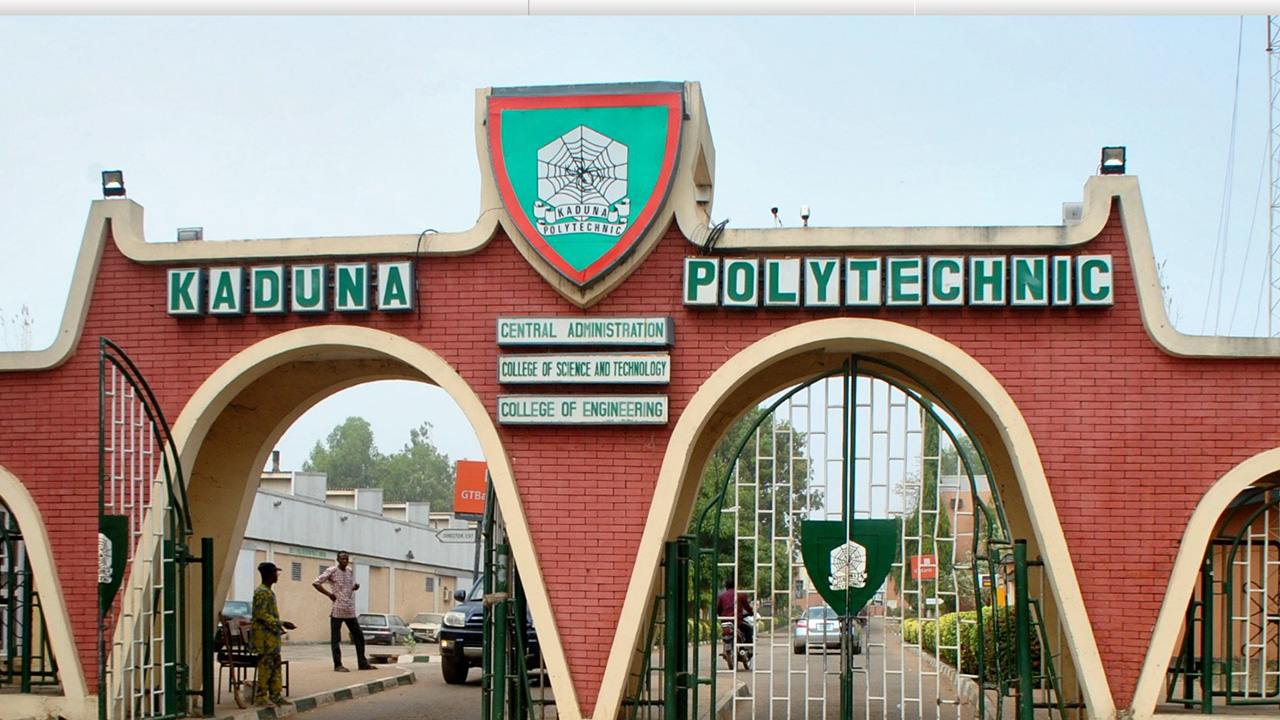
The management of Kaduna Polytechnic has expelled 85 students for their involvement in examination malpractice and suspended eight others. 

A statement issued on behalf of the Registrar, Dr Muhammad Sani Musa, said the decision to expel and suspend the affected students was reached at a meeting by the Academic Board held on 25th August 2021, thereby recommending different levels of punishment for the students, depending on the degree of involvement. 

The list includes forty-four (44) HND students and forty-one (41) ND students. Their expulsion was said to have been prompted by the approval of the report of the Academic Board at its extraordinary meeting held last week.  

The affected students have been asked to vacate the institution’s campuses immediately and hand over all polytechnic property in their custody to their respective heads of department.

See the list below: