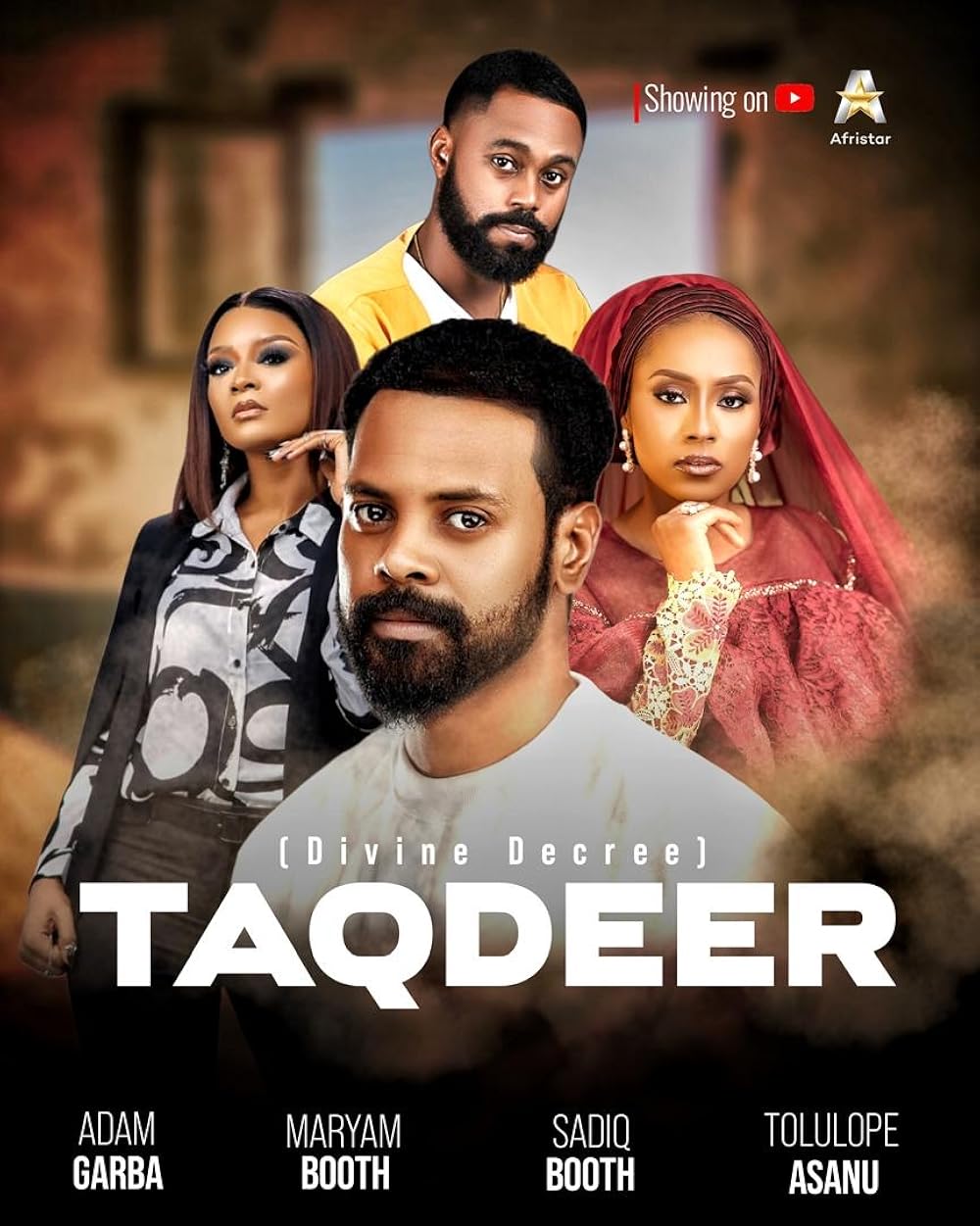
Taqdeer (Divine Decree), a 2025 Nigerian Islamic film directed by Ruben Reng, is a captivating tale of love, fate, and cultural heritage. Starring Ibrahim, Sakina, Mustapha, and Zainab as leading characters, this film weaves a narrative that explores the intricacies of human relationships against the backdrop of Nigerian and Hausa traditions.
The film’s plot revolves around themes of destiny, faith, and choices, unfolding a story that keeps viewers engaged. The narrative delves into the lives of its characters, exploring their struggles and triumphs in a way that resonates deeply.
Watching Taqdeer is a visually immersive experience. The cinematography captures the vibrant essence of Abuja, blending traditional and modern elements harmoniously. The film’s use of Hausa language and Islamic cultural references adds authenticity, making the story feel both personal and universal. The performances by the cast are compelling, bringing depth to their characters.
Taqdeer’s formal techniques, such as its cinematography and sound design, effectively enhance the narrative’s emotional impact. The film’s portrayal of Islamic moral themes and traditions provides a rich context for the story, making it relatable and thought-provoking. The blend of music and story-based sound adds to the film’s atmosphere, drawing viewers into the world it creates.
Analytically, while Taqdeer is strong in many areas, certain scenes linger longer than necessary, which can detract from the story’s overall momentum. Nevertheless, these moments are outweighed by the film’s strength, particularly its moral richness.
In conclusion, Taqdeer is worth watching for its engaging narrative, moral richness, and strong performances. It offers a glimpse into Nigerian Muslim culture and explores universal themes of love and fate, making it a compelling watch for audiences interested in diverse storytelling.
A new book examining the cultural and religious forces shaping the Hausa-language film industry, Kannywood, will be released on 5 December 2025 by Springer Nature.
Titled Kannywood: Film, Faith and Identity in Northern Nigeria, the work critically explores how filmmakers navigate religious expectations, cultural norms and language ideologies while appealing to a diverse audience.
The author, Dr Muhammad Muhsin Ibrahim, teaches Hausa Studies at the University of Cologne and is an expert in Hausa media and cultural production.
The study employs audience reception theory and a close analysis of selected films to reveal tensions within the industry, including the dominance of the Kano dialect, the marginalisation of others, such as Sokoto’s, and the commercialisation of “broken” Hausa.
The book also highlights the pressures of global influences and conservative religious forces, presenting Kannywood as a contested space of identity and representation in northern Nigeria.
Innalillahi wa inna ilaihi raji’un. May Allah have mercy on Professor Hafizu Miko Yakasai. He was such a wonderful man that he never held any grudges against anyone.
I met Prof. Hafizu as far back as 2003/2004, and by 2007/2008, he had supervised my B.A. project on Hausa translation. While writing the project, Malam pushed me so hard that it later transformed my life for the better.
Malam was hardworking, friendly, calm and always gentle. You can even say that Malam was the nicest of them all. Malam was always smiling, and he spoke to us as if he were talking to his friends or even his bosses. Malam always looked down when he spoke to you. So kind and loving. We will genuinely miss his charming smile, especially when he wants to make a point or respond to an interesting topic.
To have known Malam was to have known a rare and gentle light in this world. The always smiling gentleman. Today, that light feels dimmed, the smiles have left us, and our hearts are heavy with a grief that words can scarcely hold. Yet, even in this time of mourning, we are compelled to celebrate the extraordinary person he was —a teacher, a mentor, and one of the kindest souls to have graced our lives at Bayero University, Kano.
Prof. Hafizu was a teacher in the truest sense of the word. His classrooms were not just a place of learning, but a sanctuary of encouragement and support. He didn’t just teach Semantics; he taught us how to think, how to wonder and how to believe in ourselves even when we doubted our own capabilities.
The professor saw potential in the quietest student and brilliance in the most struggling mind. His greatest lessons were not found only in the textbooks, but in his unwavering patience, smiles and profound belief that every one of us had something unique and valuable to offer the world.
When Malam became the President of Nigeria’s Institute of Translators and Interpreters, he called me and asked me to participate in a high-level process of evaluating new intakes. I felt as if Malam was elevating me to a position for which I wasn’t qualified, but Malam sat by my side while I put the records in order and smoothed out the process, and together, we made it a success.
Wallahi Malam was a very great gentleman to the core. A peace-loving fellow. A man of charisma and calibre. I never saw him become angry. Perhaps he has a unique way of swallowing all the anger and reveals only soothing smiles.
There was a time when Malam invited us to a project that he had obtained from his good friend, Barrister Dasin. It was a project of translation. We really enjoyed ourselves and have our pockets filled up.
One day, we sat at the Centre for Research in Nigerian Languages, Translation & Folklore. All of a sudden, Malam asked Muhammad, ‘How can we translate…’ He then mentioned a particular word. I was amazed that this was my teacher, who had taught me for years, now asking me for something. This is to show you how simple and easy-going Malam was.
Besides teaching us, Malam took us as his own children, always drawing us nearer. He never acted like a boss; he was a guide who walked beside us, and with us, not ahead of us. He offered counsel without judgment, wisdom without arrogance, and a listening ear that made even our most minor problems feel important. He shaped not only our intellect but our character, leading always by the quiet example of his own integrity, compassion, and grace.
And yet, what we will carry with us most indelibly, what is etched into our memory with the warmth of a permanent sun, is his utmost kindness and smile. That ever-present, genuine, and kind smile. It was a beacon of welcome in the morning, a signal of understanding during a difficult lesson, and a silent celebration of our successes. In a world that can often be too serious and too harsh, his smiles were a constant reminder that joy is a choice, and kindness is a language everyone understands. It was the purest reflection of his beautiful spirit.
Thank you for everything. Your syllabus for a life well-lived is complete, and you earned an A+ in humanity, wisdom, dedication and kindness. We will miss you more than words can say, but we will never forget your lessons and your magnificent smiles.
Malam was an HOD many years ago; he was a Dean, a Professor, and a pioneer Provost of the College of Arts, and he died in active service. He came and worked in the university even in the last days of his life. Above all, he was a very kind gentleman, a devout servant of Allah.
The best part of Malam’s life was that not many people knew he was an A-grade student and teacher of the Qur’an. Coincidentally, the last events he attended in his academic life were on the glorious Qur’an. The Centre organised the last for Qur’anic Studies under the leadership of Sheikh Prof. Ahmad Murtala. May the almighty Allah raise you among the Qur’anic reciters on the Day of Judgement, amen.
Prof. Hafizu has done his part and left. It is now time to reflect on his life and build on the good legacies he left. I extend my condolences to his family, friends, students, Bayero University, Kano, and the entire academic community.
May Allah forgive your shortcomings, Malam. May Allah make Jannatul Firdaus your final home. You have done wonderfully, Malam, with endless gratitude and love. Insha’Allah, you will continue to smile in Jannah, sir. Ameen!
Cast: Adam A. Zango, Ghali Abdallah DZ, Auwalu Isma’il Marshall, Fatima Muhammad, Maryam Usman Shuaibu, Mukhtar Aminu etc.
Release date (Nigeria): 19-7-2024
It’s no longer news that TV series have recently dominated the Kannywood filmmaking sphere. However, Prince Daniel Aboki produced an epic period film titled Mai Martaba in a bold move to revitalize the film industry. The film, roughly based on the popular Arewa Radio drama series Kasar Jallaba, has generated immense excitement among fans eager to see the gripping story come alive on screen.
Made on a sweeping budget of over ₦125 million, Mai Martaba surpassed Nanjala (which had a budget of over ₦65 million) to become Kannywood’s most expensive production. But does it justify this substantial investment? I watched it on Sunday, and here is my review.
Mai Martaba is an exciting tale of a succession struggle among competing claimants for the throne of the Jallaba kingdom. The storyline unfolds through an omniscient narrator, beginning with a few flashbacks of the kingdom under the previous reign of the Agadashawa dynasty. Now occupied by the Jallabawa clan, a sacred decree secures the throne.
Before death, each king must name a successor from within the clan, ensuring the Agadashawas would never return to power. King Mu’azu honoured this legacy by naming Sanaya (Auwal Ismail Marshall) his heir, with a written agreement that Sanaya would one day pass the crown to Mu’azu’s son, Magajin Gari (Ghali Abdallah DZ). But Sanaya breaches the agreement and crowns his daughter, Princess Sangaya (Fatima Muhammad), as his successor, setting the stage for an intense power struggle.
Will Magajin Gari reclaim his birthright? Who is the other claimant to the throne? Can a female monarch win over the hearts of the Jallaba people? Find out in the cinemas.
The movie is generally captivating. However, with a short runtime of less than 90 minutes, the screenplay fails to do complete justice to the compelling story. It features little action scenes and ends quickly when it is supposed to be at its climax. For instance, there is a brave bandit kingpin, Shugaba (Adam A. Zango), whose brother was killed in the kingdom. He is in alliance with Magajin Gari. Driven by revenge, the two could have been shown in a fierce battle against the Jallaba kingdom, adding a dramatic action sequence to the film.
Also, as an adaptation of the Kasar Jallaba radio serial, apart from the setting and select character names, Mai Martaba shares minimal similarity with the original sourcing material. It’s somewhat like the American TV series House of the Dragons, where King Viserys appointed his female child, Princess Rhaenyra, as heir to the throne. The theme of ‘succession war’ is also prominent in many other local and international movies.
However, Mai Martaba remains a satisfactory period drama, boasting a spectacular setting and near-authentic period costumes. It may not be the most engaging Kannywood epic, but it could be the best in general production quality. Its exceptional cinematography and technical excellence is a breakthrough in the Hausa film industry. I salute the director, executive producer, and all other crew members.
The cast should also not be forgotten. Though it consists of new actors, they deliver impressive performances with good dialogue rendition. Ghali Abdallah DZ stands out as the ambitious Magajin Gari, plotting political machinations to get the throne. As Princess Sangaya, Fatima Muhammad was not given much scope but showed confidence in every scene she featured. Adam A. Zango (Shugaba) and Auwal Ismail Marshall (Sarki Sanaya) also deliver solid performances, fitting their roles perfectly.
Overall, Mai Martaba sets a benchmark for cinematic excellence in the Kannywood film industry. It’s a lavish epic film that justifies its hefty price tag. I strongly recommend it. Rating: 3.5/5.
Habibu Maaruf Abdu wrote from Kano. He can be reached via habibumaaruf11@gmail.com.
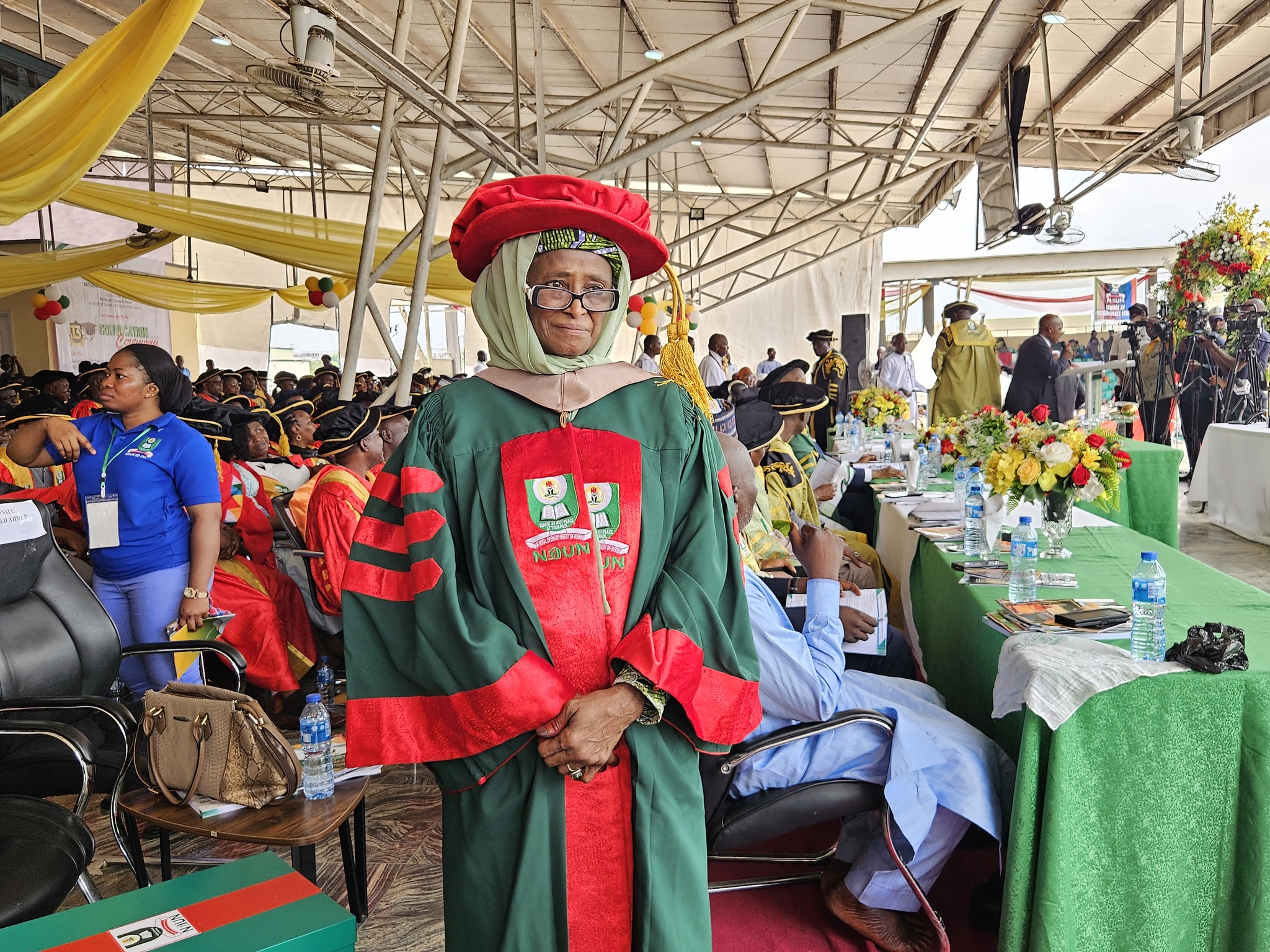
She has done it again. She first did it in 1974/80. In 2024, she repeated it. The feat that no female northern Nigerian has ever performed. Hajiya Hafsatu Abdul Waheed (b. 1952, Kano, northern Nigeria) was the first woman creative fiction writer from northern Nigeria to be published in any language, although hers was in Hausa.
On 13th April 2024, she became the first female Muslim northern Nigerian to be honoured with D.Litt. (Honoris Causa “for the sake of the honour”) doctorate degree from a no less institution than the biggest online university in Africa, the National Open University of Nigeria (NOUN). This was at the 13th Convocation Ceremony of the university held on 13th April 2024 in Abuja, the main headquarters of the university.
In a way, Ms. AbdulWaheed represents a paradox. She is not Hausa or Hausa-Fulani. She is Fulani, pure and simple. She learnt Hausa only outside her family home, in school, but at home, it was Fulfulde all the way. Yet her creative writing has always been in Hausa, with the exception of one book of poetry in English and the recently published collection of short stories titled Sharo. Nothing in Fulfulde, though.
The common historical narrative on literary development in northern Nigeria was that a literary competition to encourage the reading culture among Hausa youth was organized by the Northern Nigerian Publishing Corporation (NNPC) in 1978. One of the entries, which was also one of the winners, was “So Aljannar Duniya” by Hafsatu Abdul Waheed. It was in the Hausa language. However, it would appear, according to Hafsatu herself, that she wrote the novel in 1972, and it was published in 1974.
It was, quite simply, the most radical novel in Hausa literary history. Even “Ƙarshen Alewa Ƙasa” by Bature Gagare (who died in 2002), an unconventional novel, , published in 1982 (as a result of a literary competition organized by the then Federal Department of Culture, Ministry of Social Welfare and Culture) did not come close. Curiously, they contrasted each other. Gagare’s novel is about the lost glory of the ‘original’ Hausa people—the Maguzawa. Hafsatu’s novel is about breaking the Pulaaku—the Fulani code of behaviour. Both Hafsatu and Gagare became spokespersons of their ethnicities.
So Aljannar Duniya is brash, bold, audacious, trenchant, and unapologetic. It is a declaration of war against Pulaaku. It was unarguably the first Fulani feminist tract written in Hausa. Hafsatu’s style and critique of tradition might be compared with those of Bilkisu Salisu Ahmed Funtuwa and Balaraba Ramat Yakubu. However, there are quite a few differences.
Despite its pioneering boldness, So Aljannar Duniya is difficult to read. Perhaps that was because the author started writing it while still in secondary school! Its narrative is often jumbled and non-linear. Understandable. It was written in anger, so words tend to wobble, but the message is clear. This is more so because it is ethnographic. Hafsatu wove a story around her sister, of course, a Fulani, who had every intention of marrying an ‘alien’—an Arab from Libya. So Aljannar Duniya is, therefore, a true story, spiced up by fictional elements to convey a message. As I said before, it is a feminist tract.
Balaraba Rama Yakubu, however, writes in a deeply engaging mature and absorptive style with plenty of hooks. For instance, “Wa Zai Auri Jahila?”, which I consider her best novel, is dark and deeply disturbing narrative of what in contemporary feminist Woke world would be considered an injustice to women, especially young girls in a traditional African society.
Although Novian Whitsitt, who did his PhD on Balaraba’s novels, referred to it as ‘feminist’ I disagreed with him. I labelled her works ‘womanist’, after Alice Walker’s short story, ‘Coming Apart’ (1979). As explained elsewhere, “a womanist is committed to the survival of both males and females and desires a world where men and women can coexist while maintaining their cultural distinctiveness.” This inclusion of men provides women with an opportunity to address gender oppression without directly attacking men (Adamu 2003). Balaraba reflects this in her novels, especially “Alhaki Kwikuyo” (translated by Aliyu Kamal and published by Blaft Books in India). Can’t say much about Bilkisu Funtuwa’s books, though, as I have never read any.
But Hafsatu AbdulWaheed is a feminist—at least as portrayed in So Aljannar Duniya. The plot revolves around a young Fulani lady who wants to marry an ‘alien’ (Arab) from Libya. In real life, Hafsatu’s elder sister. Their parents rejected the idea. The plot of the novel does away with the Fulani Pulaaku and introduces a brash, assertive, loud and anti-establishment heroine, Boɗaɗo, who, armed with a degree in Pharmaceutical Sciences, comes back to her village to set up a drug store (called Chemists in Nigeria, a bit like Walgreens) and introduces her fiancé—all un-lady like behaviours in the Fulani mindset.
Thus, she discards the Fulani munyal (self-control), semteende (modesty) and hakkillo (wisdom)—central components of Pulaaku—and declares, openly, her love for an “alien” in her auntie’s presence! The opening dialogue from the novel sets the pace in which Boɗaɗo, speaking, informs her aunt:
(Hau) Aure! Inna ni fa na gaya muku ba zan auri kowa ba sai wanda nake so. Kun san zamani ya sake.
(trans) Marriage! Aunty, I have told you that I will only marry the man I love. You know times have changed.
Such direct confrontation in a Fulani village was uncommon and reflects the author’s autobiographical rebellion against tradition. Her aunt—delegated to mediate in these matters on behalf of the protagonist’s mother—is shocked. As she lamented:
(Hau) Mhm! Wannan zamani, Allah Ya saukaka. Yarinya ki zauna kina zancen auren ki, sai ka ce hirar nono da mai. Don haka fa ba ma son sa ɗiyar mu makarantar boko. In kun yi karatu sai ku ce kun fi kowa. Me kuka ɗauke mu ne?
(trans) Mhm. These are difficult times. May Allah save us. Listen to you talk about your marriage as if you are talking about milk and butter. That is why we don’t want to send our daughters to school. After you finish, you feel superior to everyone. What do you take us for?
A battleground and the rules of engagement have been established—female empowerment through education—and Hafsatu chose the most conservative arena: a Fulani settlement, considered generally more trenchant about Pulaaku than urban Fulani. Additionally, the novel’s subtext of rebellion against arranged and forced marriage underscores Hafsatu’s acerbic demand for personal choice in marital affairs by women. It was a template for rebellion.
Another contrast between Hafsatu’s So Aljannar Duniya and Balaraba’s Wai Zai Auri Jahila? is in the choice of careers. Hafsatu chose Pharmacy for her protagonist, while Balaraba made her own a nurse. Pharmacy was a profession in the period, and by making her character a pharmacist, she thrusts Boɗaɗo into a man’s world to compete equally with men. Balaraba, on the other hand, by making her character a nurse instead of a doctor, maintains the womanist ethos of an achieving woman in a male-dominated society, fitting in with career stereotypes of women in caring professions.
The success of So Aljannar Duniya sent a message to the budding Hausa literati to pick up their pens and set to work—thus spawning a genre which t revolutionized the Hausa literary landscape in contemporary times.. Furthermore, the combined effects of the harsh economic realities of the 1980s (the decade of military coups and counter-coups in Nigeria) ensured reduced parental responsibility in the martial affairs of their children. Therefore, fantasy, media parenting, especially Hindi films, anti-authority and a loud, persistent message from bursting testosterones in a conservative society that sees strict gender separation combined to present Hausa youth with soyayya (romance) as the central template for creative fiction. It was a safety valve to repressed sexuality.
Hafsatu’s radicalism, however, did not end at rebellion against arranged or forced marriage for women. At one stage she declared to run for the office of the Governor of Zamfara State. This was provoked by a statement by the sitting governor that there were no educated women in the state. To prove him wrong, she decided to campaign for his chair! She even made posters, but was asked by her father to stop. At least, she had made a statement. Furthermore, her real-life echoes Boɗaɗo’s—she was also married to an ‘alien’ from the Middle East (a Syrian). Incidentally, it was a marriage that took her to Gusau, the Zamfara State capital, and I had the pleasure of meeting her late husband, Malam Ahmad Abdul Waheed, during a British Council “Intensities in Ten Cities” Islamophobia tour on 9th July 2003. Both Hafsatu and her husband were born and raised in Kano. It was his career that took them to Gusau.
In literary circles, she also has a voice. For one, she used to assiduously attend every single literary convention anywhere it was held. As part of ANA Kano activities, we were together in Niamey and Maraɗi in Niger Republic at various times to attend international conventions of Hausa writers. She never tired of attending and actively participating. Wonderful enough, she often went with her children and grandchildren, showing them the way. It is little wonder that some of these children became well-celebrated in their chosen professions—for they had a strong role model at home. A good example is her eldest daughter, Kadaria Ahmad, the award-winning journalist who owns and runs the NOW FM radio station in Lagos.
Thus, the recognition of the pioneering efforts of Hafsatu AbdulWaheed by the National Open University of Nigeria (NOUN) on 13th April 2024 during the university’s 13th Convocation was a salute not only to the resilience of feminist women but also to all Hausa language writers of both genders. As far as I know, she was the first female Muslim Fulani (or Hausa) writer to be so honoured by any university in Nigeria. She has, therefore, entered the history books. She is truly a woman of substance.
References.
Adamu, Abdalla Uba. “Parallel Worlds: Reflective Womanism in Balaraba Ramat Yakubu’s Ina Son Sa Haka.” JENDA: A Journal of Culture and African Women Studies, no. 4 (2003). https://bit.ly/3Q2gNlY.
Whitsitt, Novian. Kano Market Literature and the Construction of Hausa-Islamic Feminism A Contrast in Feminist Perspectives of Balaraba Ramat Yakubu and Bilkisu Ahmed Funtuwa. PhD dissertation, University of Wisconsin, 2000.
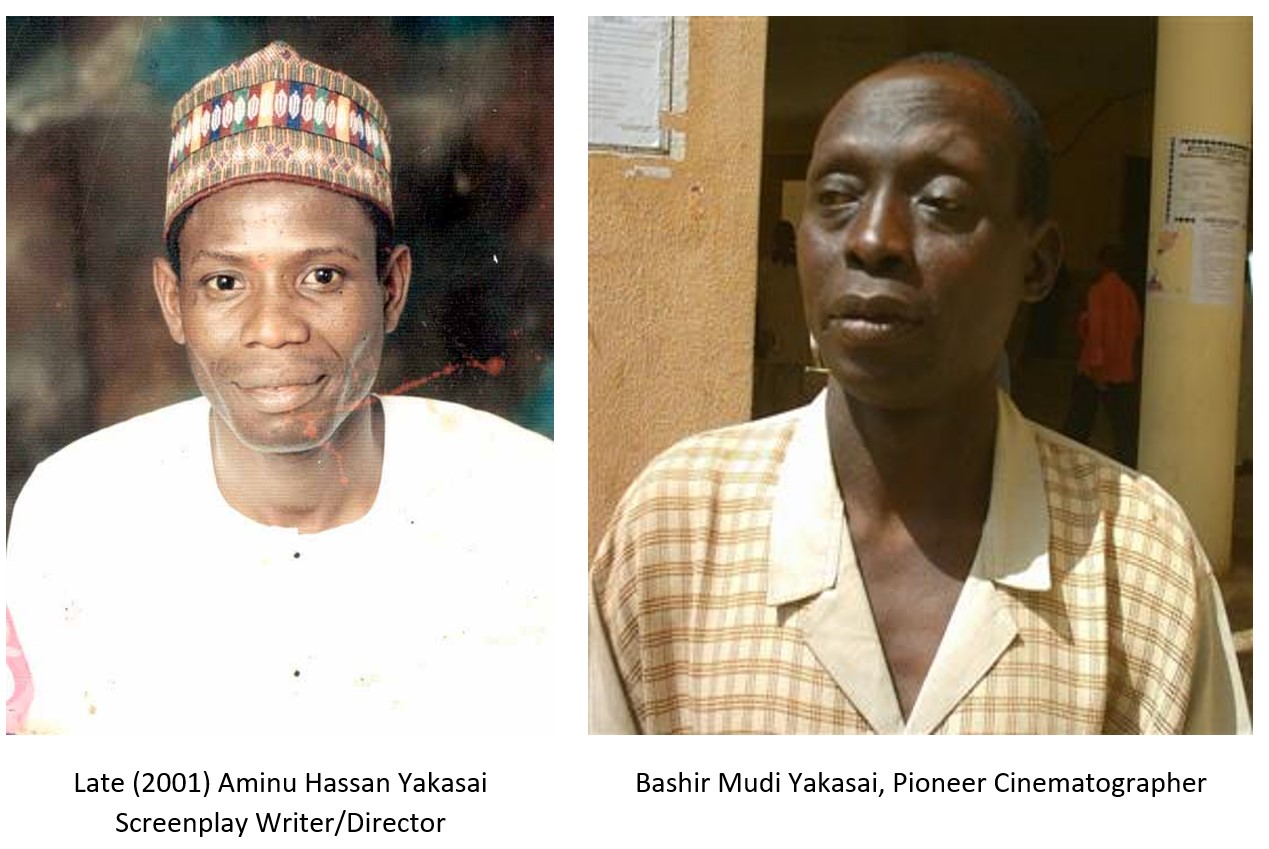
An industry is a system made up of interconnecting parts that synchronise together to create a perfect dynamic and functional entity. However, there is a central creative focus. Thus, while no one can claim to have been the actual originator of commercial Kannywood since many people – and processes contributed to its development – nevertheless, the creative spark that lit the fire of Kannywood was the late novelist Aminu Hassan Yakasai. If one person can be credited with creating the industry, it was him and only him.
In the late 1970s, the Nigerian film director Ola Balogun directed two successful Yoruba films. The first, “Ajani Ogun”, was co-produced with the actor Ade Love. The second, “Ija Ominira”, starred Ade Love. Hubert Ogunde, a famous Yoruba travelling theatre showman, decided to join the trend. He invited Ola Balogun to direct Aiye, which was hugely successful and led to a follow-up, Jaiyesinmi.
These Yoruba films found their way to Kano’s bustling “stranger” (or, more appropriately, “guest settlers”) communities of Sabon Gari in the 1980s, where they were shown in cinemas and hotel bars. This attracted the attention of Hausa amateur TV soap opera stars and crew, such as Bashir Mudi Yakasai (cinematographer), Aminu Hassan Yakasai (scriptwriter) and Tijjani Ibrahim (director). Surprisingly, despite the massive popularity of Hausa drama in television houses and government financial muscle, the idea of full-scale commercial production of Hausa drama episodes by the television houses was never considered. Individuals wishing to own certain episodes simply go to the television station and pay the cost of the tape and a duplication fee, and that was it. There was no attempt to commercialise the process on a full scale.
In the same period, the northern cities of Kano, Kaduna, and Jos benefitted immensely from the massive transfusion of modern media influences caused by not only a liberal society but also the tolerant interaction of diverse cultures and religions in the same public spaces. They were, undoubtedly, the creative hubs of northern Nigerian popular culture. Jos was famous for its vibrant nightclub and music scene. Kaduna also had a rich musical heritage, coupled with a TV culture. Kano was more muted and relied on music and club life inflows to Sabon Gari from other regions.
However, one aspect of popular culture Kano had that was absent in Kaduna and Jos was prose fiction. While other cities were grooving the night away, residents of Kano were burning the midnight oil. The first published modern Hausa fiction was “So Aljannar Duniya” by Hafsat AbdulWaheed from Kano in 1980`. It opened the floodgates and led to hundreds of novelists creating a whole genre of African indigenous fiction referred to informally as Kano Market Literature.
Also, at the same time, Kano had many drama groups that enjoyed stage plays that were often improvisational and not based on any script but with a general focus on social responsibility. These drama groups became spawning grounds for those who established the Kannywood film industry. These included Tumbin Giwa Drama Group (Auwalu Isma’ila Marshall, Shu’aibu Yawale, Ibrahim Mandawari, Adamu Muhammad, Ado Abubakar, Jamila Adamu. (Gimbiya Fatima), Hajara Usman, Ɗanlami Alhassan, etc.), Jigon Hausa Drama Club (Khalid Musa, Kamilu Muhammad, Fati Suleiman, Bala Anas Babinlata), Tauraruwa Drama & Modern Film Production (Abdullahi Zakari Fagge, Shehu Hassan Kano, Iliyasu Muhammad, Hajiya Rabi Sufi, Auwalu Ɗangata, Ado Ahmad G/Dabino, Asama’u Jama’are), and Hamdala Drama Wudil ( Its members include Rabilu Musa Ɗanlasan (lbro), Mallam Auwalu Dare, Ishaq Sidi Ishaq, Bappah Yautai, Bappah Ahmad Cinnaka, Haj. Hussaina Gombe (Tsigai), Shua’ibu Ɗanwamzam, Umar Katakore etc.) There were many more, of course, but these were foundational to Kannywood.
The TV shows from then Radio Television Kaduna were gripping and inspiring to these drama groups. TV show stars that became role models to these Kano drama groups included Ƙasimu Yero, Usman Baba Pategi Samanja, Haruna Ɗanjuma, Harira Kachia, Hajara Ibrahim, Ashiru Bazanga (Sawun Keke) and others.
Thus, it was that at the time of producing Bakan Gizo in Bagauda Lake Hotel 1983 to 1984 Aminu Hassan Yakasai, Ali “Kallamu” Muhammad Yakasai, Bashir Mudi Yakasai started strategising creating a drama for cinema settings (thus Kannywood was often seen as the creation of a ‘Yakasai Mafia’ as those from Yakasai dominated its creative direction!).
The tentative title of the film they were thinking of shooting was to be called Shigifa. It was a story of four unemployed graduates thinking about setting up a company – a departure from the romantic or comedic focus of then-then-popular TV shows. A script idea was floated, and Aminu Hassan Yakasai was to be the scriptwriter. However, before the idea matured, the group started getting contracts for video coverage of social events, etc. Actually, part of the coverage was also stored as footage, although the film was not eventually made.
The precise decision to commercialise the Hausa video film, and thus create an industry, was made by Aminu Hassan Yakasai in 1986, with technical support of Bashir Mudi Yakasai, the leading cinematographer in Kano, and Tijjani Ibrahim, a producer with CTV 67.
Aminu Hassan Yakasai was a member of the Tumbin Giwa Drama Group. He was also a writer and a member of the Raina Kama Writers Association, which spearheaded the development of what became known as Kano Market Literature in the 1980s. Thus, the idea of putting Hausa drama—and extending the concept later—on video films and selling it was a revolutionary insight, simply because no one had thought of it in the northern part of Nigeria. The project was initiated in 1986, and by 1989, a film, Turmin Danya, had been completed. It was released to the market in March 1990—giving birth to the Hausa video film industry. Salisu Galadanci was the producer, director, and cinematographer, while Bashir Mudi Yakasai provided technical advice.
The moderate acceptance of Turmin Danya in Kano encouraged the Tumbin Giwa drama group to produce another video, Rikicin Duniya in 1991 and Gimbiya Fatima in 1992 — all with resounding success. By now, it was becoming clear to the pioneers that there seemed to be a viable Hausa video film market, and this viability laid the foundation of the fragmented nature of the Hausa video film industry. While organised groups formed to create the drama and film production units, individual members decided to stake out their territories and chart their future. Thus, Adamu Muhammad, the star of Gimbiya Fatima, decided to produce his own video film, independent of the Tumbin Giwa group in 1994. The video film was Kwabon Masoyi, based on his novel of the same name, and outlined the roadmap for the future of the Hausa video film. At the same time, it sounded the death knell of the drama groups. This was because Aminu Hassan Yakasai, who created the very concept of marketing Hausa video films—and thus created an industry—broke away from Tumbin Giwa and formed Nagarta Motion Pictures. Others followed suit.
Other organised drama groups in Kano did not fare too well either. For instance, Jigon Hausa, which released a genre-forming Munkar in 1995, broke up with the star of the video film, Bala Anas Babinlata, forming an independent Mazari Film Mirage production company (Salma Salma Duduf). Similarly, Ado Ahmad Gidan Dabino broke away from Tauraruwa Drama and Modern Films Production (which produced In Da So Da Ƙauna) and formed Gidan Dabino Video Production (Cinnaka, Mukhtar, Kowa Da Ranarsa). While Garun Malam Video Club produced Bakandamiyar Rikicin Duniya, written by Ɗan Azumi Baba, after the video film was released, Baba left the group and established RK Studios (Badaƙala).
From field studies and interviews with the producers in Kano, most of these break-ups were not based on creative differences but on financial disagreements or personality clashes within the groups. The number of officially registered “film production” companies in Kano alone between 1995 and 2000 was more than 120. There were many others whose “studio heads” did not submit themselves to any form of registration and simply sprang into action whenever a contract to make a film was made available.
Interestingly, Adamu Muhammad of Kwabon Masoyi Productions produced the first Hausa video film entirely in English. It was “House Boy”. Although it was an innovative experiment by a Hausa video filmmaker to enter into the English language video genre, it was a commercial disaster. Hausa audience refused to buy it because it seemed too much like a “Nigerian film”, associating it with southern Nigerian video films. When the producer took it to Onitsha—the main marketing centre for Nigerian films in the south-east part of the country—to sell to the Igbo marketers, they rebuffed him, indicating their surprise that a Hausa video producer could command enough English even to produce a video film in the language. Further, the video had no known “Nigerian film” actors and, therefore, was unacceptable to them. Thus, the Hausa audience rejected it because it looked too much like a “Nigerian film”, while non-Hausa left it because it used “unknown” Hausa actors, so it must be a Hausa film, even though the dialogue was in English!
Tragically, Aminu Hassan Yakasai died in an automobile accident on Saturday, June 16, 2001, on his way to Katsina to participate in a film, “Arziki da Tashin Hankali”.
Meet Professor Rudolf Gaudio (he has adopted a Hausa name, Sani), a professor of anthropology at the State University of New York, who started learning Hausa in the US in 1986. He had never visited any African country, not to mention any Hausaland, when he started speaking Hausa. His first contact with the Hausa people was in 1991 in Sudan before coming to Nigeria. He started learning Hausa alongside Swahili.
This reminds me of an Igbo girl at Nigerian Law School, Yenagoa campus. She was awestruck when she saw me speaking Hausa with another Igbo girl. She retorted, “So you can speak that ‘thing’?” From her tune, I could see that she thought it an abomination for the person I was speaking to speak the ‘Aboki language’. The person I was talking to speaks the Hausa language fluently, though was born and raised in Bauchi.
Another incident was when I took a tricycle in Yenagoa. The driver told me the fare, which I bargained for. He told me, “Ka cika son banza.” I was surprised at how an Igbo man (he later told me he was Igbo) could speak Hausa, though with a heavy accent.
One day, I was at a restaurant alone at the Yenagoa campus. Another co-student was sitting by himself and three other female students from the northern part of Nigeria were at another corner gossiping. They, along the line, turned their gossip on the other lad. They were making jest of him, believing he couldn’t speak Hausa. When it was time for him to leave, he bade farewell to them in Hausa, saying, “Na gode [probably for making jest of him], sai an jima.” (Meaning, “Thank you, goodbye.”)
The German immigration officer looked at me and gave the usual clenched-mouth smile. I did the same. I am used to it. He flipped through my passport and then looked up.
“How many days are you staying THIS time.” Emphasis on THIS.
“Two days in Cologne”, I replied. “Today, tomorrow, and the day after that, I am off.”
He stamped the passport without asking for the usual – return ticket, invitation, hotel booking – all of which I had. He wished me a pleasant say and waved to the next person behind me.
I was then in Cologne to attend the valedictory retirement conference held in honour of the woman who mentored me and virtually adopted me as her son – Heike Behrend, who was retiring from the Institute of African Studies, University of Cologne, Germany, where she was the Director. She created the research category of “Media and Cultural Communication”, and I was the first African to be invited to deliver a lecture at the cluster. The Immigration Officer’s reference to the length of my stay was in response to the numerous times I had been to Germany – and never stayed beyond the time necessary for whatever it was that brought me.
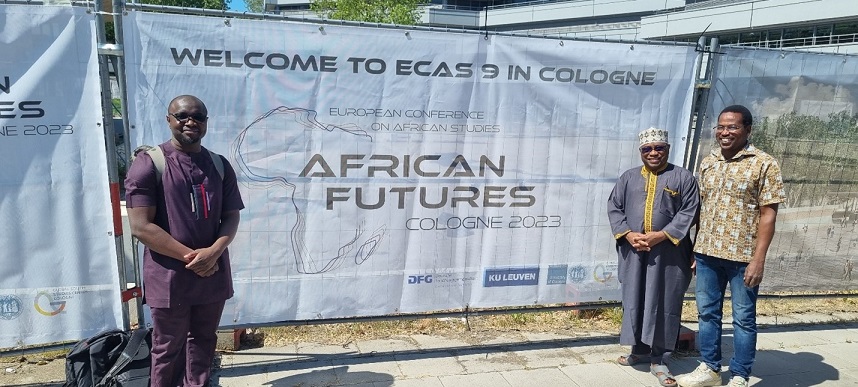
The week from Tuesday, 30th May to Sunday, 4th June 2023, I returned after ten years. This time, the occasion was to attend ECAS2023: 9th European Conference on African Studies, with the theme of “African Futures.” It was hosted by the University of Cologne. “African Futures” explores the continent’s critical engagements with the past, present, and future of Africa’s global entanglements. ECAS is the largest and most visible single event under the AEGIS umbrella. AEGIS is an expression of a much wider and dynamic set of African Studies connections, collaborations, activities and opportunities within and beyond Europe. The conference, lasting four days, had over 70 panels involving hundreds of papers and speakers. All were efficiently coordinated through the various classes at the University of Cologne.
Earlier in the year, I and colleagues from Germany and US had submitted a panel, “Digital/social media and Afrophone literature”, for consideration at ECAS 9. It was accepted. The conveners were me (BUK), Uta Reuster-Jahn, Umma Aliyu (Hamburg) and Stephanie Bosch Santana (UCLA). Before submitting our panel to ECAS, we first held an online symposium which was preceded by a call for papers. Despite sending the CfP to various universities and the Nigerian Academy of Letters (NAL), the response was pretty poor. The symposium was titled Social Media as New Canvas, Space and Channel for Afrophone Literatures. It was eventually held online at the University of Hamburg, Germany, on 22-23 February 2023. The participants then were from Germany (Uta Reuster-Jahn, Umma Aliyu Musa), Nigeria (Abdalla Uba Adamu, Zaynab Ango, Ado Ahmad Gidan Dabino, Nura Ibrahim, Asabe Kabir Usman, Isyaku Bala Ibrahim), Tanzania (Hussein Issa Tuwa, Zamda Geuza), Ghana (Nikitta Dede Adjirakor), Stephen Ney (Canada), US (Stephanie Bosch Santana).
After the symposium, we submitted a panel for the ECAS 9th edition. Our panel was accepted, and all the participants of the online seminar were issued official letters of invitation to process their funding for the conference in Cologne in June 2023. As a panelist, I was fully funded to attend by Deutsche Forschungsgemeinschaft (German Research Foundation, DFG). Umma and Uta were able to sponsor themselves from Hamburg. Unfortunately, only Nikita from Ghana was able to come from the others who could not get any funding. As a result, our panel, held on Wednesday, 31st May 2023, had only four speakers. It was déjà vu all over again – after almost 24 hours of flying and waiting at airports (Kano, Abuja, Doha), I was given only 20 minutes for the presentation.
My paper was “From Kano Market Literature to Kano Social Media Literature: The Reincarnation of an Afrophone Literary Genre.” The paper traces the trajectory of the genre from print media to its liberation in online media, with a specific focus on Facebook, Wattpad and APK files on Google Play. The paper uses netnographic methodology to harvest the dominance of and reaction to the newly reincarnated genre, which, far from being dead and buried, is more than ever before, alive and kicking in other spaces – beyond censorship or any form of criticism. In the process, the paper explores the freedom gained by the authors in unrestricted storylines that cross boundaries of identity, gender and alternative sexualities. The Journal of African Literature Association (curated by Taylor and Francis Group) has agreed to publish the papers of the Symposium in 2024. We will have to ask for more contributors.
Another dividend for me was that I was approached by a representative of Lexington Books in the US for the possibility of publishing my paper as part of a book on Hausa media cultures if I have something like that. As it happened, I have almost completed such a project titled “Hausa Cinema” (to complement Jonathan Haynes’s book, “Nollywood”) which was to be published by the Ohio University Press in 2010, but things went southwards! Now Lexington Books is providing an opportunity, and I am excited about it.
Our panel was lively, though, and I even met a fan! He was Jos Damen, Head of the Library and ICT Department of the African Studies Centre at the University of Leiden. While I was making my presentation, he took my picture with his phone and uploaded it to my Wikipedia page (itself created by another fan)! Later he told me I needed to have a picture there, and he took that responsibility. So it was kind of him!
The conference attendance was a fantastic homecoming for me because although Heike Behrend had retired back to Berlin, where she came from (and where I visited her in 2015 had a wonderful dinner when I was a guest of the Haus der Kulturen der Welt, Berlin), Muhsin Ibrahim is now in the same institute. Both Muhsin and I were from Bayero University Kano. Muhsin was teaching Hausa at the Institute.
I first came to Cologne in 2004 – at the invitation of Heike Behrend when I met her in Kenya. At that time, I had an invitation to participate in an African Literatures project at Johannes Gutenberg University, Mainz. Heike asked me to reroute my itinerary to stop at Cologne, teach a Postgraduate class and give a public lecture. I did both on Monday 15th November 2004. Since then, I have almost lost count of the times I visited Germany – Berlin, Freiburg, Hamburg, Leipzig, and the wonderful Cologne with its incredible, massive and stupendous cathedral – the largest Gothic church in Northern Europe. It was in Cologne in 2004 that the foundation of my ethnographic foray into critical media studies was laid. Unlike in Nigeria, where many saw me as an ‘interloper’ (as they murmur, ‘After all, he is a Biologist, isn’t he?’), here it is not what you study but what you can contribute to any discipline. I have been to Colone four times and other cities several times – all on the same mission of promoting Hausa media studies.
ECAS 2023 started wonderfully with Muhsin meeting me at the Koln Hauptbahnhof and helping me drag my luggage through various concourses to the trains that would take us to his flat: a very lovely well-furnished, and very spacious space. Upon arriving and freshening up, a massive mountain of uncharacteristically fat masa was waiting for me. Even the masa looks like a ‘Bajamushiya’! The soup alone could feed a family for a week! It was a truly delicious welcome. Once I got rid of the hunger, he took me to my hotel, IBIS Centrum.
Breakfast in the morning at the hotel saw a meeting of Who-is-Who in African studies – both diasporic Africans, home-based Africans and European and American researchers. It was indeed a wonderful gathering. In addition, I had a chance to reconnect with one of the most promising diasporic Hausa African Studies experts – Musa Ibrahim.
Musa is based in Ghana. He travelled there through South Africa and Japan, ending up in Bayreuth, Germany, where he obtained his doctorate. We met at Leipzig in 2018, and I collected his CV with the hope of getting him employed in our Information and Media Studies department, Bayero University Kano. However, the university was not interested. Before you knew it, he was grabbed by the University of Florida, Gainesville, where he spent about three years before getting another appointment at the University of Ghana. Such rich and varied experience would have been valuable to us in Kano, but the parochialism of our university system did not factor in multidisciplinarity.
The following day saw dinner at Muhsin’s house, and this time, Umma Aliyu, originally from Bauchi, joined us. Umma now lives and teaches in Germany at the University of Hamburg (after her studies at Leipzig). Like Muhsin, she also teaches Hausa at Hamburg, where she took over from Joe McIntyre (Malam Gambo), who retired some time ago. During dinner, we brainstormed the idea of two book projects – which, for me, was one of the significant takeaways from ECAS9.
Muhsin, Abdalla and Musa at ECAS9, Cologne
The first book project would be tentatively titled “Hausa Studies in European Diaspora: Experiences and Perspectives.” This will be a collection of chapters written by Hausawa living and working permanently in various European universities, either teaching Hausa or other disciplines. The objective is to demonstrate how internationalised Hausa scholarship is. We started with about five in Germany alone.
The second book project would be a post-Boko Haram narrative. So far, the Boko Haram literature has focused on the human disaster of the insurgency – virtually all books written were from the governance, security and disaster perspectives. Yet, much success has been and is being recorded in the war against terror in the form of surrenders, deradicalisation and reintegration. Yet, no one is looking at this. Using ethnographic field data, the book project will provide another side of the war on terror in Nigeria. We were excited and promised to work on various draft proposals before embarking on the works, which we hope will be completed by 2025.
The Conference’s overwhelming focus on the multidisciplinarity of African Studies was an eye-opener—no room or time for a narrow perspective on scholarship. No one cares about what your degrees are in – what matters is what you are bringing to the table NOW and how it impacts the knowledge economy of African societies and contribute to the decolonisation narrative.
For me, Cologne is a Return to Forever – the beginning of an endless loop of research and investigation.
My deepest thanks to Muhsin for being such an excellent, graceful host.
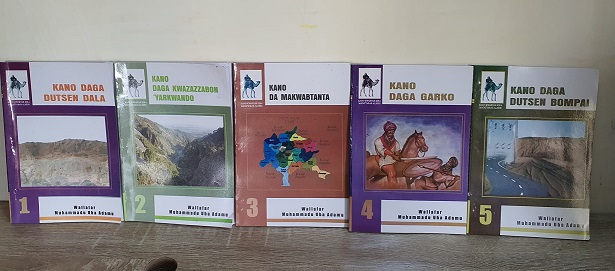
In my opinion, as a student of knowledge, there might be three reasons why I think everyone interested in Kano should read the 5-volume book Kano Ƙwaryar Ƙira Matattarar Alheri by the late Muhammadu Uba Adamu. May Allah bless his soul, amin.
1. Uncovers hidden narratives: the book offers a treasure trove of untold stories and forgotten or rarely told narratives of Kano history. The author masterfully explored the archives and conducted meticulous research allowing us to have a glimpse of the subtle Kano historical junctures, bringing to light stories of critical contributions, struggles, and resilience.
It is this very academic inclination to the Kano historiography that helps us challenge traditional historical narratives and gain a more inclusive understanding of our community’s past. By infusing creativity and academic rigour into the study of local history, the books unlock their transformative potential, fostering critical thinking, empathy, and an appreciation for the complexities of our community’s past and present.
2. The volume examines the microcosms of Kano’s ancient history: the author skilfully delves into the intricacies of our community’s past, helping us discern the impact of broader historical events, such as religious and economic shifts, social movements, or political changes. This very nuanced perspective enables us to grasp how global temporal processes shaped local realities, fostering a more comprehensive understanding of our interconnected world.
3. Analysis of spatial dynamics: in these volumes, it is discernible how the author uses the Kano history to analyse the spatial dynamics of our community’s development. Each volume uses an important geographical pivot point to relay historical milestones. This analysis provides insights into the social, economic, and cultural factors that have shaped the physical environment and spatial organization of our locality and our overall architectural heritage.
His name was Tijjani, and nicknamed Ma’aslam. He mainly lived in the Sabon Sara ward, Kano city, but was a common sight along the Mandawari junction to Kasuwar Kurmi corridor in the 1960s.
Everyone considered him nuts. Apparently, he built a single-storey building without stairs to access the upper floor. He did not think a door was necessary for any structure either, so the building had no doors. He simply jumped up to the upper floor at night and jumped down in the morning. It was enough for the ward head to report him to the Jakara magistrate for him to be locked up on insanity charges.
During the hearing, he was given a basket to fetch water. He simply laughed at the judge, informing him that only a madman would attempt to fetch water in a basket. The judge threw the case out, declaring him perfectly rational. He may be nuts – although eccentric was more apt to describe his behaviour. But then, it takes a certain amount of nuttiness to be an innovator. And he was an innovator.
As children – and I am talking 1960s inner city Kano – we simply referred to him as Ma’aslam. He, I would argue, planted the seeds of onomatopoeic intertextuality in Hausa popular culture, at least in Kano. This was the process of picking up an element of popular culture, say, a song, converting it side-by-side into a different language (intertextual), using ‘sound-alike’ of the original (which is onomatopoeia) into a new one. A quick example was the Bob Marley hook:
Get up, stand up,
Stand up for your rights
Sadi Sidi Sharifai, a Kano onomatopoeic superstar, converted this to:
Jallof, Jallof,
Jallop, sai da rice
Try singing both the original and Sadi’s interpretation, and you have become an onomatopoeic star yourself!
In 1967, the American super soul star James Brown & the Famous Flames recorded the stunning live double album of their concert at the Apollo Theatre in New York. It was, perhaps unimaginatively enough, titled, ‘Live at Apollo.’ A standout track on the album was ‘I Feel Alright’. Its choral hook was:
‘Hey, hey, I feel alright
One time, uh!’
The album of the concert was released on 16th August 1968. I was 12 years old then, and still now, totally wired in music, complete with a Ukulele guitar, given to me by David Hofstad (author of Tabarmar Kunya play). My Dad, an avid music lover, noting my attachment to the song which was played on the radio, simply bought the double album for me at Musa Zamani Record store in Fagge (are there any old codgers who remember this record store?). I played it to death on the old Grundig music player we had then.
Back to Tijjani Ma’aslam. With his eccentric behaviour categorising him as loony, Ma’aslam started reciting the ‘Dalailul Khairat’, a celebrated manual of salutations upon the Prophet Muhammad (SAW), written by Muhammad ibn Sulayman al-Jazuli in 15th century Morocco. What was unique about Ma’aslam’s open-air recitation, however, was that he adopted the James Brown meter in the song, ‘I Feel Alright’, as his chorus. His rendition of the hook for his recitation of the Dalai’lu was:
Mujibun, Mujabun,
Afiyan, Afuyan,
Rasulillahi
Ahlan wa Sahlan
Rasulillahi
This was accompanied by James Brown’s dance moves (shown on Television’s Soul Train, which was available in a few houses that he might have access to). Maybe he was not reciting the salutations in their structured order, but at least his verses were discernible, as the Dalai’lu itself was recited in a song form by many reciters in Kano. What he did, and did it differently, was using a foreign music meter to make it more accessible. This formula was to be adopted by the Ushaqu Indiya group of devotional singers in the city of Kano (actually along the same neighbourhood as Tijjani Ma’aslam). More of this in subsequent articles/posts.
Tijjani Ma’aslam’s delivery mode was intertextually onomatopoeic to ‘Hey, hey, I feel alright’. The chorus was ‘Rasulillahi’. Ma’aslam was usually followed by a gaggle of kids echoing the chorus while he merrily led the way, clapping his hands, dancing and reciting the names of the Prophet from the Dalai’lu. Elders were bemused at the spectacle and simply labelled Ma’aslam crazy. He might have been. He certainly was not following the sequencing of the Salawat from the book. But his performances opened a door.
Up the road from his haunt and covering the same zone was the Palace cinema. This was built and completed in 1951 and opened in 1952. Palace cinema became an instant hit with the youth, closeted in the city and without any visible means of night-time entertainment. Before its opening, and still a carryover from the World War II years (1939 to 1945), a curfew used to be imposed on city residents at 8.00 p.m. With the relaxation of the curfew, the few neighbourhood plazas (dandali) that offer games for youth (both boys and girls) were no match for the sheer spectacle of a massive screen accompanied by loud music. The predominant films shown in the cinema were cowboy or mainstream European films. However, after independence in October 1960, Indian films started to be shown from November 1960 in Kano cinemas. Early films screened included Cenghiz Khan, Jaal, Sangeeta, Raaste Ka Patthar, Waqt, Amar Deep, Rani Rupmati, Dharmatama, Dost, Nagin and thousands of others. The one that caught massive imagination in Kano’s inner city, however, was Rani Rupmati, originally released in India in 1957 but only found its way to Kano cinemas in the 1960s.
Like all Indian films, at least from what the industry refers to as Bollywood, Rani Rupmati had a lot of songs – in fact, its overall screenplay is based on two people united by their love of music. However, two songs from the film caught Kano’s inner city imagination, ‘Itihaas Agar Likhna Chaho’ and ‘Phool Bagiya Mein Bulbul Bole.’ Interestingly, there was no choreographic dancing in these two songs, unusual for general Bollywood films but typical of earlier, more historical and artistic ones.
The first, ‘Itihaas’, sung by Lata Mangeshkar, has a great hook that, thanks to Tijjani Ma’aslam, became domesticated by kids along his sphere of influence and Palace cinema zone. It goes something like this:
Itihaas agar likhana chaho /
Itihaas agar likhana chaho /
Azaadi ke mazmoon se /
…
To seencho apni dharti ko /
Veeroon tum upne khoon se /
Har har har Mahadev /
Allaho Akubar /
Har har har Mahadev /
Allaho Akubar /
Sung within the backdrop of a band of warriors getting ready to go into a battle, led by a woman (the titular Rani Rupmati), it certainly gave the picture of a woman more enlightening than what was both the Hausa and Indians are used to. The film itself endeared itself to Hausa through the modesty of the women – shy drooping kohl-enhanced eyes with long blinking lashes, fully clothed (even the swimming scene shows the singers fully clothed in the river), with sari that resembles Hausa wrapper (zani), lots of jewellery, and stunning beauty. A Hausa common saying of the period was, ‘Allah, kai ni Indiya ko a buhun barkono’/God, let me visit India even in a sack of pepper. That was how besotted Hausa youth were to the beautiful Indian women seen on the screen, giving a false impression that every single Indian woman is beautiful.
Hausa youth, inspired by Tijani Ma’aslam, quickly domesticated the chorus of the song as:
Ina su cibayyo ina sarki / where are the warriors, where the is king?
Ina su waziri abin banza / And the useless vizier?
Mun je yaƙi mun dawo / we have return from the war
Mun samo sandan girma / and we were victorious
Har har har Mahadi / hail, hail the reformer
Allahu Akbar / Allah is the Greatest
Har har har Mahadi / hail, hail the reformer
Allahu Akbar / Allah is the Greatest
In an interesting case of lyrical substitution, the Hausa intertextual transcription captured the scene of the song as shown in the film, if not the actual meaning of the words. Loosely translated, the original verse was urging warriors to defend their land with their lives and become part of history. The chorus translates as ‘Let each of us sacrifice ourselves to Mahadev’.
While Mahadev was a reference to the Indian deity, Shiva, this pantheistic line was followed by a monotheistic reference to Allah, the Supreme Being in Islam. Thus, two contrasting religious sentiments were expressed in the song. It was likely that S. N. Tripathi, who directed the film and composed the music, introduced the chorus to attract both Hindu and Muslim audiences. After all, while Rani was a Hindu, her love interest in the film, Baaz Bahadur, was a Muslim. The expression, however, has since then been used as a slogan of communal harmony between often warring Hindu and Muslim communities in India.
But more stunningly, the Hausa version substituted the word ‘Mahadev’ with ‘Mahadi’. The Hausa heard ‘Mahadi’ (guided one), not ‘’Mahadev’, which worked perfectly well. Substituting Mahadev for Mahadi Islamized the song, as it were. In Islamic eschatology, Mahdi is a messianic deliverer who will fill the earth with justice and equity, restore true religion, and usher in a short golden age lasting seven, eight, or nine years before the end of the world.
The second song from the film, ‘Phool Bagiya Mein Bulbul Bole’ (also sung by Lata Mangeshkar, with Mohammed Rafi), also inspired onomatopoeic intertextually but further afield from Kano and bizarrely entered into Hausa urban legend of the 1960s. Its first verse goes something like this:
Phul bagiya me bulbul bole /
Daal pe bole koyaliya
Pyaar karo /
Pyaar karo rut pyaar ki aayi re /
Bhanwaro se kahati hain kaliya /
Ho ji ho ho ji ho ho ji ho /
Ho ji ho /
What Hausa youth heard in the choral refrain was ‘Hotiho’, not ‘Hojiho’, and in the film Rani Rupmati, the lady (played by Nirupa Roy) came to be referred to as Hotiho. The Hausa griot, Mamman Shata (d. 1999) popularised the word (which has no particular meaning) in his song, Mallam Sidi, ‘Mijin Hotiho’/Mallam Sidi, Hotiho’s husband.
In the film, there was no marriage between Rani and Baaz Bahadur because she said she was ‘married to her music’, despite living with him after running away from home to avoid death from a chalice of poison given to her by her father to avoid the shame of her rejecting a chosen husband. In all their dialogues, Rupmati and Baaz Bahadur stress their shared love for music, not their love for each other. So, Shata did not accurately describe the relationship in the film. However, such deep film analysis is not important to the transnational interpretation of Shata of Baaz Bahadur as a signature tune for a hen-pecked husband. Shata’s interpretation of the actor who played Rani’s lover was certainly in order as he was effeminate and obsessed with music rather than empire building, despite being heir to a throne. It was even Rani who led their army into war. He was wounded in the battle and ran away.
Another Hausa griot, Ali Makaho (d. 1984), known famously for his anti-drug song, ‘Mandula’, briefly referenced Rani Rupmati in another of his songs.
Za ni Kano / I’m going to Kano
Za ni Kaduna / I’m going to Kaduna
Mu je Katsina lau za ni Ilori / Let’s go to Katsina and Ilorin
Na je Anacha / I will go Onitsha
Ni ban san kin zo ba / I didn’t know you had arrived
Da na san kin zo ne / If I had known you have arrived
Da na saya miki farfesu / I ‘d have bought you [pot of] pepper soup
Hitoho hotiho /
Hotiho hotiho /
With a comedy skit thrown in, Ali Makaho’s rendering uses Phoolbagiya’s meter to narrate a series of anticipated travels over northern Nigeria. As an intertextual comedy, it worked and remained of his most memorable skits.
A third Hausa griot to adapt a song from Rani Rupmati was Abdu Yaron Goge, who played the goge (a large fiddle played with a bow). Abdu picked ‘Raat Suhani’ from the film for his adaptation. Since, unlike the other griots who used the elements of the songs from the film, Abdul was a musician, he used two approaches – first was rendering the symphonic structure of the opening bars of the actual composition, Raat and playing it on his fiddle, then secondly, he onomatopoeically appropriated Mangeshkar’s lyrics as Hausa version. The original lyrics were as follows:
Raati Suhani /
djoome javani /
Dil hai deevana hai /
Tereliye /
Tereliye /
These lines were pure expressions of love the protagonist has for her lover, especially ‘in the beauty of the night’ [raati Suhani]. Abdu Yaron Goge’s rendition was as follows:
Mu gode Allah, Taro / We should thank Allah, people
Mu gode Allah, Taro / We should thank Allah, people
[These lines vocalized the opening bars of Raat]
Duniya da daɗi /This world is nice
Lahira da daɗi / The hereafter is nice
In da gaskiyar ka / If you are truthful
Lahira da daɗi / The hereafter remains nice
In babu gaskiyar ka / If you are untruthful
Lahira da zafi / The hereafter is blazing
Thus, in a single verse (which he kept repeating over and over till the end of the performance), Abdul Yaron Goge borrowed a popular musical motif from another culture and domesticated it to Hausa entertainment. At the same time, he delivered a message totally different from the original meaning.
There were, of course, many other onomatopoeic intertextual interpretations of Indian film songs, but the three songs from Rani Rupmati, predated by Tijjani Ma’aslam’s innovative use of foreign motifs, were the definitive pioneers in music. In Literature, look towards Abubakar Imam and Magana Jari Ce. The intertextual origins of Hausa arts, of course, started in the 1930s; but its migration to music was certainly in the 1960s. It spawned a Hausa Cinema industry which was labeled ‘Kanywood’ in 1999, a few years before the term ‘Nollywood’ to refer to the Nigerian English language cinema, was created.
On a final note, Nazeer Abdullahi Magoga, a Kano ‘Indian’ (who speaks the language fluently, to the shock of BBC Delhi, who sent a crew to interview him in Kano, in Hindi) composed a song for the Centre for Hausa Cultural Studies, Kano which I was heading, but which I had to pause due to lack of funding. He used the Raat Suhani meter and used both Hausa and Hindi lyrics in his wonderfully beautiful tribute to the Centre. A link to the song on YouTube is given below. To really appreciate Nazeeru’s performance, listen to the original Raat Suhani from the film Rani Rupmati, also provided in a link.
Cibiyar Nazarin Al’adun Hausa by Nazeer Magoga [Raat Suhani template]