Hardship

Ghanaians reject ruling NPP: A caution for Nigeria’s APC

By Zayyad I. Muhammad

Ghanaians have voted out the ruling New Patriotic Party (NPP) in the presidential election on 7 December 2024. The party’s candidate, Vice President Dr Mahamudu Bawumia, has conceded defeat to former President John Dramani Mahama of the opposition National Democratic Congress (NDC).

The NPP’s downfall is attributed mainly to Ghana’s economic woes. Under its leadership, the country has experienced its worst financial crisis in decades, marked by skyrocketing food prices, rampant unemployment—particularly among the youth—soaring living costs, and an overwhelming debt burden.

Although no party in Ghana has ever won a third consecutive term, many observers and analysts believe the NPP was punished for failing to alleviate citizens’ economic hardship. Despite criticisms of Mahama’s previous tenure—characterised by a weak economy, allegations of corruption, and widespread power outages—Ghanaians have opted for his return. Mahama has promised to chart a new course for the nation – though politicians are like that!

What makes Ghana’s December 7 presidential election particularly striking is that even supporters of the NPP welcomed their party’s defeat. This unusual occurrence reflects the extent of the economic challenges faced by Ghanaians—challenges they claim are unprecedented in recent generations.

Ghana’s presidential election result sends a strong message and serves as an early warning to Nigeria’s ruling All Progressives Congress (APC). For the majority of voters, particularly the masses, what truly matters are tangible results: affordable food, reduced living costs, and economic relief. They care little for figures, statistics, reforms, or long-term projections if their immediate needs remain unmet.

Nigerians today face similar struggles: soaring food prices, escalating petrol costs, and crippling transportation fares. These same issues that brought down Ghana’s NPP threaten to undermine Nigeria’s APC, which is already losing sympathy in its traditional strongholds, especially the North. However, the APC still has time to take stock, address these challenges, and implement meaningful changes.

Ghana’s ruling NPP’s defeat is a stark warning to Nigeria’s APC. When the economy fails, so does the people’s trust. Voters, particularly those struggling to meet their basic needs, will not hesitate to hold governments accountable at the ballot box. 

Rising food prices, high living costs, and unemployment are not just economic indicators—they are everyday realities that define the quality of life for ordinary citizens. If the APC fails to address these pressing challenges and provide visible, immediate solutions, it risks suffering a fate similar to Ghana’s ruling NPP. 

The Ghanaian experience highlights a universal truth: no amount of political rhetoric or long-term promises can outweigh the frustration of citizens whose daily struggles remain unresolved.

Zayyad I. Muhammad writes from Abuja, zaymohd@yahoo.com.

Hardship: “Things’ll get better soon” Tinubu, Sanwo-Olu assure Nigerians

By Anwar Usman

President Bola Ahmed Tinubu on Monday, affirmed that Nigerians are going through a serious difficulties, but assured that the situation will soon change for the better.

While Tinubu insisted that his administration was on the right track, he also noted that solutions to these problems cannot be an instant one.

On his part, Lagos State governor, Babajide Sanwo-Olu, described the current administration as tough men working to get Nigerians through the prevailing difficulties.

Represented by Secretary to the Government of the Federation, Senator George Akume, Tinubu, and the Lagos governor spoke at the 70th birthday of the Overseer of Citadel Global Community, Pastor Tunde Bakare in Lagos.

Akume said: “The president is aware of the hard times, but at the end of it all, there is always light. And solutions to diverse issues can never be as instant as coffee, but we are on the right track.”

The president also described Pastor Bakare as a spiritual leader and advocate for truth who had left an indelible mark, not just on those who follow his teachings, but on the nation as a whole.

“I am aware of your relentless passion for better Nigeria, a country where equal justice and good government prevails. This celebration is a testimony to a life of strength and courage, of powerful messages and fearless advocacy, deep volumes of your dedication to lifting humanity.

On another development, Sanwo-Olu said those in public office needs the public’s prayers, saying “It’s a hard times, but you see, we are also tough men, and we know that at the end of the tunnel, there will be a bright phase.”

Tinubu responds to Atiku: “Your proposals lacking in details, rejected by Nigerians”

By Uzair Adam

President Bola Ahmed Tinubu has responded sharply to former Vice President Alhaji Atiku Abubakar’s recent criticism of his economic reform agenda.

The Daily Reality reports that the response was conveyed in a statement issued Tuesday by Bayo Onanuga, Special Adviser to President Tinubu on Information and Strategy.

Onanuga noted that Atiku’s proposals, which he described as lacking in detail, were already rejected by Nigerians in the 2023 election.

“If he had won the election, we believe he would have plunged Nigeria into a worse situation or run a regime of cronyism,” Onanuga stated.

The statement began, “We have just read a statement credited to former Vice President Alhaji Atiku Abubakar, in which he tried to discredit President Bola Tinubu’s economic reform programmes while pushing his untested agenda as a better alternative.”

It added that Atiku’s defeat in the election was partly due to his commitment to privatizing the NNPC and other national assets, a move perceived as favoring close allies.

“Nigerians have not forgotten this, nor would they be comforted by Atiku’s track record when he managed the economy during President Olusegun Obasanjo’s first term from 1999 to 2003.

“As Vice President, Atiku supervised a questionable privatization program. He and his boss displayed a lack of confidence in our educational system, establishing their own universities while public institutions struggled.”

Onanuga criticized Atiku’s statement as “cheap talk,” suggesting it is easy to criticize without acknowledging the positive outcomes already emerging from Tinubu’s reforms, even amidst temporary challenges.

“Despite his futile attempt to sway Nigerians, it is clear that the former Vice President could not refute the soundness of the reforms pursued by the Tinubu administration.”

He added that Atiku’s call for a gradualist approach reveals a misunderstanding of the severe challenges faced by the Tinubu administration.

“President Tinubu met a country facing several grave challenges. Fuel subsidies were siphoning away enormous resources we could ill afford, and there was criminal manipulation in the forex market. No responsible leader would allow these economic disorders to persist.”

While advocating for gradual reforms may sound appealing, Onanuga asserted that Tinubu has taken decisive actions that should have been implemented years ago, during the administration when Atiku served as Vice President.

In response to Atiku’s call for empathy in governance, Onanuga highlighted that this aligns with Tinubu’s commitment to protecting the most vulnerable.

“President Tinubu has consistently emphasized the need for compassion in his reforms, prioritizing social safety nets and targeted support for those affected by economic transitions,” he added.

64 years after Nigeria’s independence

By Rabi Ummi Umar

A few weeks ago, Nigeria marked its 64th independence anniversary, commemorating more than six decades since gaining freedom from British colonial rule on October 1, 1960. However, this year’s celebrations were unusually subdued, devoid of the usual fanfare, pomp, thrills and frills. 

The once-familiar scenes of face painting, jubilant crowds, and flags waving in patriotic pride were replaced by an eerie silence that echoed across the nation. Despite this significant milestone, many Nigerians found little reason to celebrate. The mood was sombre, reflecting a collective sentiment that these are not times for revelry.

Instead, citizens believe it is a time for reflection and a renewed commitment to steering the country back toward prosperity, as envisioned by the men and women who fought for the independence we now enjoy. In the eyes of most Nigerians, the celebration only serves as a distraction from the harsh realities of daily life.

The more one reflects on the state of the nation, the more troubling it becomes. What exactly are we celebrating? Is there anything genuinely worth commemorating at this point? After the fireworks, what awaits us—more suffering? The unspoken truth is that the situation has grown so dire that it is almost impossible to ignore the country’s challenges, no matter how much we might want to.

One of the major concerns plaguing citizens is the aftermath of the subsidy removal, which continues to wreak havoc on lives and livelihoods. While the minimum wage has been signed into law, its implementation remains uncertain, casting doubt on the government’s ability to deliver on promises and its tendency to prioritise talk over tangible action. 

These discrepancies raise questions about the effectiveness of policies aimed at alleviating the struggles of Nigerians. Our leaders have made numerous promises, but despite their assurances, little has been done to address the suffering of the people. Take the much-touted Compressed Natural Gas (CNG) buses, for example. Despite promises, these buses have failed to materialise in significant numbers. Even the few introduced fall short of addressing Nigeria’s transportation challenges. 

How much progress can we realistically expect from such initiatives? Unemployment remains a persistent issue, exacerbating the nation’s woes. Although the National Bureau of Statistics (NBS) reported an unemployment rate of 5.3%, many believe the actual figure is much higher, especially given Nigeria’s struggle with accurate population data.

Insecurity is another critical concern. Terrorism, banditry, and kidnapping for ransom plague every region, with countless lives lost, even after ransoms have been paid. Nigerians are grappling with hunger as the crisis reaches alarming proportions. Starvation, suffering, and even death from hunger have become stark realities.

According to the Food and Agriculture Organization (FAO), 80 to 82 million Nigerians are at risk of severe hunger if the current trajectory continues. Given our vast agricultural potential, how did we reach this point? Politics in Nigeria remains largely a curse, with politicians exploiting religion, region, and ethnicity to garner support. 

Instead of uniting to solve the nation’s problems, they engage in ridicule, even on pressing national issues, as seen in the aftermath of the President’s October 1 address. Poverty also remains a major concern. The NBS reports that 63% of the population—approximately 133 million people, or six out of every ten Nigerians—are trapped in multidimensional poverty. 

It is little wonder that Nigerians are not in a celebratory mood. So much has gone wrong recently that even wishing someone a “Happy Independence” feels offensive. What, after all, have we indeed achieved in these 64 years? Nigeria has the potential for greatness, and the government can and should do better. President Tinubu, please, we are begging—Nigeria deserves better.

Rabi Ummi Umar is an intern at PRNigeria and a student at Al-Hikmah University, Ilorin. She can be reached via rabiumar058@gmail.com.

Palliatives are not solutions for hardship: The bitter truth

By Rabiu Musa

The removal of fuel subsidy has become increasingly problematic for the masses. The declaration was made by Bola Ahmad Tinubu on 29 May 2023, during the inaugural speech as Nigerian president.

On the occasion, the president said, “We commend the decision of the outgoing administration in phasing out the petrol subsidy regime, which has increasingly favoured the rich more than the poor. Subsidy can no longer justify its ever-increasing costs in the wake of drying resources. We shall instead re-channel the funds into better investment in public infrastructure, education, health care and jobs that will materially improve the lives of millions.”

As a result, several filling stations, not less than 24 hours after the president declared an end to fuel subsidy, saw the pump price of Premium Motor Spirit, commonly known as petrol, soared to N600 per litre from N195/l in many parts of the country.

This also triggered a 100 per cent hike in transport fares, and queues in filling stations worsened because many stations were shut down. The situation has become unbearable for many citizens due to government policies drastically affectingtheir livelihoods. The surge in hardship has been linked to rising insecurity and widespread hunger, leaving millions in dire circumstances.

Poverty in the country is escalating at an alarming rate, and many people can no longer afford necessities like food, healthcare and education. Civil servants, for instance, are forced to sell their cars or abandon them entirely due to skyrocketing and unstable fuel prices.

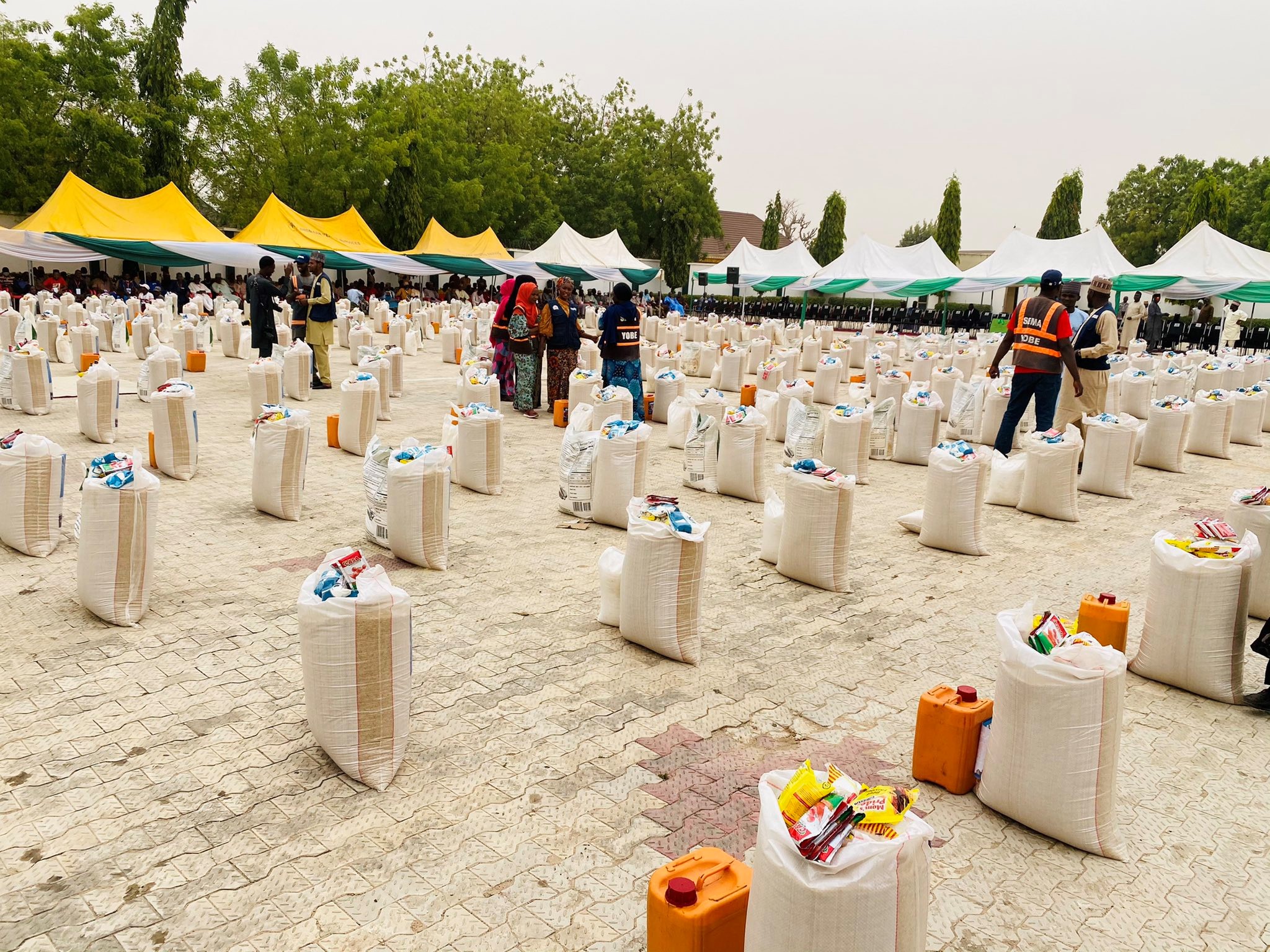
The government has introduced various palliative measures to relieve vulnerable citizens and ease their hardship. However, These poverty alleviation schemes are far from sufficient to address the root causes of economic distress many Nigerians face.

The former head of state, Gen. Abdulsalami Abubakar, recently expressed concern over this approach, stating that palliative measures alone are not the answer to the hardship and will continue to urge the government to address the hardship confronting the people. He said this during a visit from a delegation of Campaign for Democracy (CD), a Civil Society Organization (CSO) hosted in Minna, Niger State. He emphasised the need for the government to find more sustainable ways to alleviate the economic struggles of the people.

In an estimation of  216 million Nigerians population, according to the National Bureau of Statistics (NBS), Nigeria’s palliative distribution efforts are not enough to address the depth of poverty and hunger affecting the masses. The key questions are: Will these palliative measures truly alleviate the hunger people are experiencing? Are the goods and support reaching the most vulnerable citizens? 

Numerous reports of corruption and mismanagement in the distribution of palliatives have been published. For example, a report published by Punch Newspaper on September 5, 2023, highlighted that the Department of State Services arrested some Nasarawa State Emergency Management Agency officials for allegedly diverting palliatives meant for vulnerable citizens.

The government should rethink its policy-making process and prioritise the needs of the poor before implementing any new actions. One crucial step would be to create an enabling environment that attracts investment, which can, in turn,positively impact the lives of citizens. Achieving this requires adopting a flexible and inclusive approach to policy-making

—one that genuinely considers the welfare of the masses.

Rabiu Musa wrote from the Department of Mass Communication, Bayero University, Kano. He can be reached via musarabiu913@gmail.com.

Nigeria at the crossroads: Should this be our reality?

By Rabi Ummi Umar

A reality check is not a punishment but a reminder to refocus. – Unknown. 

Monday is the day of the week that people generally dislike. It is usually laden with the stress of getting to work early and getting the job done. I contend I have grown past the assertion that all days of the week are the same to me. Some think Mondays set the tone for the week. 

As I finished up my work for the day, feeling a sense of reprieve, I began browsing through various travel apps in search of a ride home. It is always like this when I finish my 9-to-5 weekday. Only this time, it was different. Rides were scarce, and frustration started to creep in as it also started to rain cat and dog.

The driver arrived, and I hastily exited the building to meet him outside. Upon reaching the vehicle, we exchanged pleasantries as I promptly fastened my seatbelt and leaned against the window, savouring the decidedly cold air while simultaneously trying to make sense of the chaos surrounding me.

My frustration mounted as we remained stuck around the office vicinity, surrounded by a series of sounds. Cars honked incessantly, drivers venting their frustration at the gridlocked roads, and some bumped into each other. It was not difficult to guess that their anger was from waiting in long queues at the filling stations and the urge to make some money before the end. Should this be our reality? 

Meanwhile, commuters on the road struggled to secure a ride home because some who own vehicles have abandoned them. Hawkers shouted and called out to prospective customers to patronise them. The standard of living is expressly high; they are fighting tooth and nail to feed their families. Should this be our reality?

Nigerians have gone from one issue to the other, but the most recent and important is the fuel hike, which most Nigerians rely on. This has affected so many lives, from pedestrians and drivers to heads of households and children. Should this be our reality? 

Many people are suffering, even dying. You can hardly make ends meet even with your money; imagine not having any for basic necessities. The question of “Renewed Hope” still lingers in the hearts of Nigerians as we are forced to adapt to every unfavourable situation. Should this be our reality? 

Citizens have gone from hoping for renewed hope to just wanting to be alive. Things have taken extreme turns, and no one even knows where we are heading. Talk more about the final destination. Should this be our reality? 

As I watched these events unfold in just minutes, road traffic getting worse and rain still drizzling, my mind jolted back to Maiduguri. The people are still struggling with the damage to so many lives and properties. How pathetic, I thought. Should this be their reality? 

How are they coping? How are they coming to terms with this loss? Do they have shelter to take refuge under when it pours like this? I tried to put myself in their shoes, and this exercise only made me even more appreciate all I have now. 

Earlier, I was scrolling through my TikTok app and stumbled upon a shocking sight: suspected bandits doing a ‘giveaway’ on TikTok. My jaw dropped. We have all been forced to familiarise ourselves with the unsettling reality that terrorists have a presence on social media. Still, the audacity of openly carrying out such an act is genuinely alarming. It seems they no longer have any regard for authority. Should this be our reality? 

I went onto ‘X’ to clear my head after what I had just witnessed, and lo and behold, someone had already tweeted about it. They wrote, “Bandits dey do giveaway for TikTok, God which kind country you put me so.” I could not resist tapping into the replies, and while some were humorous, they only pointed out that we were doomed. Should this be our reality? 

Many people find it funny; some even want to participate because the country is tough. But this is highly concerning. Our reality is so concerning. Are we really succumbing to these? Should this be our reality? 

This is the state of the nation—Nigeria. As the quote above suggests, a reality check is not a reprimand but a chance to recalibrate. Therefore, it is time for the government and citizens to work together for a better reality!

Rabi Ummi Umar is an intern at PRNigeria and a student at Al-Hikmah University, Ilorin. She can be reached at rabiumar058@gmail.com.

Hardship: Nigerian university students bear the burden

By Zainab Haruna Shittu

The economic downturn in Nigeria has reached alarming proportions, leaving no one unscathed. The youth, particularly university students, face unprecedented hardships. Financial constraints, food insecurity, and limited access to resources have become the norm for many Nigerian university students.

Research has shown that economic hardship profoundly impacts students’ academic performance and mental health. A National Bureau of Statistics (NBS) study reveals that poverty and hunger are major factors contributing to students’ poor academic performance. Similarly, a report by the United Nations Children’s Fund (UNICEF) highlights the devastating effects of food insecurity on students’ mental health.

For many students, the struggle is personal. “Academic pressure mounts, but hunger weighs heavier. I’m constantly worried about where my next meal will come from,” confesses a 21-year-old student who wished to remain anonymous.

Another student echoes this sentiment. “I struggle to focus in class because I’m constantly worried about where my next meal will come from. My parents’ hard work doesn’t pay enough to sustain us, leaving me hungry and stressed. The toll on my mental health is overwhelming,” shares a 20-year-old university student.

To mitigate the effects of economic hardship on university students, policymakers and stakeholders must prioritise education and food security. This requires collaborative efforts, including government support for education and food programs, increased scholarships and financial aid, improved access to mental health resources, and community-based initiatives for food security.

Nigeria’s economic woes have far-reaching consequences, affecting various sectors, including education. University students deserve support and resources to thrive. It is imperative that we prioritise their well-being and future.

Zainab Haruna Shittu wrote from Bayero University, Kano, via harunazainabshittu7567@gmail.com

Ajuri Ngelale’s Exit: Tinubu should rejig his media & PR team 

By Zayyad I. Muhammad

Ajuri Ngelale, President Asiwaju Bola Ahmed Tinubu’s special adviser on media and publicity, has announced that he will be taking an indefinite leave of absence to focus on medical issues concerning his immediate family. Ngelale hoped to return to national service when circumstances, recovery, and fate allow.

President Bola Ahmed Tinubu has accepted the decision and wishes Ngalele well.

Ngalele’s leave of absence has sparked numerous reactions from many Nigerians. This comes as no surprise; anyone taking an ‘indefinite’ leave or resigning from President Tinubu’s administration is likely to be viewed negatively due to the country’s current economic challenges and some of the administration’s unpopular decisions and policies. 

Additionally, there is a public perception that those not in the Tinubu administration’s ‘inner circle’ may encounter difficulties or hiccups—though such assumptions have always been Nigerian. However, the Daily Nigerian reported that Ngalele was forced out. The paper said that Mr Ngele was only given a soft landing to quit as presidential spokesman, but he chose to quit all his positions.

Since Mr Ngelale’s appointment, which was influenced by the first family, campaign spokespersons have been under internal pressure to replace him with “someone with better media relations” or “someone the president is more pleased with.”

DAILY NIGERIAN also gathered that Mr Ngelale was also on a collision course with other media aides working for the president for allegedly sidelining them in the running of the affairs of the office. According to sources, Mr Ngelale had also chewed more than he could bite, taking several roles that affected his primary media relations role. The sources said the tasks of being a Special Presidential Envoy on Climate Action and chairman of the Presidential Steering Committee on Project Evergreen have created a role strain and given the cabal a reason to convince the president to replace him.

Given his skills, experience, and expertise, Ngalele has done an outstanding job as a spokesperson. While the Tinubu administration must find a capable replacement for him, they must focus on more than just appointing another Senior Special Adviser on Public Affairs. The administration requires a dynamic and versatile media and PR team that can shift from a reactive to a proactive approach, as Nigerians will not now listen to just standard good English.

President Tinubu needs a PR team that can effectively reinvent Nigerians’ familiar image of Asiwaju Bola Ahmed Tinubu. The focus should not be on finding a replacement for Ngalele but on assembling a dynamic and strategic team capable of rebranding and promoting Tinubu. This team should highlight his accomplishments and present them in a way that can restore public confidence. 

For instance, Tinubu’s PR should focus on the North, where the president’s rating decreases daily. Moreover, it’s essential to showcase the value and contributions of each cabinet member, emphasising what they bring to the administration’s overall agenda. The greatest mistake Tinubu will make is to bring on board politicians; most Nigerians will not listen to them.

President Tinubu should Rejig his media and PR team, and they must communicate in a way that resonates with Nigerians and actively engage with them. They must speak to Nigerians in the ‘language’ they understand, but the bottleneck is that the only language Nigerians understand is what will bring ‘rice and beans’ to their tables.

Zayyad I. Muhammad writes from Abuja via zaymohd@yahoo.com.

Nigerian predicament: In search for the headway

By Bilyamin Abdulmumin, PhD

Nigerians appeared to have tried several options without a glimmer, so the option to try the youth is now gathering momentum. This call comes at the heels of the ten days of the recent controversial protest. Two other options were weighed during this protest: military takeover and alliance with Russia.

 Nigeria’s (or even African) history didn’t support the clamour for a military takeover. In the 64 years since Nigerian independence, military rule (according to my arithmetic) lasted 31 years, but at best, the military—once seeming the panacea—didn’t proffer any solution.

In another desperation to find the nexus, some protesters fly Russian flags. One interpretation of this antics is that they want Nigeria to cut any ties with the U.S. and most of Europe by proposing a shift of alliance to Russia. According to this argument, Western economic policies haven’t benefited Nigeria, so perhaps a different geopolitical alignment will.

However, aligning with Russia, an equally extreme approach, is not guaranteed to yield better outcomes. Has this group of protesters heard about the Scandinavian Economic Model? This model seeks to strike a balance between the capitalist extremes of the U.S. and the state-centred economies of Russia, offering a suitable middle ground for us. Instead of Russian flags, these protestants might have flown those of Sweden, Finland, or Denmark.

The search for a better headway began in 2015 when Nigerians, for the first time, voted for a leader based on integrity and record antecedent, putting aside money, politics, and tribal loyalties to some extent. However, by the end of President Buhari’s first term, the public began to have second thoughts. After his two terms, something unthinkable happened: many staunch supporters turned critics, and now, a year into Tinubu’s presidency, the failure of seasonal veterans is sealed, hence fueling the growing clamour for young leaders.

This urge for youth takeover is a more realistic option. The youths have become tired of being used and “dumped.” given that most of those who vote are youths, they now want to take a leading role by floating a political party exclusive to the youth.

The youth proponents argue that the youth have energy, time, and health. To boot, youth leadership is characterized by pressing the button; their hands are always close to the button, just waiting for a slight opportunity to press it.

This argument came to the forefront during f-PMB leadership, when he appeared to be going too slow, hence nicknamed Baba go slow; one of my friends opined that Nigeria then was in dear need of young leaders’ vitality, speed, and urge to get us out of the mud. According to my friends, a young leader would have made several decisions faster in tune with the situation and public yearning.

However, there is a crack in the foundation; one problem with youth is unity and cooperation; we always find that we want to help fellow youths whenever the need arises. Several youths aspire to different positions in this country, but the first people to boycott them are fellow youths; it will be their fellow youths who begin to mock them. This is a similar dilemma the women face. Women worldwide decry exclusion, but when a fellow woman tries to compete with men, it would be the fellow women that bring them down. This internal counterproductivity must be addressed for the current movement to get hold.

In addition, those who side with veterans criticize youth leadership with haste, which often leads to regret; this category argues that sound decision-making comes from experience—something older leaders have in abundance. They believe leadership is a process, not an event, and that wisdom is forged through trial and error.

 By and large, if the current movement sees the light of day, to slow down the haste and reduce mistakes, please let the old guards deputize the new crops.

Fuel price hike pushes Nigerians to breaking point – NLC, Atiku sound alarm

By Uzair Adam

The Nigeria Labour Congress (NLC) and former Vice President Atiku Abubakar have issued warnings that the recent increase in petrol prices by the Federal Government is pushing many Nigerians to a breaking point.

This comes as prominent human rights lawyer Femi Falana, SAN, calls on the government to complete the rehabilitation of the nation’s refineries by September 2024 or take legal action against contractors for failing to meet project deadlines.

The Socio-Economic Rights and Accountability Project (SERAP) also urged President Bola Tinubu to order the Nigerian National Petroleum Company Limited (NNPCL) to reverse the price hike, labeling it as “illegal and unconstitutional.”

While the NLC advocated for public resistance to the fuel price increase, Atiku highlighted that the government’s plans to raise Value Added Tax (VAT) would further worsen the economic strain on citizens.

NLC President Joel Ajaero, represented by Prince Adewale Adeyanju at a Labour Writers Association of Nigeria workshop, decried the combination of fuel price hikes, naira devaluation, and rising electricity tariffs as policies that have deepened the struggles of ordinary Nigerians.

Atiku also voiced concerns that the VAT increase, following the petrol price surge, would severely impact the country’s already fragile economy and the livelihoods of Nigerians, compounding the existing cost-of-living crisis.