Google

Senator Natasha Akpoti tops Google’s 2025 list of most-searched Nigerians

By Hadiza Abdulkadir

Google Trends has released its Year in Search 2025 report, revealing the Nigerians who drew the most online attention throughout the year. Leading the list is Senator Natasha Akpoti, whose political activities and rising national profile kept her at the centre of public conversation.

Natasha Akpoti, the recently reinstated senator, has remained at the centre of national attention following a turbulent political year marked by her suspension after accusations from the Senate President, Godswill Akpabio, and an ongoing defamation suit he has filed against her.

Sen. Akpoti’s return to the Senate coincides with a period of renewed visibility at home, where she celebrated her 46th birthday and launched several constituency projects, including a new maternity hospital. In a gesture that drew widespread public reaction, she also gifted houses to some of her aides, further solidifying her image as a polarising yet impactful political figure.

The second most-searched Nigerian is Eberechi Eze, the England-based football star of Nigerian descent, whose impressive performances and debates over his international future fueled widespread interest. Siminalayi Fubara, Governor of Rivers State, ranks third as developments in the state continued to dominate headlines.

In fourth place is Chika Ike, the acclaimed actress and filmmaker whose resurgence in Nollywood and strong social media presence kept her trending. Closing the top five is Mr Eazi, the Afrobeats musician and entrepreneur whose creative and business ventures sustained considerable public curiosity.

The 2025 search trends show Nigerians’ keen engagement with politics, entertainment, and global sports. It also offers insight into the personalities who shaped national discourse over the past year.

The Google gauntlet and the grandfather’s trust: An African lesson in peace

By Hauwa Mohammed Sani, PhD

I thought I was making a simple, kind gesture—choosing an older gentleman’s cab late one night after a long flight. I figured it would be an easy ride. What unfolded next wasn’t just a navigation problem; it was a bizarre, real-time collision between the old way of the world and the new, AI-driven one. This true story of a taxi ride truly happened to me last week.

​It was late, the kind of late where the airport lights look sickly and the air is thick with fatigue. I needed a ride. Looking over the line of sleek, modern taxis, my eye landed on one driven by an old man—a true gentleman of the road, old enough to be my own grandfather. A small surge of pity, mixed with a desire to give him the fare, made me choose him. Little did I know, I wasn’t just hopping into a cab; I was walking into a generational drama.

​The man knew the general area of my destination, but finding the exact estate became an odyssey. We drove, we turned, we asked passersby—a frantic, real-world search in a fog of darkness and street names. Frustrated, I reviewed the apartment information on my phone and saw a contact number within the address details. I called it.

​The voice on the other end was bright and American. “Oh, that’s my apartment, but I live in the U.S.,” she cheerfully informed me. “I’ll have someone call you.”

​True to her word, a local contact called back. “I’ve sent you the location,” she said. “Just Google it.”

​And there was the rub. My driver—a man whose mind held a living map of the city’s every alley and backstreet—and I, a modern traveller, stared at each other. Neither of us was familiar with using Google Maps.

​The poor old man was desperate. “What are the landmarks? Describe the building!” he pleaded into the night air. The girl on the phone, however, was stubbornly one-dimensional: “Just follow the GPS. Google the location.”

​That’s when it hit us both. In that moment, the taxi cab became a time capsule. Here were two people operating on landmarks, intuition, and human description, battling against an AI generation that has completely outsourced its sense of direction. Simple communication—a left at the bakery, a right past the big tree—was utterly lost.

​The driver was absolutely fuming. He kept grumbling, “Where is our sense of reasoning? They’re being machine is programming them!” To him, this reliance on tech wasn’t progress; it was the crippling of a fundamental human skill. He saw creativity and simple reason dying, replaced by a glowing screen that gives an answer but can’t hold a conversation.

​We eventually found the place, not by Google, but by a final, desperate, human description from a local. But the lesson lingered: Technology is fantastic, but sometimes, when it replaces basic common sense, it really can feel useless. We need to remember how to read the world, not just the map.

The Climax: The Race for the Flight

The next day, it was time for my return. The old man—who I now affectionately called Papa—had promised to pick me up. He came, but he was late. I kept calling, reminding him of my flight and the town’s busy roads. He assured me we would take an “outskirt” route with no traffic.

We found otherwise.

The clock was racing, and the roads were choked. In his confusion, the poor man even pulled into a station to buy fuel, a detour that felt catastrophic. But the beautiful part? He kept accepting his mistakes. He was frantic, not defensive. We kept running against the clock, fueled by mutual anxiety.

By the time we reached the terminal, the counter was closed.

“Hajiya,” he said, using the Hausa honorific reserved for me, the Yoruba man’s passenger. “Don’t worry about the fare. Just run. Run and make your flight first.”

I rushed in and had to beg the counter staff to issue my ticket. I became the last passenger on the flight, all thanks to a desperate sprint.

The Unbreakable Trust

A display of profound, inter-tribal trust eclipsed that moment of panic. Here was Papa, a Yoruba man, sending off Hajiya, a Hausa woman, without a dime for his service, instructing me not to worry about payment until I was safely at my destination.

He kept calling me after I took off, checking on my travel and praying I made my connection. Not once did he mention money.

It wasn’t until I reached out and said, “Papa, please send me your account details,” that the drama of the day resumed (as expected, getting that detail was another adventure!). But in the long run, I paid Baba a generous amount—one he met with a flood of heartfelt prayers for my future.

This journey, from a confusing GPS battle to a race against the clock, taught me the most significant lesson: amidst all the conflict and generational friction, there is still peace and trust in connection. 

As I work on our research for the University of Essex London on conflict resolution and prepare for my ‘Build Peace’ conference in Barcelona, I realise that sometimes the greatest examples of peace aren’t in treaties, but in a simple promise between a Yoruba taxi driver and his Hausa passenger.

Hauwa Mohammed Sani, PhD, teaches at the Department of English and Literary Studies, Ahmadu Bello University, Zaria.

Reasons to avoid searching for your health symptoms on Google

By Mutalib Jibril

Have you ever felt a sudden twinge in your back, experienced a sharp pain in your chest, or noticed unusual fatigue? Did you rush to your favorite search engine to discover what might be wrong? You could be a patient of Dr. Google. Even with the best intentions, your search can quickly become a tangled mess of confusion.

Technology has made nearly everything easier and more convenient, giving us access to a wealth of information at our fingertips. This convenience extends to the health sector as well. 

A research review suggested that 90% of people in the United States have searched the internet for health information. It also revealed that 1 in 3 adults have gone online to try to diagnose a medical condition.

Googling your symptoms makes you believe you have a serious or even deadly health condition. When this happens, it’s known as cyberchondria. This term is used for an individual who develops extreme, unwarranted anxiety by using the internet to search for medical information.

For instance, you are experiencing a persistent cough. Almost instinctively, you grab your phone and search “persistent cough is a symptom of ….” In an instant, you are bombarded with a range of potential causes, such as allergies, asthma, tuberculosis, pneumonia, whooping cough, and chronic obstructive pulmonary disease (COPD). Now, you are not only coughing but also feeling overwhelmed and anxious. 

Turning to Google to diagnose what is wrong with you can lead to fear and anxiety because Google will not provide specific information about your health.

Online resources can be beneficial but are often confusing, alarming, and filled with inaccurate information. Google has no knowledge of your medical history, current medications, or other personal details crucial for an accurate diagnosis. One of the biggest risks of self-online diagnosis is that it may deter you from seeking the professional help you need.

When your car breaks down, you don’t just Google the problem to find out why it happened. Searching online may provide numerous reasons, but it won’t pinpoint the exact issue. Instead, you consult a mechanic with the expertise to identify and fix the issue. 

Similarly, seeing a medical doctor is more effective when you are experiencing health problems rather than relying on search engines.

When your smartphone starts acting up, you wouldn’t just rely on online searches to troubleshoot the issue. Instead, youwill visit a tech specialist who can fix the problem. Why, then, are you Googling your health problems? These two examples illustrate why seeking expertise is always the best approach.

Medical doctors undergo years of training that fully equip them with the precision to diagnose and treat a wide range of medical conditions that Google simply cannot match.

Mutalib Jibril wrote via mutalibdantanisabi300@gmail.com.

Shettima commends Google’s N1.2b grant initiative to support Tinubu’s employment target

By Muhammadu Sabiu

Vice President Kashim Shettima applauded Google’s N1.2 billion grant programme for the President Tinubu administration’s one million jobs goal.

The compliment was given by Mr. Shettima on Tuesday in Abuja when he welcomed several executives of Google, a well-known international technology corporation, to the Presidential Villa.

He believes the N1.2 billion award announced to support the Tinubu administration’s digital jobs initiative is admirable and deserving of imitation by other businesses.

“Let’s think outside the box and create more job opportunities. We need to walk the talk. It is easy to pontificate but very difficult to bring all of the ideas to fruition. I want to assure you, this administration is ready to partner with you.

“Nigeria is ready for business. The President that we have now wants to leave a legacy that Nigerians will be proud of many years after,” Mr Shettima said.

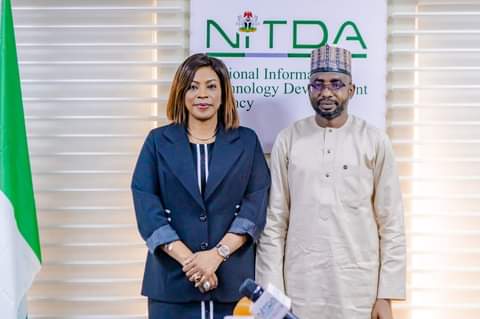
NITDA strengthens relationship with Google

By Ahmad Deedat Zakari

The Nigerian Information Technology Development Agency, NITDA, strengthens its relationship with Google West Africa. 

The NITDA Director-General, Kashifu Inuwa, made this known on Friday, April 8, 2022, while playing host to the Google West African Director, Juliet Ehimuan, in Abuja.

“If we can come together to strengthen the collaboration, we will eliminate duplication of efforts and working in silos,” He said.

 Mr Inuwa emphasized the importance of a good relationship between the two organizations and the aim of governmental regulations. 

“Together, we can achieve greater results. Governmental regulations are not to stifle or be an obstacle to your business; rather, it is to enable and unlock more opportunities and protect your business and our citizens,” He stated

Mr Inuwa also commended the effort of Google in the capacity building of Nigerians with a plan to train about five million Nigerians.  

Ehimuan, in her remarks, thanked NITDA for being one of Google’s major partners in the public sector with precedence of a great working relationship.

She confirmed the fact that Google has invested in a lot of capacity building over the years.

“Our initial estimate is to contribute directly and indirectly to create about 1.6 million jobs over time and work around device financing in partnership with telcos to make sure that people have access either through infrastructure or device data to gauge the digital world”, she disclosed.

According to Ehimuan, they will be about 300 million more internet users in Africa in the next five years, which will translate to more jobs and an enormous contribution to Nigeria’s Gross Domestic Product (GDP).