
Global North

The old playbook is broken: Emerging markets must navigate the new, polarised global economic disorder

By Ahmed Usman

The global economic order is no longer merely under strain; it is fragmenting in ways that are particularly costly for countries like Nigeria and much of the Global South. Across continents, economic anxiety is feeding political instability, geopolitics is reshaping markets, and institutions once designed to stabilise the world are struggling to remain relevant. What we are witnessing is not a temporary downturn or a cyclical adjustment, but a deeper structural breakdown, driven by forces once assumed to guarantee global stability. For many emerging and developing economies, this moment is not just about global disorder; it is about survival within it.

Global economic power is shifting rapidly. Liberal market-oriented democracies are facing unprecedented domestic turmoil, and the deep integration of trade and finance that defined recent decades is steadily unravelling. From supply-chain fragmentation to trade wars, sanctions, and tariff escalation, the global economy is retreating from openness toward fragmentation. The question is no longer whether the post–World War II economic order is weakening, but how it reached this point and what, if anything, can replace it.

Ironically, the very country long believed to anchor global stability is now fueling its destabilisation. Globalisation was supposed to spread prosperity, deepen interdependence, and reduce the likelihood of conflict. Instead, it has widened inequality within countries, eroded the middle class in developing economies, and concentrated gains among a narrow elite. These imbalances have stoked political backlash, empowered populist movements in developed economies, and turned trade into a political weapon rather than a shared economic good.

This shift became unmistakable during the Trump administration, when tariffs, once viewed as relics of a protectionist past, returned to the centre of global economic policy. The imposition of broad tariffs on China and other trading partners signalled a decisive break from the rules-based trade order. What began as “America First” protectionism quickly reshaped global behaviour, legitimising unilateral trade actions, encouraging retaliation, and accelerating the erosion of multilateral discipline. Trade policy, once anchored in cooperation, became openly confrontational, and the precedent has proven difficult to reverse.

Nowhere is this erosion more evident than in the weakening of trust in liberal democracies themselves. Economic dislocation has bred social resentment. In developing countries, repeated external shocks such as oil price shocks, global interest rate hikes, and pandemic disruptions have led to inflation, currency depreciation, and shrinking real incomes. Rising living costs, youth unemployment, and fiscal austerity have weakened trust in democratic institutions and fueled social unrest.

Domestic politics, in turn, have become more constrained, limiting the policy space needed to pursue long-term development strategies. Political polarisation has weakened governments’ ability to sustain coherent economic policies. As domestic politics grows more volatile, foreign economic policy becomes reactive and confrontational. Trade barriers rise, industrial policy replaces market openness, and economic nationalism becomes a political necessity rather than an exception in many Western countries.

At the same time, the global institutions meant to manage these tensions have failed to evolve. The International Monetary Fund, the World Bank, and the World Trade Organisation, the cornerstones of the post–World War II economic architecture, were designed for a world dominated by a small group of advanced economies. Today, they struggle to respond to capital-flow volatility, technological disruption, climate risk, and the growing power of emerging markets. Their rules remain largely intact, but their legitimacy and effectiveness are increasingly questioned. Their frameworks are still anchored in assumptions that often underestimate social costs in developing countries. Conditionality, delayed financing, and inadequate attention to inequality and structural transformation have weakened their credibility across the Global South. The World Trade Organisation, meanwhile, has struggled to prevent powerful economies from bending trade rules in their favour through subsidies, tariffs, and industrial policy practices that have become more entrenched since the normalisation of tariff-based trade conflict under Trump.

For a time, the rise of emerging markets such as India, Brazil, Nigeria, and Turkey seemed to promise a more balanced and stable multipolar world. These nations benefited from globalisation without fully aligning with any single power bloc, acting as bridges between North and South, East and West. But today, that space is narrowing. Intensifying rivalry between the United States and China has turned trade, technology, finance, development assistance, and even currency choices into tools of geopolitical competition, forcing emerging market economies to pick sides in a contest they did not create.

For countries like Nigeria, this strategic squeeze is especially critical. Dependence on imported technology, foreign capital, and external energy markets makes neutrality costly. Sanctions regimes, supply-chain fragmentation, tariff escalation, and financial market volatility now transmit geopolitical tensions directly into domestic inflation, exchange rates, and public finances. What appears as global disorder at the international level is experienced as household hardship at home.

What emerges from this landscape is a destructive feedback loop between economics, domestic politics, and geopolitics. Economic shocks fuel political instability; political instability drives inward-looking policies; those policies heighten geopolitical tensions; and geopolitical tensions, in turn, further destabilise the global economy. Each turn of the loop reinforces the next, making disorder self-perpetuating.

This is why familiar prescriptions no longer suffice. Calls for more trade liberalisation, fiscal discipline, or institutional reform are not wrong, but are no longer enough. The world has changed too profoundly. Technology is reshaping labour markets faster than institutions can respond. Climate change is imposing costs that markets alone cannot price. Capital moves instantly, while political accountability remains national. Old solutions were built for a slower, more predictable world.

Breaking out of this cycle requires abandoning the comforting illusion that existing global arrangements will eventually self-correct. Calls for more liberalisation, deeper financial integration, or stricter fiscal discipline ignore the lived realities of developing economies. The old playbook was written for a world of expanding trade, cheap capital, and geopolitical cooperation. That world no longer exists.

What is needed instead is a fundamentally new approach. For Nigeria and the Global South, this means redefining integration on terms that prioritise resilience over efficiency. It means reforming global financial institutions to provide faster, more flexible support during shocks. It means investing in domestic productive capacity, regional trade, and human capital rather than relying on volatile external demand. And it means recognising that economic policy must be politically sustainable to endure.

The global economy is spiralling into disorder, not because globalisation failed entirely, but because it evolved without fairness, adaptability, or legitimacy. For countries like Nigeria, the stakes could not be higher. Remaining trapped in the doom loop will deepen vulnerability. Escaping it demands new thinking, new institutions, and a development model rooted in resilience rather than dependency.

The future of the Global South will not be secured by waiting for the old order to return. It will be shaped by how boldly countries confront the reality that the old solutions can no longer solve today’s problems.

The world is not spiralling into disorder by accident. It is doing so because the systems governing it have failed to adapt. Recognising this is the first step. The harder task of building a new framework for global cooperation in an age of rivalry, inequality, and uncertainty is now unavoidable.

The choice ahead is unambiguous: continue circling the doom loop, or accept that the old economic order cannot save us and begin the difficult work of inventing something new.

Campaign against deforestation and promotion of tree planting

By Alkasim Harisu

As a people, we need to consider afforestation to avoid global warming. Deforestation is a menace that a good Samaritan—Isma’il Auwal, a Facebook friend—is discouraging by embarking on a project of planting four thousand trees within Kano. Other good Samaritans, either inspired by him or not, are fast getting on the bandwagon by advocating for afforestation, which, if appropriately executed, will help reduce the scorching heat Kano is immensely experiencing. 

Deforestation and its effects need no introduction. This activity has spanned many decades. For different reasons, man fell trees to cook, make furniture, manufacture vehicles, or clean his environment. Deforestation engenders climate change and combines carbon dioxide with oxygen, eventually returning to its emitters (human beings), affecting them negatively. Deforestation is the removal of forests. It happens for several reasons, causing devastating consequences. It can be deliberate, natural or accidental. This unwelcoming act changes the climate, desertifies the land, erodes the soil, reduces crops, brings floods, and increases greenhouse gases in the atmosphere.

Battling the devastating effects of climate change requires a great effort from the government and non-governmental organisations, as well as the public. Climate change has caused a growing concern around the globe. As an end-product of vehicle exhaust and factory emissions, climate change is a global challenge enjoying little attention, especially in the Global South. To tell the truth, while a minority of the Global North pays much attention to reducing the effects of climate change, a majority, mainly comprising the Global South countries, do nothing to curb the problem. Some people, especially in developing nations, consider forests underdeveloped, not knowing that their lack poses a great challenge to life.

How people frequently fell trees defies explanation. With the rapid rural-urban migration, people become more interested in deforesting the world to build houses, companies, etc. Urbanisation is another reason for deforestation. With the current raging global warming debilitating the world, the earth will not only be in a jam but will also represent hell on earth. Worst comes to worst, the earth can become inhabitable. The current exceedingly hot weather in Kano and elsewhere is fast becoming a pain in the neck. 

Causes of Deforestation

The causes of deforestation are numerous, with agriculture ranking first. Since time immemorial, people have cultivated acres of land numbering in the thousands. As a result, forests are cleared and/or burnt for farming. The Industrial Revolution in the late 18th century, which continues to the present, is another significant cause for concern. The processing of raw materials necessitates the rampant cutting down of trees. In Africa, although large amounts of forests are cut down for burning at homes for food and sale, rendering communities prone to the obnoxious effects of climate change, little or no efforts are made to reforestation. 

Deforested for commercial or home use: Places are left to reforest themselves or waste away forever. Deforestation engenders the loss of habitat, which causes more and more animals and plants to die. A forest is home to countless animals and plants. Therefore, plants and animals lose their homes if a bush is deforested. Not only does deforestation affect the animals and plants we know, but also those we don’t know. 

Deforestation causes the greenhouse gases to be released into the atmosphere. The fact that trees absorb carbon dioxide and emit oxygen into the atmosphere is not less known. Trees control the water level in the atmosphere by regulating the water cycle. By working together, millions of trees refine the moisture obtainable in the air. While there is enough water in forested areas, there is less in deforested ones. This dries up the soil, making it grow less crops. 

Further, soil erosion and flooding count among the effects of deforestation. Trees provide nutrients and retain water. Without forests, like it or lump it, the soil erodes, losing nutrients and becoming barren and open to flooding. With the help of their roots, trees absorb and store a large amount of water when it rains. When they are felled, the flow of water stops, depriving the soil of its ability to retain water. While this brings floods in some areas, it causes droughts in others. 

Last, deforestation causes a lack of food, medicine and building materials. Many people, both within Nigeria and outside, consider forests the only source of food and medicine. However, with deforestation, they don’t only lose food and medicine but also their lives.

Toward Solving Deforestation

Deforestation occurs due to several reasons. While this cannot be more correct, there are solutions to the problem notwithstanding. Considering the threat climate change poses to the ozone layer and the heightening greenhouse effect, promoting afforestation is necessary. The fact that developed countries worldwide advocate tree planting needs no emphasis. Thus, tree planting should be encouraged, and campaigns against unnecessary felling of trees should be launched. 

We need to do the following:

1. Enlightening People about the Effects of Clear-cutting of Forests: Unless enlightened, people will continue to deforest communities for reasons better known to them. To discourage deforestation, we need to initiate campaigns and give lectures to awaken people to the devastating effects of deforestation before things go out of hand.

2. Reforestation of Clear-cut Lands: When deforested, we should consider planting young trees to replace the ones cut down. Around the world, every year, under several initiatives, trees are planted. Celebrating World Environmental Day 2022, in collaboration with UNESCO and Concordia College, Yola, a foundation whose name I have forgotten, gave, in June 2022, in the Concordia College hall a mesmerising public lecture on climate change and deforestation. 

3. Educating the Public: Although some people are informed about the global warming problem, many are not. We should be determined to educate the public about the causes and effects of deforestation. It is noteworthy that people have to either avoid unnecessary tree cutting down or risk damaging the ozone layer.

In conclusion, even though the campaign against deforestation is widespread, many people, especially in urban areas, fail to feel the urge to afforest their respective communities. This spells doom. Of course, a disaster is looming large. We will be doomed unless we come together to prevent it.

Alkasim Harisu wrote from Kano via alkasabba10@gmail.com.

Niger Coup d’État: The gale of change and the balance of global power 

By Bilyamin Abdulmumin

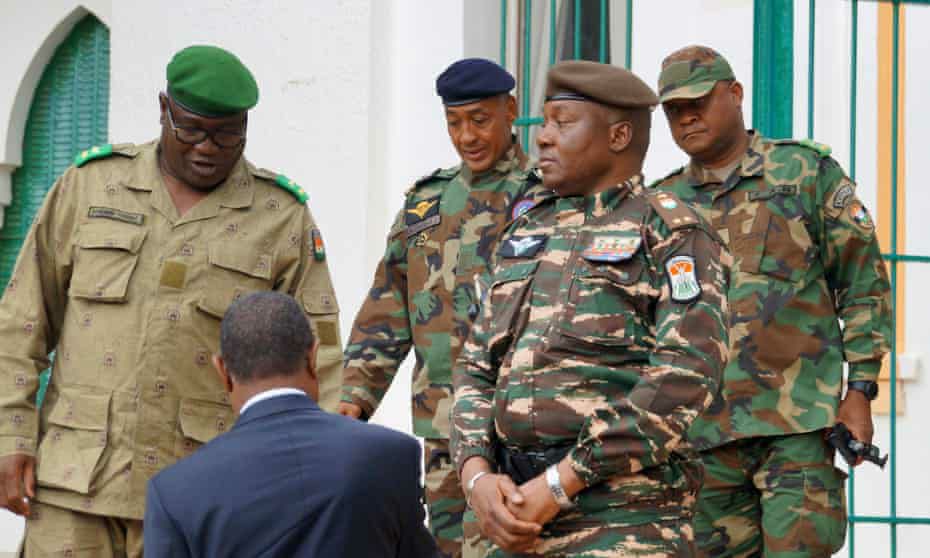
What initially appeared as rumours of a coup attempt in the Niger Republic gradually and eventually proved true. Even when the leader of the coup d’état, Presidential Guard Commander General Abdourahamane Tchiani, announced the overthrow and proclaimed himself the leader of a new military junta, there remained a doubt in the air due to the exclusion (or so it seemed) of the Nigerien Chief of Army Staff. However, all traces of doubt cleared when the military declared their support for the coup. They cited loyalty to avoid casualties from internal military clashes. Since then, news and developments have dominated the public discourse hourly. Small and major national and international media outlets pinched their tenths on this event. 

The Nigerien coup has drawn significant attention compared to other recent similar operations. For instance, in Conakry, Chief of Army Mamady Doumbouya ousted his authoritarian leader Alpha Condé. In Mali, the junta overthrew its transitional president a few months after their appointment. In Niger’s neighbouring Burkina Faso, the junta toppled another transitional government they had installed months earlier. 

The reasons for the global condemnation of the Nigerien coup differ among various blocs. France and its allies might be concerned about the potential loss of influence over their former colonies. The U.S. stance is partly rooted in their role as self-appointed global police guardians of democracy. It is also due to their military base housing thousands of soldiers within the country. Russia, on the other hand, seems to be benefiting from the situation. However, for organisations like the African Union (AU) and the Economic Community of West African States (ECOWAS), the coup posed a direct threat to democratic leadership, reaching an alarming level. So the ECOWAS bigwig Nigeria, which not only shares proximity with Niger but also has its president as ECOWAS leader, tends to overreact. Bola Ahmed Tinubu was fighting from a dual role. 

The Nigerian coup came as a surprising shock, sudden and unexpected. Unlike many similar military strikes, this coup lacked potential factors pointing to its occurrence. Such factors often include internal crises, insecurity, tension, hardship, prolonged presidential tenure, crackdowns on the opposition, and suppression of dissent. The renowned Ghanaian coup leader Jerry Rawlings once noted that the success of his coups was owed to the ripe situation in his country. He likened the atmosphere for coup success to a saturated atmosphere filled with gas, waiting for ignition to burst into flames. However, in the case of Niger, none of those factors seem to be in play. 

One plausible theory regarding the reason behind the Niger coup has been put forward by a friend who also serves as an elder brother figure. This theory revolves around the wave of change sweeping through Francophone Africa. The leadership of France appears to be faltering due to its neo-colonial approach toward its former colonies. This approach doesn’t align with the interests of the affected countries, leading to increasing unrest. Both civilians and the military are discontented with this interference, creating an environment conducive to a coup. This theory gains weight considering the surge of support that followed the coup. The military cut all ties with France to bolster this perspective and sought to shift their allegiance towards Russia. But wait! President Basoum’s public statements aligned with this shift. His videos, circulating on social media, included threats to sever remaining ties with France gave rise to the conspiracy theory as the reason behind the coup. But with the current unfolding, the question arises: Is Basoum genuinely committed to this path, or is he merely putting on a facade? 

Russia appears threatened by Western encroachment, mainly through proxy conflicts in its neighbouring countries. The most recent instance of this is the situation in Ukraine. However, suddenly, Russia found a windfall at the doorstep: developments in Africa. Aggrieved African countries with the West swiftly shifted their allegiances towards Russia as a rival to Western powers. This scenario offers an alternative to the dominant Western influence—a sort of counterbalance. The concept of the BRICS (Brazil, Russia, India, China, and South Africa), akin to NATO or perhaps a stronger G7, also garners mass interest in joining. Six countries, namely Iran, Saudi Arabia, the United Arab Emirates, Argentina, Egypt and Ethiopia, joined this movement in January 2024. Such a development holds promise for rebalancing global power dynamics. It provides other developing countries with an alternative.

Those who previously leaked atomic technology to Russia would be very happy with this development. After the United States successfully developed and detonated nuclear bombs on Hiroshima and Nagasaki, effectively ending Second World War II, some of the bomb’s developers had worries: the disruption of the global power balance. As a result, according to reports, they leaked the technology to their arch-rival, the USSR.

Bilyamin Abdulmumin is a Doctoral candidate in Chemical Engineering at ABU Zaria. He is also a social and political affairs commentator and science writer.