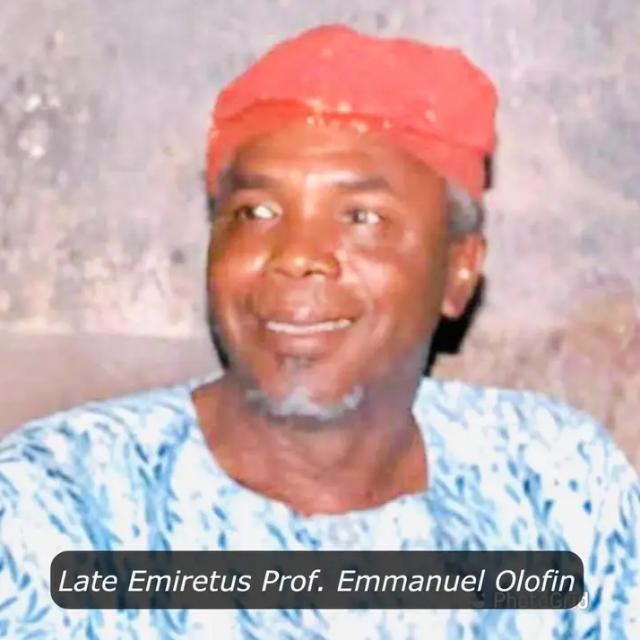
The fall of a giant: A tribute to Professor Olofin
By Murtala Uba Mohammed, PhD
“The source of concern is not in losing an erudite but getting his replacement”, Hausa adage.
It was around 1:54 pm on Tuesday 14th June 2022 that I learned about the death of the Emeritus Professor Emanuel Ajayi Olofin, popularly known as EAO among the staff of the Department of Geography, Bayero University, Kano (BUK). The sad news was first broken to us on the departmental WhatApps platform by his colleague and our respected teacher, Professor J. Afolabi Falola. Although already octogenarian, the death came to many with a shock because we were unaware our professor was sick.
Born in 1941, Olofin started his Bachelor of Geography at the University of Nigeria Nsukka, but due to the outbreak of the Nigerian Civil War in 1967, he and his coursemates were transferred to the University of Ife, where he graduated. He was also the first Nigerian to attend the Malaysian Premier University of Malaya for his master’s degree. He joined the services of Bayero University, Kano (BUK), immediately after his return to Nigeria. He later went to Ahmadu Bello University (ABU) Zaria for his PhD, specialising in Fluvial Geomorphology.
Professor Emanuel Ajayi Olofin was not only a teacher of teachers of Geography, his name was synonymous with Geography at BUK. Until his retirement from the services of Bayero University in 2015 and his subsequent demise, Olofin remained the first name to know and remember in the Department of Geography. Until he left BUK, Olofin had been one of the most respected names in the defunct Faculty of Social and Management Science (SMS) and the University at large.
While many a time, a scholar is respected for the depth of their knowledge or soundness of their character, Olofin was respected for his exquisite mastery of Geography, and those who came across him would testify to that. Here was a man who crossed the proverbial seven oceans, came to settle in a foreign land, and not only made a name but secured a good position, having been nicknamed “mutumin kirki” by the university community, which is located in a predominantly Muslim society. The Ekiti-born Professor of Geography remained the longest-serving staff in BUK, and he served the University for forty-one years (1974 to 2015).
I first heard the name Olofin in 2001 when I was still an IJMB student at the Kano State College of Arts, Science and Remedial Studies (CAS, Kano). The name was mentioned several times by one of his students and my teacher, Malam Adamu Mustapha (now a Professor of Hydrology), during Landforms classes. When I was admitted to study B.Sc. Geography at BUK in the year 2003, my hope then was only to meet this man we were told that he was a reservoir and encyclopedia of geographical knowledge. Interestingly, he was the only person described in the Departmental Handbook as a Professor of Geography (others were either Professors of Rural, Water Resource or Soil Geography).
Throughout my level 200, I always yearned to meet him, thinking that he would teach us Kano Region (GEO2201), for which he authored a book titled Some Aspect of Physical Geography of Kano Region together with Human Response, which remains, until now, the most authoritative guide for teaching the course. But, unfortunately, that very year, the course was assigned to, and taught by, another veteran geographer and his only contemporary then, the late Mr Oyeniyi.
The first course that connected me with Olofin was Introductory Geographical Hydrology (GEO3214). Honestly speaking, I never came across any person teaching hydrology in a simple and innovative way as Olofin. In addition, I also attended his lectures of 400-level courses, namely, Environment and Development (GEO4302) and System Approach to Geomorphology (GEO4325). For all his courses, Olofin did not only lecture us, as the tradition was in those days but also recommended good teaching materials in addition to the books he had authored, which he gave as guides to students to xerox.
The beauty of Olofin’s class was in its good illustration, lucid language, deployment of humour and riddles, and imparting good morals. In addition, Olofin had carved a name for himself as an embodiment of good character, whose courses one hardly fails unless they were not either attending lectures or failed to sit for exams. It is well known that Olofin informed his students as to when he would take attendance.
I recalled that in one of his classes, Professor Olofin complained, with a gloomy face, that some students would fail a course no matter how much he or any other teacher tried. When we asked for his reason, he narrated what transpired between him and one of our coursemates.
The story was that the student missed his test, which was announced weeks before it was conducted. The student did not complain to the Professor, rather, it was Olofin that came to the class and looked for the student; he asked the student to see him after the class. When the student went to his office, he queried if the student was ready to take the test, and he responded that he was not ready. Instead, an assignment was given to the student to write before the closing hours. The student submitted the assignment to the Professor in time, but when he checked the assignment, he suspected that the writing looked so good to be ascribed to that student. Therefore, he passed a paper asking the student to write his name and registration number. Unfortunately, his handwriting was conspicuously different from the one on the assignment. Olofin asked the student, “who wrote the assignment for you?” After insisting, the student informed him that his friend, a lady, wrote it for him! He counselled the student to be committed to his studies and always be honest and upright!
Professor Olofin had retired from active service and only taught as a contract staff when I joined the services of the Department in 2012. I could not recall a time when he missed his lecture, refused to attend staff meetings, or submitted his marked sheets/scripts late. In fact, Olofin always submitted his marked sheet earlier than any staff of the Department despite his age and the fact that all the staff of the Department, except late A.D. Maiwada and Prof. J.A. Falola, were his students at either their undergraduate or postgraduate levels.
Olofin can be described as jovial and accommodating in terms of interpersonal relationships. I recall his famous joke and parable on Nigeria that when the Almighty was creating nations of the earth, he gave each country a resource or two. But when it came to Nigeria, he put so many resources under its land. People, out of inquisitiveness, asked why did He do so? The Almighty replied: “Wait and see the kind of humans I will populate it with”. This parable describes the real situation of the so-called “African Giant” that is paradoxically rich and poor. Nigeria has all it takes to blossom as an Iroko but remains a low dwarf shrub due to its corrupt leadership and docile followership.
Olofin was not only an epitome of good character and knowledge, he was faithfully dedicated to his job. I can testify to this though not to the extent that his old students can do.
From the little I learned when we were neighbours (his office was next to mine), he used his office hours mainly for writing, teaching and research. He rarely engaged in frivolous discussions outside classrooms or meetings. Instead, he was constantly working with his computer, reading different genres, and reviewing students’ dissertations/theses. For this, he was not only a geographer but a consummate poet and essayist. His anthology of poetry titled Lifeless Line is eloquent testimony.
By a way of conclusion, I wish to say that the death of Olofin is one of the greatest losses to Geography as a discipline and Nigerian academia. It is not only because he was the first Professor of Geography in BUK and the first in the Faculty of Social and Management Science; it is not because he was the longest-serving member of the faculty; it is not also because he was among the first five to be awarded Emeritus Professors in BUK; but because he was an amalgam of a sound knowledge of his discipline, dedication to duty and moral uprightness.
In the realm of geographers, Olofin’s name can only be written with those of other giants such as Akin Mabogunje Nurudden Aloa and RK Udo. For these reasons, I write to extend my condolences to his family, colleagues, students, Bayero University, the Association of Nigerian Geographers and academia at large. May the Almighty Allah give his family the fortitude to bear the loss, amen!
Murtala teaches Geography at the Department of Geography, Bayero University Kano and can be reached via murtalamuhammadu@gmail.com.
