General Babangida

Israeli apartheid regime and Adeboye’s laughable prayers

By Professor Abdussamad Umar Jibia

In 1992, about 20 years after Nigeria severed ties with Israel, General Ibrahim Babangida’s administration restored diplomatic relations with the Jewish occupier state. This followed incessant calls for doing so by Nigerian Christians. 

Islamic scholars berated the Christian clerics who called for restoring ties with Israel for their blatant ignorance of the Jewish state and what it stood for. Contrary to what is believed by the Nigerian Christian clergy, Israel is not a Christian state, and Jews do not believe in Jesus Christ either as a Messiah like the Christians believe or even as a Messenger of God like I, a Muslim, believe. As far as the Jew is concerned, Jesus is an illegitimate child of Mary who is a product of fornication committed by his mother.

And what is special about Israel? Unlike Ghanaian, Nigerian, Pakistani and other nationals who feel at home whenever they are in their countries, the Israeli carries the guilt and discomfort of an occupier even while “at home” in the land now called Israel. Many countries do not recognise the existence of Israel as a state. 

What followed Babangida’s diplomatic decision is a shame. A Christian Pilgrims Commission at the centre and a Christian Pilgrims Board in each state. That’s not all. While my own grandfather travelled to Saudi Arabia to perform the hajj on foot without any Government facilitation, and I saved my own money to go on hajj by air because we believe in hajj as part of our religion, an average Nigerian Christian is waiting for Government to pay for him to visit Israel to do what they call a “religious” duty. The journey, year in and year out, by Nigerian Christians to visit Israel for ‘pilgrimage’ has thus been a huge burden on the Nigerian Government. I believe there should be an act of the National Assembly to criminalise the sponsorship of pilgrims by Governments at all levels to whichever holy land the former want to go for their worship. 

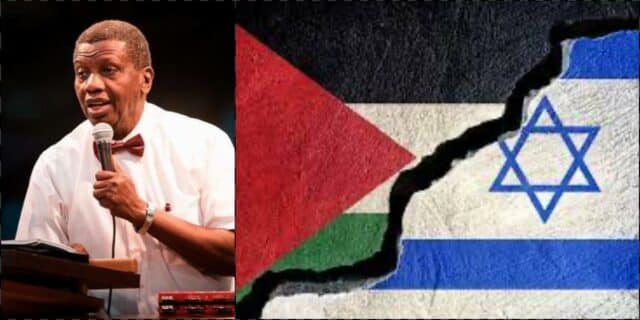
The latest struggle by Hamas to free Palestine from Zionist occupation is now in its second week. Governments and individuals worldwide have been voicing their opinions, with many taking sides and others calling for cessation of hostilities. One would commend the Christians Association of Nigeria (CAN) for being cautious this time. The Nigerian Christians’ umbrella body spoke against bloodletting and preached the sanctity of human life. I am personally impressed. The leadership of CAN under Daniel Okoh should go a step further to end hostilities against non-Christians in Christian-majority communities of the North. This would contribute towards the desired peace and development that has eluded Nigerians.

If CAN exercised caution under Most Rev. Daniel Okoh, the same cannot be said about the overseer of the Redeemed Christian Church of God (RCCG), Pastor Enoch Adeboye. When I saw him calling Jews his “brethren”, I wondered whether I would laugh or cry. No matter how one tries to give Pastor Adebayo the benefit of the doubt for being a Nigerian respected by many, one will have to admit that the Pastor has, in this case, behaved like one of those roadside church-goers who have not been to school. Otherwise, how on earth would a Christian refer to Israeli criminals as his brethren and even ask thousands of unsuspecting RCCG members to pray for them?

Perhaps Pastor Adebayo is unaware of the Jewish state’s atrocities against innocent Palestinian Christians. Only recently, the head of the Roman Catholic Church in Jerusalem, Pierbattsta Pizzaballa, was reportedly complaining of increasing attacks by Jewish extremists “emboldened by [the] Israeli Government”. 

The attacks on the Christian community in Israel, whose record is handy for anyone looking for it, include attacks on Christian sites, which people like Adeboye say they go to Israel to visit and Christian worshippers whom the attackers refer to as idol worshippers who should be, “killed according to Torah”.

According to a recent NBC News report about Jerusalem, “Churches have been graffitied and clergy who live and work here report being frequently spit on, harassed and even physically attacked by extremist Jews”. The report concluded that “Christian leaders say most incidents are never thoroughly investigated,” confirming that it has the backing of the Zionist state.

Hear Pastor Adeboye, “It is my prayer for all our brethren in Israel that the Almighty will grant you absolute peace from now on in Jesus’s name”. Haba Pastor! What does Jesus have to do with Zionists? And what do Zionists have to do with Jesus? The only non-Christian group who accepts Jesus, the son of Mary and believes in the virgin birth, are Muslims. 

And he said, “The almighty God, the only one of Israel…”. My dear pastor, which God are you referring to here? Is it Jesus Christ whom they refer to as an idol or the only God who created Jesus without a father, just like he created Adam without two parents?

Adebayo and other African Christians should get their priorities right. Palestinian Christians have done so long ago. They have always identified with Palestinian Muslims in their struggle for freedom. 

Professor Abdussamad Umar Jibia wrote from Kano via aujibia@gmail.com.
Musings on the solution to university education in Nigeria

By Ahmadu Shehu, PhD

Once again, there is a total blackout in Nigerian public universities. Last week, the Academic Staff Union of Universities (ASUU), the umbrella Union of academics working in Nigerian public universities, declared a one-month warning strike to remind the government of their promises signed just a year or two ago. 

It has been decades since the rift between ASUU and the Federal Government of Nigeria took the lives and progress of Nigerian students to ransom without a foreseeable end to the debacle.

ASUU was a child of necessity born out of the precarious situation Nigerian lecturers found themselves in the 70s under the various military juntas bent on killing the tertiary education in Nigeria as they did basic education. 

Thanks to radical scholars and the rise of socialism as an alternative economic and political ideology to capitalism the government prefers, ASUU got a deep ideological rooting. It also gets a wide acceptance among diverse social domains of the Nigerian society, who, like ASUU, were disenfranchised by and dissatisfied with the tyranny of successive regimes. 

The confrontations between ASUU and the military junta of Ibrahim Babangida and Sani Abacha made the association a front-wheel of social activism in Africa and gave it a legitimate voice that is believed to stand for the masses not just on education but also human rights and socioeconomic advancement. 

Over the decades, ASUU became very wealthy and stubbornly anti-establishment, which had assisted in its success against the government and lost popularity among Nigerians. But, these are topics for another day. 

While there are physical successes credited to ASUU struggles, the incessant strikes have killed many, delayed millions and subverted trillions of aspirations, destinies and successes of millions of Nigerians. Thus, one of the emergencies facing Nigerian university education today is this endless and worthless rift between ASUU and the Federal Government. 

A serious-minded government in Nigeria should have education as a priority. Any education policy that does not consider the solution to this rift is not comprehensive enough and may not solve the quagmire of education in Nigeria. 

How do we end this decades-old problem that has defied most solutions? Some people have advocated for the privatisation of Nigerian universities to have a purely money-driven university system reminiscent of the US-style, where citizens have to pay through their noses to acquire tertiary education. 

An opposite idea is one the one ASUU pursues. It is a totally free, accessible, and one hundred per cent public university education where all willing and qualified citizens can enrol and acquire tertiary education in fields of their choices and mental capabilities. 

ASUU’s idea is noble and ideal of a functional socialist society where education is an inalienable right of citizens. However, the situation in Nigeria and our economic ideology doesn’t allow for either of these ideas to work. It is why ASUU and the government have been going around the same hole of self-deceit and conscious pretence. 

To provide a lasting solution to this endless crisis that have killed our education and our economy,  I believe that privatisation is not the right solution, just as a costless education is not. We’re not America that the insensitive capitalists admire without reason nor the defunct Soviet Union that ASUU loves to imitate. These approaches do not fit our realities.

The alternative is for the government to collect and allocate special taxes to fund education. Again, we can see the models in Western and Central Europe, even in Asia, where citizens pay special taxes to fund education. In this regime, a specific percentage of all taxations will be allocated to education, and citizens will access this service which has been paid for in a different way, supposedly free of charge. 

Then, all federal universities shall submit and defend their budgets at the national assembly, effectively giving universities financial autonomy and removing them from the shackles of the ministry of education and, by extension, the cumbersome nature of mainstream Nigerian civil service. 

That means that each university will be an independent government entity responsible for 100% of its affairs without recourse to other government agencies. This equally requires that we abolish bottlenecks such as Tetfund or limit their capacity to specific funds. The ministry of education will only be a regulatory body in collaboration with the National Universities Commission (NUC). 

That way, the university management can be charged with the responsibilities of funds generation and management to the extent that lecturers no longer need ASUU as an association as all employees of a given university are totally within the purview of the university that employs them. The Federal Government doesn’t need to deal with the basic needs of university academics, such as salary and allowances.

In this model, academics take up their jobs knowing that their remuneration and social welfare are subject to their immediate employers, which is the university management. In turn, they submit their budgets yearly to the national budget and planning office, which will be debated and approved by the national assembly. Whatever they get is their own cup of tea. 

That effectively means that ASUU as an association will cease to exist because each of its members will be totally and absolutely under the purview of their immediate employers  – their home universities. There won’t be the federal government to fight. The common enemy will be gone, and there won’t be the basis for a national strike because each is on their own. 

This, as simple as it is in words, is a herculean task that cannot be easy to achieve. It requires a huge political will, legislative and administrative changes. 

No matter how long it takes, making universities entirely independent and autonomous while subjecting them to the same accountability measures prevalent on other government agencies is the surest, if not the only way to achieve a stable, qualitative and functional university system.

That way, there won’t be ASUU talk more of strikes, and the quality and quantity of education will be solely a responsibility of the universities and, therefore, the academics. 

Dr Ahmadu Shehu writes from Kaduna and can be reached via ahmadsheehu@gmail.com.

Where will Buhari retire to?

By Ahmadu Shehu, PhD

Since The Daily Reality has become the darling medium through which northern elites are called to task, I would instruct them to extend a short message to President Muhammad Buhari this weekend. Although Nigerians are used to the deafening silence of this administration to most of our perils and concerns, the president needs to be reminded of a few disturbing, foreseeable facts.

Let me first state that the people of this country, especially his brothers and sisters in the north, can’t wait to see the end of his rule. His ethnic group, the Hausa-Fulani, have carried his cross for too long. For over a decade, they gave their lives, wealth and resources for his candidature, and for seven years, they bore the blames, stereotypes and animosities for his presidency. What is their gain? An avoidable but seemingly inevitable genocide. If the president does not know, I will tell him that the people of this region are tired! They are no longer looking for what he can do for or to them. They are only anxious to survive the remaining days.   

I want the president to observe a few things. First, all Nigerian leaders lucky to have left the Villa alive went back to their hometowns after their tenures. For instance, Shehu Shagari, who was overthrown by then General Muhammadu Buhari, moved permanently to Shagari, securing a serene, fruitful life after that. While in retirement, Shagari remained relevant and served in various traditional positions within the Sokoto Caliphate. His love for his people, his engagements with his roots throughout his career, his pride in his people and culture and constant, persistent and proud leaning to his region endeared people to him even after his tenure. That love held him physically and psychologically intact, made him relevant and happy all through his old age.  

General Ibrahim Badamasi Babangida, who succeeded Gen. Buhari, retired to Minna, his birthplace from where he and his wife established great organizations that engendered socio-economic development. As a result, Babangida’s home became a centre of excellence in Minna metropolis, and people trooped to his doors for all kinds of support and favours.

General Abdussalami Abubakar became the Head of State after the death in office of Gen. Sani Abacha. Abdussalam followed the footsteps of his predecessors and retired in Minna, his hometown. This was possible for the two Generals only because of their good to their people and region. To date, Niger and indeed the North-Central are thankful for their service as Heads of State. They gained relevance and recorded developmental strides hitherto impossible without the emergence of their worthy sons.   

Then came Olusegun Obasanjo, who returned to power for the second time. After eight years in office, Obasanjo moved to Otta – not even Akure – to start a new life as a statesman. While Yar’adua died in office, his successor, President Goodluck Ebele Jonathan, immediately vacated Asorock for Otuoke, his birth village and assumed his gentle duty as the breadwinner of his people and region. Jonathan has was devilishly maligned as the enemy of the north, the clueless president of the country. But he ensured that the Niger Delta amnesty program succeeded, for he was conscious of life after office in the creeks. He, therefore, begot for himself and his people a place to live in peace. 

Here at home, the breadwinner of Adamawa state, former vice president, Alhaji Atiku Abubakar, ensured that the state’s economic strength is sustained. He established institutions, provided hundreds of thousands of employments, empowered businesses and established banks for entrepreneurs and start-ups. Atiku Abubakar built his retirement home in Jada and moved his business headquarters to the state. He ensured that human development services, such as education, healthcare, media and IT industries only obtainable in the cultural West are brought home to the doorsteps of his compatriots. Thus, he was able to stay at home and proceed with his political career gracefully.  

But with all the situations in the northwest, especially Katsina – his home state – and Kaduna – his preferred haven, where does President Buhari intend to retire and spend the rest of his life? For one, at 80, Buhari will be the oldest Nigerian president to leave office and probably the sickest at that weak point of human life. That is the moment he needs people the most and will undoubtedly go through the most painful retrospections of his administration’s actions and inactions. Then, he would face realities – poverty, inhumanity, misery, deprivation, etc. – that have become the norm on Nigerian streets. At that point, Buhari would need Nigerians, and Nigerians would not need him for anything.

The excoriating economic disaster in Buhari’s northwestern region today has not been seen in a long time. Thousands of people are homeless, hopeless and desperate for food and shelter. In Daura, for instance, hundreds of thousands of youth are unemployed. At the same time, his close relatives and families have bought over most farms and grazing lands around the emirate, extending the wicked hands of poverty to more people than ever. As it stands, hundreds of thousands of people are fleeing this region for safety, as kidnapping and banditry have overtaken citizens’ daily lives. Worse still, the president’s disposition and sheer lack of concern on anything “north” make it impossible for him to enjoy his cult-like mob that kept his military retirement years afloat.

Sadly, there is no going to be Buhari the messiah, Buhari Maigaskiya or Buhari jagoran talakawa. There will be only one Buhari in the world: the one who became president and failed to help his people. The one that has disappointed his most loyal supporters; the messiah that couldn’t save his people from hunger, deprivation and poverty. The Buhari who oversaw the worst economic period of his country. That Maigaskiya supervised the most criminal and cruellest regimes of corruption. The one that promised heaven but gave hell. How life looks for someone at that age in this condition will be very interesting to see.

Dr Ahmadu Shehu is a nomad cum herdsman, an Assistant Professor at the American University of Nigeria, Yola, and is passionate about the Nigerian project. You can reach him at ahmadsheehu@yahoo.com.