Fulani

Fulani as Endangered Species in Nigeria (I)

By Ahmadu Shehu, PhD.

It is generally considered an impossible hyperbole when the current trajectory of ethnic profiling against the Fulani people in Nigeria is linked with the road to Kigali. But, except something drastic is done, for most dispassionate observers, this is as sure as the sun rises from the east. Therefore, as Mbororo (i.e. a herdsman), I write from experience to call the attention of Nigeria and the world to the danger facing not only the Fulani but also millions of Nigerians who look like them. With this article, I hope to save the world from escapism and blame-game when our negligence eventually allows the deed.

Let me quickly disabuse the minds of my audience. I do not stand for any criminal, regardless of ethnic, religious or regional background. I do not also hold excuses, whatsoever, for any form of criminality. However, the world needs to understand that the unfolding events in Nigeria are beyond ordinary and are very alarming, even intimidating for every Fulani person of whatever background and socioeconomic status. We are all sinking into a dark hole, scared of what tomorrow may hold for our children or us for simply being Fulani and herders.    

The Rwandan, Bosnian and Burmese genocides, and indeed the worst human tragedies in history, such as the Holocaust in Europe, are all events no one anticipated as possible outcomes of “simple” stereotypes, ethnic and social profiling. For instance, when the Rwandan actors of genocide characterised the Tutsis as cockroaches, not even the victims of that profiling imagined that they were meant to be crushed and eliminated like cockroaches without a drop of human sympathy. But such is the power of language. Its control over our minds and worldviews means that our emotions and worldly experiences are conceptualised, i.e. conceived, and coded, i.e. expressed, based on metaphors that underlie our bodily experiences. This is the subject of Conceptual Metaphor theory[1]

The world looked on as the influential media of Nazi Germany propagated hateful stereotypes against the Jews, poisoning the minds of the majority, providing a fertile ground for the emergence of one of the most despicable men in history, Adolf Hitler, as the Chancellor of Germany. Coming to power under these circumstances, Hitler had all he needed to implement his long-desired goal of “cleansing Europe” from the Jews.

It began by implementing bigoted policies, such as boycotting Jewish businesses and isolating the Jewish population in segregated ghettos, followed by the policy of extermination fondly described as “the solution to the Jewish question” in Europe. The so-called “Jewish question” tells you that Jews were objectified, problematised and removed entirely from the human society of Europe. It went to the extent that most people saw them as a nuisance, a source of their problems, and therefore, unsympathetic to their course. Today, there is seemingly a sad “question of the Fulani problem” in Nigeria, on which the dubious media and politicians thrive.

Today’s Nigeria is to a Fulani what Rwanda of the 1990s was to a Tutsi. The prerequisites for the looming disaster have been met and are consistently, persistently and comprehensively being propagated, promoted and disseminated. Of this, the world must not claim ignorance. Despite their historical contributions to the Nigerian and African civilisations, the economic value chains they have helped sustain and subsidise for centuries, the scholarship they have institutionalised on the continent, and their passionate, patriotic contributions in the creation and growth of this entity called Nigeria, the Fulani are today being commodified and dehumanised in deliberate ethnic profiling.

Like the Jews in Europe, Fulani folks are the herders of Nigeria, holding the largest share in the country’s livestock sector. Unfortunately, this cultural means of livelihood has fallen under persistent attacks and other bigoted attempts to impoverish the herding population. Once the most prosperous, most self-reliant and wealthy in northern Nigeria, millions of the Fulani people have become destitute, impoverished by the twin evils of bad governance and climate change. The results of this are apparent: many have turned to criminality as means of survival. Instead of treating the root causes of this menace, the Nigerian governments at all levels have resorted to criminalising every Pullo and whoever that looks like “them”.  

At every checkpoint of the Nigerian security agencies, one demography is a primary target: The Fulani. The state that has deliberately refused to educate and enlighten them, despite being the highest tax-paying single ethnic group, has turned its security agencies into lions that hunt and extort these vulnerable citizens without discrimination. Police stations, prisons and other detention centres around this country are filled with innocent, young Fulanis without being charged or tried.

The results of this indiscriminate maltreatment are blanket distrust, anxiety and hopelessness that eventually provide the basis for these people to see no reason to abide by the law. Such people are hardened and no longer fear the law, for whatever the law was to do against them for being criminals have been meted against them as innocent citizens. They have lost their livelihood and now their dignity. They have nothing to lose for being a criminal or even a terrorist. This natural law of social injustice applies to all human beings, regardless of ethnic, religious or other backgrounds. 

Similar policies to those deployed to ensure the exclusion of Jews and their final settlement into ghettos designed for their final extermination have long been propagated in Nigeria. It is no coincidence that ethnic warlords who gained political power in Plateau and other middle-belt states in 1999 orchestrated the indigene–settler dichotomy deeply rooted in the hatred for peace-loving neighbouring ethnic groups, perceived as prosperous minorities.

False stories of dominance have been normalised and entrenched in the minds of unsuspecting innocent citizens for political purposes. This deliberate and dangerous xenophobia have plunged these areas into endless ethnoreligious crises, animosities and restlessness. The far more dangerous outcome from this is the reactionary tendencies that have continued to be the basis for the emergence of ethnic chauvinists and bigots as leaders, ala Jonah Jang and that buffoon called Samuel Ortom, the governor of Benue State.

The decades of cattle route blockades across the country has confided herders, who are mostly the disadvantaged category of the Fulani people, to the deserts. More than anyone else, livestock herders cannot do without water and green vegetation. Those are the only sources of livelihood for their stock and subsequently their only means of subsistence and culturally the essence of their lives. But, of course, a country such as Nigeria that cannot help cater for its human population may not be expected to care for its environment – forests, waterways, trees, vegetation have all disappeared, leaving us on drylands. These social and ecological factors have pushed millions of Nigerians whose livelihoods depend on the livestock to possible extinction. I will show you how.

My father had three herds of cattle and two of sheep. Each pack was around 70 to 80 heads of cattle. Each cattle would approximately sell for 80 – 100 thousand naira. Do the math. From the late ’80s to the early 2000s, less than ten cattle were left in my extended family. Add this to family growth and needs. Now you can imagine! Our family had moved thousands of kilometres through these years, from Maini in Niger to Dapci in Yobe, up to the Mambilla Plateau, down to Banyo, Doualayel in Cameroon, and finally Mamukan in Jada LGA, all in search of pastures to nurture the cattle.

With everything lost to the criminal state actors, ethnic discords, climate change and economic instability, an ever-growing family of four is now over twenty and can no longer sustain its only means of livelihood. Sad as this may sound, my story is humane and less tragic than what the herders go through today. The rate at which herders lose their means of subsistence is alarming. By a stroke of a police pen or at gunpoint by cattle rustlers or kidnappers, a Fulani may lose everything he ever worked for to escape detention or rescue himself or his loved ones. Why are we surprised at the natural consequences of this cruelty?       

What has been discussed so far may seem to be based on the unintended consequences of a dysfunctional state, corruption, population explosion, climate change, and the failure of the Nigerian state to implement developmental and social programs for its citizens, which arguably affect all citizens, albeit disproportionately. However, the resulting crises have provided fertile ground and ample opportunity for bigoted politicians to seize power and deliberately formulate and implement desperate, dangerous, racist, chauvinistic policies aimed at ethnic cleansing of the herders’ population. Mind you, herders, not Fulani population, for now, because the road to Kigali is systematic. This is the subject of the second part of this essay.        

Dr Ahmadu Shehu is a nomad cum herdsman, an Assistant Professor at the American University of Nigeria, Yola, and is passionate about the Nigerian project. You can reach him at ahmadsheehu@yahoo.com.


[1] If you are interested in the details of this theory, read Lakoff & Johnson, 1980.

Fulani attacks, Hausa-Muslims die

By Ishaq Habeeb 

The issue that allegedly triggered the recent violence in Jos was that a fortnight ago, men believed to be Fulani militia attacked the Irigwe community and killed 40 people, burnt down an unspecified number of houses and as is their style, vanished into thin air shortly after.

A fortnight later, the aggrieved Irigwe youth decided to block a road, stopped cars, cherry-picked Muslim passengers and slain them in cold blood in reprisal to the ‘Fulani attack’ on their community. 

Now one of the secondary dangers of this barbaric culture of reprisal that’s since become a norm, in Jos, southern Kaduna and other places, is that often, innocent Hausa Muslim travellers and remote village dwellers, where few Fulanis also reside (not the actual Fulani militia), end up as victims of such Fulani militia attacks on random villages at various times for whatever bad blood they must have against such places and also of the eventual reprisals by residents of the attacked communities.

The major reason for this silly idiosyncrasy isn’t far-fetched. For the ignorant, vicious, islamophobic residents of those villages, Fulanis and Hausa are mutually inclusive, since to them, the two appear culturally and religiously homogeneous. Hence, they must share the same agenda; the common denominator here is Islam. But, other than that, I don’t see how Hausa could strike any, as Fulani, physiologically and traditionally.

The shocker to this age-long madness of confusion has now added the Yoruba Muslims to the equation, seeing that as news has it, some of the slain motorists in the Irigwe community were Ondo Yoruba Muslims who were only in Jos for a quick visit.

The sick irony in all of this is that some Fulani pastoralists are only Muslim by birth and name. That aside, the only real religion they have is ‘Fulani’ itself and the real god they really worship and can kill and die for, any day, anytime, anywhere and whoever, is their cow (“nagge“). Their cattle is what they live for and the primary essence of their existence; mess with that and win yourself a lifelong enemy.

Now one easy way to put my theory to the test is to wait until any Hausa community dares to kill or rustle Fulani cattle the way some members of those attacked communities do sometimes – whether as revenge for having their farmlands devoured by the herd or simply for evil intent as is mainly cited. Then, you would see how the Fulani militia will unleash their wrath on such Hausa community in like fashion; the Islam identity you think we share becomes immaterial.

Thank God the Hausa people are not as half as vengeful as the Fulani and those other tribes could be. Otherwise, considering the numerical strength of the Hausa people, then Nigeria as we know it would have long been history by now.

May Nigerians have a sense,
May the Nigerian government grow a conscience,
May peace take over Africa and the world.

Ishaq Habeeb can be contacted via simplyishaqhabeeb@gmail.com.

The cow is not Fulani

By Ahmadu Shehu, PhD.

There is this misleading argument that the government should not support cattle breeding and animal husbandry and that public funds cannot, and must not be invested in any way, to develop the livestock sector in Nigeria. The protagonists of this opinion argue that livestock production is a private business, and as such government should not invest “taxpayer money” to develop the sector. They hold that other citizens provide everything to run their businesses, often citing examples with shop owners, mechanics, transporters, etc. Therefore, in their minds, livestock producers – and millions of Nigerians engaged in the sector – should not receive any form of incentives from the government – financial or material – to enhance their businesses. Well, I know that for most dispassionate and well-meaning Nigerians, the faults in this line of argument are crystal clear. However, as illogical, naïve and vividly absurd as this argument sounds, there’re still Nigerians who believe in and are continuously promoting it, hence the focus of this article.

The whole argument advanced in this line of thought is often faulty, funny, and absurd. For instance, the people fighting against this would be found complaining severely of the government’s failure to provide enabling environments, such as electricity, convenient shelters, and other critical facilities necessary for their trades and businesses. But, the same people deliberately refuse to accept that it is equally the responsibility of the same government to provide enabling environment for all sectors of the economy – including livestock – to thrive. That is the extent to which the Nigerian public discourse is polarised.

Such people feign ignorance of the fact that government spends billions of naira to subsidise and support crop production, which is in the same category as animal husbandry. For decades, the federal government has been sinking billions in fertiliser and agrochemical subsidies and providing single digit loans to farmers and stakeholders in the crop production sector. It is common knowledge that these sub-sectors complement each other and that they are not mutually exclusive. The serial failures of successive governments’ agricultural policies may not be unconnected with the dislocations caused by this partial approach, as the livestock sub-sector heavily influences the Nigerian agricultural sector. Interestingly, however, the self-acclaimed defenders of the free market do not agitate against the government involvement in a “private business” of farming, as if all the farms in Nigeria belong to the government.

Moreover, our darling oil and gas industry is, unfortunately, one of the cruellest beneficiaries of government interventions and subsidies. For many decades, Nigeria has provided a conduit for oil marketers to make billions out of public funds in the name of oil subsidy, without recourse to the economic (dis)advantage it portends. Similarly, the industrial sector engulfs billions under the Bank of Industry and CBN interventions, where producers, factories and businessmen and women are supported to do business. Similarly, the aviation industry consumes billions from the government every year and uses airports and facilities provided 100% from the public purse. Moreover, all Nigerian ports and rails on which business people feed fat are provided and maintained by the taxpayer money. We can go on and on. 

I assume that people adamant on this argument are not actually against the government’s intervention in any economic sector. Their actual grievances are the particular target sector and the perceived beneficiaries of such investments in Nigeria. It is motivated by the social ills of hatred, provincialism, ethnic, religious and regional chauvinism that define the Nigerian social space and the highest form of ignorance. If the hatred is for the cattle, the livestock sector is not all about cattle. Similarly, if the envy and malice are towards the Fulani – the perceived cattle owners – the cows are actually not Fulani. This line of thought is also evidently illogical, uninformed and oblivious of what an economy is all about. That is because it fails to recognise that a sector of an economy cannot exclusively benefit only a section of the population. It may be true that cattle are the central concentration of the Nigerian livestock and that they are identified mainly with the Fulani, but the truth of the matter is that the Fulani are not the most significant economic beneficiary of cattle. They are, in fact, at the bottom of the list. I will explain.     

The Fulani might be the initial owners of the cattle (assuming they are not just employee-herders), but they are not the dealers at the cattle market. While they had spent years growing cattle, day-in-day-out, a dealer trades off the cattle and earns a decent living. Another dealer buys and transports it to other parts of the country, such as the southeast, and makes a profit upon selling it to local cattle dealers, who also earn their living by selling to consumers. The Fulani do not own the trucks that transport these cattle; neither are they the drivers, or other employees working in the transportation sector, all of whom are beneficiaries of the cattle value chain.

The Fulani are not the local butchers whose livelihood depends on the cattle produced by the Fulani that they love to hate. While cattle are the source of the multibillion-naira leather industry in Nigeria, a Fulani has no business being a tanner, skin dealer or exporter. The Fulani produce cattle, but they do not sell bones, blood and other minerals derived from cattle. They are not the owners of the local companies in Port Harcourt, Warri, Enugu or Lagos that use the beef, dungs, skin and other raw materials extracted from cattle. In the dairy sector, the Fulani may produce milk and even sell it out, but they are not the owners of the dairy companies littered all around this country.

Yes, the Fulani love the cow, but they do not own the businesses within the cattle economy. They are unaware and genuinely do not care who makes what out of the cattle they spend many years growing. But for bigotry and subjectivity, these facts are not difficult to grasp. The whole scenario should not be too difficult to understand. Still, let me borrow the language of the cynics to boldly say that given the raw material and mineral resources inherent in cattle, and the role of the Fulani in cattle production, several sectors of the Nigerian economy as well as the billionaires controlling those sectors depend on the Fulani to thrive.

Furthermore, the Fulani provide a whole chain of employment, from the herders to the traders, transporters, butchers, restaurants, and other giant industries. Yet, they are erroneously assumed to be the only beneficiary of this endless economic chain. I do not know a single ethnic group in Nigeria that could match this contribution, and at the same time, bear the brunt of negligence, alienation and even aversion from the society they serve and the economy they support.   

When people argue against investing taxpayers’ money into this sector, I wonder what tax they are precisely talking about. If this is a result of ignorance, let me highlight the tax chain obtained within the livestock value chain. Apart from the taxes paid during herding, cattle are taxed at all markets by the governments; the cattle transporters pay taxes; butchers, tanneries, factories, etc., that deal in the value chain pay heavy taxes to the governments. There are very few sub-sectors that generate this kind of taxation within the Nigerian economy. Therefore, to argue that the livestock sector cannot be funded by “taxpayers’” money is to betray logic.

The preceding discussion shows that even though the Fulani are in love with the ancient traditional human occupation of herding, they do not do so because they are the biggest economic beneficiary of the trade. If anything, the Fulani subsidise the beef and dairy markets, create and sustain millions of jobs, and maintain an extensive value chain, which is crucial to the Nigerian economy. Therefore, if you hate the Fulani, please know that the cow is not Fulani. 

Dr Ahmadu Shehu is a nomad cum herdsman and an Assistant Professor at the American University of Nigeria, Yola. He is passionate about the Nigerian project.     

The North, the Media and the Way Out

By Ahmad Shehu, PhD.

In recent years, Nigeria, particularly the northern part of the country, has gone through a series of debilitating crises that have become existential threats to the region and the entire country and even the West African sub-region to some extent. The Boko Haram insurgency in the northeast, the herder/farmer crises in the north-central, the kidnapping and banditry in the northwest, the ethnic clashes in the middle-belt have all spilt over across other regions of the country, causing chaos, social instability and economic devastation.

Governments at all levels have tried hard to contain these menaces through conflicting policies, strategies and approaches. But, evidently, none of these has succeeded, yet, as these crises grow and engulf more Nigerian lives and properties daily. With the troubles raging, the regional economic and social fabrics go down the slope. Farmers have abandoned their farmlands; herders are on the run, business people are on a massive exodus to urban centres. Schools, hospitals, and other social services are no longer obtainable in many places across the region. These are serious but not insurmountable challenges.

Despite its effects on livelihoods, physical destruction can easily be reversed in a relatively short period. The political history around the world teaches us this basic fact, with Germany, Poland, Russia and even Rwanda as cases in point. Left in rumbles decades ago, these countries provide development models for the world to follow today.

On the contrary, a society whose social fabrics are destroyed is more difficult to rebuild, for a nation grows in and flourishes from the minds of its citizens – their beliefs, dispositions, attitudes, education, etc. Sadly, the proud, significant historical antecedents of northern Nigeria are maliciously challenged on all fronts, with destructive narratives, or what my friend Dr Samaila Yandaki calls “falsification of history” being pushed against the people, culture and sociopolitical freedom of the region. This, as far as statecraft is concerned, is more dangerous to the corporate existence of the area and indeed Nigeria in the long run than the physical challenges we are currently battling. Here is why.  

For many decades, northern Nigeria and its people have endured a consistent assault on their historiography, heritage and sociopolitical status. At the expense of sounding conspiratorial, I believe it is safe to state that the constant ethnic and regional profiling of the North and its people is a deliberate, well-planned assault aimed at breaking the very social fabric that held people together. The orchestrators fully understand the natural advantages and disadvantages of the region at equal proportions.

In today’s Nigeria, the North has been stereotyped in the most dangerous way. In the Nigerian sociopolitical scheme, northern leaders have been systematically stigmatised, with all the evils and ills of the country being falsely but persistently attributed to the failures of the North, even though history proves to the contrary. Some people propagate this antagonism without equal acknowledgement of the good tidings, sacrifices, patriotism and contributions of northern leaders and northerners in the Nigerian project. The bitter, unbiased truth is that the problems and prospects of the Nigerian state are Nigerian, with all regions, ethnicities and religious identities contribute their fair share in making or marring the country.

Similarly, the Nigerian media has worked hard to regionalise or ethnicise all kinds of human criminalities against the North. The media ascribe all sorts of criminal acts to northern folks or, precisely, Fulani, without recourse to the dangers these kinds of ethnic and regional profiling pose to the ordinary northerner. Conversely, criminal gangs, armed robbers in all southern states, notorious kidnappers, internet fraudsters and corrupt public officials would pass as mere criminals if, at all, they get reported. There won’t be a mention of the regional, ethnic or religious identities of those criminals. Unlike the former, we all share the criminal’s misdemeanour as humans and Nigerians. They are now “Nigerians”, not southerners, Igbo, Yoruba, Ijaw, etc. The hypocrisy is stinking.

Furthermore, today’s public discourse in, about and on Nigeria is a mere comparison between a supposedly ‘wealthy, educated’ south versus a supposedly ‘poor, illiterate’ north. This narrative gained traction by consistent and persistent reportage, which went unchallenged for too long. It is indeed true that all you need to validate a narrative is to keep saying it. While the ills caused by the utterly disgusting failure of the Nigerian leadership obtained in the North are reported or tagged as northern, the similar or worse scenarios obtained in the south will not belong to the southern region but the Nigerian federation. For the common audience, this kind of deliberate misrepresentation of information has caused deep-rooted mischief and hatred against northerners.

The dangers this stereotyping portend for the region’s future is, in the long run, worse than its current physical challenges. For one, the political leadership required to solve the physical problems will be entirely messed up in ways never seen before. Secondly, the communal consensus that gave the region the upper hand in the political scheme of the country will be dismantled, leading to distrust, disharmony and possible internal disintegration. Thirdly, young Nigerians constantly fed these venomous, hate-filled narratives are prepared to antagonise their northern counterparts, a situation that will affect their participation in the Nigerian project. The tail end of this debacle is not a story I would like to predict. We have seen examples in Nazi Germany and Rwanda.

The good news, however, is that the solutions to this seemingly intractable problem are not farfetched. It has been said that if you want to use a mirror, buy your own. People are made by their history; their minds are shaped by their stories; while their future is dependent on their world views, their dignity and respect depend on how others view them.

Indeed, the animosity and distrust between the major ethnic and religious groups in Nigeria are as old as the country itself. Among the major culprits in fanning the embers of this powerful but devilish attempt to demonise the North is the Nigerian media which has deliberately and consistently pushed stereotypical narratives against the region.

However, one of the reasons the campaign is succeeding is the total lack of counter-narratives that would eventually challenge the misinformation churned out by the Nigerian media against the region. If this is the case, then the only way out for the North is to speak out, provide content and information, counter-narratives and reliable, factual evidence that will eventually challenge the calculated attempts to demonise its history and hamper its progress. To do this, the region’s intelligentsia, political and economic leaders must be dedicated to and invest heavily in the media. It is only then that the North and its people will be fairly represented.

PS:

I celebrate the courage and dedication of the young men and women who started this medium, The Daily Reality. It is indeed one of the success stories of the North in 2021. Congratulations.

Ahmadu Shehu is an Assistant Professor at the American University of Nigeria, Yola. He writes from Yola, the capital of Adamawa State.

Emir of Muri’s Eid speech and matters therein

By Abdulrazak Iliyasu Sansani 

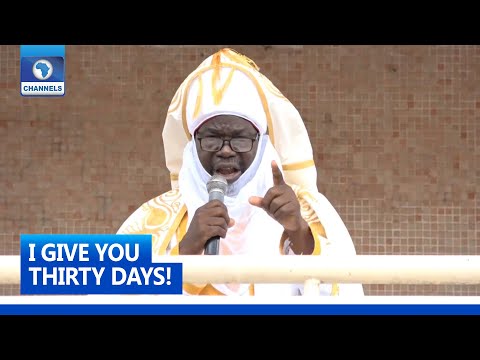
The Emir of Muri, HRH Alhaji Abbas Njidda Tafida OFR, as it is the tradition, delivered an Eid ul-Adha speech to his subjects to celebrate the event. As it is the norm, the Emir does so in both of the Eids in his palace, in Jalingo, the Taraba State capital. Accordingly, the people of Muri Emirate every year eagerly look forward to attending his court to listen to his Eid speech for the contextual significance of such addresses. 

The last one which was delivered, after the Eid prayers, was not overly different from any he had made before in terms of the tone except for those, who had not been following the Emir’s activities, especially Sallah speeches. Sarkin Muri Alhaji Abbas Njidda Tafida OFR has been known to have a reputation for blunt speaking, fearlessness, and daring to a fault. He has indeed followed in the footsteps of his famous forefathers, Hamman Ruwa dan Usman, Abu Bakar dan Hamman Ruwa, Muhammadu Nya dan Abi Bakar, and his grandfather, Muhammadu Mafindi dan Muhammadu Nya and indeed, all other emirs of Muri emirate whose place in history has long been cemented for bravery. 

The names mentioned above are not the chronological representation of the noble people who have ruled Muri, the Emirs of Muri or rightly Lamibe Muri in Fulfulde. Instead, this is just a sample of the historical antecedents of the current Emir, which is apparent to many. So, this digression towards memory lane is for the consumption of those who barely know him. 

Lamido Abbas Njidda Tafida OFR has never been known to mince words. He spoke and spoke truth to power without any element of fear, which for me is the hallmark of a good leader. When I saw the video clip of the said speech the next day after Sallah, I listened to what I thought my leader or leaders anywhere should speak to a large extent in this highly demanding moment in our history as an independent entity.  Nigeria is on the edge of the precipice. I have always believed that the avalanche of security challenges bedevilling this country makes every contribution towards getting us out of the woods worth considering before making decisions. 

I believe the Emir of Muri was disappointed, appalled, and outraged at the spate of insecurity confronting his emirate in particular and the nation as a whole, which led him to deliver the speech. He acted as anticipated of leaders, especially of his nature, the traditional rulers, whom so many have opined to understand better their domains than any other constituted authority of whatever magnitude. Whereas this may not be applicable in all places, it is to a large extent. 

Yes, His Royal Highness, Lamido Alh Abbas Tafida OFR made some rather harsh points, which I understood as someone speaking from the point of view of a leader enraged by hardened criminals who have held our people to ransom. So, he made comments which were largely misconstrued or deliberately taken out of context to suit a specific agenda, script, or scheming of those who don’t mean well for anyone. Some tabloids, blogs, newspapers, etc., reported that the Emir of Muri had given a 30-day ultimatum to Fulani to leave his emirate or be evicted, eliminated, and all sorts of strong, wordy, and sensational headlines that are in line with what they perhaps want, which are all false.  

For some, it doesn’t matter the fact that the Emir of Muri himself is Fulani and could not have issued an ultimatum to all Fulanis, which will include himself. He won’t do that and not for any sentimental reason. But for equity and justice. He certainly won’t issue an ultimatum to any other tribe. However, this doesn’t matter to some, who are hell-bent on making the Fulanis scapegoats for every misfortune that befalls them. 

Of course, some so many kidnappers are Fulani by tribe, so many bandits are Fulanis, and indeed other criminal activities, which the Fulanis engage in. I can’t write any percentage here because I don’t know the percentage. However, it is also true that all tribes are involved in all of these acts of criminality. In light of this, I will concentrate on what directly connects to the speech made by our revered leader, the Lamido of Muri. It won’t be wide of the mark if the Fulanis are said to be the majority embroiled in all these. I think it is the crux of the matter being discussed, the Emir of Muri’s Sallah day speech. 

As a royal father, especially the overall leader of all Fulanis in Taraba State, it is only right that he spoke his mind and made it vivid that he is disappointed with those Fulanis who engage in these nefarious activities. This is the right step to take, and he boldly took it. But, unfortunately, it is left for others who prefer to play politics with everything to proceed when their houses are not just literally on fire but also their entire emirates, chiefdoms, kingdoms, local governments, states, or even the country as the case may be, is sitting firmly on a powder keg. 

If there is any moment to act, it is at this decisive moment. Any other moment we aren’t guaranteed. If the sight of a hapless woman running and leaving her children despite the well-known affection that exists between children and mothers, don’t throw you into inconsolable grief then, I am sure the sight of any of those condemned criminals harassing your loved ones while asking you to raise ‘astronomical figures’ in currency, at a time when feeding any meal at all three times a day is fast becoming the exclusive of a few: this is the height of callousness and should be collectively confronted by all citizens without adding any ethnic colouration to it. 

Criminals, as I have always maintained are nothing, but criminals. Any other thing is secondary. You may not understand this now. However, I pray you never have to face them, but asking anyone who has been a victim of kidnapping, banditry, or even terrorism knows for a fact that there is no special treatment for victims based on ethnicity, faith, or region, at least to the best of my knowledge based on my interactions with some victims and the literature I have consumed in that regards. Unique treatments are the only figment of the imagination of some of us law-abiding citizens, who those contemptible people haven’t caught, but sit behind their keyboards, write columns, or even go to national television to eulogise those criminals because of their ill-thought-out affinity with these beasts. When you are caught, God forbid, everything will be crystal clear. I hope it doesn’t get to that. 

It is not enough to merely hope. We are doomed if the only thing we could do is hope without holding our government accountable so they can do even more to win these wars. The worst mistake we could make is paying lip service to this predicament because our kinsmen are involved, some adherents of our faith are part of it, or to achieve a sinister motive. There is only one result coming our way with this mindset, a certain outcome of unimaginable proportion: by then, the deed would have been done, and we cannot turn the tide.

We must unite, cooperate with security personnel to arrest the array of security challenges we are battling with; when we fail to do so because we fear for our lives, we shouldn’t live under any illusion that we are secure with that miscalculation, for no one knows the next victim. But one thing is sure we will all die one day, for some of us, we believe at the appointed time. The bandits and terrorists that sack villages and go about maiming, eliminating, or leaving deep scars on us have one life too. However, with more beneficial civil-security relations and a better understanding among all Nigerians, we stand a tremendous chance of getting the right result. 

The Emir of Muri as a sage has come out to take practical steps. Where he erred in that speech by resulting in generalisation, the Emir has already made amends. He summoned a meeting of the Fulani leaders where he admonished them using verses from the Holy Qur’an and other sources of knowledge for the benefit of what we all seek, peace.  For his intentions from the get-go were clear. 

The speech was delivered to find lasting solutions and should be firmly situated in its context bearing in mind that we are on the verge of self-destruction as a nation. Therefore, it was done to seek the return of peaceful, serene, and lively emirate where people will go to sleep with their two eyes closed, where our widow’s mite would not be used to settle some kidnappers even when we are barely surviving, where criminals would not be given any breathing space because they are our relatives, purportedly share the same faith with us, or for whatever reason. I long for this day when criminals will be criminals and rightly dealt with as such. 

It should be noted that the vast majority of the Fulanis, like all other ethnic groups, are law-abiding citizens. Therefore, it is up to all Fulanis, the security personnel, and Nigerians, in general, to work amicably to return Nigeria to the path of sanity, meaningful life, and mutual respect for one another. May the reign of Emir of Muri, HRH Alh Abbas Njidda Tafida OFR belong, as he recently clocked 33 years on the throne of his forefathers.  May his Emirate continue to prosper, and may the good triumph over evil everywhere. 

Abdulrazak Iliyasu Sansani wrote from Tukari B, Jalingo, Taraba State. He can be reached via abdulrazaksansani93@gmail.com.