Federal Government of Nigeria

Nigeria Jubilee Fellows Programme: Why you should apply

By Ishaka Mohammed

After many fruitless applications, job seekers in Nigeria get frustrated. As some delve into crime, others retire to idleness, leaving everything to fate. Neither of these options is advisable. Nevertheless, there’s no need to stop trying. The following instances might suffice.

In Nigeria, being called a SAN comes with prestige. The bearer of the title is an experienced legal practitioner, considered professionally (and to a large extent, economically) successful. It means Senior Advocate of Nigeria (SAN), yes? But, no, there’s a different angle to it.

Many young Nigerians can bear an unfortunate version of the acronym SAN. They don’t have to study law, not to talk of being called to the Bar.

To cut it short, a guy and two ladies meet (for the first time). In response to the question of what he does for a living, he replies, “I’m a SAN.” The ladies are amazed due to his age, so they try to congratulate him, but his conception of the acronym fills the scene with abundances of laughs. He gently says, “I am a Senior Applicant of Nigeria (SAN).” The guy has applied for many jobs, but he has yet to secure employment. After listening to his story, the ladies offer him a job.

That’s in a Nollywood movie, though. Now, let’s discuss reality. A friend and former colleague is currently an officer in the Nigerian military. At a point in his life, he handed copies of his credentials to a cybercafé attendant and asked him to keep applying for jobs that matched the credentials; he would pay after every application. That was after being tired of visiting the café all the time.

Road Safety, Prison Service (now Correctional), Navy, name it — my friend had sat tests or gone for physical screenings, but none had worked in his favour. He was literally tired, so exhausted that when he was called for a physical screening after his last application, he had concluded to ignore it. If not for the timely intervention of his family, he wouldn’t have gone for the screening. He made it afterwards and the rest is history.

The above instances clarify that you have no reason to give up. You don’t have to wait for the required “connection”. Keep trying. Thomas Edison once said, “Our greatest weakness lies in giving up. The most certain way to succeed is always to try just one more time.” That one more time might be the last effort required. That one more time shouldn’t be about today or tomorrow; it shouldn’t be about the number of attempts; it should simply be about whether or not you have attained your desired goal.

As a Nigerian, you can irrevocably say that many things have gone wrong in your country. The rate of unemployment is high and scary. Thanks to members of the political elite, who are busy hijacking what is meant for the citizenry.

Attempting to minimise unemployment in the country, successive governments have come up with beneficial programmes targeting the youth. However, the politicisation of selection processes and inconsistent remunerations have sabotaged the otherwise commendable initiatives. For instance, many of the past N-Power volunteers are still owed stipends after one year of exiting the programme. And even while in the scheme, a significant number of these youth often received overdue allowances. What about the Special Public Works Programme for 774,000 unskilled labourers? The three-month programme ended in March 2021, but many of the beneficiaries have yet to be paid. It’s worth stressing that each beneficiary is entitled to just N60,000 (spread across three months).

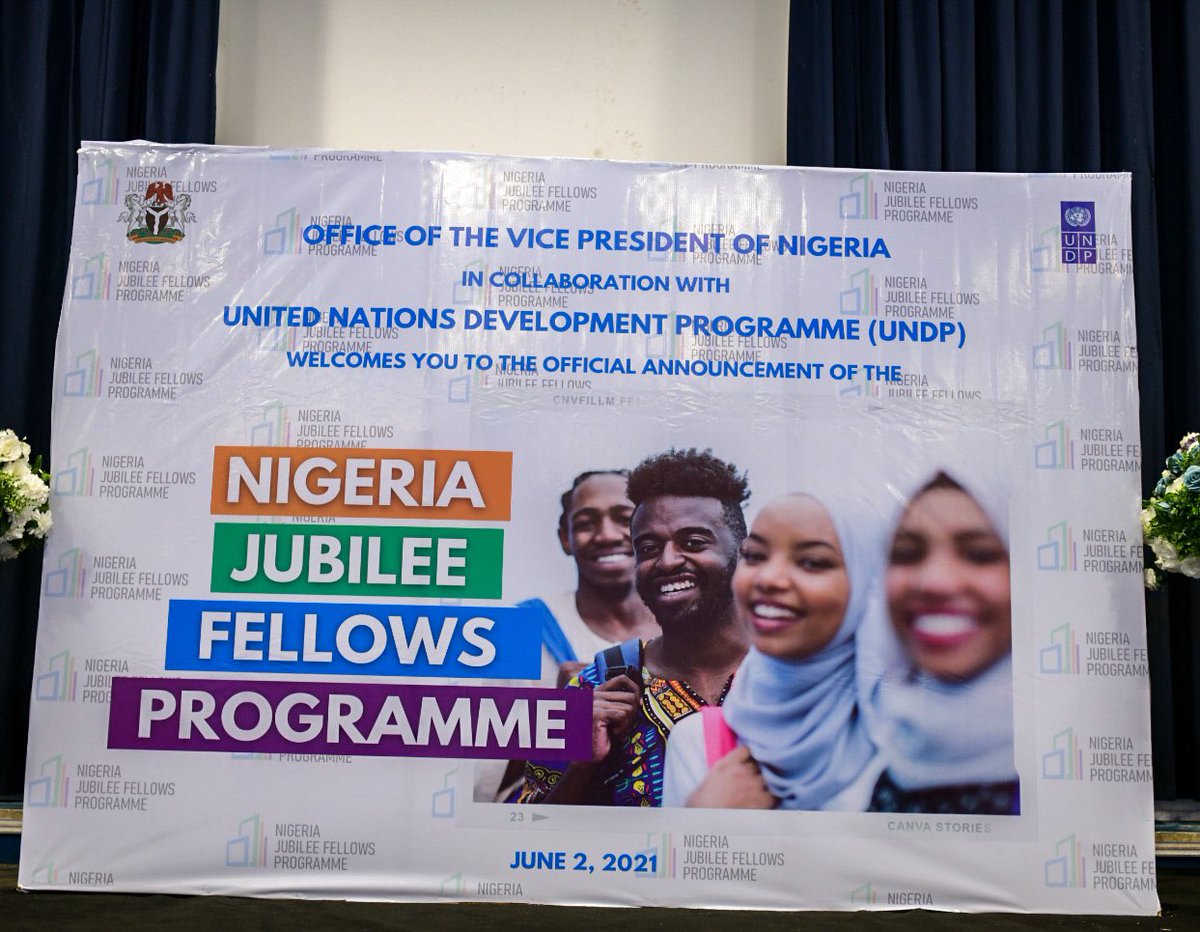
Despite the ugly situations in Nigeria, try this one. In collaboration with the United Nations Development Programme (UNDP), the Federal Government of Nigeria is enrolling 20,000 recent graduates in full-time paid employment for twelve months. In addition, the Nigeria Jubilee Fellows Programme is for young graduates.

I partook in a briefing session on Zoom with one of the programme’s team members, Erere Oghoghome, on Tuesday the 17th of August, 2021. According to her, the programme will engage 100,000 people across five years, and the first cohort will be inducted by October 2021. That means the call for applications will be out in the coming weeks. Every eligible and interested person is expected to have developed a craving for a particular skill.

Aside from being paid employees for the period of the programme, fellows stand the chance of being retained by their host organisations. Plus, they’ll join the alumni network upon completion of the programme, and the team will be the first choice for organisations seeking personnel to fill vacancies.

The basic requirements are: graduated not earlier than 2017, less than 30 years of age, unemployed, and possessing NYSC discharge or exemption certificate.
At this juncture, I implore anyone who meets the requirements to keep tabs on the UNDP in Nigeria for this rare opportunity. It might just be that one more step to their dream job.

Other than using the experience to land a job after the programme, one can deploy the skill, money, or both in self-employment. Remember, fellows will be paid as graduate employees, not given stipends.

Therefore, it’s vital that unemployed graduates apply for the programme. There’s no harm in trying.

Ishaka Mohammed writes from Kaduna. He can be contacted via ishakamohammed39@gmail.com.
In Search of Solutions for Northern Nigeria

By Ahmadu Shehu, PhD.

The current situation in northern Nigeria is very discouraging, even depressing. But it is not hopeless. Daunting as the current challenges seem, they are far from insurmountable. Before sounding over-optimistic, let me admit that things can head south and that the danger ahead is by no means to be underestimated. The problems bedevilling this country have been dissected, analysed, revised and reviewed regularly. They are well-known to the extent that a curious baby could make a list of them; insecurity, poverty, joblessness, poor education, healthcare, lack of power, water, and all other social amenities. That is how obvious our problems are.

Unfortunately, although various solutions to the above problems have been proposed over time, few improvements are being recorded. On the contrary, things have become worse by the day. What this means is that either the proposed solutions are wrong, inadequate or that these solutions are not well-implemented. Regardless, we shall acknowledge that these problems have been with us throughout our recent history; they have been acerbating all through the decades of our independence, and that they are not going away on their own. Though, it is not as if nothing is being done to ameliorate this sorry situation; it is just not enough.

For instance, as people of faith and conscience, we have been encouraged to pray hard, submit to the true spiritual powers that create and sustain the universe. Luckily, Nigeria is reportedly the most religious country globally, and our attitude to religiosity attests to this claim. As a nation of faith, we have benefitted from our dedication to prayers and spirituality in many ways. However, the deteriorating state of our affairs shows that something is definitely wrong with this approach. We can see that as hard and as much as we pray, these problems are not going away – they have refused to disappear after the night vigils. The home truth is that they will not disappear because they are man-made and, therefore, require human solutions. Consequently, we have to undo them by matching our spirituality with the necessary practical actions.

As concerned and enlightened citizens, we have cried out as loudly as possible, written treatises, provided all the analyses in this world. Still, that is undoubtedly not going to do much in salvaging this precarious situation. This decay is beyond words. As individuals, each of us has a responsibility to this country. Therefore, some pundits claim that we shall quickly solve these problems if we do our parts as individuals. Well, yes and no. Resorting to self-help is itself a measure of failure in a cooperative society. We can only do so much as individuals, but not enough to correct the ills of this society. That is why human society is politically structured since time immemorial. We have never heard of a country, an entity – not even a family system – without a workable structure. As Femi Falana says, “there is indeed no republic of non-governmental organisations”. 

As citizens and subjects of a political structure, we have always pushed all the blame to the region’s political leadership. Indeed, the responsibility of a people is absolutely on the political leaders who have all the instruments of power, administrative and constitutional resources, privileges and responsibilities. But, this too is very much debatable. One undeniable truth is that while political leaders are responsible for the development of a society, the quality of followership has a significant stake in the success of public policy and programs.  Is leadership not the product of followership? Or is it the other way round? This is the case with chicken and egg. Your guess is as good as mine.

As a government, various laws, policies and programs have been formulated, enacted, assented, proposed, implemented, or use any vocabulary that suits your purpose. The bottom line is that we are sinking deeper, moving in reverse order, and things are getting worse. Governments at all levels adopt often conflicting policies and programs on various challenges facing the region. For instance, on insecurity, the Zamfara state government embraces negotiations and amnesty for criminals, while Katsina state adopts the often faulty stick and carrot approach. On the contrary, the Kaduna state government insists on non-negotiation with criminals, without any alternatives for the victims. The governments apply the same conflicting methods to other critical issues such as education, employment, poverty eradication, healthcare, etc. If results are to judge actions, we can loudly, albeit sadly, say that successive governments at all levels have failed in basically everything.

The evidence of the failure of these approaches lies in the fact that there is no sector – one aspect of life – that is better than it was years ago. But at the same time, this evidence is the same reason we should do more because our problems are bigger and more today than yesterday. It means, therefore, that the people of this region must continue brainstorming and inventing new, dynamic solutions in tandem with the current challenges facing it. Northern Nigeria is full of potentials and opportunities to get out of this mess and attain its developmental goals.

The best way to do this, in my opinion, is by focusing on the human capital of the region. The problems mainly result from neglecting the wealth of human resources, both in quality and quantity, by undermining critical social development issues, especially education and skills acquisition. Yes, this region might be rich in natural resources, such as gold, ore, iron, and other geological elements. Still, the truth of the matter is that no society has ever mined itself to greatness. In recent years, the federal government has been fond of oil exploration in the north to counter the southern narrative of “oil-producing states”. But, the essential truth is that the so-called oil-producing states are as underdeveloped as any other state of the federation, except that they alone have the environmental degradation of that magnitude. This tells us that our society cannot drill itself to development.

Likewise, we may argue that agriculture has sustained us for millennia, but the population explosion, waning natural resources, desert encroachment and other global factors mean that the current scale of subsistence farming does not feed us, let alone sustaining our economy. Thus, we cannot farm ourselves out of these troubles.  

I believe we can think and invent ourselves out of these problems. The surest way to development is education – education that develops the minds of the citizens to think, organise and prosper. Fundamentally, this is what only education (in its real sense[1]) can do. Many countries and societies have done this in recent decades. Nations are not born or produced by the roads, farms, bridges, mines, oil fields or industrial estates. They are born by the minds of citizens. The growth of societies is not measured and cannot be attained or sustained by the physical attributes, items and objects on the ground but by the enlightened minds of their citizens. Thus, learning from both our history and the history of nations worldwide, the north can and will be developed, but only through quality education and nothing else. If we can get this right, we will be able to think ourselves out of these problems.

Dr Ahmadu Shehu is an Assistant Professor at the American University of Nigeria, Yola. He writes from Yola, the capital of Adamawa state.


[1] My definition of education and the model that I believe can do this is explained in my article entitled Towards a Community-Based Model of Basic Education in Nigeria published in Chido Onuma’s Remaking Nigeria: Sixty years, sixty voices.

River Jama’are needs ecological fund attention

By Mallam Musbahu Magayaki

It is no longer news that flooding has washed away about 1,567 farmlands on Tuesday 10 August 2021 in Jama’are Local Government Area of Bauchi State. According to reports by Daily Trust, there were seven villages affected by the menace.

However, Jama’are River, also known as the Bunga River in its upper reaches, starts in the highlands near Jos, Plateau State, Nigerian, and flows northeast through Bauchi and Yobe States before joining the Hadejia River to form the Yobe River. Therefore, if and when over flooding occurs, the resultant effect would undoubtedly lead to the loss of countless lives of peoples’ and destroy their farmlands because of its wide range.

Furthermore, mitigating flooding hazard is one of the responsibilities of ecological fund management by funding the projects to alleviate and manage social-ecological knots. And by extension, the management concerned can liaise with the state government witnessing devastating and uncontrollable flooding risk.

Remember that almost 80 per cent of Jama’are dwellers are farmers where they find it too difficult to get their farming crops for sale in the market when flooding occurs. People from various regions of this country are struggling in Jama’are to buy farming materials. As a result of continuous flooding each rainy season, there are attendant of loss of farming produce.

The government is negligent in mitigating the flooding menace. As the federal government fully knows all the areas submerged by flooding in the rainy season, the government should do the needful before the season.

Advisably, the government should set up committees for monitoring flooding affected areas by observing the type of works that the site needs.

In a nutshell, ecological fund management and state government should, in a matter of urgency, collaborate with World banks flood protection projects to seek their assistance because the projects are capital intensive.


Mallam Musbahu Magayaki writes from Sabon Fegi, Azare, Bauchi State. He can be reached via usbahumuhammad258@gmail.com.