Fake News

Chinese influencers now required to hold degrees to discuss serious topics

By Hadiza Abdulkadir

Influencers in China will now need to hold a university degree or relevant professional qualifications before discussing serious topics such as medicine, law, education, or finance online, according to new regulations aimed at curbing misinformation.

The policy, announced by Chinese authorities this week, requires prominent online personalities — particularly those with over one million followers — to provide proof of their expertise. Those who fail to comply risk fines of up to ¥100,000 (about $14,000).

Officials say the move is designed to tackle the growing problem of false information and deceptive advertising, especially in areas such as fake medical treatments and supplements that have proliferated on social media.

While supporters argue the measure will help protect the public from misleading content, critics warn it could tighten state control over online speech and limit discussions on critical social issues.

The new rules mark another step in China’s ongoing campaign to regulate its vast and influential online ecosystem, emphasising “professional responsibility” and “accuracy” in digital communication.

Nigeria Customs Service warns public against fake appointment letters

By Sabiu Abdulahi

The Nigeria Customs Service (NCS) has cautioned the public against a fake appointment letter currently circulating on social media, describing it as a scam.

In a statement titled “SCAM ALERT!!!”, the Service clarified that it is “not issuing appointment letters at this stage of its recruitment exercise.” It further emphasized that the letters in circulation are “FAKE and should be disregarded.”

The NCS explained that the recruitment process is still ongoing and has not reached the stage of issuing appointment letters.

It stated that “the ongoing recruitment process is still at the examination stage; the Superintendent Cadre recently completed their CBT across the six geopolitical zones, while the Inspector and Customs Assistant Cadres also just concluded their online CBT.”

According to the Service, the fake letters are “another attempt by fraudsters to mislead unsuspecting applicants.”

The NCS urged applicants and the general public to remain calm, avoid sharing unverified information, and rely only on official updates from its verified communication channels.

It advised the public to follow the Nigeria Customs Service on its authentic social media platforms and website.

NCS denies viral social media list on 2025 recruitment shortlist

By Muhammad Sulaiman

The Nigeria Customs Service (NCS) has dismissed as false a viral social media post claiming to reveal the number of shortlisted candidates per state for the final stage of its 2025 recruitment exercise.

In a public disclaimer, the Service clarified that the publication did not originate from any of its official communication channels and urged the public, especially applicants, to disregard the information entirely.

According to the NCS, the ongoing recruitment process began with an official advertisement on December 27, 2024, attracting a total of 573,523 applications across the Superintendent, Inspectorate, and Customs Assistant cadres. After an initial documentary screening, 286,697 candidates were shortlisted for the first phase of the Computer-Based Test (CBT).

The Service further explained that while all cadres took part in the CBT, only successful applicants under the Superintendent Cadre were invited for the second phase, which will be conducted across the six geopolitical zones in line with candidates’ states of origin.

The NCS reaffirmed its commitment to a transparent, fair, and merit-driven recruitment process, in accordance with the Federal Character principle. It also advised applicants to rely solely on official updates via the NCS Recruitment Update Portal at https://updates.customs.gov.ng for verified information.

Ulama Forum refutes claims of 500,000 Christian deaths in Nigeria

By Hadiza Abdulkadir

The Ulama Forum in Nigeria has condemned what it describes as false and inflammatory allegations by some international media outlets, including Fox News, Radio Genoa and American talk show host Bill Maher, claiming that 500,000 Christians were killed in Nigeria last year.

In a statement signed by Convener Aminu Inuwa Muhammad and Secretary Engr. Basheer Adamu Aliyu, the Forum described the claims as “entirely unfounded, reckless, and designed to misinform the international community.” 

It added that Nigeria’s security challenges—terrorism, banditry, and farmer-herder clashes—affect both Muslims and Christians, not any single religious group.

The Forum noted that Muslim communities, particularly in the Northwest, have “suffered disproportionately,” with thousands killed in repeated attacks ignored by international coverage. It warned that spreading false genocide narratives could inflame tensions and undermine peace efforts.

Quoting the Qur’an, the Forum reaffirmed Islam’s prohibition of killing innocents and called for unity among Nigerians “to resist attempts by foreign actors to manipulate false narratives.” 

It also urged the government to intensify security measures and advised international media to report responsibly and respect Nigeria’s diversity.

Christians are not persecuted in Nigeria

By Bashir Jelani, PhD

It has been trending over the past two days that Boko Haram killed more than 500,000 Christians and burned 18,0000 churches in Nigeria since 2009. Local and international news media are spreading false information that Muslims are carrying out ethnic cleansing against Christians. 

Till now, no news media from Arewa has debunked this news. No Arewa intellectual, writer, or public figure responded to this. It is a big shame on us. Thanks to Femi Fani-Kayode for sincerely putting the record straight.

This phoney propaganda did not start today. Some insincere Nigerian Christians have been working hard to blackmail Muslims on the international stage. I don’t know what they want to get by fabricating that fake news. The dead silence from Arewa is what makes this misleading information gain momentum. 

I have debated this issue with Christian friends for many years. I have maintained that the majority of the victims of Boko Haram and bandits are the Muslims themselves. The Boko Haram terrorists do not spare Muslims. They don’t care about your religion. 

Boko Haram wouldn’t be operating in Northern Nigeria if its target were to cleanse Christians. I sympathise with some Christians who were affected, but the truth is that the Muslims are Boko Haram’s target. That is why they do their evil atrocities in the Muslim dominated regions, mainly killing Muslims.

Arewa needs to wake up. Debunking this dangerous propaganda is very important.

The afterlife of a conspiracy: Why facts alone cannot bury “Jibril of Sudan”

By Ibraheem Muhammad Mustapha

The passing of former President Muhammadu Buhari on July 13, 2025, presents a fascinating and troubling paradox for the information ecosystem. Instead of closing a chapter, it appears to have reopened a well-worn, debunked narrative that the “real” Buhari died during his medical trip to London in 2017, and was replaced by a clone or body double named “Jibril” from Sudan. 

As a fact-checker who has previously addressed and debunked this claim, this moment is a sobering litmus test for me and other fact-checkers, as it poses an elementary question of whether classical fact-checking is effective. My analysis leads me to a disquieting conclusion: we are not merely fighting a deficit of information, but a surplus of emotionally resonant, identity-affirming mythology.

Motivated Reasoning and the Psychology of Belief

To grasp the tenacity of the “Jibril” theory, we must first dispense with the simplistic notion that its believers are merely ignorant or unintelligent. The phenomenon is far more complex, rooted in predictable and well-documented psychological mechanics. The primary force at play is what political scientists Milton Lodge and Charles Taber have extensively studied as motivated reasoning. This framework posits that humans, especially in politically charged contexts, behave less as impartial judges and more as motivated attorneys seeking to arrive at a conclusion that aligns with their pre-existing beliefs and identities. For Nigerians whose political identity was defined by opposition to or deep disappointment with the Buhari administration, the “Jibril” narrative was never a hypothesis to be tested; it was a conclusion to be defended.

This dovetails seamlessly with the basic cognitive dissonance theory as was first postulated by Leon Festinger in the 1950s. From the perspective adopted by Festinger, an individual suffers great mental discomfort when they hold contradictory beliefs or are confronted with new information that challenges their existing beliefs. For a citizen who felt alienated, disenfranchised, experienced worse economic conditions or insecurity under a leader they may have once supported or hoped would succeed, the psychological stress is immense. It is far less dissonant to embrace a radical conspiracy that the “real,” competent Buhari is gone than to accept the more painful and complex reality that his administration, for a host of intricate reasons, fell short of expectations. The “Jibril” theory, therefore, is not a failure of logic but a psychological coping mechanism, a path of least resistance to resolve an otherwise unbearable internal conflict.

The Power of Narrative and the Poverty of Facts

Furthermore, fact-checkers fundamentally misunderstand the nature of the battle when we arrive armed with a dossier of facts and data to a war of narratives. Human cognition is not optimised for data points; it is wired for stories. The “Jibril” theory is a masterclass in narrative potency. It contains a villain (the cabal that orchestrated the switch), a victim (the Nigerian populace), a tragic secret (the president’s death), and a mystery to be solved. It transforms the believer from a passive citizen into a heroic truth-seeker, possessing gnosis —a secret, elevated knowledge unavailable to the deluded masses. In contrast, what does the truth offer? It offers the mundane and often unsatisfying complexity of economic policy, security logistics, and bureaucratic inertia. The conspiracy narrative is simply a better, more emotionally gripping story. It provides a scapegoat, assigns clear blame, and creates a sense of intellectual superiority in the believer.

For its most ardent believers, “Jibril” is a symbol of how distant, disconnected, and unrepresentative Buhari’s government felt. Claims that he no longer spoke Fulfulde fluently or looked physically different were not weighed as forensic evidence; they were experienced as embodied metaphors of alienation.

 The Core Crisis is Institutional Distrust

This entire dynamic is supercharged by a catastrophic collapse of institutional trust, which I see as the true Achilles’ heel of fact-checking as a profession. Our work as fact-checkers is predicated on the assumption that a trusted, authoritative third party can adjudicate truth claims. The “Jibril” case demonstrates the collapse of this assumption. The theory gained traction in an environment of profound distrust in public institutions. When citizens do not trust the government to tell the truth about policy or the economy, why would they trust it to tell the truth about the president’s identity? The fact-check is DOA (Dead on Arrival) because the source is already deemed compromised. Therefore, in an environment of deep-seated cynicism towards government, media, and experts, any attempt at debunking is easily reframed as part of the cover-up. Hence, the more forcefully an official source denies a conspiracy, the more it can convince believers that the conspiracy is real. This phenomenon was documented by researchers Brendan Nyhan and Jason Reifler, who identified the backfire effect: each denial is interpreted as a sign of panic from those trying to hide the “truth.” President Buhari’s own need to address the rumour in 2018 (“It’s the real me, I assure you”) was, for many believers, served not as a refutation but as high-level confirmation that they were indeed onto something big.

Reassessing the Role of the Fact-Checker

Therefore, I am forced to reassess our role as fact-checkers and the efficacy of our traditional methods. The “Jibril of Sudan” case study demonstrates that reactive debunking is akin to trying to unring a bell. The path forward must be a paradigm shift towards what social psychologist William J. McGuire pioneered as Inoculation Theory. Rather than merely correcting falsehoods after they have taken root, we must pre-emptively “vaccinate” the public by exposing them to weakened forms of misinformation and deconstructing the manipulative techniques being used. The goal is to build cognitive antibodies against emotional manipulation, conspiratorial thinking, and logical fallacies.

Also, we need to learn how to fight a narrative war, not a Factual Skirmish, because we cannot defeat a powerful story with a list of facts. We must counter it with a more compelling, truthful narrative. This involves storytelling that explains complex realities in an accessible and empathetic way.

Then we need to embrace the method of empathy before evidence. The first step in engaging a believer is not to present a fact-check but to acknowledge the underlying grievance. A conversation that starts with, “I understand the frustration with the country’s direction that leads people to seek drastic explanations,” is more likely to open a door for dialogue than one that starts with, “You are wrong, and here’s why.”

Lastly, the ultimate antidote to misinformation is trust. This is a generational project, not a short-term fix. It requires sustained efforts from the media, government, and civil society to operate with transparency, accountability, and a genuine commitment to public welfare.

The persistence of the “Jibril of Sudan” theory, even in the face of death, is not an indictment of our work as fact-checkers. It is a diagnosis of a deeper societal condition where trust has eroded, and narratives have become more powerful than reality. It signals that the core battle is not over facts, but over trust. Until we can begin the long, arduous work of rebuilding faith in the institutions that serve as arbiters of reality, we will remain locked in this frustrating cycle. The work of a fact-checker, I now believe, must evolve from being a mere verifier of claims to becoming an architect of a more resilient, critical, and trust-based information ecosystem.

MIL Policy Integration: MAIN, in collaboration with UNESCO, trains media executives, senior editors, and content creators in Kano

By Nusaiba Ibrahim

Media Awareness and Information for All Network (MAIN) in collaboration with the United Nations Educational, Scientific and Cultural Organisation (UNESCO) has conducted training for media managers, senior editors and content creators from the Northwest region on the Integration of Media and Information Literacy (MIL). The two-day event took place in Kano State from May 19 to 20, 2025.

In his welcoming address, the Chairman of MAIN, Prof. Jide Jomoh, Lagos State University, appreciated all the participants and guests for sparing time out of their busy schedules to attend the session. He also appreciated the support of the Kano State government. Some of the objectives of the training, he said, included ensuring that editorial policies are reviewed in line with the rise of technology and the emergence of AI, as well as strengthening the capacity of journalists with the skills needed to combat information disorder.

To declare the event open, Hon. Commissioner for Information and Internal Affairs in Kano State, Alhaji Ibrahim Waiya, expressed his gratitude on behalf of the Kano State government to MAIN and UNESCO for organising the event. He said the training comes at a time when journalism is facing challenges on issues brought by information disorder. He noted that the training will surely equip the participants with the practical skills they need, especially for national development.

Also speaking during the occasion, Adamu Salisu, the State Coordinator of NBC, Kano State, who represented the Zonal Coordinator, said there are indeed blurred gaps between content creators and journalists, which make activities quite uneasy for media managers today. He added that “Integrating MIL is not merely a theoretical exercise but a practical necessity.”

Notable presentations on the first day of the event were made by Dr. Ruqayyah Yusuf Aliyu of Bayero University Kano, who spoke on MIL in Journalism – Challenges and Prospects, and Dr. Helen T. Olojede, the Head of the Department of Philosophy at the National Open University, who discussed Media and Information Literacy Responses to Generative AI. The sessions presented participants with the opportunity to discuss contemporary issues surrounding information disorder, combating misinformation, using AI and technology ethically, and how MIL can be integrated into media practice for the benefit of the public.

Also, during the session, Ms. Yachat Nuhu, from the Communication and Information sector, UNESCO Abuja, gave an overview of the organisation’s work on media and information literacy. Additionally, Dr. Oluseyi Soremekun, the National Officer of the United Nations Information Centre (UNIC), discussed extensively the issues and competencies of understanding Media and Information Literacy.

The second day of the training was focused more on discussions and active participation from the attendees. Prof. Jimoh led a discussion on MIL and national development, reviewing the editorial policies of selected media organisations. Participants were later divided into groups for in-depth discussions, and thereafter, representatives from the groups presented on the key competencies needed to support the implementation of policies and strategies on MIL in their respective media organisations.

In their various remarks, the participants stated that the program has achieved its objectives to the tune of 80 per cent. Media practitioners from The Daily Reality, the Nigerian Union of Journalists, Katsina State Television, Abubakar Rimi Television, Freedom Radio Kano, Daily Trust and the Vanguard Newspaper, as well as Hausa_Fulanii, a notable northern Nigerian blogger, among many others, participated in the session.

Finally, the session concluded with the formation of the Nigeria MIL Media Executive Network, which will be chaired by Mr. Abba Zayyan, a seasoned media professional in Nigeria. The training will also be replicated in the other zones of the country, as that of the North West was the first.

Nusaiba Ibrahim Na’abba is a freelance journalist and communication specialist from Kano, Nigeria. She can be reached via nusaibaibrahim66@gmail.com.

BUA clarifies stage of refinery amidst misleading reports

By Anas Abbas

BUA Refinery and petrochemicals has dismissed a report claiming that its 200,000 barrels/day refinery is 90% complete, describing it as misleading and inaccurate.

In a statement, The Daily Reality, gathered that, the company urged the public to disregard these misleading claims, emphasizing that they did not originate from BUA company.

The company confirmed that construction is progressing steadily and remains on track to meet its delivery timelines in collaboration with partners.

The Akwa Ibom refinery project is seen as a significant step towards enhancing Nigeria’s refining capacity and energy security.

In addition to the refinery, BUA is also advancing other energy initiatives, including a mini-LNG plant and new hybrid power plants across the country, aimed at increasing its existing captive power generation capacity of over 1,000 megawatts.

BUA also, encouraged the public to verify information through its official channels to avoid being misled by false reports. The company reiterated its commitment to transparency and excellence, noting that it has successfully completed over 12 major industrial projects worth more than $3.5 billion in the last decade.

As the Akwa Ibom project progresses, BUA expressed appreciation for the publics’ interest and support, affirming its dedication to building a robust industrial and manufacturing base for a self-reliant Nigeria.

Who can tell you the truth?

By Tijani Abiola

In a spacy world saturated with information, the desert of personal interest and a space box of selfish interest, discerning the truth has become increasingly challenging, from social media feeds to 24-hour news cycles.

We are inundated with facts, opinions, and outright falsehoods. Yet, the quest for truth remains vital, influencing our decisions, shaping our beliefs, and guiding our actions. So, who can tell you the truth?

Science, by its very nature, is a rigorous pursuit of truth. Through the scientific method, hypotheses are tested, results are peer-reviewed, and conclusions are drawn based on empirical evidence. Institutions like the National Aeronautics and Space Administration (NASA), the World Health Organization (WHO), and universities worldwide are pillars of this endeavour. Their commitment to objectivity and reproducibility makes them reliable sources of truth, particularly in areas like medicine, climate change, and technology, but can we say they are the real source of truth?

Media outlets are a relaxed space for the most trusted outlets for news reports, an avenue that most use to suit themselves and tailor their way of life. Most of the time, the media can also be biased. Established organisations like the BBC, The New York Times, and Reuters have built reputations for thorough and responsible journalism. These institutions adhere to journalistic standards, including fact-checking, corroboration, and ethical reporting. Their role in a democratic society is to hold power accountable and inform the public, making them essential sources of truth, but yet, can they tell you the truth?

Experts with a deep understanding of their fields and elders with numerous past useful experiences can provide accurate information and insights. Whether it’s a doctor discussing health issues, a historian analysing past events, or an economist interpreting market trends, these individuals rely on years of study and experience. Their expertise and dedication to their disciplines make them credible sources of truth; still, will you accept trends, mind experience and expertise ideas as the truth?

Ultimately, each of us has the responsibility to discern the truth. Critical thinking is our best defence against misinformation. By questioning sources, analysing arguments, and seeking evidence, we can better navigate the complex landscape of modern information. No one takes information to trust and accepts it as truth, except if they are convinced to accept it as truth.

In a world where the truth can often seem elusive, it is essential to exercise critical thinking before accepting any information to be true. One can only convince and prove with past experiences or actions that seem to complement the existing information left for you to think deeply and analyse whether to believe or negate the information. 

Still, you are the best person to tell yourself the truth through your critical thinking, valuing evidence over opinion, expertise over hearsay, and integrity over convenience. We can navigate the complexities of our information-rich world. Ultimately, the truth is out there, but we must seek and accept it diligently and responsibly.

Tijani Abiola T. wrote via abiolatijani001@gmail.com.

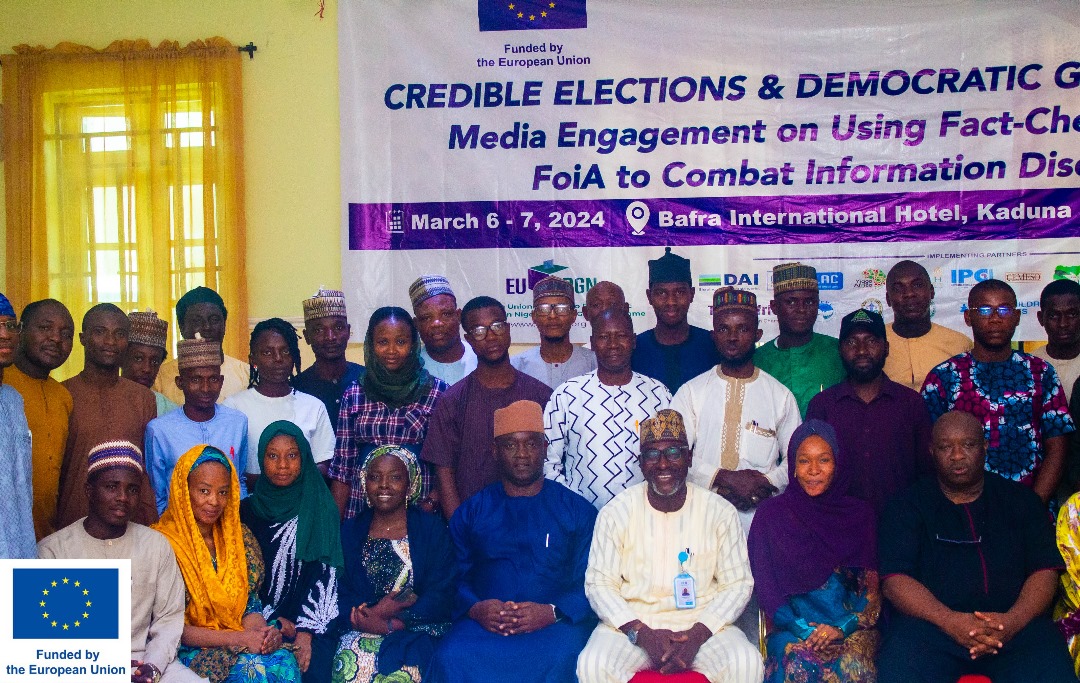
IPC trains journalists in combating information disorder

By Umar Namadi

International Press Centre (IPC) held a two-day capacity-building workshop on combatting information disorder in democratic governance reporting using fact-checking and FOI tools. 

The workshop is being held as part of the activities under Component 4 (Support to Media) of the European Union Support to Democratic Governance in Nigeria (EUSDGN II) project. IPC is the lead implementing partner. 

The two-day workshop held at Bafra International Hotel in Kaduna had in attendance 40 participants across nine (9) states of Northern Nigeria (Abuja, Kaduna, Kastina, Niger, Bauchi, Jigawa, Kano, Jos, Benue) who are new/mid-level journalists, community journalists, freelance journalists, etc. 

Participants were introduced to the rudiments of fact-checking using a tool and how to hold government and public institutions accountable for their activities using the FOIA (2011). 

As the program manager, Mrs Stella Nwofia, stated in her welcome address at the Sardauna Hall in the hotel, “The training program seeks to address a critical aspect highlighted in the EU-EOM final report on the 2023 general elections, which underlines that online social platforms played a significant role in both campaigning and public oversight of the electoral process. 

However, there were instances where these platforms were misused, either for campaigning lacking transparency or for creating misleading impressions of widespread support. 

Despite repeated warnings from government officials about the dangers of misinformation, various entities, including individuals associated with major political parties, disseminated false information online. 

Additionally, the report notes that major parties utilised paid advertising on online platforms. However, the full extent of this practice remained obscured due to a lack of transparency within these platforms.” 

She added that “The training program, which commenced in Ondo State as the initial phase and was followed by Port-Harcourt, is designed as a three-part series. Its primary goal is to provide journalists nationwide with essential tools, skills, and knowledge. The program aims to empower journalists to adeptly navigate the challenges of the digital era while maintaining standards of responsibility and ethical behaviour.

“Our goal is to empower journalists to uphold truth, advocate for integrity, and safeguard democracy by promoting a culture of critical thinking, fact verification, and media literacy.”