English language

David Jowitt, eminent English teacher, dies at 80

By Abdurrahman Muhammad

David Roger Jowitt, the renowned British professor of Nigerian English, who had lived in Nigeria for six decades and became a citizen in 2023, died yesterday after a brief illness.

Professor Jowitt was an academic and an author. His books, Nigerian English and Common Errors in English, are some of the best on the subject. He had reportedly been working on his memoir before his death.

He also taught at Bayero University, Kano, University of Jos, among many other institutions across the country.

Embracing Perseverance: A journey of triumph in English

By Abdurrazak Mukhtar

Introduction:

In the face of adversity, some individuals find the strength to rise above their challenges and achieve greatness. Such is the remarkable story of one individual who refused to let failure define them. Despite enduring twelve failed attempts at obtaining credit in English for their SSCE, they persevered, eventually mastering the language and becoming a mentor for HND and degree students. This story is a powerful reminder of the transformative power of perseverance and the unyielding spirit that can lead to incredible accomplishments.

The Will to Succeed:

Life has a way of testing our determination; for this individual, the English language became their ultimate hurdle. Year after year, they faced disappointment as the elusive credit seemed just out of reach. But instead of succumbing to despair, they summoned the courage to keep trying. Their unyielding will to succeed became a driving force that fuelled their journey towards mastery.

The Turning Point:

After numerous setbacks, the individual refused to let failure define them. Instead, they embraced the challenge head-on, recognising that actual growth often arises from struggle. So, rather than giving up, they embarked on a relentless pursuit of knowledge and skill, dedicating countless hours to studying and honing their command of the English language.

The Power of Education:

With each setback came a valuable lesson. The individual began to understand that learning is a lifelong journey and that education extends far beyond the walls of a classroom. They sought guidance from mentors, devoured books and resources, and immersed themselves in the intricacies of the English language. Slowly but steadily, their proficiency began to improve.

From Struggle to Mentorship:

The incredible twist in this story lies in the individual’s transformation from a struggling learner to a mentor for others. First, through their perseverance and hard work, they developed a unique insight into the challenges faced by students grappling with English. Then, armed with their own experiences, they became an inspiring guide, supporting and motivating HND and degree students in their pursuit of linguistic excellence.

Inspiring Others:

As this individual continued to impact the lives of others, their story became a beacon of hope for those who had lost faith in their abilities. They showed that failure does not define one’s potential but serves as a catalyst for growth. Furthermore, their remarkable journey instilled in others the belief that success is attainable with unwavering dedication and an unrelenting spirit.

Conclusion:

The story of this extraordinary individual serves as a testament to the power of perseverance. Despite repeated failures, their unwavering determination to conquer the English language transformed their lives and inspired countless others. Furthermore, it teaches us that setbacks are not roadblocks but stepping stones to success. With the right mindset and an unyielding spirit, anyone can triumph over adversity and achieve their goals.

So, let this story remind you never to give up, no matter how challenging the journey may seem. Instead, embrace each failure as an opportunity for growth and keep moving forward. Your struggles today may become the source of inspiration for others tomorrow. Remember, the key to success lies within you.

Alcohol, ethanol and beer

By Bilyamin Abdulmumin

Days ago, a picture of a beer advert on a bus with the caption: “ba barasa a cikin wannan giyar” dramatically attracted public attention. First, it appears the translation was outright flawed. The English direct translation may read thus: the alcohol doesn’t intoxicate.

Every native or one conversant with Hausa would find it difficult to wrap his head around this Hausa translation. So, some think it was out of the sheer cheap labour that the South African wine industry relied on the online translator to land them into the translation comatose. It might also be the usual case of giving the advert to the wrong agent or hiring a non-native to advertise the product.

Forget it; even if you are a professor in a particular language but happen to be not native or brought up in that typical language culture you will end up harming the advert than promoting it. One such advert that went wrong recently was that of one famous company, which read: “ko wanne zubawa, muhimmanci da ya wuce gwaji”. The equivalent English version read, “Every drop treasure beyond measure” What a rape to language!

As promoters of products, one can never dare associate the advert with alcohol in Hausa or any Islamic land; else, the result will be a mass exodus from the product. The brewing companies are still recuperating from the wound their Maltina product suffered because the same company is producing it as beer.

One factor that even fans the fire of controversy is that alcohol, beer/wine, and intoxicants are used interchangeably as the same thing: giya/barasa. So it becomes meaningless to try to separate one from another: that is to say, the beer contains no alcohol, alcohol is not intoxicated, or the alcohol is non-drunken. In the Hausa language, as long as it is alcohol there is nowhere to turn around.

Notwithstanding, are alcohol, ethanol, beer/wine, and intoxicants the same or different?

Alcohol is a general term referring to any organic compounds with OH functional groups. Therefore, any organic chemical with -OH in its makeup is alcohol. Examples of alcohol (alkane series) are methanol, ethanol, propanol, butanol, and the list goes on…. Alcohol has been a subject of controversy, no thanks to one of its family members: ethanol.

This controversial member: ethanol, is composed of two carbon, six hydrogens, and one oxygen; because of the presence of OH (hydrogen bonding) in its makeup, ethanol enjoys a wide range of applications. It is next to water as a global solvent. In addition, where water fails in industrial application, ethanol as an organic chemical (with carbon in its makeup) swoops in.

The industries where ethanol easily finds its way include Pharmaceuticals, several medicines you can’t do without today owe themselves to ethanol; Paint Industry, where your favourite paint can’t exist without ethanol; Fragrances, ethanol, not water is the solvent for making many perfumes; the Medicinal Properties, ethanol is a death sentence to microorganisms so when next used sanitiser, know that ethanol is that potent content; Bakery Industries, yeast is used in the bakery to give the bread desired quality as a result of ethanol and carbon dioxide as a by-product; Electrical Repair, ethanol is used as spirit, take your gadget for repairs they use ethanol for cleaning; Oil and Gas, perhaps the most economical part of ethanol use is when employing as fuel, depending on the purity, ethanol can be used as complement or substitution to transportation fuel (PMS); Brewing Industry, now the most controversial part of ethanol is when used as a drink, such as beer or wine. In beer, starch, e.g. corn or maize starch, is acted upon by appropriate enzymes and yeast industrially to produce beer. In a similar passion, fruit instead of starch is used in winemaking. Ethanol in brewing is the most dominant public knowledge, so it has become synonymous with alcohol (even among native English speakers).

The beer and wine produced conventionally contain up to 15 per cent of ethanol. This percentage is quite enough to intoxicate the drinker. Islam has outrightly forbidden taking intoxicants, such as beer and wine. The consequence for the global brewing industries is that they can only bite their fingers to watch a market of a staggering 1.5 billion people impossible to penetrate. So this became the mystery brewing industry struggled to crack. They finally get a catch.

Because the prohibition in Islam said intoxicants, so by this view, the brewing industries can design beer and wines that contain quantities of ethanol that is not enough to intoxicate a drinker, making beer and wine halal. Some Islamic countries like Malaysia have already nodded to this explanation by setting 1 % ethanol as a limit. Perhaps this was the intention of the South African wine advert on the bus.

On the other hand, the ethanol prevalence is more than what we could imagine; we are as indispensable as ethanol is concerned. Because the enzymes, yeast, and starch/sugar necessary to make ethanol are ubiquitous and, by extension, the ethanol itself. The cups, plates, our hands, and system you are using currently to read this article are a community of microorganisms; among them are the saccharifying enzymes and yeast. So with food readily available in the form of rice (rice), kunu, zobo, pieces of bread, fruits, etc., the right contact is just required to get the ethanol. Fura is the breeding ground for ethanol. The longer the “fura da nono” takes (without refrigeration), the higher the quantity of ethanol will be in it. But this passive ethanol prevalence is non-intentional.

Bilyamin Abdulmumin is a Public Affairs commentator and a Doctoral candidate at the Department of Chemical Engineering, ABU Zaria.

English: Language of science and emancipation

By Abdurrazak Mukhtar

English has become the language of science and emancipation. Whether we like it or not, this is a fact that we cannot ignore. The reasons for this dominance are complex, but we can trace them back to several historical and cultural factors.

In many ways, the emergence of English as the language of science can be traced back to the scientific revolution of the 17th century. This was when scientific knowledge expanded rapidly, and scientists needed a common language to communicate their findings. English became the obvious choice as the language of the dominant scientific culture in Europe and North America.

Over time, English has become the dominant language of science for many other reasons. First, it has a large and growing population of speakers worldwide, making it a common second language for many people.

Second, English has a relatively simple grammar and spelling system, making it easier to learn than many other languages. Finally, English-speaking countries have historically been major scientific research and development centres, giving English prestige in the scientific community.

Beyond science, English has also become the language of emancipation in many parts of the world. The spread of English has been closely tied to the expansion of Western political and economic power, and many countries have adopted English as a way of breaking free from the legacy of colonialism. Today, English is seen as the language of global commerce, and proficiency in English is often seen as a key factor in social and economic mobility.

Of course, the dominance of English is not without its drawbacks. Many languages and cultures risk being marginalised in the global marketplace, and there is a growing recognition of the need to promote multilingualism and cultural diversity. Nonetheless, proficiency in English remains a valuable asset for individuals looking to succeed in science, business, or other areas of international engagement.

The good news is that mastery of any language can be rewarding personally and professionally. The ability to speak multiple languages opens up new avenues of communication and understanding and can lead to greater cultural exchange and collaboration opportunities. Moreover, mastering a language is an art in itself, requiring discipline, creativity, and perseverance. Whether you choose to focus on English or another language, the art of mastery is a valuable skill that will serve you well in any field.

In conclusion, English has become the language of science and emancipation for various historical and cultural reasons. While there are challenges to this dominance, the rewards of mastering any language are great in terms of personal growth and professional success. So, whether you want to improve your English or learn a new language entirely, mastery is always worth pursuing.

Abdurrazak Mukhtar can be contacted via prof4true1@gmail.com.

Language is not a friend – I have bound my project

By Bilyaminu Gambo Kong-kol

Language is considered the principal method of human communication, consisting of words used in a structured and conventional way and conveyed by speech, writing, or gesture. It is a tool that establishes commonness between the sender and the receiver.

For the commonness to be established, the encoder must be well-grounded in the language he chooses to use and arrange his words systematically. He must also consider meanings such as denotative, connotative, reflected, and social, among others. 

The receiver must also do his part as interference is likely to occur from him, the environment, channel, or encoder.

However, language sometimes becomes a betrayer by betraying even the native speakers due to its rigid nature. The fact is that even if you are familiar with the rules, language may decide to disgrace you abruptly.

In this piece, Hausa, Fulfulde, and English languages will be used to explain my points.

In Hausa, it is a rule that most of the words that end with the letter “A” are feminine, and those ending with E, I, O, and U are masculine. But there are exceptions. For instance, words like kotu (court), gwamnati (government), and kwallo (ball) end with masculine vowels, but they are feminine. On one part, ruwa (water), zama (sitting), and kira (call) are masculine despite having feminine endings.

Hausa also demands that wherever possessives “Na” and “Ne” are used for masculine words, they should be substituted with “Ta” and “Ce” for feminines. For example, Jirgina ne (It is my plane), motata ce (It is my car).

Many Hausa speakers, including some of the natives in northwest Nigeria, are struggling to adhere to the rules. To get primary data on this, choose any state in Nigeria and listen to their radio stations or have physical interactions.

In Fulfulde, the law states that a word’s ending determines its demonstrative adjective. For instance, it is okay to say this horse, this room, or this pen in English, but the case is different in Fulfulde. Wamnde nde, sudu ndu, bindirgol ngol. To learn more, get a Fulani friend or wife.

This rule is giving headaches even to the LI in Yola, as it requires alertness and quickness of thought. It is normal to hear a typical Fulani man saying “Mi laari mo” instead of “Mi laari ngal” when he is referring to “I saw the hen”.

Another blunder is the introduction of the letter “V” in Fulfulde. In a standard Fulfulde setting, there is nothing like the consonant sound /v/. Hausa, too, does not have it. That is why some Hausa say bery good instead of very good. Just like the way some Hausa misplace V for B in English, some Fulfulde speakers misplace W for V in their first language. 

For example, “O vindi” instead of “O windi” (He wrote), “Mi vi” instead of “mi wi” (I said), “O va’i leggal” instead of “O wa’i leggal” (He/she climbed a tree).

One interesting thing about Fufulde is that, unlike Hausa and English languages, Fulfulde does not have pronouns that differentiate gender. Fulfulde’s pronoun “O” refers to he/she in English and Shi/ita in Hausa.  And Fulfulde’s pronoun “Ma” refers to Ka/Ki in Hausa. Maybe this was done to show our shyness and respect (Pulaaku). 

Another virus that is threatening Fulfulde is code-mixing and code-switching. Some Fulfulde speakers in Adamawa, Taraba, Gombe, and Yobe could not speak pure Fulfulde for an hour without borrowing from Hausa, English, Arabic, or their L2 words. This signifies a low level of grammar or lack of respect for Fulfulde language. It needs to be fought gallantly.

In English, rules of concord, tenses, syntax, and semantics are hectic for learners and L2 speakers. 

Concords like: “He says, I say, they say, he has, I have, they have, he does, I do, they do, he does not have, I do not have, and they do not have” are found to be confusing most especially by learners. Also, the sentences below, even though correct, may not convince learners as plural nouns could be seen nakedly. Shamsu, together with his wife, is coming to London or Maijama’a, along with Bilkisu, is coming to Cyprus. Think of “Neither Ghali nor the students are present” vs “Neither the students nor Ghali is present”. 

In tenses, the unjustified usage of the past in the present, the present in the past, or the distortion of the entire tenses is common. Moreso, the choice of words and sentence construction are influenced by speakers L1. You will see an English sentence given direct translation from Hausa, Fulani, Igbo, or Yoruba. Example: Haruna said it is for you and me.

In phonetics and phonology, words are pronounced mostly the way we hear others articulate them over time. Sometimes, Lll speakers localise the British accent. Consonant sounds like /θ/, /ð/, /ʃ/ /ʒ/, /ʈʃ/, /dʒ/, and ŋ/ are mispronounced in some words. Vowel sounds /ʌ/,  /ə/, /ɜ:/, /æ/ and the eight diphthongs play with the tongues of learners. Or should we say learns to play with them?

The topic is broad, but advisably, make sure you learn all the dos and don’ts of every language you want to communicate with people. This will pave the way for you to communicate effectively and earn your respect. By so doing, you minimise 70% to 90% of your chances of making mistakes. Don’t expect 100%; even the natives are still looking for that!

Nevertheless, always remember that language is not a friend. It may decide to disappoint you unexpectedly. I received mine on my last day as an undergraduate student at Bayero University, Kano. I was stuck fishing out whether the word “bind” is a regular or irregular verb. What is the past participle; binded, bounded, or bound? It had escaped my memory. I still don’t understand why English decided to misbehave on this special day of mine (04/05/2023).

Whatever the reason, I got a pitch that led to the writing of this article. Alhamdulillah! My appreciation to communication scholars, the Vice Chancellor of Federal University, Kashere, Professor Umaru A. Pate, and OPEC’s PR Coordinator, Dr Umar Jibrilu Gwandu, for drawing my attention immediately. I HAVE BOUND MY UNDERGRADUATE PROJECT!

Bilyaminu Gambo Kong-kol is a graduating student of the Mass Communication Department at Bayero University, Kano. He can be contacted via bilyaminugambokonkol20@gmail.com.

Is English a measure or determinant of intelligence?

By Ismaila Academician

I wake up with a demanding subject of debate – English Language as a measure of intelligence. Be that as it may, whether language, English or any other language, will be considered as a measure of intelligence is a non-binary proposition. As a linguist, I know it requires explicit and implicit discourse that will result in a logical conclusion. Hence the question:

Is language a measure of intelligence?

The 1950s is the year American linguists will see the improved acceptance of the Sapir-Whorf Hypothesis, popularly known as ‘Linguistic Relativism’. In the 1920s, Edward Sapir and a co-researcher, Benjamin Lee Whorf, made a sudden revelation to the American Society of Social Sciences that language shapes how one sees the world. Sapir-Whorf Hypothesis belongs to behavioural sciences.

This statement only explains that language is like a window, a spyglass through which speakers of that language build cognitive mechanisms to view, perceive, and explore the world and beyond, like Alice (in Wonderland), who studies the utopian world through the ‘Looking Glass’. It goes far as saying that to have a second language is to have a second soul – that is too important to say.

In sum, Linguistic Relativism allows one to see that fundamental differences between languages exist, and language actively influences the speaker’s worldview – concept formation, concept perception and concept interpretation. We kept rolling on this hypothesis till 1950, when the idea went out of favour. Cognitive Psychologist such as Chomsky sends this idea out of propulsion.

Around the 1960s and 1970s, Cognitive Psychologists studying mental processes such as creative thinking, problem-solving, and attention mapping rejected the idea. They found vulnerabilities in the Sapir-Whorf Hypothesis, such as conceptualisation which says if a given concept is unavailable in a given language, the speakers of that language won’t understand that concept is untrue. Also, language does not control our ability to reason. However, they argue that because speakers of different languages think differently doesn’t tell us whether it’s a language that shapes thought or vice versa.

Language as a measure of intelligence, influence or determinant?

We have seen the roles of language as a tool, what it’s and what it’s not. So now let’s return to the topic of the debate – the English Language as a measure of intelligence. But before we answer this question, let’s draw clear patterns. We may even breakdown the above question as follows:

Does language influence how we view and form reality (partial), or simply determine how we view and create reality (absolute)?

I believe the above questions will leave many strangled at the end of the tether. So let’s explore together how language works in real-life situations and see whether we can answer the questions appropriately.

Generally, linguists assert that language is a human invention – and it amounts to intelligence to invent a phenomenon as complex as language. It’s an essential tool to convey our mental processes to correspond to the physical and abstract world. It’s also considered one of the salient features of humans above other animals that are far more intelligent than human beings. Language makes our destiny clear and gives us a sense of humility, responsibility and belongingness.

Speaking of the English language, it is considered as the world language. It’s a first language to many people and a second language to many others. However, it has the largest stock in Literature. About 60% of contemporary knowledge is written in English, and a large share of ancient world knowledge is translated into it. This will give one confidence to say that your ability to navigate in English will determine the amount of knowledge one can acquire. The greater the amount, the higher the level of intelligence.

Law as a profession revolves around language proficiency. Characteristics of being a good lawyer include mastery of language(s). The ability to read, write, speak, and listen with unquestionable prowess. The greater the competence, the greater the performance and vice versa. The same applies to medical doctors.

For example, a lawyer with good command of English is likely to win cases. While a lawyer with bad command of English will not only fail but he’s also putting the life of his clients at risk. He will make the matter worse, complicate the process, and wrong justice will be served since the judge(s) depend on his presentation of reality.

Dear readers, for obvious reasons, don’t let anyone anywhere rob you of your conscience. Learning the English language is pragmatic and a must in the twenty-first century. However, while learning the language is necessary, being an expert is only advantageous. It will place you above yourself and many others and reward you in many ways: financial rewards and leadership roles. It can also earn you respect and integrity, among other things.

Wole Soyinka has been enjoying favours worldwide because he is considered intelligent, and his intelligence is tied to his mastery of the English language. As a Muslim, I believe if your mastery of (the English) language is utilised in good ways, it can earn you rewards hereafter. Translation of the Holy Qur’an from Arabic to English is an excellent example of the English language as a measure of intelligence.

Ismaila Academician can be contacted via ismailaacademician@gmail.com.

In response to Farouq Abba’s baseless critism of Pantami’s book 

By Usama Abdullahi

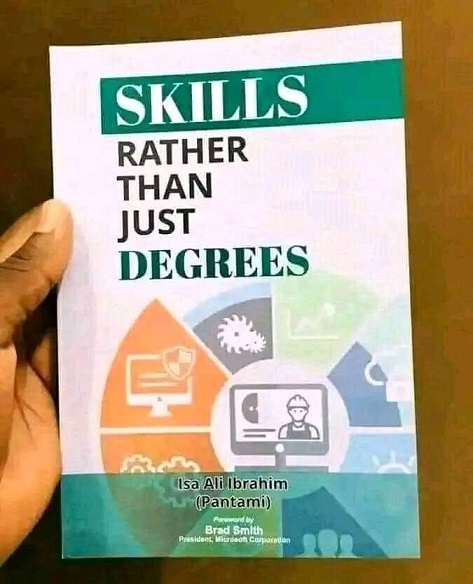
I don’t understand why someone like Farouq Abba, whose command of the English language is faulty, would waste his time kissing off Sheikh Ali Isa Ibrahim Pantami’s book titled, Skills Rather Than Just Degrees. I am pretty sure everyone who stumbles upon his criticism of the book would know that it’s such a ridiculous attempt to downplay the superbness of the book. To be honest, I find his criticism very tasteless and insulting. To insist that a comma must precede  ‘Skills’ before ‘Rather’ is to insist that the English language isn’t a complex one. Unknown to the faultfinder-Abba, putting a comma before ‘Rather’ is quite unnecessary.

It’s up to the author to decide whether to insert a comma or not. And the absence of a comma in the book’s title doesn’t invalidate the effectiveness of the book. Well, it’s obvious that the critic is plainly being too naive to conceive that idea. That being said, his understanding of grammatical rules is limited. So, we may wish to dismiss his critique as a misguided priority or some sort of attention-seeking thing.

Surprisingly, Abba has admitted by himself that he hasn’t yet read the book. But he’s quick to point out some “gaffes” in the book’s title. I guess he’s simply being hypocritical like he has always been when it comes to matters of great importance. 

I’m amused that he ended up exposing his ignorance while trying to alter what’s already inalterable. I understand that there are a number of people who wrongly assume that the use of ‘just’ in the book’s title is shocking. Contrary to their misapprehension of the adverb ‘just’, it can be understood in a series of ways. We all know that ‘just’ is synonymous with ‘only.’ Therefore,  there’s nothing to worry about in that title. It’s as simple as it seems. I, however, do not wish to denigrate Abba. I only wish to disagree with him. 

He also characterised the art on the book’s cover as being “too basic”. I don’t know what he clearly meant by that. But, to think that way is to think that the earth should revolve around him alone. That the book’s painting is “too basic” doesn’t mean the book won’t be impactful as it’s expected to be. You can only imagine what the book has in store if you haven’t read it. A good brother-cum-friend has shared the book with me via WhatsApp, and I have started reading it. It’ll be an interesting one. 

In conclusion, the book is such a great masterpiece. It argues that having a degree doesn’t guarantee that a person possesses the necessary skills to succeed in a given position or industry. Moreover, it suggests that instead of sorely relying on academic achievements, employers should focus on an individual’s (applicant’s) experience, practical knowledge and work-related skills because that determines how they will perform the job effectively.

The truth is, having relevant skills is much more valuable than simply having academic qualifications. Isn’t it funny that this is the kind of book which Abba sought to dishonour?!

Usama Abdullahi is an Abuja-based writer.  He can be reached via usamagayyi@gmail.com.

The importance of proficiency in the official language of one’s country

By Abdurrazak Muktar Makarfi

The ability to communicate effectively in the official language of one’s country is a hallmark of education and social mobility. Mastery of the official language is essential for communication and for accessing educational, economic, and social opportunities.

Language proficiency is a barometer of education and intelligence. One’s ability to articulate themselves with precision and clarity in the official language of their country is a reflection of their level of education, critical thinking, and cognitive abilities. Proficiency in the official language is integral to formal education, typically mandatory for accessing higher education and advanced employment opportunities.

Furthermore, proficiency in the official language is crucial for social mobility. Communicating effectively in the official language is paramount to accessing educational, economic, and social opportunities. Individuals who lack proficiency in the official language face barriers to accessing these opportunities, resulting in social exclusion.

Additionally, proficiency in the official language is pivotal for national integration and unity. A shared language promotes a sense of national identity and solidarity, fosters social cohesion, and enhances cultural exchange and understanding. The ability to communicate in the official language facilitates participation in democratic processes and civic engagement, promoting active citizenship and democratic values.

In conclusion, proficiency in the official language of one’s country is a crucial aspect of education, social mobility, national integration, and democratic participation. Therefore, it is imperative to prioritise language learning and provide equitable opportunities for all individuals to develop their language skills and reach their full potential. Doing so will foster inclusive and cohesive societies that value linguistic diversity and promote social and economic progress for all.

Makarfi can be contacted via prof4true@gmail.com.

Is English proficiency a measure of intelligence in Nigeria?

By Rabiu Shamma

English is the official language of Nigeria, and it’s often considered a measure of intelligence. However, it’s important to provide some context for this claim. Many Nigerians learn English as a second language, and it’s often used in formal education and business settings. Therefore, having a sound command of English can be an essential asset for success in these fields.

While it’s true that speaking good English does not necessarily make one intelligent, the ability to communicate effectively in the language is often associated with intelligence. In addition, studies have shown that individuals who speak multiple languages tend to have higher cognitive abilities than those who speak only one language.

Furthermore, evidence suggests that individuals with a poor command of English are often perceived as less intelligent. This may be partly because English proficiency is often associated with higher education and social status. Therefore, those who struggle with English may be perceived as lacking in these areas.

However, it’s important to note that English proficiency is not the only measure of intelligence. Many other factors contribute to one’s intelligence, including problem-solving skills, creativity, and emotional intelligence. Therefore, it’s important not to rely solely on English proficiency as a measure of intelligence.

While English proficiency is essential for success in Nigeria, it’s important to recognise that it’s not the only measure of intelligence, as I have come to understand in my many years of learning and teaching English. Individuals who struggle with English may still be intelligent in other areas, and it’s important not to make assumptions based solely on language proficiency.

Rabii Shamma wrote from Kano.

Is the English language a measure of intelligence? 

By Salisu Yusuf

I was drawn into this debate by Abubakar Shuaibu Rimi when he mentioned my name under the status update of one of his Facebook friends on the above subject. Rimi wanted to hear my side of the argument. I am not supposed to say something on this issue because it’s my area of specialisation. But I am writing on it to make some clarifications.

First language is a name given to either native speakers or those who acquire a language from early childhood; I mean those whose parents are non-natives but who are exposed to the language after birth. So first language is learned successfully during childhood without the need for a formal setting. First language is, in fact, acquired (acquisition), not learned, because a child is endowed with what linguists call LCD, a natural gift endowed by God so that a child will automatically acquire any language he’s exposed to.

The first language is learned with less effort because the acquirer acquires it subconsciously, as he’s not even aware of grammatical rules.

 A second language learner, on the other hand, is someone who learns a language later after acquiring his native language. It’s usually through the formal setup and is leaned consciously with a lot of effort. While the first language is natural, the second language is a gift(intelligence), as the learner learns it consciously aware of grammar and can talk of the rules. 

Second language learner is intelligent because:

In second language learning, the learner grapples with linguistic elements such as grammar, syntax, phonology, phonetics, sociolinguistics, morphology, semantics, etc. Whenever he’s speaking in the target language, he’s conscious of almost all of them, yet you say he’s unintelligent!

When learning a second language, the learner must scale cultural barriers and embrace certain new cultural elements in the target language. In other words, he must acculturate by bypassing what linguists call social and psychological distances.

Part of the learner’s acculturation is to learn how to use the new target language independently of his mother tongue,  even though traces of his first language can be found in his expressions.

A second language learner must be intelligent enough to fight certain linguistic impediments such as systematic errors, mistakes, language interference, transfer, and interlanguage and learn the language, not his own.

A second language learner must pass certain difficulties to learn, especially when he passes 15 years, as his linguistic receptors in the brain are becoming strained, therefore, making learning more difficult. 

The question ‘Is the English language not a measure of intelligence?’ may only be applicable to native speakers because they have learned the language since childhood and in their linguistic environment. Even this claim is contestable. This is because not all speakers of a language communicate with it efficiently. A select few do. For example, if the late Ɗan Masanin Kano or the former Emir of Kano, Muhammadu Sanusi II, addresses a Hausa audience in Hausa, people tend to listen because any one of the two masters the art of speaking even in Hausa. Can you call any one of the two dull? 

So not only the English language, which isn’t our language, even a good Hausa speaker is intelligent because an unintelligent man can’t organise his words to impress an audience. Also, a good native/non-native Arabic speaker is also intelligent enough to organize his words to communicate impressively, so also is a Hausa native who communicates in either Fulfulde, Yoruba, etc.

Generating some linguistic elements such as grammar, phonetics, phonology, morphology, syntax, semantics, etc and combining them to negotiate meaning isn’t an unintelligent job. Not all language users combine the spoken and written expertise of language. The Hausa oral skills of Ɗan Masanin Kano, for example, wouldn’t be a sign of dullness but intelligence.

In other words, reaching linguistic “competence and performance” (the ability to combine sounds and meaning to communicate) even for native speakers isn’t a simple act of a simpleton, for not all language users are endowed with the skill to communicate well.