English language

Ghana adopts local languages as medium of instruction in schools

By Muhammad Sulaiman

The Government of Ghana has introduced a new education policy mandating the use of local languages as the primary medium of instruction in all schools across the country.

Announcing the policy, Minister of Education, Haruna Iddrisu, said the decision marks a major step toward resetting Ghana’s education system to better reflect the nation’s linguistic and cultural realities. He emphasised that children learn best in their mother tongue, which enhances understanding and cognitive development.

“The use of our local languages in classrooms will not only improve learning outcomes but also help preserve Ghana’s rich linguistic heritage,” Iddrisu stated.

The Ghana Education Service (GES) has been directed to oversee the nationwide implementation of the policy. The move is expected to significantly reduce the dominance of English in the country’s early education system and promote inclusivity through indigenous languages.

FG removes Mathematics as compulsory subject for Arts students

By Muhammad Abubakar

The Federal Government has announced a major review of admission requirements into Nigeria’s tertiary institutions, declaring that Mathematics will no longer be a compulsory subject for candidates seeking admission into Arts and Humanities programmes.

The new policy, unveiled by the Federal Ministry of Education, forms part of a broader revision of the National Guidelines for Entry Requirements into Tertiary Institutions in Nigeria. According to the guidelines, Mathematics remains mandatory only for Science, Technology, and Social Science courses, while English Language continues to be compulsory for all programmes.

Under the revised rules, candidates seeking university admission must still obtain a minimum of five credit passes in relevant subjects, including English. For polytechnic admission at the National Diploma (ND) level, four credits are required, while five credits, including Mathematics and English, remain mandatory for the Higher National Diploma (HND).

Similarly, in Colleges of Education, English Language is compulsory for Arts and Social Science students, while Mathematics is required for Science, Technical, and Vocational programmes.

The government explained that the reform aims to make tertiary education more inclusive and accessible, reducing unnecessary barriers that have prevented thousands of qualified candidates from securing admission. Officials project that the new policy could enable an additional 250,000 to 300,000 students to gain admission annually.

Education stakeholders have welcomed the move as a progressive step towards aligning Nigeria’s education system with global best practices, though some have called for careful implementation to maintain academic standards.

The Hausa reading culture is dead: Long live the Hausa reading culture

By Prof. Abdalla Uba Adamu

As we celebrate the World Book and Copyright Day (the UNESCO, not UK version) on 23rd April 2025, and even though it is targeted at children and youth, let’s reflect; after all, we were once children and youth. A historical excavation of our reading habits shows how lucky we were.

Hausa folks over 50 have always lamented the death of reading culture among contemporary Hausa youth. Such old fogies always hark back to the days of reading, mainly English language authors: James Hadley Chase, Denise Robins, Jacqueline Susann, Frederick Forsyth, Nick Carter, Stephen King, Robert Ludlum, Harold Robbins, Ayn Rand, Wilbur Smith, etc. Almost always English. Always British or American. The novels written by these authors, I would argue, laid solid foundations for their knowledge, command and mastery of the English language. 

And the comics. Tintin (actually, Tan-Tan), Asterix, Mad Magazine, Marvel comics (Spiderman, Fantastic Four, Thor, X-Men, etc). The entire comics of London’s Fleet Street. Evoking memories of Valiant, Thunder, Eagle, Commando, Cor!!, Buster, Tiger, Battle. Even football comics (even though I don’t particularly like football at all), such as Roy of the Rovers. The novels, the comics and the TV shows (Star Trek, Space 1999, Man from U.N.C.L.E., Man from Atlantis, Perry Mason, etc.), to be frank, laid the foundation of what I am today. Not much from Africa, though. But the little we had was superb as well. These included Lance Spearman’s African Film, Fearless Fang’s Boom, and a romantic tear-jerker, Joy.  

All were readily available at the Post Office in Kano and major supermarkets of Leventis and Kingsway. The latter in particular became a must-visit place for me in the 1970s. Nothing, absolutely nothing, beats the wonderful smell of fresh books being stacked on their shelves. And it wasn’t just books. I scrimped and saved pennies and shillings until I had enough to purchase my first vinyl record album – Rare Earth’s Get Ready in 1972, three years after it was released in 1969, when I first heard a single version on the radio. 

This was what defined reading culture, at least for those of us in the urban centres who grew up with it. And even if one can’t afford fresh new books and comics from Leventis and Kingsway stores, there are many places in Kano centred around Plaza in Fage, Coca Cola Roundabout, and even the main Post Office frontage itself, where hundreds of second-hand books are sold, even up to now. 

Exchanging books and discussing their plots, characters, and titles set the tone of conversations with friends. The most popular pulp fiction writer, of course, was René Lodge Brabazon Raymond, most popularly known as James Hadley Chase. Interestingly, his novels were written in the 1930s and later, painting an often-depressing picture of his setting (mainly the United States, even though he was British). Titles like Tiger By the Tail, Tell It to the Birds, Just a Matter of Time, Knock, Knock! Who’s There? There is a Hippy on the Highway that evokes our hastily copied Americanism. The garish covers, almost always graced by a long-legged sultry female model, made many truly judge the book by its cover. 

These foreign novels existed alongside African novels, particularly those published by Heinemann since 1969. The Heinemann African Writers Series produced a massive variety of novels, almost 225, many by people from the eastern part of Nigeria. For most of us, though, their postcolonial themes seemed too intellectual. Further, they were made part of the set reading for those offering literature, so again, many who want to read a novel just for pleasure rather than pan-African political philosophy simply avoided them. 

The struggle for the souls—and pockets—of school children in the 1970s continued in efforts to dislodge James Hadley Chase. In 1977, Macmillan Publishers decided to publish a low-cost paperback series under what they called the Pacesetters Series. These were published from 1979 to 1988 and became massively popular. I remember seeing one of the earliest, The Undesirable Element by Mohammad Sule from Kano, published in 1977, while we were students at ABU. 

When Sule finished the novel (which he wrote while a student at the now Rumfa College Kano), he initially took the manuscript to the Northern Nigeria Publishing Company (NNPC) in Zaria, which rejected it because it was in English. Luckily, Macmillan was in partnership with NNPC and the MD, a Briton, asked his wife to evaluate it. She did it positively and recommended it to Macmillan London, who were just about to start their Pacesetter series. See providence. If NNPC had accepted it, they would have created a large pool of English language novelists in northern Nigeria

For Baby Boomers (1946-1964) and Generation X (1965 to 1979), the Structural Adjustment Program (SAP) of 1986 severely affected their reading culture in one way: the books just dried up, whether foreign or local. Foreign became too expensive, local became too repetitive and static. We simply went back to the old classics and read them again and again. It was Robert Ludlum re-read (especially The Parsifal Mosaic) for me. 

All this was for ƴan boko. What about Hausa novels or reading materials? There are very few. By the 1980s, all the classics had been read, and no new ones were coming out. These included Magana Jari CeIlya Ɗan MaiƙarfiGogan NakaNagari Na KowaSihirtaccen GariDau Fataken Dare, and a whole bunch of plays. Writing and publishing was very strenuous. Publishers could only publish if the books were to be made part of the set reading for WAEC, which limits the writer’s imagination and creativity. 

Then Hafsat AbdulWaheed came along with So, Aljannar Duniya in 1980. The first published Hausa language novel. The first by a woman from northern Nigeria. Plotting the classic Hausa marriage situation. A revolution was ignited in Hausa language fiction, leading to Mills and Boons style romantic fiction or Littattafan Soyayya. In less than five years, both male and female writers had emerged with stories to tell. Writers’ collectives were formed. The printing presses of party politics made it easier to self-publish. So, the writers ignored the snotty hoity-toity “big” publishers, especially NNPC (although NNPC can PRINT your book for payment, as they did with Balaraba Ramat’s early novels).  

In less than five years, the emergent authors have published more volumes than Heinemann (225) and Pacesetters (130). This made Hausa the most voracious reading public in Nigeria. Prof. Graham Furniss of the SOAS London even published a bibliography of the genre, including a whole website based at SOAS. When they became too much for the Kano State public culture, for that was where they flourished, a censorship board was created in 2001 to curb them. When that did not work, the Kano State government burned them in 2007 to cleanse the youth of the books. A harsher censorship regime debilitated them even more, throwing them out of business. The Hausa reading culture died. 

Then the Smartphone came in 2007—the then-Kano state Governor publicly burned Hausa books the same year. The same year, a harsher censorship regime was instituted in Kano that made life hell for the creative industries (Maryam Hiyana, anyone?). The iPhone, while not the first smartphone (Blackberry, anyone?), nevertheless revolutionised communication in its innovative approach to design. Clone copies with Android operating systems cemented the mass appeal of the smartphone. Eventually, it became commodified. 

Then, in 2013, Hausa novelists had their epiphany. They realised that with Facebook bubbling away, they could write their novels and escape censorship. Sure, no money, but they would be sharing their ideas. Things then blossomed from there. They created hundreds of Facebook pages for Hausa novels. When they became technologically proficient or engaged those who were, they created blogs sharing Hausa novels and creating massive readership throughout the Hausaphone world. For instance, Hafsat Hausa Novels (H²) had 471,000 members last time I checked. 

Then they discovered Wattpad, which had been in existence since 2006. They moved on the site with massive gusto, creating novels in three presentation modes – Hausa, English and Enghausa. Mainly by women. The migration online redefines “reading culture” if it is seen as engagement with text. Wattpad’s metrics alone convincingly show that the Hausa reading culture has been revived. For instance, Jewel by Maymunatu Bukar had 1.1 million reads. Thus, E-books and online literary content became increasingly popular, and social media can be used to share and discuss these resources

And let’s not ignore social networks and social media posts and COMMENTS. Agreements, disagreements (including insults typical of Arewa Social Media), expanded explanations – all are READING, and far livelier than just reading a book on your own. But again, social media gives us the opportunity to discuss – have a debate – about the books we like/hate (Goodreads, anyone?). 

“Reading culture” is a dynamic and evolving concept that encompasses more than the mere act of reading. It is an intricate web of practices, values, and institutional structures that defines how individuals and communities interact with texts. Whether viewed through a sociological, historical, or digital lens, understanding reading culture involves recognising the interplay between technology, policy, and the deeply personal ways that texts influence and reflect who we are.

I therefore argue that reading social media is very much part of today’s reading culture. It is a re-invention of reading culture. It may differ from traditional literary reading in depth, tone, and purpose, but it still involves interpretation, meaning-making, and cultural exchange. In any event, all the books, comics, and TV shows you so favoured are now digitally available (I have sourced all of these that defined my youth).

As reading culture adapts to the digital age, social media becomes an important arena for literacy and engagement in all spheres. Hey, you might even find the rest of the James Hadley Chase books you missed (you know he published 98, right?). 

Happy World Book and Acibilisian Day to y’all.

Trump signs executive order designating English as official language of the U.S.

By Hadiza Abdulkadir

President Donald Trump has signed an executive order designating English as the official language of the United States. The order, announced at a press briefing at the White House, aims to standardise government communications and promote the use of English in official capacities.

“This is a step towards unity and efficiency,” President Trump stated. “English has always been the common language of our nation, and this order reinforces that tradition.”

The executive order directs federal agencies to conduct all official business in English and encourages state and local governments to adopt similar measures. It also outlines provisions for English-language education programs to support immigrants in learning the language.

Before this order, the U.S. had no official language at the federal level, and multiple languages were widely used, including Spanish, Chinese, French, German, Tagalog, Vietnamese, and Native American languages such as Navajo and Cherokee. Spanish, in particular, has been a dominant language in several states, especially in the Southwest and large urban centers.

Critics argue that the move may marginalise non-English speakers and undermine the country’s linguistic diversity. Advocacy groups have vowed to challenge the order, citing concerns over accessibility and inclusivity.

Supporters, however, praise the decision as a necessary step in strengthening national identity and simplifying government operations.

It remains to be seen how the order will be implemented and whether it will face legal challenges in the coming weeks.

Prof. Mustapha Muhammad retires after nearly 50 years at Bayero University

By Muhsin Ibrahim

Professor Mustapha Muhammad, a long-standing figure in the Department of English and Literary Studies at Bayero University, Kano, officially retired after an impressive 47 years of service. His disengagement marks the end of a significant chapter in the university’s history.

Known for his dedication to teaching, research, and mentoring, Professor Muhammad leaves behind a legacy that has shaped the minds of countless students and educators. His farewell on January 5 was not only a personal milestone but also a moment of reflection for the department that has greatly benefited from his wealth of knowledge and experience.

Colleagues express concerns about the impact of his retirement on the department. Malam Maikudi Zukogi noted that while Professor Muhammad’s departure was anticipated, it highlights the challenges ahead, especially following the recent retirements of two other long-serving faculty members – Profs. Isma’ila Tsiga and Sa’id Babura Ahmad. Zukogi stated, “His absence creates a significant vacuum that will be difficult to fill.”

As Professor Muhammad embarks on this new phase of his life, colleagues and students alike have extended their well wishes, expressing hopes for good health and a smooth transition into retirement. The university community acknowledges his invaluable contributions and looks ahead to sustaining the foundation he helped establish.

Definitions of 20 newly added Nigerian words in Oxford English Dictionary

By Ishaka Mohammed

The Daily Reality earlier reported that the Oxford English Dictionary (OED) had included 20 Nigerian words in its latest update. Below are their definitions.

1. 419 (noun): Fraud (now usually perpetrated on the internet) involving requests for advance payment in return for a substantial share of a large amount of money, which ultimately is never given. Frequently as a modifier, as in 419 emails, 419 scams, etc.

2. abi (adverb): Used as a sentence adverb: clearly, obviously; of course. Also used interrogatively, at the end of a statement, to prompt agreement, approval, or confirmation: ‘isn’t that so?’, ‘am I not correct?’, etc.

3. adire (adjective, noun): Made of a type of fabric produced mainly in south-western Nigeria, featuring patterns obtained by applying indigo or other dyes using various resist-dyeing techniques; a type of fabric produced mainly in south-western Nigeria, featuring patterns obtained by applying indigo or other dyes using various resist-dyeing techniques. Also: the method of producing this fabric.

4. agbero (noun): Originally: a person (usually a boy or young man) who works as a tout, typically at car parks and bus stops, collecting money from passengers and drivers and ushering passengers onto vehicles. Later also (now chiefly): a person (usually a boy or young man), who obtains money or wins influence by engaging in criminal activity, such as extortion, theft, and drug dealing, often as a member of a gang.

5. area boy (noun): A person (usually a boy or young man), who obtains money or influence by engaging in criminal activity, such as extortion, theft, and drug dealing, often as a member of a street gang. Also: a person (usually a boy or young man) who works as a tout or enforcer.

6. cross-carpet: (verb): Of a politician: to move from one political party to another.

7. cross-carpeting (noun): The action or practice of a politician moving from one political party to another. Also: an instance of this.

8. eba (noun): A kind of dough made with boiled cassava meal, typically shaped into balls, forming a staple food in parts of West Africa.

9. Edo (noun; adjective):  A member of a people inhabiting the ancient Benin Kingdom in present-day southern Nigeria; of or relating to the language of the Edo, a member of the Benue-Congo branch of the Niger-Congo language family; designating this language.

10. gele (noun): A West African head-tie originally worn by Yoruba women, typically consisting of a stiff piece of fabric printed with designs in bright colours, which can be tied or wrapped around the head to form various shapes.

11. jand (noun; verb): A foreign country; a country other than one’s own; to travel overseas, esp. in search of further education, employment, or economic opportunity.

12. janded (adjective): Designating a person who has travelled overseas; of, relating to, or characteristic of such a person. Also: characteristic of or coming from a country other than one’s own; foreign.

13. japa (noun; verb): The emigration of Nigerians to other countries (esp. those in Europe or North America) in search of further education, employment, or economic opportunity; to leave Nigeria for another country (esp. one in Europe or North America) in search of further education, employment, or economic opportunity. Also more generally: to escape, to flee. 

14. Kanuri (noun; adjective): A member of a group of African peoples principally inhabiting north-eastern Nigeria, with some populations in Niger, Chad, Cameroon and Sudan; of or relating to the language of the Kanuri.

15. kobo (noun): Also in extended use: a very small amount (of money); usually in negative constructions, as in not a kobo, not worth a kobo, etc.

16. Naija (adjective; noun): Of, belonging to, or relating to Nigeria or Nigerians; a native or inhabitant of Nigeria, or a person of Nigerian descent.

17. suya (noun): In Nigerian cookery: a dish consisting of thinly sliced pieces of spiced meat grilled or roasted on a skewer, usually sold by street vendors and eaten as a snack.

18. yahoo (noun): Fraud perpetrated on the internet, esp. involving requests for advance payment for services or products that are ultimately never provided. Usually reduplicated, as yahoo yahoo.

19. yahoo boy (noun): A person (esp. a man) who commits fraud on the internet.

20. yarn dust (verb): to talk nonsense.

The history, pronunciation, example sentences and other details about each word are available at https://www.oed.com.

Breaking: “Agbero”, “japa”, “suya”, 17 other Nigerian words enter Oxford English Dictionary

By Ishaka Mohammed

The Oxford English Dictionary (OED) has published its latest updates, featuring a collection of 20 words and phrases from Nigeria, Dr Kingsley Ugwuanyi, a consultant on Nigerian English for the OED, announced.

The Daily Reality can confirm that the dictionary has defined the words and phrases. However, while the majority of them (agbero, eba, japa, suya, etc.) were first published in December 2024, others (edo, kanuri, kobo, and yarn) were only updated with new meanings.

Dr Ugwuanyi, who played a significant role in the update, revealed that, in addition to drafting most of the words, he also provided their pronunciations. “When you explore the OED online and click on the pronunciations, you’ll hear my voice bringing these words to life,” he shared in a celebratory post on LinkedIn.

The newly added words reflect diverse aspects of Nigerian life, from everyday slang to cultural expressions. The list includes:

1. 419

2. abi

3. adire

4. agbero

5. area boy

6. cross-carpet

7. cross-carpeting

8. eba

9. Edo

10. gele

11. jand (noun, verb)

12. janded (adjective)

13. japa (noun, verb)

14. Kanuri

15. kobo

16. Naija

17. suya

18. yahoo

19. yahoo boy

20. yarn dust

Dr Ugwuanyi thanked Danica Salazar, the OED’s World Englishes editor, and the entire editorial team and encouraged Nigerians to share their favourite words from the list and suggest new ones for future updates.

Recall that the dictionary added 29 Nigerian words and phrases in 2020, and CNN reported that those were in addition to the at least 57 others already in the dictionary.

The Daily Reality is still compiling the definitions of the latest additions for easier access.

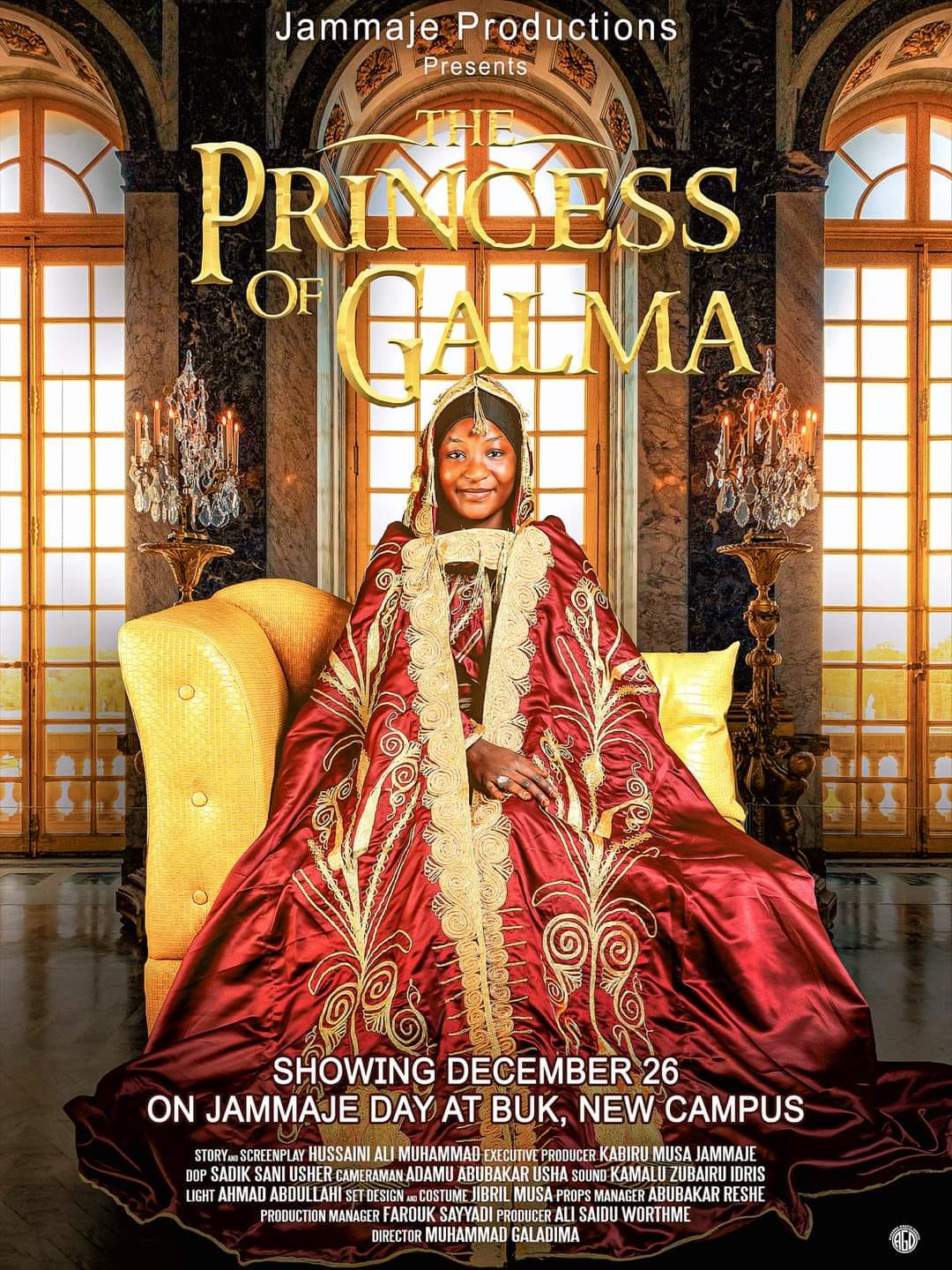
Kannywood movie review: The Princess of Galma

  • Director: Muhammad Galadima
  • Producer: Ali Saidu Worthme
  • Company: Jammaje Productions
  • Language: English
  • Release Date: 26th December, 2023
  • Cast: Hajara Yusuf, Magaji Mijinyawa, Abba Zaki, Billy O, Tijjani Faraga, Mustapha Musty, and others.

The Princess of Galma is another ‘Kannywood film in English’ from the promoter of the genre, Malam Kabiru Musa Jammaje, who has produced a few others before. The film was screened during an annual event, ‘Jammaje Day’, attended by hundreds of English language enthusiasts. Jammaje seems to have made the event a new way for showing his English movies as the attendees clearly make the audience he targets.

Despite its glorious title, The Princess of Galma is neither a historical drama nor an epic adventure. It’s a regal fiction set in a contemporary, fictitious kingdom, Galma, where King Ahmadu (Magaji Mijinyawa) suffers from a serious illness. The film begins with King Ahmadu’s illness, which caused widespread concern in the kingdom. His only daughter, Princess Nafisa (Hajara Yusuf), is deeply worried about her father’s deteriorating health condition. 

Meanwhile, the kingdom’s cabinet deliberates on the succession dilemma, as tradition dictates that the one who marries the princess inherits the throne. This makes Waziri (Tijjani Faraga), a cabinet member, send his son Sahabi to propose to the Princess. But she promptly rejects him despite his being a royal son and the most handsome young man in the Kingdom. The ensuing drama unveils Waziri’s struggle, the princess’s personal choice, and more…

Although the plot has its share of clichés, it maintains a reasonable flow, ensuring no dull moments throughout the story. But the screenplay runs too fast to a hasty finish. It would have been better if it had more scope, especially for Waziri’s secret schemes and the Princess, who suffers magic afflictions.

Beyond its regal and romantic themes, the film emphasises the healing power of prayers. We see how the prayers heal the king after everyone has begun to despair. It also highlights the prevailing theme of good triumphing over evil, as depicted in Sahabi’s loss of the princess despite his father’s magical attempt to acquire her. Besides, it also subtly addresses big security challenges in northern Nigeria.

The film also tries to be brim-full of cultural showcase but falls short of capturing the intrinsic value it truly deserves. It lacks the seriousness and dramatic intensity expected in a movie of its genre. The technical aspects are also average. A film like this should be carefully produced with a considerable budget to get the required impact. 

However, the English usage is generally flawless. The dialogue is captivating, and the actors deliver their lines remarkably. A few scenes were rendered entirely in the Hausa language, with others having lots of code-switching and mixing to accentuate comical effects and cultural representation.

On the other hand, all the actors try to pull off a good performance, especially Hajara Yusuf, who perfectly fits the role of Princess Nafisa and delivers her lines effectively. Abba Zaki leaves an impression in a brief role as the man of Nafisa’s dream. The scenes where he expresses his love for her captivate the most. Also, Billy O. gives a very real performance, similar to Malam Abdulhadi. The comic gestures he portrays get the audience laughing throughout.

Finally, The Princess of Galma qualifies as a worthy addition to Kannywood’s archive of English movies. It has little novelty but offers much to keep you glued to the screen. I commend the efforts of the director (Muhammad Galadima) and all the cast and crew members. Rating: 3/5.

Reviewed by Habibu Maaruf Abdu

habibumaaruf11@gmail.com

Spoken on the Moon: English as the leading international language

By Musa Touray

Africans who dwell on the torturous past of slavery and colonialism find it hard to recognise the essence of a language that has long transcended its original shores. Deepening one’s intellectual quest through the continually universalised medium of communication is, to them, an acknowledgement of superiority some users have attached to the language.

This popular warped perception has dampened our commitment to the pursuit of the English language in a world where minimal mastery of it is a marketable accomplishment. Striving to learn and apply the basics of the language is not only weighed down by dissuasive forces of mediocrity but the process is often mischaracterised as a showy obsession with ‘big English.’ It’s time we broke free from this notion and joined the rest of the world to maximise our understanding of a globally sought-after commodity.

English is an epilanguage in most, if not all, spheres of life—scholarship, extraterrestrial research, scientific studies, diplomacy etc. An epilanguage is used as a means of expression for some purpose, such as those highlighted above. Major scientific discoveries and breakthrough publications have been made in English, even by scholars who use it as a second language and do not have the littlest anthropological affiliation with its native speakers.

“(Proficiency in) English is not a measure of intelligence” has become a central assertion in a section of non-native users’ undervaluation campaign against the language. Unless there exists nuanced definitions of the word beyond me, expressing oneself in any language, not just in English, is itself intelligence.

A hostile follower on X, formerly Twitter, challenged a renowned public affairs analyst to use English and buy fuel if his love affair with words was beneficial. “You may not want to hear this, sir,” replied the analyst, “but I make a living by writing proficient English.” This response clarified for a man who fell under the category of those in oblivion about the language’s incomparable marketability in the contemporary world. “I am paid for producing grammatically-decent content,” he added. 

Using a language also means we should not hold the laws that govern it in contempt. As they obtain for man, rules ensure correct usage and fight off linguistic anarchy. This is one aspect most of us have ignored in making a living through the English language. For example, newspapers, a traditional platform for learning English, have become guilty of unforgivable solecisms.

The convenience of social media has given birth to a handful of commentators and self-styled journalists who exhibit a flagrantly terrible command of the language they choose to communicate. The urgent need to learn the basics of their preferred language is overshadowed by a desire to generate reactions and clout. With hundreds of thousands of followers, some pass off bruised grammar to an uncritical readership.

School-going enthusiasts of current affairs are bound to accept as grammatically flawless whatever they read in newspapers or press releases. This is supposed to be the case if the articles are subject to rigorous editorial scrutiny to establish facts and ensure that grammar rules are respected.

The growing popularity of English in non-anglophone domains is telling. While we continue to dismiss it as the colonisers’ tongue, others have recognised it as an indispensable language that serves transactional and communicative needs in ways and styles no other language does.

Musa Touray wrote from Sandu Kuwonku, The Gambia. He can be reached via musatouray970@gmail.com.

Bridging linguistic worlds

By Abdussamad Yahya Sufi

My Literature teacher cautioned me in secondary school to avoid using Pidgin English during communication. Mr. Ibrahim Bello would always tell me that using pidgin in the infancy of learning English would affect my budding standard English. Since then, I have never used it and always try to avoid it in writing and speaking.

Now that I’m at university, I have met different people from southern Nigeria who always use pidgin. At first, I feared what would happen to my infant English. However, later, I realised that I could still maintain the standard since they all understood standard English; they just chose not to use it.

During my first days at university, the pidgin speakers in my hostel irritated me the most. Everyone used the language, and I didn’t understand 80% of it. When someone talked to me, especially my roommates, I would ask them to translate what they said.

After a few days, many of the guys in the hostel noticed me and began teasing me, thinking I simply chose not to speak the language until they understood that I didn’t understand it. They started calling me ‘English Man,’ which didn’t bother me as I had heard such names before.

Some invited me to their rooms to tell me stories, and I never rejected that opportunity. I knew it would help me improve my English skills. When I told them stories, they paid attention and asked questions in good English, not bad pidgin. 

Honestly, that helped me build my public speaking skills, and I appreciate the guys for understanding me then, unlike before. Even when I meet any of them on campus now, they introduce me as the ‘English Man.’ to their friends, and they all speak good English while exchanging greetings.

I don’t mind being silly while learning; I don’t hide myself when interacting with my schoolmates and friends. They are my laboratory, where I practise what I have learned. Even if they laugh at me or call me names, I use those experiences to practise my learning skills.

Abdussamad Yahya Sufi wrote via abdussamadsufi744@gmail.com.