Empowerment

‎‎Yobe senator empowers six female constituents with ₦1 million each‎‎

By Kasim Isa Muhammad‎‎

In a deliberate move to cushion the impact of economic hardship and create sustainable opportunities for women, Senator Ibrahim Mohammed Bomai, who represents Yobe South Senatorial District, has empowered six women with financial support of ₦1 million each.

The initiative, which was unveiled in Potiskum on Friday, is part of the senator’s ongoing interventions aimed at addressing poverty, improving livelihoods, and encouraging women to actively participate in business and community development.‎‎

According to Yusuf Zaki, a close aide of the senator who represented him at the event, the programme was carefully designed to give women in the constituency the financial muscle to either start or expand their businesses.‎‎

He explained that Senator Bomai recognises the enormous contributions that women make to household welfare and the local economy, and has therefore prioritised their empowerment.‎‎

“Senator Bomai believes that empowering women is one of the most effective ways of reducing poverty and improving livelihoods in our communities. The ₦1 million given to each of the beneficiaries will enable them to invest in viable ventures that can sustain their families and, by extension, contribute meaningfully to the growth of the local economy,” Zaki stated while addressing journalists.‎‎

He also noted that this intervention is not an isolated gesture, but part of a broader empowerment agenda that the senator has consistently pursued since assuming office. ‎‎

According to him, the lawmaker has previously supported educational programmes for indigent students, invested in healthcare projects, and initiated youth empowerment schemes to tackle unemployment in Yobe South.‎‎

Zaki added that the women’s empowerment programme was deliberately crafted to focus on those who have shown entrepreneurial drive but lacked access to capital due to the harsh economic realities and limited opportunities in rural communities.

‎‎One of the beneficiaries, Aisha Mohammed, who operates a small tailoring business, spoke emotionally about how the support has given her a renewed sense of hope.

‎‎She said she had struggled for years to keep her shop running with outdated sewing machines and insufficient materials.

“This money is a lifeline for me. With ₦1 million, I can now buy better sewing machines, employ two apprentices and expand my shop to cater for more customers. It is not just about money; it is about the dignity and confidence it gives me to keep going. I am grateful to Senator Bomai for remembering women like us who are struggling to survive,” she told our correspondent.

‎‎Another beneficiary, revealed that she intends to invest in poultry farming, which has long been her dream but was hampered by lack of capital.‎‎

According to her, poultry has the potential to provide steady income and create employment opportunities for others in her community.

“With this support, I can start on a solid foundation by setting up proper structures and buying enough birds and feed. It is a dream come true because women in rural communities like ours hardly get access to bank loans or financial institutions. This is why we are so grateful to the senator for giving us a chance to stand on our feet,” she said.

‎‎Community leaders in Yobe South have also applauded the initiative, describing it as a commendable step towards poverty reduction and local economic revitalisation.

‎‎Alhaji Idi Jugujugu, a respected elder in Potiskum, said the programme goes beyond financial empowerment, as it also builds confidence in women and encourages them to see themselves as active contributors to development.

‎‎“This is not just about giving money, it is about building confidence in women and showing them that they can also be economic pillars in their families and communities. If more leaders would replicate such interventions, many families would escape poverty and our society would be stronger,” he stressed.‎‎

Musa Abubakar Daura: The talented blind man who defies odds

By Salisu Yusuf

Musa Abubakar, 29, was born a full-sighted child in Daura, Katsina State. He came from a low-income family, though his mother teaches at a primary school. Her job helps her support a family that lost their breadwinner 18 years ago.

At 9, Musa started feeling some discomfort and strain in his eyes. When his mother took him to a hospital, he was diagnosed with “retinitis pigmentosa,” a rare inherited degenerative eye disease. Initially, he witnessed vision decrease and impairment, especially at night or in low light. While Musa went through this predicament, his father was bedridden with a terminal illness. So, he was loaded with the dice at a tender age.

At 11, he lost his father and, later, his sight. Life had taken its toll on him as he grappled with going to school, looking for a guide and contending with walking with a blind cane. Musa felt lonely, isolated and disillusioned; he needed a company that proved elusive. Sometimes he would want somebody beside him with a gentle nudge, but nobody was around to whom he could unburden and escape from his loneliness. So he started meditating on an escape route.

Later, Musa discovered that education was the only antidote against loneliness, boredom and disillusionment. So he went back to school. In the beginning, his classmates served as his guides. However, social stigma forced him to opt for a blind cane as his guides were insulted or maligned daily. Whenever he reached class, his classmates would take notes and dictate to him. His mother had attested to his precocious talent; he demonstrated extra guile and quick-wittedness during his childhood.

After his primary education, he also joined another conventional junior school, obtaining a junior school certificate with flying colours. His potential was realised when in 2015, he joined Katsina School for the Blind. He learned how to use his “embosser typewriter” to take braille (a form of written language for the blinds, in which the characters are represented by raised dots that are felt with the fingertips). He also learned to use his emboser printer to convert conventional texts into braille for easy manual reading. He artfully mastered the skill of manual reading. Whenever I visit him, I am bewitched by the power, beauty and manual dexterity of his tactile reading. 

Musa Abubakar completed his ABU diploma in English Education at the College of Arabic and Islamic Studies, Daura, with a merit pass in 2020. 

His academic activities were wonderfully exceptional; he didn’t only surpass many full-sighted coursemates, but he mastered a good command of English during class presentations.

While studying for his diploma, Musa proved exceptional and combined conventional and unique learning methods. He used the braille writer to take notes, a recorder to record the lecturer’s voice,  and would later use the braille printer to write his notes and unorthodoxly use the braille writer to convert longer texts into braille for easy manual decoding. 

Musa is currently a 200-level undergraduate of English at an NTI degree satellite centre in Daura. He weaves baskets and local chairs to earn his daily bread and support his education. He can teach and perfectly write on the board. He can also assess his students by converting their works into his embosser and grading them. He’s also computer literate. 

Katsina State Government should not leave this talented blind man to waste. Instead, he should be employed so that his intellectual treasures are explored. His likes shouldn’t be left to beg. They should, like his braille, be converted to help the human cause. 

Salisu Yusuf wrote from Katsina via salisuyusuf111@gmail.com.

Are persons with disabilities rightless? An open letter to Jigawa North-East politicians

By Abubakar Umar Gbs

Dear Sirs/Madams,

Let me start with these questions: Who among you has ever included people with disabilities in their empowerment programs? Who among you has ever offered a single person with a disability a job? Who among you has ever appointed a person with a disability as his aide? Finally, who among you has ever sponsored their basic diploma, NCE, or undergraduate program?

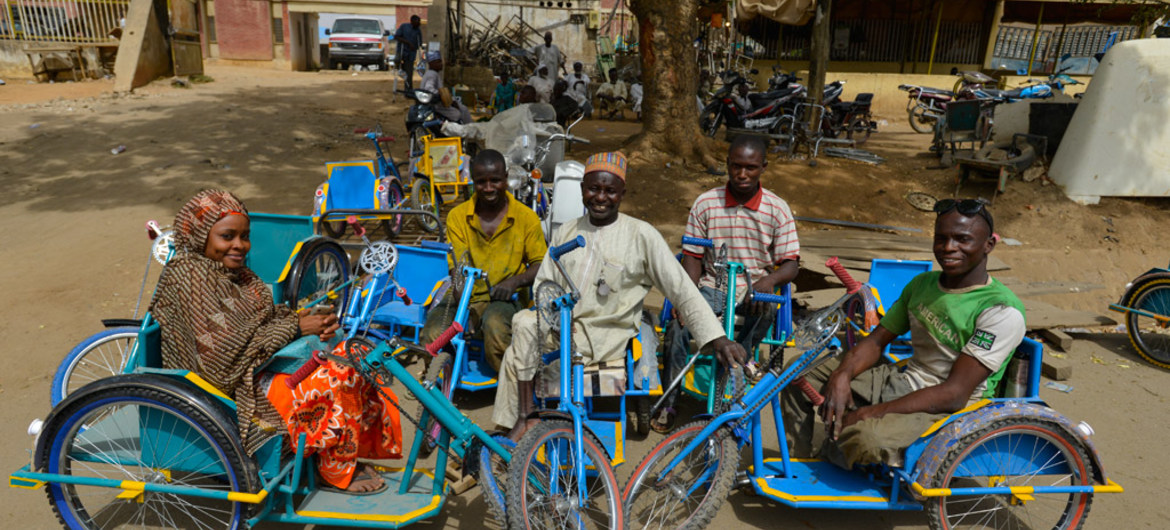
Since the 2015 election, Persons with Disabilities (PwDs) in the said region have suffered negligence from you even though they voted for you like everyone else. You do not consider them for empowerment, job provisions, educational supports, and so on. For basic education, many of their parents cannot take them to the only deaf school in Hadejia because of their physical location. There is no school for the blinds in the region, making it difficult for parents of blind children to take their children to school. The cripples, too, suffer going to school because of the absence of tricycles or other accessibility measures.

Please note that their defects made them require special needs, which means they should be given ‘special’ consideration in all aspects. Their needs should equitably be granted. They require inclusion, equal treatment, but this is not the case in the region as “those not in need are given more than those in need” or “those not in need are given what those in need needed the most.”

At this time, we have many PwDs from all over the region who have qualifications doing some handwork and are expecting jobs because their impairment may affect them doing other self-employed jobs. Some want to start a business but do not have the capital to kickstart. Some have hidden talents but do not dare to put them into practice or are being discriminated against in government and private companies, making them wait for government jobs which you (politicians) have the opportunity to offer them. 

There is one disabled lady who completed her NCE 5 years ago, but until now, she hasn’t secured any job or any seed capital to start a business as she complained.

Where are all those offers you are giving your people? Where are all those empowerment packs you are giving to your people? Did you know how it feels to have a defect in any body part? What if one of your children has a defect?

Imagine the son of less privileged parents with physical defects. They are citizens who have equal rights to education, health, and human rights. Sometimes, you will ask for what belongs to you from a serving leader like you, but you will be labelled a beggar. How can someone beg for what belongs to him? You begged them for votes that don’t belong to you but themselves and took them for granted after that. Their exclusion in campaigns has reasons as we can’t expect crippled men to take their bikes or join campaigners to go far and campaign. In the meantime, you can expect a blind man to do so too, so the deaf has his limitations.

Every citizen, irrespective of disability, race, tribe, or religion, deserves to be treated equally as per the constitution. Also, traditionally, persons with disabilities have equal rights, even if not constitutional. They have 100% rights, and that should be respected.

We know how well you perform, but the ‘well’ is not enough until you put PwDs’ rights on top of the agenda because society needs them. If they are neglected, they retort to some odd jobs to survive life which I don’t see their mistakes.

Thank you

Abubakar Umar Gbs sent the letter via abubakargbs@gmail.com.