Education

It is time to question creativity amidst AI chatbots     

By Timothy Agberagba 

Artificial intelligence (AI) chatbots have gained prominence in Nigeria, bringing benefits and potential side effects to Nigerian students and the general public in particular. 

AI chatbots are computer programs or interfaces that can carry on human-like conversations using natural language understanding (NLU), natural language processing (NLP), and machine learning (ML). 

Those programs are designed to help with academics, business, data analysis, and entertainment. To use them, you instruct the chatbot to provide a solution to a particular problem, and it will automatically generate the result. 

Many Nigerian students have embraced AI as a resource for academic exercises. Some use it for research, presentation, and literary compositions. Lecturers also use it to generate lecture materials without the stress of surfing the internet. Information can be easily accessed through AI Chatbots.

However, this trend has become a matter of concern as many Nigerian students and graduates heavily depend on these AI chatbots rather than engage in critical reasoning and rationality. AI Chatbots have made many people so lazy and dependent that they cannot conduct joint research on issues around them. 

Many fail to understand that AI chatbots collect information randomly from published materials and present it as facts. This is why people, mainly Nigerian students, should always engage in personal research rather than depend on AI.

With the emergence of AI Chatbots, it is also disturbing that many Nigerian youths cannot compose a simple essay without using AI chatbots anymore—a 2024 research by Prof. Oluebube Miracle on the effect of AI chatbots in Nigeria revealed that “many students boycott knowledge construction process, leading to a dearth of experience, irrationality, passive learning, groupthink, academic dishonesty, and a diminished propensity for critical thinking”. This negates the future of academics and knowledge transfer because future generations will depend on it, and creativity and brain work will die naturally. 

Additionally, in a developing country like Nigeria, people need to engage in creative thinking and innovation rather than allow AI to think for them. The secret behind developed countries is the constant brainstorming of creative ideas that translate into innovative undertakings. This is exactly what Nigeria needs. 

It is said that youths are leaders of tomorrow, but if they heavily depend on AI chatbots for ideas, what will happen to the country? AI can only give you what you ask for and nothing more. It doesn’t feel or think and is not sensitive to the environment. By implication, dependence on AI is a sign of gross failure as far as creativity is concerned.

Finally, to mitigate the tendency to over-depend on AI Chatbots and promote creativity among Nigerian youths, educators, policymakers, and stakeholders need to work collaboratively to ensure that the integration of AI in education promotes independence and critical thinking. Nigerian youths should not abandon traditional study methods to enrich themselves with the knowledge necessary for self-development and national progress. 

Timothy Agberagba writes from the Mass Communication Department at Bayero University, Kano.

11 Kaduna inmates graduate from NOUN

By Sumayyah Auwal Ishaq

No fewer than 11 inmates at the Medium Security Custodial Centre, Kaduna, Kaduna State, graduated from the National Open University of Nigeria in various disciplines.

The inmates, who received their certificates at the convocation ceremony organized by the institution on October 16, 2024, were pronounced graduates after completing their various programs for the 2022/2023 academic session.

They comprised 11 males who had undertaken courses in the Post Graduate Diploma in Education and undergraduate degrees. The Daily Reality gathered that seven inmates graduated with Second Class Upper Division, while two graduated with Second Class Lower Division, and two inmates completed the Post Graduate Diploma in Education.

Speaking at the ceremony, the Vice Chancellor, who was represented by Dr. Baba, praised the Nigerian Correctional Service (NCoS) and the management of the facility for giving the inmates such an opportunity. He said such feats should be emulated by other inmates who have yet to undertake any program with the institution.

The Controller of Kaduna State Command, Nuru Mohammed Isah, advised other inmates to seize the opportunity and maximize their time by emulating their graduating colleagues.

Mr Isah also emphasized the role of the NCoS in reforming inmates. He implored the newly graduated inmates to continue embodying the good values they learned during their time in the correctional facility.

The officer in charge, DC Abdullahi Dangani, promised to continue giving support to all inmates to achieve their aspirations in life.

Classroom Dynamics: A call for modern teaching methodologies in Nigeria

By Buba Kamal Danladi

In education, the approach to teaching is as crucial as the content itself. Teaching methodology, the comprehensive plan or strategy for systematically presenting material in the classroom, goes beyond merely delivering facts. It embodies beliefs about learning and teaching and specific techniques and activities aligned with these ideologies.

The choice of teaching methodology profoundly influences knowledge acquisition, skill development, and capacity building. Educators must embrace innovative methods that promote critical thinking and interactive learning in an era that transcends traditional role learning. This is especially pivotal in Nigerian tertiary institutions, where outdated teaching approaches often lead to disengagement and subpar academic performance.

Several methodologies warrant attention and adoption in Nigerian educational settings, such as Differentiated Instruction, Catering to diverse learning styles and abilities; Lecture-Based Learning, Traditional yet evolving to include interactive elements; Inquiry-Based Learning, Encouraging curiosity and critical analysis; Technology-Based Learning, Integrating digital tools to enhance understanding; and kinesthetic Learning: Emphasizing hands-on experiences and physical engagement. 

Reflecting on my undergraduate experience at Skyline University Nigeria, I recall the transformative impact of Mr. Abdulhameed Olaitan Ridwanullah’s teaching methods. He epitomised effective education through interactive sessions that valued each student’s thoughts and promoted a culture of inquiry and confidence. His teaching philosophy centres on interactive and student-centred learning. 

Unlike the conventional lecture-heavy approach, his classes are characterised by lively discussions, group projects, and the use of technology to facilitate learning. By integrating digital tools into his curriculum, he engages students and equips them with essential skills for the modern workforce. This tech-savvy approach is particularly relevant in mass communication, where understanding digital platforms is crucial.

Also, his departmental seminar, which he organised, nurtured my public speaking ability. He mandated that all students offering his courses research specific topics and present their findings to seasoned academics. Many students at first despised it, but as some of us inevitably embraced it, it became a ritual. 

The students’ seminar approach not only fostered a deep understanding of the themes the students researched but also ignited a passion for learning, a stark contrast to the disinterest prevalent in many Nigerian institutions.

Educators must critically assess and adapt their teaching strategies to address the disconnect between teaching methodologies and student engagement. The goal is to cultivate an environment where learning is not a passive experience but a vibrant journey of discovery.

However, the transition to such innovative teaching practices requires systemic changes. It calls for investment in digital infrastructure, teacher training, and curriculum development. Policymakers and educational institutions must recognise the value of these modern methodologies and provide the necessary support and resources to implement them.

To our students, I offer this reminder: “Do not merely pass through school; let the transformative power of education pass through you.” Embrace learning as an active participant, for the quality of your education shapes your future.

Buba Kamal Danladi writes from Lagos via kamalbuba05@gmail.com.

My university or yours? My take on the worn debate

By Mutalib Jibril

A few days back, I stumbled upon a post about two graduates from a particular university in Nigeria who went for a job interview. On getting to the venue, they started interrogating some workers in the organisation about the qualifications of the interviewer.

Unfortunately, the interviewer overheard their conversations and prepared to daze them with some basic questions in English, which he noticed most graduates usually struggle with. In no time, the interview commenced. It was a written test. They were handed their questions, and then they answered the questions.

Behold! They could not reach the cutoff mark, and they failed the questions. This is just one funny instance out of a thousand and one of how students often think their university is the best or better than others.

I agree that some universities are better than others in infrastructure, research innovations, and achievements. This is why we do have a university ranking annually.

However, I can categorically state that all universities have met the benchmark; better still, they have fulfilled all the criteria set by the Nigerian Universities Commission (NUC).

Any university that does not meet the set criteria for a particular course—let’s say Radiography, for instance, wouldn’t be accredited. Therefore, any institution running that course has met the requirements and been subsequently accredited by NUC.

Therefore, most students are oblivious that what makes an individual student stand out from their peers from other institutions is mainly tied down to individual sacrifices and effort.

This is not to say that the university doesn’t have a role in making students exceptional. No! Even if you attend the best university in Nigeria, the onus still lies on you to make yourself stand out. The school cannot teach you everything.

However, no matter the university you find yourself in, develop yourself and stand out.

It doesn’t matter if your university has the lowest ranking in the country; I know that no university would be accredited without meeting the requirements. Some standards must be met.

What matters is what you can do to ensure you are prepared for life after university and stand out.

Many people graduated from the least-ranking universities in Nigeria but are doing exceptionally well academically in Nigeria and abroad.

I have never heard of a scenario where a third-class graduate from a top-rated university is selected for a job over a first-class graduate from the lowest-rated university—I’m not talking about connections here. I am talking about employment based on merit.

It’s high time we stopped making unnecessary comparisons about universities. Let’s channel that energy toward making our self-development.

Mutalib Jibril wrote via mutalibdantanisabi300@gmail.com.

Gombe students receive African Union scholarship awards

By Abdullahi Mukhtar Algasgaini

Six indigenes of Gombe State made the list in the 200 Scholarship Award of the African Union Development Agency in the New Partnership for Africa’s Development (AUDA-NEPAD), in partnership with the Renewed Hope Initiative (RHI), of the First Lady, Senator Remi Tunibu.

The commissioner of education, Prof Aishatu Umar Maigari, stated this on Thursday in Abuja while leading the successfully selected students from Gombe State to the award presentation.

The program according to the commissioner was designed to support secondary school graduates particularly from the less privileged families to further their education at the tertiary level.

Speaking at the unveiling, held at the Banquet Hall of the State House Abuja, the First Lady Senator Remi Tinubu said President Bola Ahmed Tinubu’s administration will continue to prioritize education as evident in the various policies and programmes been implemented in the sector since inception.

Senator Tinubu also emphasised that education and empowerment of the Nigerian girl-child will consistently be given priority attention to fill the gap with their male counterparts in receiving comprehensive formal education, which she said has brought about the need for the establishment of Alternative High Schools For Girls across the country.

In a remark, the Minister of Education, Prof. Tahir Mamman, described the First Lady as an Education champion who is always concerned about the education of the younger generation and commended her initiatives under the Renewed Hope Initiatives, which are geared toward complementing the educational policies of the Tinibu-led administration.

The successful students to benefit from the initiative from Gombe State as approved by the office of the First Lady, Senator Tinubu, include Abdullahi Abubakar, Kamal Abdulsalam, Elisha Eglah, Muhammad Abdul-Azeez, Hajibukar Mohammed and Yunusa Umar Farouq.

They have since been inaugurated with others across the country and presented with their Award letters in a colorful event.

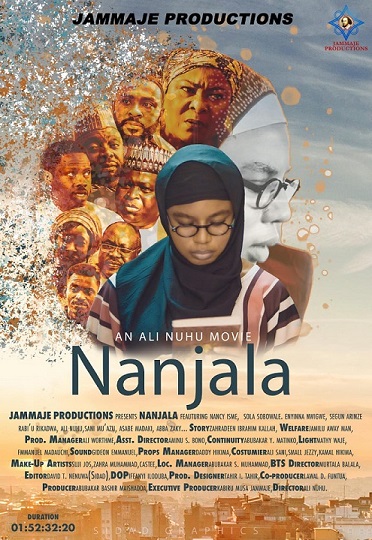
A feminist reading of Jammaje’s Nanjala

  • Production:    Jammaje production
  • Producer:       Abubakar Bashir Maishadda
  • Director:        Ali Nuhu
  • Cast:               Sani Mu’azu, Ali Nuhu, Nancy Isime, Enyinna Ngwige, Rabi’u Rikadawa, Segun Arzine, Abba Al-Mustapha, Asabe Madak, Abba Zaki.

Nanjala, an eponymous and one of the most expensive movies in the Kannywood industry by Jammaje Production, is a breathtaking movie that explores and thematises patriarchal power, domination and mistreatment towards women gender. Nanjala, a leading character, is victimised by her chauvinistic father, who disbands her for being a female in favour of a male child, Dititi (Abba Zaki). Captain Jimmoh (Rikadawa) becomes her adopted father and helps to actualise her dream of becoming a renowned journalist.

Furthermore, Captain Sembene’s family is set on fire as his beloved son, Ditit, becomes a spoiled child, drug addict, thief and clubgoer. Plus, his other female daughter, Jarry, takes a leave from home for her father’s chauvinistic mistreatment. Falmata, another victim of Captain Sembene’s chauvinism, befriends her biological brother, Ditit, with a view to wed him.

Nanjala becomes a renowned and influential journalist who tirelessly fights and exposes corruption in the government. She encounters obstacles along the way from the authority. She is detained in cells for exposing corruption. Finally, she appears triumphant.

Mistreatment and domination are long-held traditions shown to women by a patriarchal world. Women, as chauvinists maintain, are disaster and second-class citizens who can’t contribute to one iota of life. In those days, women had to cancel their identities to have their voices heard—the same as Nanjala has to take a leave from a patriarchal home to attain her potential. 

Thomas Aquinas (1274) opines, “A woman is really an imperfect man… an incidental being … a botched man’’. Nanjala’s treatment by her father affirms Aquinas’s stance that women are imperfect and a botched to her male brother, Dititi. Plus, according to Baudelaire, “woman is natural, that is abominable’’ Some men consider women disgusting. This perception runs through Nanjala’s father, who finds the female gender abominable – divorcing Falmata’s mother for carrying a female unborn child, making life unbearable to Majuma (Asabe Madaki) and causing a great aspersion on Nanjal and Jarry, whom all are females. They have to leave their homes to feel at home.

The belief that women are nothing but second-class citizens, abominable and sex machines for men to exploit became prevalent during the Victorian period (1837-1901) and also in plenty of their literature. We see the fate of Susan Henchad, who is auctioned in Thomas Hardy’s The Mayor of Caster Bridge (1886), women who are sexually exploited by men at Sixa in Mango Beti’s Poor Christ of Bomba (1956) and Firdaus’s sexual abuse by men in Women at Point Zero (1975). Likewise, patriarchal domination doesn’t put a halt here but tries to silence any emerging powerful female voice. 

Women like Gorge Eliat (1919-1880), Gorge Sand (1904-1876), Charlotte Bronte (1816-1855), etc., succumb to patriarchal pressure and accept defeat to vie with men intellectually and literarily. Comparatively, Nanjala encounters the same treatment, where patriarchs try to silence her intellect and voice. They envy her fame, success, and education. Men are jealous of women’s successes, but Nanjala struggles and succeeds. 

For women to succeed in the patriarchal world, they have to be educated, pushed, and struggled. We see how women break the bonds. Li succeeds in The Stillborn (1984) via struggle and education, as Ada in Second-class Citizens(1974). Also, we see in the Kannywood movies- Hauwa Kulu (2019) where Hauwa (Hasana Muhammad) and Laila (Hadiza Gabon) in Manyan Mata (2023 succeed through education. However, Firdaus in Women at Point Zero (1975) and Nnu Egu in The Joys of Motherhood (1980) fail because they are illiterate or barely educated.

Meanwhile, Simone De Beauvoir (1908-1986) asserts that “males define what it means to be human, including what to be female. Since the female is not male”. Beauvoir maintains, “She becomes another”. Indeed, this derogatory portrayal has been born by females throughout many centuries. In the film, Nanjala’s father has this perception run in his blood. He evidently defines who a human being is to him, his male child, Ditti.  He loathes all his three daughters – Nanjala, Jarry, Falmata and Majuma because they are “others”. Women become secondary or non-existent players. 

Finally, Beauvoir asserts, “Women must break the bonds of their patriarchal society and define themselves if they wish to be a significant human”. This is what Nanjala does, and she becomes a “being” in the patriarchal society. Meanwhile, Kate Millet (1970) says, “A female is born, but a woman is created”. As Nanjala defines herself as a true human being, discarding the notion of femaleness in her, she creates womanness, as Millet (1970) puts it, through hard work, education, struggle, and boldness.

By way of conclusion, Nanjala mirrors patriarchal society and uncovers stereotypical portrayal of women as “others”, Second-Class Citizens, incidental beings, imperfect men, and abominable and other derogatory names forced women to accept by men. The film depicts the power of education and struggles as the only means for women to break the long-held tradition enjoyed by men and bury women’s intellect.

If not for education, Nanjala would have been buried alive like other female characters. The film is a clarion call to women to be educated, to disown being relegated to non-existent players or “others”. Nanjala succeeds and becomes a “human being”, whereas Majuma, Jarry and Falmata become second-class citizens.

Reviewed by Abba Musa Ibrahim. He can be reached via abbamusa6888@gmail.com.

A peep into Kano’s declaration of state of emergency on education

By Sani Surajo Abubakar

Some days ago, Kano Government House was agog with guests from within and outside the country, primarily stakeholders in the education sector who thronged the state to witness the historic declaration of a state of emergency on education by the state government under the stewardship of Governor Abba Kabir Yusuf.


The declaration was necessitated by an alarming proliferation of out-of-school children, with its figure currently at 989,234 for both genders. This situation threatens to rob the entire generation of their education rights and a brighter future.


Dilapidated school structures, lack of instructional materials, a severe shortage of qualified teachers, and inadequate teacher training programs coupled with the socio-economic challenges in basic and post-basic schools across the state made learning and teaching challenging, if not impossible.


Statistics at government disposal indicate that out of the 42516 total classrooms available, a mere 22% meet the basic standard of habitability as nearly four out of every five classrooms in Kano’s primary and secondary schools are marred by dilapidation and disrepair, rendering them unsuitable for the noble pursuit of knowledge.


At the secondary school level, less than 30% of classrooms can be deemed habitable, leaving significant students of such schools grappling with inadequate facilities that impede their intellectual growth and development.


Looking at the science and technical schools, the pathetic story is the same, with less than 20% of classes meeting the essential criteria for habitability, making it difficult to nurture the next generation of scientists, IT experts and engineers when the very environments in which they are meant to learn are ripe with inadequacies and deficiencies.


Passionate and committed to rescuing the education sector from total collapse, on Saturday, 8th of June, 2024, the Kano State Government declared a state of emergency on education to address the critical challenges facing the sector with a clarion call to all the stakeholders to unite and prioritize the revitalization of the education system for the overall benefit of the society.

The cardinal aim of declaring a state of emergency on education was encapsulated in the overall vision for the education delivery in the state as articulated in a statement viz:

Every school, a good school; every child, enrolled in school; every student, an engaged learner; every teacher, a caring educator; every parent, a supportive partner; and your government, a committed investor in human capital development.


The declaration, as envisaged, will enable the government to mobilize resources, implement urgent reforms, and focus on strategic interventions that will rebuild educational infrastructure, provide necessary materials, and reclaim schools from encroachment.  


To ensure effective revitalization of the education sector, restore its lost glory and take Kano State to greater heights educationally, eleven robust commitments are put in place that include;

In the 2024 fiscal year, Kano State has made an unprecedented budgetary allocation of 29.95% to education. This was made based on the fact that significant financial resource allocation will address underfunding problems bedevilling the sector.


Two, for the smooth operation of basic and post-basic schools, restoration has been made for the payment of upkeep and overhead funds for all secondary schools in the state.  The timely release of the funds will allow schools to maintain their infrastructure, procure essential teaching and learning materials, and aid in conducive teaching and learning processes.

Third, plans have been made to build an additional 300 state-of-the-art laboratories across 100 schools in the state. The provision of such needed facilities will go a long way in providing students with hands-on experience in scientific inquiry, fostering a culture of experimentation and discovery needed for their future and success in their chosen endeavours. The provision of laboratories is another 300 earmarked for overhauling 100 secondary schools.

Four boarding secondary schools that were hitherto closed by the immediate past administration are to be reopened and re-boarded within the next academic year. Such schools provide a supportive environment for students, particularly those from remote areas or economically disadvantaged backgrounds.


Five, to consolidate the drive to improve the education sector, approval has been granted for a comprehensive renovation of all primary and secondary schools in the nooks and crannies of the state in the subsequent two academic sessions. In this regard, the Community Re-orientation Committee (CRC), Kwankwasiyya, Lafiya Jari, and Kano Pro-PA will handle minor repairs, while the Ministry of Education, State Universal Basic Education Board (SUBEB) will shoulder all major repairs through competitive bidding.


Six, to achieve the commitment of clearing out of school children roaming the streets, 28,264 additional classrooms will be built across the state within the next three years to accommodate such children through the supervision of the Ministry of Education, SUBEB, and to be monitored by the Ministry of Project Monitoring.


Seven, to make pupils engage learners with utmost attention in their classrooms, arrangements are made to distribute free one-meal per pupil per day in all primary schools. The CRC, assiduously working as preparations, has hired cooks for the home-grown feeding program. This is in addition to the plan to re-introduce the distribution of free uniforms to all primary I pupils in all primary schools in the state.


Eight, to show a solid commitment to tackling teacher shortage and positively adjusting the students/teacher ratio, 5632 BESDA (Better Education Service Delivery for All) teachers were fully employed. Also, the governor has approved hiring an additional 10,000 teachers to go ahead with SUBEB to chart a training roaster for all teachers in the state government’s employment.


Nine arrangements are going on to commence the renovation of schools affected by fire outbreaks in the last eight years in Madobi, Gaya, Ajingi, Kiru, Dawakin Tofa, Kano Municipal, Gezawa, Kabo, Gwarzo, Dambatta and Bichi local governments respectively.

Similarly, in his second tenure, 44 schools for Islamic Studies and 44 Technical Colleges initiated by Senator Rabiu Musa Kwankwanso would be completed and put to use in earnest.

Ten, to boost the morale of teachers and prioritize their welfare for quality service delivery, approval has been granted for the disbursement of the sum of three hundred million naira as a revolving soft loan to primary school teachers in the state.


Eleven, as a government with a resolve to project Girl-Child-Education and reduce pressure on parents to transport their girls’ children to schools daily, 70 high-capacity buses are shuttling in the Kano metropolis for such purpose.


All the commitments stated above are in addition to other feats achieved that range from sponsoring 1001 first-class degree graduates for foreign post-graduate studies; settlement of registration fees for Kano indigenes studying in various higher institutions of learning across the nation; payment of NECO and NBAIS fess; renovation and upgrade of two bilingual academies of French and Chinese located at Kwankwaso town and Niamey, capital of Niger Republic to mention but a few.


With the above-stated commitments and concerted efforts of all the relevant stakeholders, one can optimistically conclude that Kano State has begun a journey of education transformations.

Sani is an Assistant Chief Information Officer at Government House, Kano

I’m happy you’ve gone back to farm—Buhari tells Nigerians

By Uzair Adam Imam

Former President Muhammadu Buhari has expressed concern about Nigeria’s uncontrolled population growth, stating that it may lead to problems for future generations.

He made this known while speaking to journalists after observing the Eid prayer in Daura.

Despite his concern, he expressed pleasure that many Nigerians have taken to farming, which has led to an increase in food production and a decrease in prices.

He encouraged citizens to prioritize education and health and to continue supporting local food production.

Buhari also urged the youth to learn about the country’s founding fathers and to play an active role in nation-building efforts.

He praised the National Youth Service Corps (NYSC) scheme, describing it as one of the greatest achievements of General Yakubu Gowon’s administration.

The former President wished all Nigerians a happy Sallah and encouraged them to help one another and be their brother’s keepers, especially in the spirit of the Sallah celebrations.

Reorganizing NOUN for excellence under new neadership

By Mukhtar Jarmajo

The recent appointment of Mallam Isa Yuguda as the Chairman of the Governing Council of the National Open University of Nigeria (NOUN) has sparked hope for a new era of growth and excellence at the institution.

As a former minister and governor, Yuguda brings a wealth of experience to the table, which will be crucial in shaping the future of NOUN.

However, the new leadership faces significant challenges. NOUN has struggled with issues of funding, infrastructure and quality of education, which have hindered its ability to reach its full potential.

One of the primary challenges is the need to improve the university’s infrastructure, including its virtual learning platform, to enhance the learning experience for students.

Another challenge is addressing the issue of funding, which has been a perennial problem for NOUN. The new leadership must explore innovative ways to secure sustainable funding to support the university’s programs and initiatives.

The quality of education is also a critical area that requires attention. NOUN must ensure that its programs meet the highest standards of academic excellence, and that its graduates are competitive in the job market.

Despite these challenges, the prospects for NOUN are bright. With the right leadership and support, the university has the potential to become a center of academic excellence, providing access to quality education for millions of Nigerians. The new leadership must also focus on building strategic partnerships with local and international organizations to enhance the university’s research and innovation capabilities.

Furthermore, NOUN must leverage technology to expand its reach and improve its services, including online learning platforms and digital resources. It has the potential to play a critical role in addressing Nigeria’s development challenges, including poverty, inequality, and unemployment. By providing access to quality education, NOUN can help build a more skilled and competitive workforce, which is essential for driving economic growth and development.

The new leadership at NOUN faces significant challenges, but the prospects for growth and excellence are bright. With the right vision, leadership, and support, NOUN can become a beacon of hope for millions of Nigerians, providing access to quality education and driving national development.

Jarmajo wrote from Lobito Crescent, Wuse 2, Abuja.

Children’s Day: A call to action for parents to educate children with disabilities

By Ibrahim Tukur

As we celebrate Children’s Day, I want to use this opportunity to remind all parents of the importance of sending their children with disabilities to school.

Education is a powerful tool for transformation. When children with disabilities are educated, they have the opportunity to grow up and become socially and economically valuable members of society. Education empowers them with the knowledge and skills to navigate life’s challenges and contribute meaningfully to their communities.

The consequences of not sending children with disabilities to school can be severe. Without education, these children are at a higher risk of growing up in ignorance, which can lead to a life of dependence, poverty, and unemployment. Many may resort to street begging as a means of survival. This not only affects their quality of life but also perpetuates a cycle of poverty and social exclusion.

Education provides children with disabilities the tools they need to escape the cycle of poverty. It opens doors to better job opportunities and higher incomes, allowing them to become self-sufficient and financially independent. Educated individuals are better equipped to make informed decisions, solve problems, and advocate for themselves, fostering independence crucial for their personal development and dignity. 

Additionally, education helps children with disabilities integrate into society, reducing stigma and discrimination and promoting understanding and acceptance within the community.

By ensuring that children with disabilities attend school, we are investing in a future where everyone has the chance to succeed, regardless of their abilities. Let’s work together to break down barriers and create an inclusive environment where every child can thrive.

On this Children’s Day, let us reaffirm our commitment to educating all children, including those with disabilities. Our collective responsibility is to ensure they receive the education they deserve, paving the way for a brighter and more inclusive future.