ECOWAS

We’re Ready for Dialogue—Niger Junta 

By Muhammadu Sabiu
 
General Abdourahmane Tchiani, the head of the Niger Junta, has consented to look into diplomatic dialogue to break the country’s political deadlock.
 
Tchiani addressed the Nigerian intervention team comprising Nigerian Islamic scholars, which was led by Bala Lau, the national leader of Jamatul Izalatu Bida Waikamatu Sunnah.
 
In a statement signed by Lau on Sunday, he told Tchiani that “the visit to Niger was to engage in constructive dialogue to encourage him and other military leaders behind the coup to embrace dialogue instead of war to resolve the crisis.”
 
Responding, Tchiani said, “Their doors were open to explore diplomacy and peace in resolving the matter.”
 
Tchiani voiced concern about the Economic Community of West African States’ ultimatums being given without the junta’s point of view being heard.
 
According to the Prime Minister of the Niger Republic, Ali Zeine, it was learned that Tchiani was prepared for a conversation and expressed the hope that the discussions with ECOWAS would happen soon.
 
Zeine noted, ‘’We have agreed and the leader of our country has given the green light for dialogue. They will now go back and inform the Nigerian President what they have heard from us. We hope in the coming days, they (ECOWAS) will come here to meet us to discuss how the sanctions imposed against us will be lifted.”
 
West African leaders ratcheted up their criticism of the coup leaders in Niger on Thursday, ordering the deployment of a regional standby army to reestablish democracy there.
 
Since late last month, when the presidential guard overthrew President Mohamed Bazoum in a coup d’état, the Niger Republic has been mired in political upheaval.
 
Days later, ECOWAS responded by imposing sanctions and giving the military junta in power one week to disband or risk military intervention.
 
On Sunday, August 6, that deadline passed without causing the political climate to change. The leaders of ECOWAS have stated that they will only send soldiers in a last-ditch effort to resolve the problem diplomatically.

Bazoum, son in critical condition—ECOWAS official

By Muhammadu Sabiu

The former president of Niger, Mohamed Bazoum, and his son, who are being imprisoned by the leaders of the country’s coup, are reportedly living in abhorrent conditions.

This is according to the ECOWAS Commissioner for Political Affairs, Peace, and Security, Ambassador Abdel-Fatau Musah.

Musah’s remarks, which were aired on Channels Television’s Sunrise Daily on Friday, were in response to claims that the Nigerien putschists had threatened to kill Bazoum in the event that the Economic Community of West African States intervened militarily.

He said, “We are going there, if need be, to rescue President Bazoum who is living in very terrible conditions today. He is being denied medical attention, he’s being denied even access to his usual food.

“His son, who is also in detention, has lost so many kilos already. They are being held in these inhumane conditions and we cannot just sit back idle and depend on the goodwill of these people who are disrupting the democratic process in the country.

“Yesterday’s communique also made it very clear that this junta will pay dearly if anything happens to the safety, security, or the physical integrity of Bazoum, his family, or members of his government. That was clearly done.

“We are not going to hold back because they are holding the president hostage. If they dare, if they should harm in any way, then they are going to pay very dearly for that. So, this is a tactic.”

Military junta in Niger ignores ECOWAS, appoints new prime minister

By Uzair Adam Imam

The Niger coupists have named former Economy Minister Ali Mahaman Lamine Zeine as the country’s new prime minister, nearly two weeks after they took power.

Zeine appointment was announced late Monday night by the military junta spokesman on television.

It was gathered that Zeine was the former Minister of Economy and Finance for several years in the cabinet of then-president Mamadou Tandja.

Our reporters gathered that Tundja had led the country from 1999 after its return to civilian and was ousted in 2010.

This is coming a few days after an ultimatum from the Economic Community of West African States to the coup plotters to reinstate Bazoum has expired.

However, the Daily Reality learned that the prime ministers of the ECOWAS member states will now meet in Nigeria’s capital, Abuja, on Thursday to discuss how to proceed.

Many Nigerians, especially the Northerners, are not in support of the ECOWAS measures that could possibly include force, as the ultimatum threatened.

War is not an option – MURIC cautions Tinubu on Niger coup

By Abdurrahman Muhammad

The Muslim human rights advocacy group, the Muslim Rights Concern (MURIC), has sounded a note of caution to the Economic Community of West African States (ECOWAS), a regional bloc under the leadership of President Bola Ahmed Tinubu, to shelve the idea of invading Niger Republic to reinstate the former President Muhammad Bazoum, who was unceremoniously ousted and detained by the military junta on 26th July 2023.

The Muslim rights organisation was reacting to a letter written and sent to the Senate and read on the floor of the red chamber by the President of the Senate, Godswill Akpabio, Friday, 4th August 2023.

In the letter, President Tinubu listed several measures already taken to pressurise the soldiers behind the coup to release and reinstate President Bazoum. 

Some of the measures in place included cutting off the electricity supply to the Niger Republic, mobilising international support for the implementation of the provisions of the ECOWAS communique, closure and monitoring all land borders with the Niger Republic and reactivating the border drilling exercise, as well as military build-up and deployment of personnel for military intervention to enforce compliance should the military junta remain recalcitrant.

While strongly condemning the unconstitutional change of government in the Niger Republic, MURIC believes the handling of the situation by the ECOWAS is harsh, unpragmatic and may be counterproductive.

MURIC’s position was contained in a statement released on Saturday, 5th August 2023, by the Chairman of its Kano State Chapter, Malam Hassan Sani Indabawa.

The statement further states:

“Military action should never be an option in solving the problem of change of government in the Niger Republic due to the current and historical relationship between Niger and Nigeria, two brotherly neighbours in West Africa. Relations between the two countries are based on a long shared border and common cultural and historical interactions.

“Citizens of Nigeria and people living in Niger are predominantly Muslims and share a solid socio-cultural and religious affinity. Nigeria also shares about 1,500 kilometres of land border with Niger.

“The Nigeria-Niger border is artificial. It was drawn in the colonial period by London and Paris, a process driven in part by the desire to check German expansion in West Africa rather than recognition of ethnicities or other indigenous factors. 

“Border crossings are also practically impossible to control. In many ways, Niger and northern Nigeria have much in common culturally, and the local language of both regions is Hausa.

“Significantly, Nigeria should maintain its age-long foreign policy of non-interference in the internal affairs, especially of a friendly neighbour.

“Before Niger, there were some unconstitutional changes of government in at least three Sahel countries, sharing the same historical and common border with the Niger Republic. Non of the countries were attacked, even though some of the countries are home to military bases of some European and US forces.

“Since 1990 till date, there have been 44 coups and 41 failed attempts in Africa. The fewest attempts, 13, came in the period between 2000 and 2009, compared with 36 attempts between 2010 and 2019 and then ten attempts since 2020 till date. The latest is that of the Niger Republic, carried out on 26th July 2023.

“The Nigerien transitional military government has already warned against any external intervention. On Wednesday, 2nd August 2023, its counterparts in Mali and Burkina Faso warned that they would treat any attempt to restore Bazoum to power militarily as a “declaration of war” against them, and it would split ECOWAS.

At the home front, the internal convulsions will escalate as the Oduduwa Republic, Arewa Republic, Biafra secessionists, Niger-Delta separatists, and other sundry anarchists may have a field day with the opening of another avoidable conflict theatre.

“Already, European countries have started the evacuation of their nationals in Niger, as Mali, Burkina Faso, and Guinea expressed support for the coup.

“Military interventions could certainly be unpopular in Nigeria and possibly lead to violent and widespread protests. This could only aggravate the worsening security situation in Nigeria.

“The situation in Niger Republic, like the rest of Africa, is an African problem that requires African solutions; going to war should never be one of those solutions. 

“It is more to do with the oppression and domination of France, the former colonial power that refused to allow her former colonies their rights to true independence.

“In the end, we call on President Tinubu, as a listening leader, to immediately withdraw the letter he sent to the Senate and toe the path of dialogue and diplomacy. 

“We also call on the Senate to flatly reject Mr President’s ill-advised request for its counterproductive and far-reaching, negative consequences that may only worsen Nigeria’s economic and socioeconomic conditions.

“We further call on Muslim faithful and other faith-based groups to intensify prayers for Allah the Most High to avert any disaster that may spell doom for Nigeria and Africa.”
Atiku warns against using military force to resolve Niger unrest

By Muhammadu Sabiu

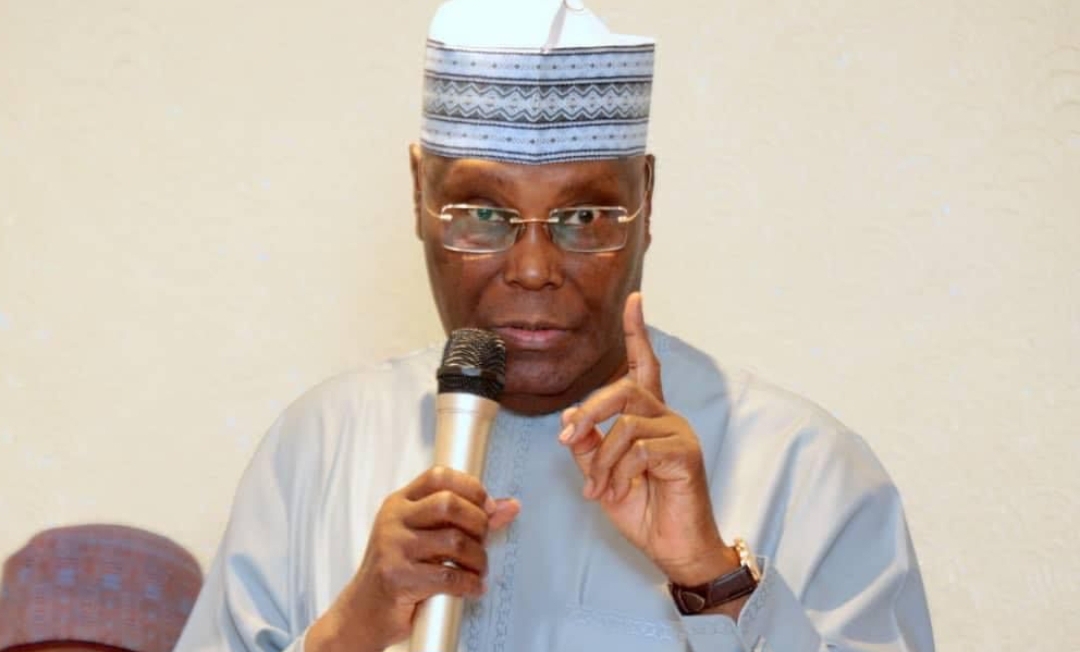
Atiku Abubakar, a former vice president of Nigeria, has cautioned the Economic Community of West Africa (ECOWAS) against using military hostilities to resolve the Niger Republic’s leadership obstacle.

Following coups in neighbouring Mali and Burkina Faso, President Mohamed Bazoum of the Niger Republic was deposed on July 26 by his own guard in the third putsch in the region in as many years.

After the coup in Niger, the regional economic bloc threatened military action.

Atiku criticised the strategy in a tweet on Thursday night, stating that deploying military techniques may make the situation worse.

He contends that the situation calls for diplomatic efforts, which implies that open lines of communication are essential.

ECOWAS picks Abdulsamami, Sultan Abubakar to go to Niger for mediation over recent coup

By Muhammadu Sabiu

Abdulsalami Abubakar, a former military leader of Nigeria, has been picked by the Economic Community of West African States (ECOWAS) to lead a mission to Niger for mediation.

He will be accompanied by Muhammadu Abubakar, the Sultan of Sokoto, who commands great sway over the Muslim population both inside and outside of Nigeria.

Alieu Touray, the head of the ECOWAS Commission, is also a member of the group.

Patrice Talon, the president of Benin, and Mahamat Déby, the president of Chad, had previously been sent to Niger by the sub-regional bloc to meet with the coup plotters.

On Sunday, ECOWAS slapped sanctions on Niger, including a travel ban and a blockade, until President Mohamed Bazoum, who was overthrown by the military on July 26th, was reinstated.

Meanwhile, it summoned the sub-region’s defence commanders and threatened to deploy force.

A meeting of the defence chiefs reportedly took place in Abuja. Mali, Niger, Guinea, Guinea Bissau, Burkina Faso, and Guinea were not present, though.

The restrictions are already in place, as Nigeria started cutting power to Niger on Wednesday.

MKO Abiola’s children drag Buhari to ECOWAS Court over mother’s death, demand $10m compensation

By Ahmad Deedat Zakari

The children of the late Mrs Kudirat Abiola have sued the administration of President Muhammadu Buhari at the ECOWAS Court of Justice sitting at Abuja over the assassination of their mother. The deceased’s children sought different reliefs from the court and a compensation of ten million dollars.

Mrs Kudirat Abiola was allegedly murdered on June 4, 1996, by the military junta of General Sani Abacha while her husband, Moshood Abiola, famously known as MKO Abiola, was in prison at the behest of the Nigerian government

According to reports, Khafilia Abiola, Moriam Abiola and Hadi Abiola are sueing for themselves and on behalf of the other children of the deceased

The Daily Reality gathered that the suit filed on Tuesday and marked ECW/CCJ/APP/62/2022 was filed on their behalf by human rights lawyer and Senior Advocate of Nigeria, Femi Falana.

The plaintiffs are challenging the “violation of the fundamental human rights to life and dignity of human person of the late Mrs Abiola.”

However, as at the time of filing this report, the court is yet to fix a date for hearing of the case

The Plaintiffs are seeking the following reliefs from the ECOWAS Court:

  1. A DECLARATION that the killing of Mrs. Kudirat Abiola by the armed agents of the defendant in Lagos on June 4, 1996 is a violation of her rights to life and dignity guaranteed by articles 4 and 5 of the African Charter on Human and Peoples’ Rights and articles.
  2. A DECLARATION that the refusal of the defendant to charge Sergeant Barnabas Jebila (a.k.a. Rogers) Mohammed Abdul (a.k.a Katako) and Aminu Mohammed Sergeant Barnabas Jebila with murder for the brutal killing of Mrs. Kudirat Abiola in Lagos on June 4, 1996 is a violation of her rights to life and dignity guaranteed by articles 4 and 5 of the African Charter on Human and Peoples’ Rights and articles.
  3. AN ORDER directing the defendant to charge Sergeant Barnabas Jebila (a.k.a. Rogers) Mohammed Abdul (a.k.a Katako) and Aminu Mohammed with murder for the brutal killing of Mrs Kudirat Abiola in Lagos on June 4, 1996.
  4. AN ORDER directing the defendant to pay the sum of $10 million to the Applicants as compensation for the unlawful killing of Alhaja Kudirat Abiola.”

President Muhammadu Buhari’s administration had on June 6, 2018 changed the Democracy Day annual celebration from May 29 to June 12. This was done to honour the sacrifices of the Abiola’s family and commemorate the democratic election of MKO Abiola on June 12, 1993.

Despite rising insecurity, Nigeria deploys over 100 troops in Guinea Bissau

By Uzair Adam Imam

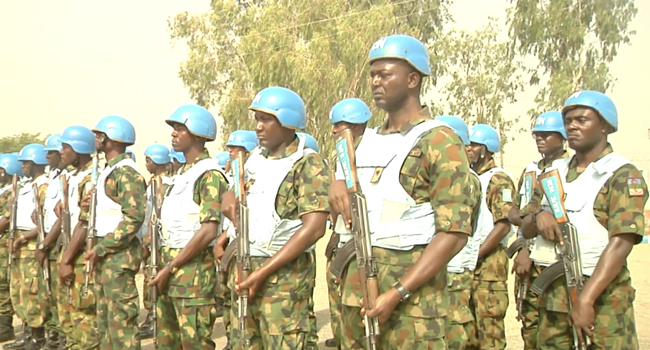
 As part of the contribution toward global peace, Nigeria has deployed about 173 soldiers to keep peace in Guinea Bissau despite rising insecurity in the country. 

The Chief of Operations, Army Headquarters, Major General Oluwafemi Akinjobi, made the disclosure at the pre-deployment training graduation of the Nigerian contingent to the ECOWAS Mission in Guinea Bissau.

He stated that since independence Nigeria has contributed over 100,000 troops to over 40 countries on peacekeeping missions.

Akinjobi, who was reportedly represented by the Chief of Operations, Major General Zakari Abubakar, noted that Nigeria remains the beacon of peace and the gatekeeper of the ECOWAS sub-region.

He added that Nigeria has helped restore peace in many conflict areas around the world.

Akinjobi was quoted as saying: “The nation continues to strive to ensure security and stability in Africa through collective security by contributing to international peace and security, which is essential to Nigeria’s defence policy.”

For Nigeria’s foreign policy and international security goals

By Mukhtar Ya’u Madobi

Nigeria is referred to as the “Giant of Africa”, largely owing to its strong economy and large population among other African countries. Nigeria has therefore continued to maintain this position by demonstrating good and quality leadership aimed at fast-tracking progress for the entire continent.

Nigeria’s goal is not only to ensure and maintain peace and security within its territory, but having the sole aim to ensure that appropriate security architecture is also mounted throughout the region for peace, development and stability to reign.

Through bilateral and multilateral agreement with other nations within the region and beyond, Nigeria was able to contribute immensely to providing sanity and solidity across various institutions both at home and between its sister countries.

During conflict situations, especially in the African continent, Nigeria had always stood to be the largest contributor of military personnel and other forms of technical assistance in the affected countries so as to restore normalcy. Professional military engagement of Nigeria was clearly demonstrated when they led the twin peace missions that returned stability in Liberia and Sierra Leone, just to mention but few. 

Recently, in early February, Nigerian National Security Adviser (NSA), Babagana Monguno has engaged his United Kingdom counterpart, Stephen Lovegrove, in a dialogue bordering on a range of issues including counter-terrorism, serious and organised crime, civilian policing and human rights. The three days long dialogue is the first of its kind since the formation of the ‘UK-Nigeria Security and Defence Partnership’ in 2018.

The latest version of National Security Strategy (NSS, 2019) released by the Office of the National Security Adviser (ONSA), retired Major General Babagana Monguno, has apparently captured and elucidated the contribution of Nigeria to international security by saying:

“Active participation in UN peacekeeping missions remains a fundamental pillar of our foreign policy. Nigeria has been a major contributor of troops and police to the UN since 1960. We have deployed military contingents, unarmed military observers, staff officers, police formed units and advisers to more than 25 missions globally.”

“Our troops constituted the military backbone of peacekeeping efforts in Liberia and Sierra Leone; initially as part of ECOWAS Monitoring Group (ECOMOG) and later under UN peacekeeping operation – UN Mission in Liberia (UNMIL) and UN Assistance Mission in Sierra Leone (UNAMSIL). We will continue to promote global peace and international security through our commitment and deployment to peacekeeping efforts.”

With the spate of military coups currently ongoing across African countries, Nigeria has been rendering diplomatic assistance through regional organisations including African Union (AU) and Economic Community of West African States (ECOWAS). This is to ensure that the affected nations return to the path of democracy and that the respect for the rule of law is equally safeguarded.

Recall that, a number of African countries are currently under the control of Juntas who have seized power after ousting the democratically-elected Presidents in various coup d’états. The countries are Mali, Guinea, and Sudan as well as Burkina Faso that recently joined the list. Meanwhile, the military also took over in Chad after the late President Idris Deby died due to injuries sustained in the battlefield.

Up to now, the regional organizations and other international communities have been working in collaborations with Nigeria to ensure a successful transition from military to democratic government in these countries.

Nigeria’s engagement on the African continent towards international security is not only restricted to peacekeeping operations, but also entails mediation in crisis situations. This is cognizant of the fact that mediation is an increasingly popular dispute resolution mechanism throughout the world as it provides a more cost-effective alternative.

As a result of this status, the ECOWAS has appointed Nigeria’s ex-president, Goodluck Ebele Jonathan as special envoy to Mali in order to head its mediation mission. The aim is to focus on facilitating dialogue with all Malian parties including the opposition leaders, religious organizations and civil societies to resolve the worsening socio-political situation in the country. 

Apart from military support, Nigeria has also been giving interventions to African countries across various imperative institutions. Nigeria provides succor to education, health and judiciary systems of many countries in the region through Technical Aid Corps.

“Nigeria’s development assistance to our neighbours and other countries in sub Saharan Africa is part of fostering mutual peace and security in the region. We will continue to extend development assistance not only to our neighbours, but other countries. We will also strengthen the Technical Aid Corps (TAC), a programme under which Nigeria deploys experts in education, health and other human endeavours to render developmental services and capacity building in the receiving countries.”

“We will equally sustain deployment of judicial officers to other countries to strengthen their judiciaries and promote the rule of law. On good governance, we will continue to offer strategic level training assistance through our strategic institutions to African countries and other allies. This will foster collaboration and strengthen democracy in the region. We will also support countries conducting elections by deploying election monitors to observe and assess the conduct of the elections as part of democratic consolidation,” NSS said.

During the 2014 Ebola outbreak, Nigeria’s approach to containing the situation was a watershed and highly commended by WHO. The country was able to train and deploy 250 volunteer personnel to Liberia to help fight the diseases. Additionally, in January 2020, Nigeria had also handed over TAC medical practitioners to the Sierra Leone Ministry of Health and Sanitation to work in various health facilities across the country. Still, Nigeria is also gearing up toward sending about 74 medical doctors to Guinea Bissau to help the country’s health sector as well.

Therefore, Nigeria must continue deepening her relationship with regional and global partners, strengthen regional and global institutions, thereby achieving national interest, foreign policy objectives and maintaining regional influence.

Mukhtar wrote from Kano via ymukhtar944@gmail.com