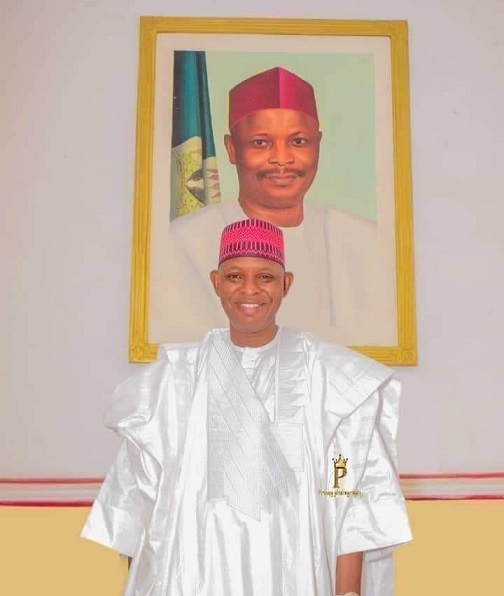
Dr. Nasiru Yusuf Gawuna

BUK awards honorary doctorates to A. A. Rano, Col. Sani Bello

By Hadiza Abdulkadir

Bayero University, Kano (BUK) celebrated a significant milestone on February 15, 2025, by conferring honorary Doctorate Degrees on Colonel Sani Bello, former Military Administrator of Kano State, and Alhaji Auwalu Abdullahi Rano, CEO of A. A. Rano Group of Companies, during its 39th Convocation.

The honorary degrees recognised their exceptional contributions to education and socio-economic development in Kano State and Nigeria. 

President Bola Ahmed Tinubu, represented by Minister of State for Education, Professor Suwaiba Ahmad Sa’id, praised the honourees and reaffirmed the government’s commitment to human capital development through education.

BUK’s Vice Chancellor, Professor Sagir Adamu Abbas, highlighted the graduation of 3,400 students, including 295 from the Dangote Business School and 275 PhD graduates, with 176 achieving First Class Honours. 

Pro-Chancellor Dr. Nasiru Yusuf Gawuna encouraged graduands to uphold the university’s reputation, noting BUK’s recent ranking of 43rd in Africa by the 2025 Times Higher Education World University Rankings, inspiring them to strive for excellence and service to humanity.

Protest Votes: Abban Kanawa and the sins of the Kano APC Government (I)

By Auwal Umar

One thing that is exciting about democracy is its being internally endowed with an inbuilt system that avails citizens with an automatic power to punish or reward their benefactors or tormentors every four years. Politically, many causative factors bring down elected officials or traditional leaders from their seats or rob away their sceptres.

In a democratic setting, nothing so precarious leads to the downfall, even more, dangerous than powerful political opposition than the collective power of protest votes. Protest votes are votes cast by various aggrieved members among frustrated citizens dissatisfied with the incumbent government and determined to cast their votes to penalise the leaders they perceive as incompetent or self-serving. In the last US election, former president Donald Trump and his fanatics were made to understand the power of protest votes. Here in Nigeria, ex-president Goodluck Ebele Jonathan had his taste in 2015.

With less than a week left for the gubernatorial election, the Kano political thunderstorms have gathered. Kano has various groups of people that have grown dissatisfied and overly tired of the APC government under Dr Abdullahi Umar Ganduje and his deputy, Malam Nasiru Gawuna. These aggrieved groups include students, Adaidaita-Sahu (tricyclists) riders, Kwari and Kofar Wambai markets traders, civil servants, and many others. These people consider voting for the current APC gubernatorial candidate and his deputy as a celebration and incentivisation of their unwanted act that led to the worst rerun election in the history of Kano polity.

That infamous rerun election has become a memory that still haunts us and deprives the Kano people of peace, especially with the daily sight of thugs taking over localities and the government seemingly unflustered. Therefore, the people seem to bear an implacable feeling of revenge towards the APC with their most potent weapon at the moment— PVC. This might be glad tidings for the NNPP and its boss, Dr Rabi’u Musa Kwankwaso, who fields the same gubernatorial candidate, Engr. Abba Kabir Yusuf, alias Abba Gida-Gida.

Abba Gida-Gida won the previous election with an unbeatable lead before it was dramatically declared inconclusive, which eventually changed the course of his victory. The kinds of people who still feel shortchanged by the results of the rerun election have come from diverse social statuses among the good people of Kano.

First, the collective electorate versus the indelible scar of “Inconclusive”: Looking at his wide popularity and acceptance across the teeming population of the state, especially among the youth, nothing was surprising in Abba’s victory in the 2019 gubernatorial election. The electorate toiled and moiled hard all day from dawn to dusk to ensure their favourite candidate emerged victorious. But inadvertently, some unscrupulous thugs led by the current deputy governor, the APC gubernatorial candidate of the ruling party, Malam Nasiru Gawuna and his deputy gubernatorial candidate, Murtala Sule Garo, disrupted the whole scene, which led to the worst rerun in our living memories.

The drama leading to the rerun is an ignominious act that still haunts our psyche and traumatises our brains. That utter embarrassment has planted an undying seed of revenge in the hearts of the Kano people for the upcoming election, irrespective of who is fielded as the APC candidate. The rerun had exposed the deeply insatiable lust for power at all costs. What else can explain the action of someone who hired the services of vampiric thugs that were so thirty of the blood of innocent voters just to ensure the will of the majority was ruthlessly robbed with not an atom of compassion?

Today, such social, psychological and physical casualties of the sham called election are still alive, hale and hearty and fully ready for revenge. People living at Gama ward, in particular, and places affected by the consequences of the terrible rerun need no more explanation of the horrors they saw with their own eyes.

Second, the Kano APC government versus scholars: Kwankwaso’s government had sponsored some brilliant Kano indigenes who went abroad to study different courses for the good of the state and the nation to add more value and human resources for the good of the general public. Some of these students who could not finish their studies during Kwankwaso’s reign needed registration and upkeep allowance to continue their studies during the outgoing Ganduje’s reign. But for the sake of bitter politics, these students were wholly ostracised despite being Kano indigenes who were abroad to study and not for tourism. These people are now ready for the 11th March in the eleventh hour to take their revenge.

Third, the Kano APC-led government versus the Kano state Students at Higher Institutions: Kano state students studying at various institutions of learning across the country have already come to terms with the deafening silence of the Kano state government that no longer gives them their meagre annual scholarship which amounts to nothing but a token of concern and appreciation of their struggle to study and liberate themselves from the darkness of ignorance. From the onset, it began with a wicked issuance of useless award letters; then, it metamorphosed to sample payment before gradually morphing into total non-payment of the scholarship. Therefore, these students are neither blind nor deaf. However, their anger is reserved and will be vented on election day.

Fourth, during Kwankwaso’s and Shekarau’s eras, Kano indigenes who successfully studied bachelor’s of Law were sponsored to attend Law School. That gesture helped many Law graduates from poor economic backgrounds realise their dreams of being called to the bar. But for this humanitarian service rendered by these two governors, many of them I know of would not have been officially addressed as barristers or learned colleagues.

The exorbitant fee for Law School has already risen, leaving many Law graduates roaming the streets with their hope dashed. But based on what I see from the lawyer-cum-activist, Abba Hikima, popularly known as ‘Champion of the Downtrodden”, he pledges to lend his voice to the cause to take those people whose hopes were dashed by this APC-led government. Of course, it is not incumbent upon the government to do that, but it’s something very laudable that might help bridge the wide gap between the haves and the have-nots in the state.

In addition, this act places Kano students in an advantageous position ahead of many students who might not benefit from the same gesture in their states. For the war to save the potential barristers and the stranded Law graduates left in limbo due to their financial status, they will express their anger through their PVCs.

Auwal Umar wrote from Kano. He can be contacted via auwaluumar9@gmail.com.

Continuity or not, no two governors are the same

By Ibrahim Siraj Adhama, PhD

In Nigeria, as in most democracies, incumbent elected office holders are given the right of first refusal by their political parties. That is to say, they are considered the first option to fly the party’s ticket again while seeking re-election, all things being equal. As an extension of that privilege in Nigeria, incumbents serving their terms in office are accorded the opportunity to handpick who they want to succeed them. The anointed candidates – as fondly called – would therefore be bequeathed the incumbency factor and everything that comes with it.

The incumbency factor entails a lot of things; it is a blessing and, at the same time, a curse. It is a blessing because the incumbent has a record in office to show. He has achievements and a scorecard of performance to campaign with. It also confers the incumbent many other advantages, especially in terms of holding over the apparatus of power and control. It gives unrestricted access to state resources and assets. It is often said that in developing democracies, the incumbent always has the highest chance of winning an election than his opponent.

Incumbency could also be a burden where the scorecard is not so impressive, or the performance is below par. Whatever the case may be, the fact is no government is perfect! No matter how good the government’s plans and programmes are and well-executed they could be, its opponents will never be done. Again, no matter how good the government’s performance is, opposition parties will still pick holes here and there to criticize it. Characteristically, they will try to belittle the success stories and amplify the weaknesses and the shortcomings, thereby promising to do things in much better ways.

Suppose there’s anything to learn from the first round of the US presidential election debate of 2012 between then-incumbent President Obama and former governor Mitt Romney, the Republican candidate. In that case, it is the difficulty inextricably associated with defending incumbency. Many people agree that former President Obama’s biggest asset was his eloquence and his way with words. Yet, the world watched as he struggled to ward off attacks against his administration by a determined and hard-hitting Romney in a debate unanimously adjudged to have gone his (Romney’s) way. It’s simply not easy!

And things get a bit more complicated when the government’s approval rating is low owing to self-inflicted and needless controversies. Such is the predicament of Dr Nasiru Yusuf Gawuna, Kano State deputy governor and the APC flagbearer in the 2023 governorship election, who aims to carry Governor Abdullahi Umar Ganduje’s baggage. Gawuna’s situation, many people would say, has been made worse by his public avowal not to betray the governor. This is, without doubt, a considerable burden on his shoulder, considering Ganduje’s numerous controversies. And this is leading to what many analysts see as considerable scepticism among some voters.

But if the truth must be told, no two governors can be precisely the same despite the pretence and ostentation of continuity. Neither will Gawuna be exactly like Ganduje, nor will Abba Kabir Yusuf be the same as Engr Rabiu Musa Kwankwaso. Whether we like it or not, all leaders are different, for better or worse. Individuals’ leadership style is influenced by their experiences, worldview, knowledge, vision, temperament, God’s consciousness, wisdom, discipline, character, etc. We’re naturally different vis-á-vis those qualities and variables mean that our approach to leadership should also be different. Thus, nothing could be more preposterous than assuming that one governor would do as his predecessor did. For me, it would be unwise – if not foolhardy – to insist Gawuna is going to be Ganduje’s puppet.

History of anointment has presented us with at least three patterns of relationship vis-à-vis predecessors and successors. First, there is the category of conformists represented by successors who are able to remain loyal to their predecessors through thick and thin. Secondly, there are the “surpassers” who are believed to have done better and outperformed their predecessors. Lastly, there is the category of derailers made up of successors who, for whatever reason, ditch their predecessors to chart a new direction. Governors under this category are often accused of betrayal if not dubbed ingrate. Successors’ overzealousness, power drunkenness, and predecessors’ desire influence their successors and get them to do their bidding in complete negation of the maxim no two captains on the same ship have always been responsible for the strained relationship. Add to that meddlesomeness of political charlatans who would want to create discord, knowing that without one, they will miss their relevance in the scheme of things.

Nasiru Gawuna is stepping into Ganduje’s shoes with a promise to continue from where he (Ganduje) left. Nonetheless, those people insinuating Gawuna will be Ganduje-reincarnate should be forgiven for their lack of understanding of the man. They were either too young or far away to know the strides he made when he held sway at Nassarawa Local Government. Those familiar with his record know full well that Kano will be in for a more fantastic future, judging by his numerous achievements.

Education, healthcare, business and commerce, security, infrastructure etc., will receive tremendous attention. Workers will be in for a greater deal as Gawuna’s people-friendly government will ensure prompt payment of salaries and other entitlements. Gawuna has long been known for his empathy and compassion. Therefore, his government will be expected to be responsive to the plight of pensioners, who are dying in silence. He will be trusted to go out of his way to offset the backlog of gratuities accrued over the years.

On the whole, Gawuna is imbued with unflinching willingness for the rapid social and economic transformation of Kano. This you come to understand each time you discuss it with him. He has the ideas and the initiatives that can change things for the better in our State. He has the leadership qualities, capacity, and determination to deliver. Ganduje himself would be proud to have a successor who will not only build on the successes achieved but also try to correct the mistakes made, sweep the mess created and improve on what is already there. And this is what Gawuna will be doing as governor.

Gawuna has the rare privilege of working closely with all the three governors Kano has had since the Fourth Republic in 1999. He worked with former governors Ibrahim Shekarau and Rabi’u Kwankwaso as Local Government Chairman and Commissioner, respectively. He is now working with Governor Ganduje as Commissioner and Deputy Governor. Therefore, it is perfect to assume that he has learnt some important leadership lessons from each. That he will be coming immediately after Governor Ganduje does not mean he is going to be having any fixation about it.

Thus, instead of continuing “from where Ganduje left”, Gawuna is expected to build on the legacies of all past Kano governors. He will hope to consolidate their individual and collective achievements as he leads Kano toward the path of more development and prosperity.

May Allah choose the best for us!!!

Dr Siraj writes from the Department of Mass Communication, Bayero University, Kano and is also a reporter for The Daily Reality.