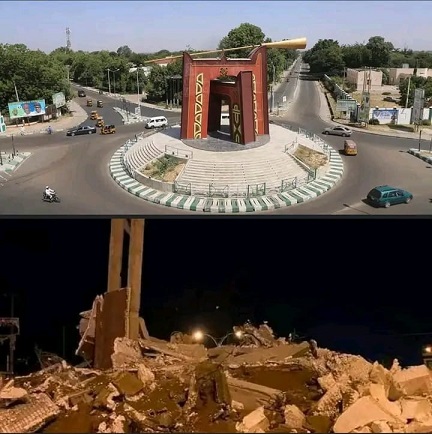
Demolishing

Borno opposition leader sues state govt over shopping mall demolition

By Uzair Adam

A former senatorial candidate of the New Nigeria Peoples Party (NNPP) in Borno Central, Hon. Attom Magira, has filed a lawsuit against the Borno State Government following the demolition of his multi-million naira shopping mall in Maiduguri.

The demolished property, a four-story commercial shopping complex with a multi-purpose hall, was situated along Sir Kashim Ibrahim Road, opposite the state low-cost housing estate.

In a press statement issued on Saturday, Magira’s lawyer, Hamza N. Dantani of Kayode Ajulo & Co., described the demolition as an unlawful act. He revealed that his client had sought legal protection against the action through a suit filed at the Borno State High Court (Suit No. BOHC/MG/CV/8/2025) against the Borno State Urban Planning and Development Board (BOSUPDB).

Dantani alleged that the demolition was politically motivated and carried out under the direct instruction of Governor Babagana Zulum’s administration.

He also criticized the state government for disregarding legal procedures, arguing that the demolition undermined the rule of law and economic development in the state.

“The demolition of my client’s plaza is not just an attack on his investment but a blatant disregard for judicial authority and the economic future of Borno State,” Dantani stated.

According to him, Magira had obtained all necessary approvals, including a statutory right of occupancy and a development permit (No. BSUPDB/DC/2194). He added that no concerns were raised by BOSUPDB during the construction phase.

Dantani further claimed that after the building’s completion, BOSUPDB revoked the development permit and issued an ultimatum, demanding the removal of a supposed “fifth floor” within seven days or face full demolition. He insisted that the property had only four stories.

Despite Magira’s appeal against the revocation, which should have automatically halted any demolition under the law, the government allegedly proceeded with the destruction of the property.

“The law is clear—where a statutory provision outlines a procedure, it must be strictly followed,” the lawyer argued, citing relevant constitutional provisions and legal precedents. The court has adjourned the matter to April 22, 2025, for a hearing.

Dantani maintained that the demolition, carried out while the case was still in court, violated due process and constituted an abuse of power.

As of press time, the Borno State Government has not officially addressed the reasons behind the demolition. However, past demolitions in the state have often been linked to urban planning regulations and public interest concerns.

Demolition: Court awards N2m damages against Kano gov’t

By Uzair Adam Imam

A Federal High Court in Kano state has ordered the state Governor, Abba Kabir Yusuf, and other respondents to jointly pay two brothers the sum of one million naira each for attempting to demolish their properties at Salanta quarters.

In a court sitting on Friday, Justice Simon Amobeda described the attempt by the state government and its agents as an infringement to the applicants right to own immovable property as guaranteed by the Nigerian constitution.

Justice Amobeda stated that the intrusion to the applicants’ properties around 11pm on 14th June, 2023, in an attempt to carry out demolition is clearly infringement to their private and family life as enshrined by the constitution.

He stated, “The Respondents are also ordered to remove the red signing marked: 14th June,/KN/ KNUPDA made by their staff or Agents on the Wall of the Applicant’s Properties situated at Salanta and to repaint the wall to the satisfaction of all respondents.”

Barrister Bashir Ibrahim, who filed the suit on behalf of the applicants, applauded the court judgement and described it as a landmark for protection of human rights.

However, also speaking with the journalists after the judgement, counsel to Kano State Government and other respondents, Barrister Musa Dahuru Muhd, said they would study the judgement and advise the Government on the next step.

Uproar over demolition exercise in Kano

By Bilkisu Kabir Ibrahim (Mrs)

It is often said, “Destruction is easy, but rebuilding takes more time to achieve.” 

Politics and governance are two sides of the same coin, as they are often used interchangeably even though they differ in veracity. In modern democratic societies, citizens (and leaders, by extension) fail to understand the difference between the two concepts in terms of meaning and operation. 

Barely less than two weeks after the swearing-in of the newly democratically elected governors and members of the states’ assemblies across the states of the federation, several governors focus on so many engagements as part of the fulfilment of their campaign promises, ranging from suspension and removing many top heads of the state’s ministries, departments and agencies alongside forwarding of new nominees to their respective state house of assemblies for various positions.  

However, the reverse is the case in Kano State as the new governor fulfils his campaign promises where demolishing illegal structures is part. In his inaugural speech, his Excellency Abba Kabir Yusif revoked all sold public places and assets by his predecessor by ordering security agencies to take over such sites. A few days later, he began a demolition exercise with a 3-story building with 90No. Shops along Racecourse Road Nassarawa GRA which were reportedly owned by the son of the outgoing governor of the state, followed by another multi-billion Naira project via Public Private Partnership (PPP) arrangement initiated by his predecessor, situated at old Daula Hotel (state’s property) on Murtala Muhammad Way, Kano.

Nevertheless, several structures have been marked and knocked down as illegal buildings, which include; Eid-Ground Shops (Masallacin Idi), shops detached from Sani Abacha Stadium Kofar Mata and Buildings at GGSS Dukawuya Goron Dutse as well as some structures at Kano Hajj Camp among others. 

Subsequently, mayhem erupted in the state capital and neighbourhood when the governor ordered the demolition of the historic Kano roundabout structure in the early hours of Wednesday, 14th June 2023. The roundabout, known as Kano Golden Jubilee Monument, was erected in 2017 and conceived and designed by a young female architect to commemorate Kano’s 50-year attainment as a state.

While several indigenes and residents have condemned in totality the demolition of the monument, the press secretary to the governor, Sunusi Bature D/Tofa, in his reaction, revealed that the roundabout was demolished for security and safety reasons, “it also poses traffic challenges around the area due to its size blocking the view of drivers accessing all routes linked through the roundabout”. 

Nonetheless, mixed reactions become the order of the day; some residents are hailing the governor for staying firmly to his campaign promises, while many traders lament the demolition exercise as it truly affects their commercial activities by creating a hostile business environment forcing many of their customers from within and outside the state to stay away. During my interview sessions, a respondent feared the ongoing action as “it scared away private investments in the state, which is the time needed for a successful administration”. Another respondent (a victim) revealed that, on Saturday, he supplied aluminium and other equipment for a window project at Old Daula Hotel worth N30,000,000.00 but were all looted in the night immediately after the demolition, which the looters termed as “GANIMA” in Hausa. 

Similarly, it was reported that, in the heart-wrenching incident, a young boy lost his life after being struck by a truck during the demolition of a structure. The unfortunate event occurred amidst the efforts to clear the unauthorised constructions. The boy was not the only one affected, but also several individuals sustained severe injuries as they attempted to take advantage of the demolition exercise and loot multimillion items.

Some critical questions were asked about this light exercise. This government is supposed to concentrate on critical infrastructure and human development to overshadow its predecessors instead engaged in revenge and self-centred aggrandisement. 

His Excellency Abba Kabir may wish to remember that some projects need maintenance and sustenance to suit the rising demands of the good people of the state. Instead, the government should have to determine the legality or otherwise of the allocated lands by constituting high-powered technical committees to, among other things, investigate the following: 

a. Whether the due process for land allocation is followed;

b. Whether all building codes and regulations have been complied with;

c. The rationale behind the building purpose;

d. Was the land sold at market price, and whose account was the money deposited into or allocated as enshrined in the Land Use Act?

e. Was the land allocated to the rightful applicant? 

f. Was the roundabout demolition in the interest of most of the populace? Etc.

g. The committee to proffer some recommendations to the government for a proper solution. 

To crown it all, the governor may further wish to recall the Oath of Office taken during the swearing-in session, that “….I will not allow my personal interest to influence my official conducts or my official decisions …” Surely, Almighty God will ask for such utterances. 

Bilkisu Kabir Ibrahim (Mrs) wrote from Kano state, Nigeria. She can be reached via bilkisukabir1@gmail.com.

On demolishing and restoration of order in Kano

By Mansur Hassan, PhD.

The abuse of the Kano State master plan during the administration of Governor Abdullahi Umar Ganduje has led to a proliferation of illegal structures. These include shops built within school premises, encroachments on mosques, hospitals, graveyards, and other areas not designated for such purposes.

Urban planning principles dictate that every city should have distinct residential, commercial, educational, and industrial areas. In line with his campaign promises, Governor Abba Kabir Yusuf’s decision to demolish these structures is a step in the right direction, aimed at restoring order and proper planning in Kano State.

Urban planning is crucial for the development of sustainable and functional cities. A well-designed master plan ensures that cities function efficiently, with designated zones for different purposes.

Residential areas provide housing and essential amenities, commercial areas drive economic activities, educational areas facilitate learning, and industrial areas promote economic growth and employment opportunities.

Under the Ganduje administration, the master plan of Kano State was severely abused. Illegal structures were erected without regard for zoning regulations, leading to numerous consequences. Shops built within the compounds of existing schools not only compromised the safety and security of students but also disrupted their learning environment.

Encroachments on mosques and hospitals within residential areas caused congestion and noise pollution, disturbing the peace and privacy of residents. Additionally, the encroachment of graveyards demonstrated a lack of sensitivity and respect for the deceased and their families.

Governor Abba Kabir Yusuf’s decision to demolish these illegal structures is a positive and necessary step toward restoring order and rectifying the abuses that occurred under the previous administration. By adhering to his campaign promises, the governor demonstrates a commitment to responsible urban development in Kano State.

The demolition of illegal structures will yield several benefits. It will reinstate order and organization, as buildings will be appropriately placed within designated areas. Schools will regain their intended space, ensuring a safe and conducive learning environment for students.

Governor Abba Kabir Yusuf’s commitment to demolishing these illegal structures helps restore public trust in the government’s ability to enforce regulations and ensure responsible urban planning. It also highlights the governor’s long-term vision for the sustainable development of Kano State.

By adhering to the master plan, the government can effectively manage the city’s growth and expansion while meeting the needs of its residents. Governor Abba Kabir Yusuf’s decision to demolish illegal structures in Kano State represents a commendable effort to restore order and proper urban planning.

By rectifying the abuses that occurred under the previous administration, the government aims to create a more organized and functional city. This action reflects the governor’s commitment to fulfilling his campaign promises and ensuring the long-term development of Kano State.

As the city progresses, prioritizing adherence to the master plan will foster sustainable growth and improve the quality of life for all residents.

Mansur Hassan, PhD is a lecturer in the Department of Mathematics, Yusuf Maitama Sule UniversityHe can be reached via mhassan@yumsuk.edu.ng