Book Review

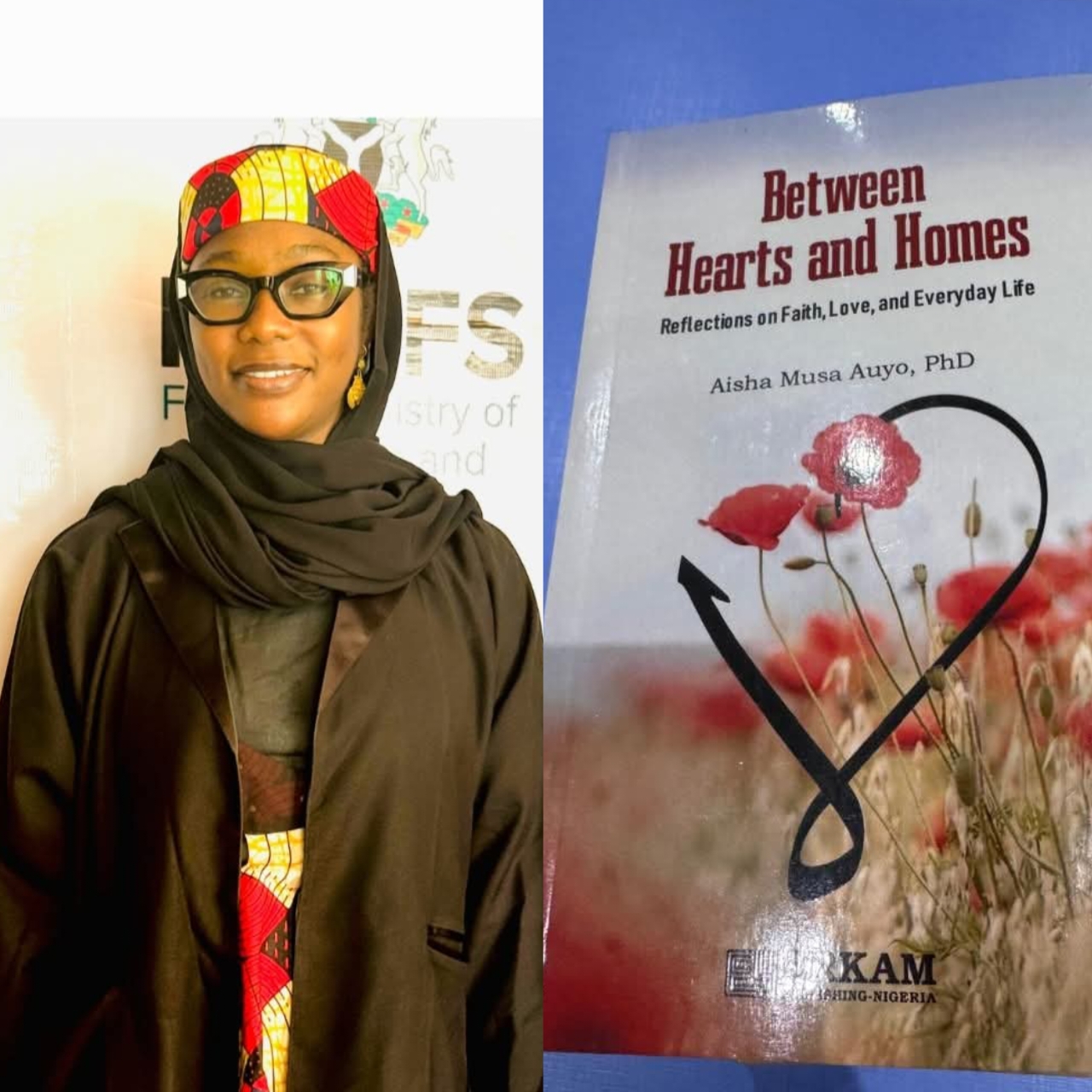
BOOK REVIEW: Between Hearts and Homes

Author: Aisha Musa Auyo

Number of Pages: 184

Date of Publication: 2025

Publisher: Erkan Publishing-Nigeria

I just finished reading Dr Aisha Musa Auyo’s book, Between Hearts and Homes: Reflections on Faith, Love, and Everyday Life. It sure leaves a lasting impression…

The book feels like a heart-to-heart conversation with someone who has literally ‘lived life’, not just studied it.

What stands out immediately is how relatable it is. The tone used is not from a high or detached pedestal. It’s more like the tone of an older sister, a friend, or that person who tells you the truth whether you’re ready for it or not. From body image and self-awareness, to marriage, motherhood, perfume, clothes, and even shawarma cravings, using your cuisine as a comic relief… Everything feels real-life. It’s so easy to see oneself in the stories.

For example, the shawarma story hits hard. We’ve all said things like “I’ll do it tomorrow” or “next time.” But here, “next time” never came. That simple moment teaches a powerful lesson: don’t delay kindness or small acts of love, because tomorrow isn’t guaranteed. That’s something everyone can relate to; whether it’s postponing a visit to a parent, delaying a call to a friend, or putting off saying “I love you.”

It’s also commendable that you used practical examples instead of abstract advice. It doesn’t just say “be kind”, it shows kindness through cooking for someone, helping neighbours, respecting professionals, and being intentional in relationships. It doesn’t just say “take care of yourself”; it talks about specifics, perfume, grooming, clothes, and your living space. Even something as simple as keeping your house smelling nice can be a lesson in self-respect and in creating a pleasant atmosphere. That’s everyday wisdom.

Another strong point is how brutally honest you were at some point without sugarcoating things. For instance, pointing out things like:

Openly talking about body shapes and dressing realistically.

Telling people to stop pretending body realities don’t exist.

Warning couples with an AS genotype to reconsider marriage, not out of cruelty, but out of concern for future pain.

That kind of honesty might make some people uncomfortable, but it’s refreshing. It’s not about trying to be politically correct; it’s about trying to be helpful.

Yet, despite the bluntness, the book still keeps a beautiful balance. It blends faith and daily life while tactfully fusing serious medical topics with soft emotional reflections. It also successfully blended romance with responsibility, self-care with modesty and so on.

If I’m being honest, I never knew that the inability to recognise people was a medical condition with a name (prosopagnosia), but that’s one thing I’ve also learnt from your book.

There were interesting discussions about prosopagnosia, sickle cell disease, parenting, and marriage, alongside perfume tips and fashion advice. That balance makes it feel complete, like life itself.

There’s also humour sprinkled throughout. Lines like “Don’t smell like a flower while the house smells like Daddawa” will make you laugh because it’s so true. Or when you mentioned dressing badly makes you look like Muciya da Zani at home, funny, but the message lands. The humour keeps the book light, even when it’s talking about heavy topics like death, genetics, or emotional struggles. Most importantly, the book carries serious ideas beneath the laughter, which made it more fun to read.

Most of all, you were able to pass key messages like: 

Be intentional in love.

Respect your neighbours, you never know when you’ll need them (the button incident was so scary to read. As a mother, I could relate so well).

Take care of your appearance for yourself and your partner.

Understand medical realities before making lifetime decisions.

Be patient with people who behave differently; they might be dealing with invisible conditions (the ID Card scenario of the lady with hearing impairments was quite touching). The personal stories, motherhood, interactions with neighbours, and dealing with loss make the lessons stick. It wasn’t about boring theory but more about fun and practical experiences.

I could go on and on…

In short, the book teaches without preaching, corrects without insulting, and entertains while educating. It’s funny in places, deep in others, and honest throughout. I laughed at some points and reflected at others. It will even make you start rethinking a few habits.

I just love how it generally reminds you that life is made of small moments, how you dress, how you speak, how you love, how you treat people, and that those small things matter more than we realise.

P.S- Meanwhile, I noticed two pages with small errors: one had a typographical mistake, and another contained a repetition. However, these are mere observations and don’t detract from the book’s powerful messages. A more thorough proofreading in future editions would help polish the work and make the reading experience even smoother.

Overall, these are very minor concerns in such an otherwise thoughtful and impactful book as yours. I look forward to more of this. Kudos and more power to your elbow, Ma’am!

Reviewed by:

Eunice Johnson (Southpaw), a UK-based media broadcaster, musician, actor, media consultant, and public relations expert, wrote via eunicejohnson001@yahoo.com.
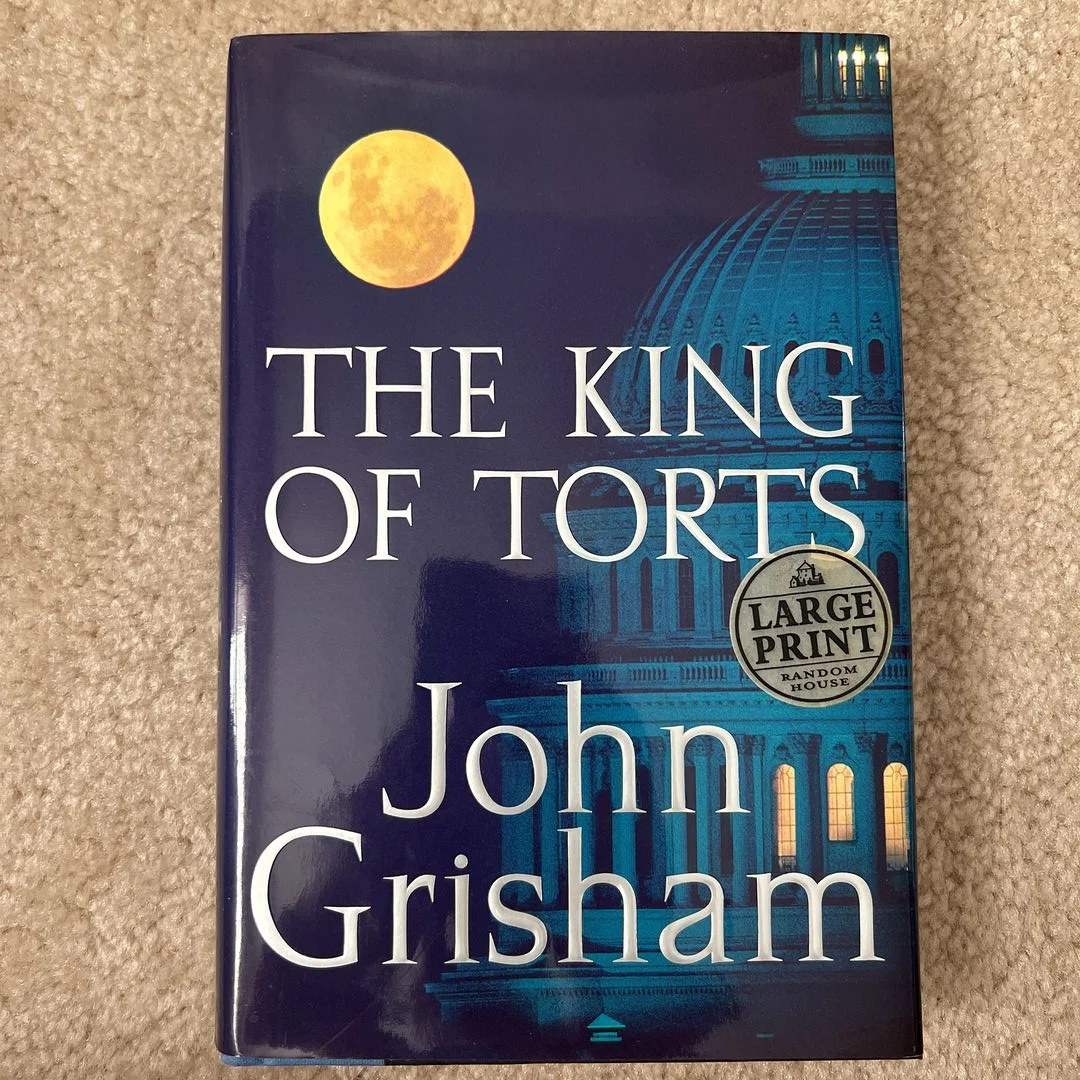
The King of Torts: The problem with overnight riches

By Saifullahi Attahir Wurno.

John Grisham’s The King of Torts tells the story of Clay Carter. He is a Washington city-based, poorly paid lawyer who works as a public defender on the city’s outskirts. Like most employees, he was unsatisfied with his job as it hardly paid his monthly expenses. Another problem with Clay was that he had been dating Rebecca for a long time, and her parents were unhappy with their relationship. These issues kept Mr Clay’s poor mind busy, always thinking of nothing but how he would become rich.

One afternoon at the office, a man named Max Pace appeared before Mr Clay, claiming to be an insider of one pharmaceutical company that secretly carried out a clinical trial on some prisoners without their consent. The story goes that a drug called Tarvan had a side effect that forced its victim to carry out senseless killings without any remorse. Mr Clay became interested in the case and went to investigate up to the prison and interviewed the victims. 

Mr Clay gathered enough evidence to sue the pharmaceutical company involved. Before that, he went into an agreement not to disclose or involve Max Pace in the dealing. After lengthy litigation, the company pleaded guilty and made a massive settlement for the victims through Mr Clay’s hands. This made Mr Clay a hot cake within a month. 

Surprisingly, Max Pace appeared again while trying to adjust to his new life, promising Mr Clay that more litigation cases needed another lawyer for the investigation, so he advised Mr Clay to try his luck. Ever greedy with money, without question, Clay accepted the challenge and plunged into action.

 This one involved another giant pharmaceutical company called Ackerman Laboratories that developed a drug called Dyloft, which was found to be carcinogenic (potential to cause cancer). This time, Mr Clay raised a campaign in TV and magazines until, eventually, the Ackerman laboratories pleaded guilty and agreed to pay a 100 million Dollar settlement. Barrister Clay became an overnight Millionaire and the talk of the city, with magazines featuring and making stories about him; they even nicknamed him ‘The King of Torts’.

Typical of a man longing for cool Dollars, Mr Clay bought a new black and latest Mercedes Benz for a couple of millions, purchased a house in a neighbouring suburb, leased a building and founded a private law firm just for handling litigation cases. He hired more smart rookies ( young lawyers) and decorated his office building to appear prominent and affluent. 

The problem with soft Dollars is that they often affect our thinking negatively. This time, Mr Clay’s relationship with Rebecca becomes sour, and he begins to distance himself from her, although they genuinely love each other. The fact that her parents are not happy with their relationship and would not allow them to live together forced Mr Clay to date other young girls secretly. He was always roaming from one five-star hotel to another, paying huge bills to satisfy his desire.

 He entered the big league of Great lawyers in town, spending lavishly, travelling around the country attending conferences in a state-of-the-art private Jet he leased! and travelling to the Caribbean Islands during holidays to enjoy his wealth. 

 He eventually met a lady named Ridley, who was a beauty Model. Ridley (modern-day prostitute). That is where Mr Clay was losing his soft Dollars quickly and without noticing. He bought many properties in her name, fearing to lose them to the FBI, thinking he trusted her enough and their relationship would be permanent.

As for his work, he was luckily getting more dollars, litigating more pharmaceutical companies, the latest involving a company called Goffman that produced a drug called Maxatil. Thinking it’s always a win, he invested heavily in this case by orchestrating expensive adverts, hiring expensive lawyers, and even recruiting fake victims just to get the soft Dollars. Unfortunately, Goffman was not ready to back down; they hired more expert lawyers and conducted a deeper investigation. Eventually, Mr Clay lost the case.

Losing for the first time, Mr Clay lost his balance, and more trouble awaited as the Goffman company sued him for blackmailing their products; this forced Mr Clay to lose a large proportion of his fortune.

 Mr Clay was sued again before the court by the clients on whose behalf he collected a massive settlement for not paying them enough to cover their hospital bills after leaked news by one of his close allies. Without saying, Mr Clay becomes more deeply in trouble.

He was eventually investigated by the FBI, risking a jail term or a settlement that would cost him almost all of his fortune. He has the option for the latter.  He lost all his assets and new ‘friends’, including Ridley, who fled without a trace. He fled the country, and surprisingly, all this while, his original lover Rebecca was married to another man but got divorced later. Finding out Mr Clay’s story, she travelled to meet him, console him and offer her genuine care and love. They continued to live afterwards, and Mr Clay learned his lessons.

History has continually shown that overnight riches or those who stumble upon a vast fortune suddenly and effortlessly are similarly more susceptible to losing it. The problem with overnight riches is that they impede our positive thinking, allowing us to dive deep into fantasies, opening unrealistic doors, and drawing us toward deceptive paths.

This story can reference some of our lives today; this insatiable search for soft money by all and sundry, hook or crook, could remind the old maxim that happiness, contentment, genuine wealth, and loving family matter more. 

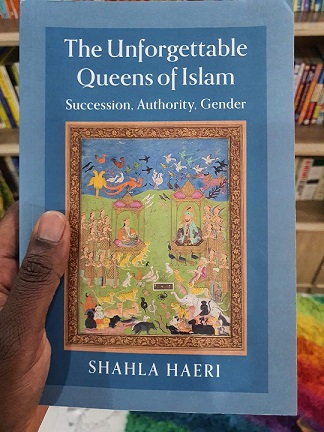
Book Review: The Unforgettable Queens of Islam

By Dr Shamsuddeen Sani

It’s very easy to ignore this book. Underrate it even. I found myself rereading it for many days, given the enormous importance of the topic, especially in the contemporary discourse in Muslim-majority countries about woman’s leadership. Being a recent publication in 2020, and although the author didn’t explicitly state it, it appears to be building to improve upon earlier work by the late Moroccan feminist writer and sociologist Fatima Mernessi with her book, The Forgotten Queens of Islam.

Shahla Haeri embarks on a journey of gendering the historical narrative of sovereignty and political authority in the Muslim world, shedding light on the lives of Muslim women leaders who defied the norms of dynastic and political power to rise as sovereigns in their deeply patriarchal societies.

The author’s usage of the term “queen” is not meant to be taken literally for all six prominent figures discussed in the book but rather to signify their immensely influential leadership roles during their respective eras. While recognising the significant impact of numerous women in Islamic history who exerted influence behind the scenes, Haeri emphasises those women who stood at the forefront of the political machinery, actively engaging with the structures of authority and power.

She doesn’t just relay the historical milestones of these great women in historical Islam but brings in a fresh perspective on how we look at the concept of women’s leadership in the Islamic tradition. The author situates women rulers’ rise to power within three interrelated domains: kinship and marriage, patriarchal rules of succession, and individual women’s charisma and popular appeal.

This book prompts deep contemplation on patriarchy within the pre-modern normative Islamic tradition. But one needs to be careful because the author appears to be overly problematising patriarchy in some instances significantly beyond what we consider as would have been normal in pre-modern Islam. She did allude, however, to the critical role of men in women ascending to positions of political authority. 

Structurally, this book has a Preface and Introduction and is broken into three main parts with two body chapters. Part I, Sacred Sources of Authority: The Qurʾan and the Hadith, lays the background for her accounts, with a deep examination of the primary sources of the Qurʾan and hadith, through the Qurʾanic story of the Queen of Sheba and the biography of the Sayyida Aisha (RA). Haeri relays the Quranic account of the dramatic encounter between King Solomon and the Queen of Sheba, popularly known as Bilqis. Drawing primarily from Tha’alabi and al-Tabari, the book cross-examines the sovereignty of Bilqis and connects the Quranic revelations with what she believes was the exegetes’ medieval patriarchal reconstructions.

Part II of the book is about Medieval Queens: Dynasty and Descent. In Chapter 3, the book explores the leadership life of the long reign of the Ismaili Shiite Yemeni queen. It examines Queen Arwa’s fascinating political acumen and how she survived the political and power succession tussle dealing with the 3 Fatimid caliphs of Cairo. Chapter 4 examines the short sovereign rule of the only female sultan of the 13th century Delhi Sultanate, Razia Sultan: ‘Queen of the World Bilqis-i Jihan. 

The 3rd part of the book, which explores the contemporary Queens and examines the institutionalisation of succession, provides an in-depth look at Benazir Bhutto and Megawati Sukarnoputri but will not spoil more here for the interesting details in the book.

Haeri concludes this work of ethnohistory which is deeply personal as she peppers in the concept of the “paradox of patriarchy,” which refers to the historical tradition of power succession among men, particularly fathers and sons, or even brothers, whose family ties legitimise the customary transfer of power. She quickly alludes that the relationship between fathers and sons can be a source of tension and rivalry, where they may fear, resent, or even seek to eliminate each other. In contrast, father-daughter relationships tend to be more personally fulfilling and have fewer political consequences for the father. The preference of patriarchs for their daughters is not only driven by self-preservation but also by their recognition of their daughters’ talents and political astuteness.

Dr Shamsuddeen Sani wrote from Kano. He can be reached via deensani@yahoo.com.

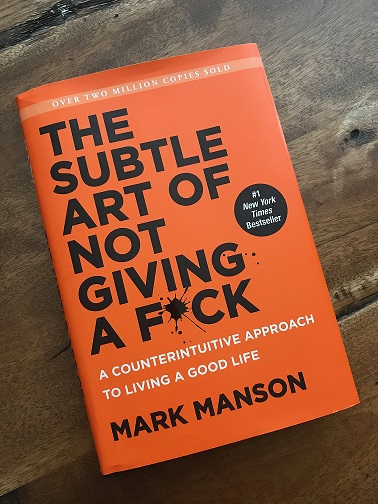
Book Review: The Subtle Art of Not Giving a F*ck

By Hafsah Ja’afar

The Subtle Art of Not Given a F*ck is a book with a provoking unconventional tone that challenges traditional sundries of happiness and success. Penned by Mark Manson, this book presents a refreshingly honest and no–gibberish approach to living fulfilling lives. Manson argues that true happiness and particular growth come from accepting our limitations, embracing discomfort, and understanding that life is innately difficult and delicate.

He encourages his readers to prioritize their values and choose what truly matters to them instead of seeking constant positivity or avoiding negative gests. Throughout the book, Manson explores colourful themes such as responsibility, authenticity, and the significance of setting boundaries.

He advocates for letting go of societal prospects, embracing failures, and learning from them. He suggests that we can lead a more meaningful and authentic life by fastening on what truly matters to us—using a mix of particular stories, philosophical perceptivity, and detailed advice.

Manson provides readers with a fresh perspective on changing happiness and purpose. It encourages them to let go of external confirmation, embrace their defects, and control their lives.

Overall, this book offers a counterintuitive yet empowering gospel that challenges everyone to rethink their precedence, review success, and live a life guided by their values rather than the prospects of others.

Hafsat Ja’afar is a school teacher and wrote from Kano via jaafarhafsat@gmail.com

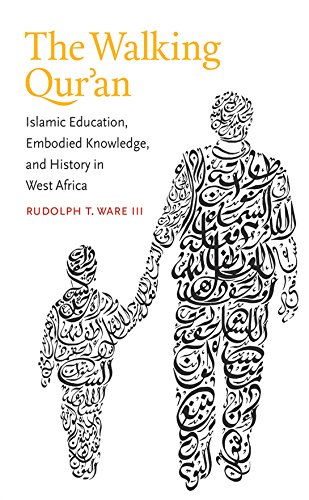
Book Review: The Walking Qurʾan: Islamic education, Embodied Knowledge, and History in West Africa

  • Book time: The Walking Qurʾan: Islamic education, Embodied Knowledge, and History in West Africa
  • Author: Rudolph T. Ware III.
  • Date of Publication: 2014
  • Number of Pages: 330
  • Publisher: The University of North Carolina Press
  • Reviewer: Shamsuddeen Sani

After recently reading a book about Quranic Schools in Northern Nigeria, I was left hungry for a less Western way of presenting the subject matter. So I serendipitously laid my hands on this book, and knowing that I have read about the author in the past, I didn’t hesitate to devour it.

Following a broad introductory section, the book delves deeply into an interdisciplinary examination of the knowledge philosophy underlying Quranic education. This required an in-depth historical ethnography of the institution in modern-day Senegambia, which lays the way for comprehension of the conceptualization and transmission of knowledge. It also strengthens the case that internalizing texts, even by swallowing them, was crucial to understanding and remembering the material. This book’s central concept represents the embodiment and actualization of Islamic knowledge.

Importantly, these early chapters look at the emergence and long-term evolution of a native West African clerisy. Ware underscores how these African Islamic instructors and thinkers were the primary agents of Islamization in a continent unperturbed by the early Islamic conquests. In order to avoid rulers (and maintain their independence), they established a unique framework for the interactions between political and religious powers. It also emphasizes both moral and political economies of studying and teaching the Qur’an throughout the 18th century focusing on how the growth of the Atlantic slave trade led to the breakup of this model of pious distance from power.

As we near the middle of the book, Ware thoroughly explored the historical account of the enslavement of ‘huffaz’ in Senegambia from the 1770s until the advent of the French colonial rule in the late 19th century. With clerics viewed as embodied exemplars of the Quran, such incidents of enslavement were perceived as more than just violations of Islamic law, but as desecrations of the Book of God.

The book meticulously illustrates the chronological narrative of Senegambia’s revolts, rebellions, and even revolutions inspired by the enslavement of “the walking Qur’an.” Without going further into spoilers, these historical happenings culminated in the climactic radical movement by African Muslim clerics and their disciples, with a cascade of events leading to the overthrow of hereditary slave-owning kings in 1776, the abolition of both the Atlantic slave trade in the Senegal River Valley and the slavery institution itself.

These narratives would lack crucial context if they did not include the efforts of formerly enslaved people and other oppressed groups to use the legal abolition of slavery in the French colonial state to assert their dignity through the dissemination of the Qur’an in the early 20th century. They fought to transform their very selves through Islamic education while doing so from within the epistemology of embodiment and in opposition to regional traditions that stigmatized their bodies because of their social standing. The establishment of mass Sufi organizations and the emergence of new French and Muslim teaching forms were only two of the many changes in colonial Senegal’s political and educational landscapes fueled by this knowledge-sifting process.

This outstanding work profoundly serves as the first step for anyone interested in learning about Qur’anic instruction in West Africa. A significant chunk of detail about Quranic education in West Africa jumps right off the page, you can feel the author’s passion, and as he claims, this is the narration from within. The writing style is genuinely simple and engaging and has a powerful sense of atmosphere. It gives you a lot to chew on and is one of those books that it would not feel right if you didn’t give it the five stars it deserves.

Rudolph T. Ware III is a historian of West Africa at the University of California, Santa Barbara. He formerly taught at the University of Michigan and then at Northwestern University. His work aims to confront and dispel Western misconceptions about Islam.

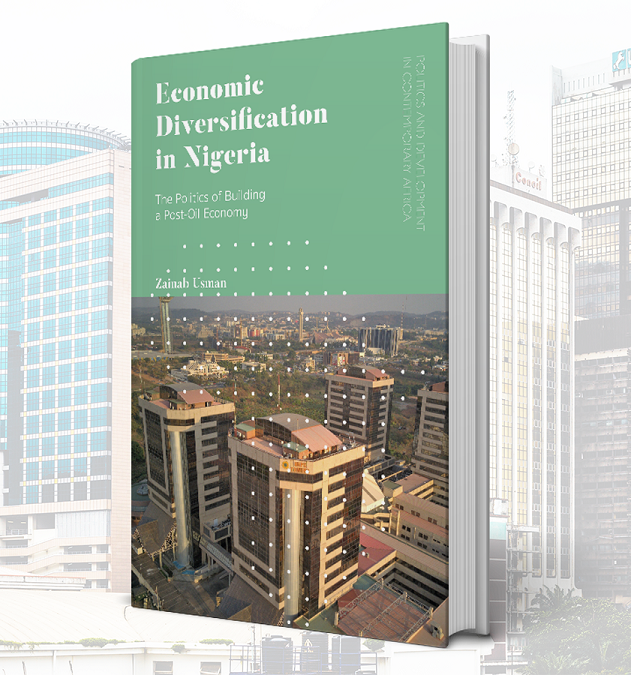
Book Review: ‘Economic Diversification in Nigeria: The Politics of Building a Post-Oil Economy’

By Abdulhaleem Ishaq Ringim

Economic Diversification in Nigeria by Zainab Usman is an in-depth analysis of Nigeria’s political economy that presents an apt delineation of the interplay of politics, institutions and policymaking in the process of economic development. Zainab’s is an attempt at instituting a diagnostic exercise to identify(beyond prevailing conventional narratives) major impediments to sustained development.

By repudiating ‘resource course’ and ‘backward neopatrimonilaism’ as the causal roots of Nigeria’s economic underperformance, the book presents a thesis that centres on challenges to economic diversification in resource-rich countries as the major impediment to economic transformation and development.

The author did a great job at identifying pathways to achieving economic transformation and establishing the state’s role in guiding the process but argued that the efficacy of the state’s guiding interventions remains a function of its institutional capacity which in turn depends on its political character.

Hence, to deconstruct Nigeria’s peculiar political character and its implications for economic transformation, the book deployed carefully designed frameworks for the analyses. Central among these analytical templates is the political settlement framework, which defines the influence of the distribution of political power on policymaking for development.

Per Zainab’s model, economic transformation, especially in resource-rich countries like Nigeria, depends on a kind of political settlement that distributes power among elite formations to ensure the emergence of a stable political coalition. This is why even while Nigeria has witnessed periods of semi-steady economic growth in her national life, such has never been adequate enough to usher in sustained development.

As an “Intermediate” State, Nigeria’s breed of political settlement is characterized by the formation of unstable political coalitions and cyclical political crises (especially in political transition periods). This has ensured that the country is always in crisis management. And the resulting policy and reform orientation has always assumed a manner that prioritizes short-term macroeconomic stabilization over long-term structural economic transformation.

The author, however, believes that such a political configuration is not immune to change. She explained that certain “critical junctures” determine whether a prevailing political configuration will change or persist. At these junctures, elites are constrained to take certain policy actions. And the economic outcomes of such policy actions depend on whether the assumed policy direction takes a stabilization or transformational orientation.

Using this framework, the author analyzed two subnationals, Lagos and Kano, to demonstrate the complex interplay of politics and policymaking and its influence on economic outcomes. The analyses mainly focused on critical junctures for both states and the resulting policy orientation and outcomes in relation to their contrasting political settlements. Lagos presented itself as a model for economic transformation while Kano a microcosm of Nigeria as it is.

The book concluded with recommendations on how Nigeria’s political settlement can be balanced by institutionalizing “zoning” as a power-sharing agreement, adopting a shared vision for transformation, and addressing market failures while emphasizing the imperative of building a post-oil economy. I find the book very interesting. It presents thought-provoking arguments and indeed updates our mental models on the challenges of economic diversification in Nigeria’s context.

Not that I agree with every postulation. In fact, I can’t entirely agree with the relegation of culture as an outcome of economic development rather than a determinant. Culture precedes economic activities(not to talk of development) in global historical trends, so I believe it cannot be an outcome of what it fundamentally precedes as far as existence is concerned.

As I posited some weeks back (linked), I belong to the school of thought that considers culture as a significant determinant of economic development alongside geography and climate. However, I believe culture itself is a product of nature, geography, climate and the environment.

I believe that at every point in human history, the culture of any people is determined and constituted by a combination of the powerful and inter-generationally persistent ‘cultural legacies’ the people have inherited over time (mostly developed in response to geographical and climatic determinants) and the cultural aspects developed as a result of the influence of [mostly unpleasant] environmental changes and the need to adapt to them.

Hence, I believe nature, geography, climate, and environmental changes determine the cultural compatibility and disposition(positive or negative) of any people towards development. Therefore, I have not seen enough reason to forgo Varoufakis, Gladwell and others on geographical and cultural determinism regarding economic development.

Nonetheless, the book is a masterpiece!