Bayero University Kano

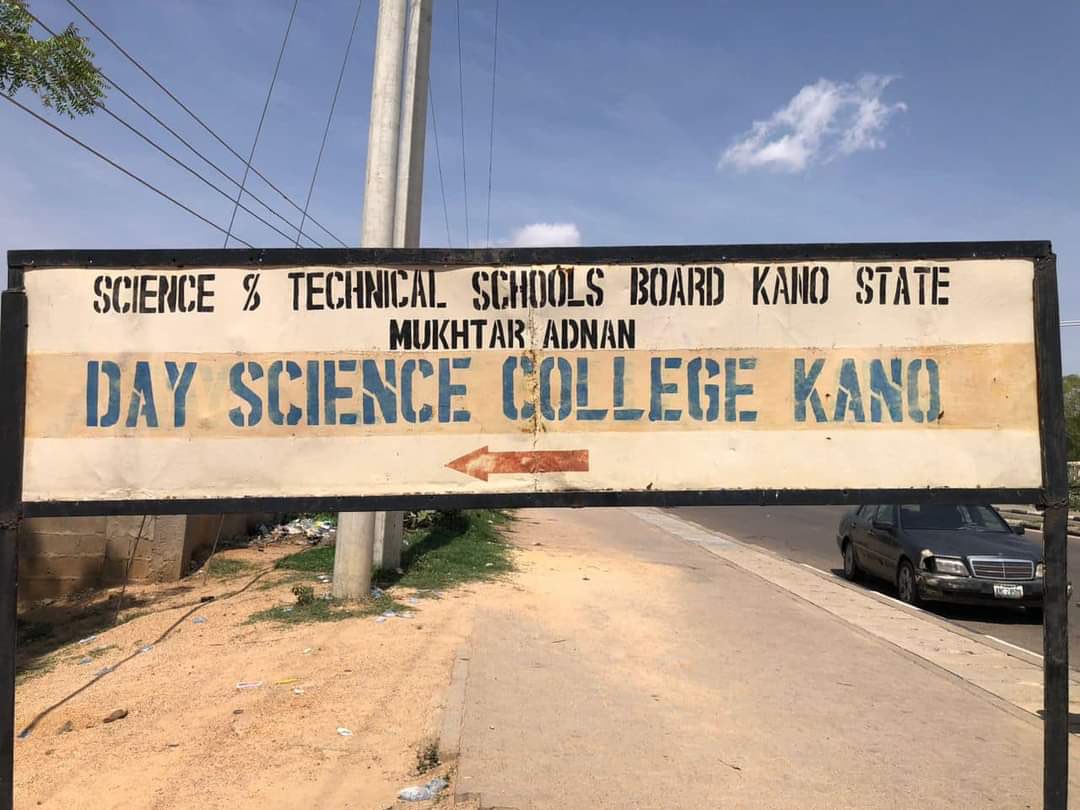
Day Science College: Sustainability in Interventions 

By Mahmud Aminu Dambazau

The renewed interest in the state of infrastructure at Day Science College, Kano, by its alumni is highly commendable. When I was admitted thirteen years back, the school was one of the best in Kano State. No student sat on the ground; teaching materials were adequate; the library was full of books; the Physics, Chemistry, Biology and  Agric laboratories were well-equipped and functional. There was a Technical drawing studio, a weather station and even a computer lab provided by MTN. 

A large generator and school bus provided by the Malam Ibrahim Shekarau administration were well-maintained and functional. The toilets were clean and accessible. We even had a mini farm utilised by the agricultural students; water was never scarce. The school mosque had enough mats. That was then!

The academics, discipline and respect were topnotch. We wouldn’t have been one of the best if we had not been so lucky to have some of the best teachers across all disciplines. The current intervention proposed by the school’s old students might solve or at least reduce the present infrastructural gap. Below are  suggestions I think would help in sustaining or maintaining such and future interventions. 

A report by the 2012 chapter of The Old Students in 2021 revealed that there wasn’t even one classroom fully equipped with infrastructure and several classes without a single seat! The situation is worse at the moment. This is despite the interventions by corporate bodies, NGOs, CBOs, alumni, individuals and probably even the government. Maintaining infrastructure and equipment is impossible without funding. This decay might have been contributed by the pronouncement of free education by the government without providing alternative funding for these maintenances and other costs. 

I, therefore, propose a meeting with parents, teachers and representatives of chapters of the old students. Parents should be made to understand the importance of quality education and the present state of the schools in the absence of a stable funding option. The parents should, therefore, pay the sum of just five hundred naira (500) per student each term, which will, of course, not be school fees but meant for the provision and maintenance of physical and learning infrastructure. The individual chapters from the alumni should similarly pledge and contribute an annual fee of ten thousand naira (10,000) to be utilised for the same purpose.  

A friend of mine, Engr. Mustapha Tukur founded an initiative initially meant to consist of one hundred individuals in the Gadon kaya area of Kano who contribute the sum of one thousand naira monthly. I still can’t believe the number of interventions we have made through the voluntary contributions, which now involve other friends of his, even outside Gadon Kaya. With thousands of us as old students of Day Science College, if we could get just one thousand volunteers who could contribute one thousand naira per term (3-4 months),  we would be getting a million naira each term, which will go a long way in solving these issues raised in both short and long term.  

These funds can be managed by a committee with representatives from the parents, teachers,  school management, the school’s alumni and a representative of the KASSOSA national body.  The committee could be named Day Science Development Fund with clear guidelines, objectives, terms, timelines and deliverables.  

The above recommendations should not stop future government,  individual, chapter, or corporation interventions.  

While interventions have almost always been focused on physical infrastructure, there is a need to pay similar attention to the quality of education rendered. I was present at a debate organised by the pioneer administration of the KASSOSA BUK chapter among science school students. Day Science emerged second to the last, even though it was among sister science schools. The school, KASSOSA, or any respective chapter did not care to collect, analyse and report students’ performances at SSCE or similar examinations. While it is possible to excel academically without infrastructure,  it is impossible without quality education, even with the best infrastructure.  

On this note, I suggest an assessment be conducted to determine the number of teachers currently available for each course. Where the teachers are inadequate, Kassosites, with emphasis on those from Day science, should be engaged on contract to supplement the shortage. 

We have numerous alumni who have graduated yet are unemployed. If monies could be realised, an allowance which can cover their transportation and possibly feeding should be given to them. With that, we would have helped the school, its students, and the members of the old students who would ordinarily have been idle. With these interventions, I believe the past glories of Day Science College, now Mukhtar Adnan Day Science College, will be renewed.  

Mahmud Aminu Dambazau is a graduate of KASSOSA DSCK Class 2013. He sent this article via madambazau@gmail.com.

“Mine is bigger than yours”, professorial count, that is!

By Prof. Abdalla Uba Adamu

The recent Facebook ribbing about the number of professors from states and localities in various northern cities with universities reminds me of the male adolescent macho posturing of “mine is bigger/thicker than yours” game played behind classrooms! I am even mentioned as a trophy — “yes but WE are the ones with a double professor!” referring to my being from Bayero University, Kano (BUK), in Kano State (Daneji in Kano Municipal).

The whole thing was ignited by an infographic with its origin in ₦airaland Forum where one Zafsy75 posted the graphic. Right away a fierce debate ensured on the forum with many commentors disputing the figure. Zafsy75 themselves did not provide additional scientific methodology on how they arrived at the figures. Nevertheless, they infographic became viral — and started the prideful ‘mine is bigger than yours’ ribbing.

The infographic was from Statisense which uses Generative Artificial Intelligence to generate its data! A search on its site revealed another graphic of “most professors” in Nigerian universities, in September 2023, with the University of Jos leading with 530 professors. BUK had 434 professors which included 10 women. I can personally count more than 20 women professors in BUK in 2021, not 2023! No methodology was provided as to how the figures for the universities were arrived at.

People should be aware that AI generated data is based on what the engine can find — it does not create the data. Thus, it is actually not possible to accurately determine the number of professors per state or local government even based on the much-quoted NUC Directory of Full Professors, 2021 (link to the publication attached below).

This is because the directory lists professors by DISCIPLINE in order to promote research collaboration and networking amongst Nigerian academics. Also, the Directory was not based on official submissions by various universities, but voluntarily by INDIVIDUALS which was synthesized and summarized by NUC. Additional source for the AI was personal websites where a professor proclaims to come from a particular university.

Thus, not EVERY professor agreed to submit their details to be captured. With this, it therefore becomes very difficult to accurately determine the number of professors from each state, as that was not the focus of the Director (or NUC’s intentions).

You can only get the official number of professors from individual universities. As of October 2023, BUK had 381 professors with the largest category being in Medical Sciences. All the professors were, however, not listed by their States or Local Governments, but their DEPARTMENTS or specializations.

So, I can’t see how the game of ‘mine is bigger than yours’ started. I believe; however, it was started by the infographic floating around showing the number of professors per UNIVERSITIES in the various states. The graphic was not providing the number of professors per state of origin, but per the universities IN the state. It made it clear by stating it is “by state where the school is located.”

Thus, if you are from Anambra and are a professor in BUK, this infographic will capture you as being from a university in Kano, but you will not be captured in any university in Anambra. In this way, it does not tell you the number of professors from indigenous to Anambra.

Right away, it is faulty (or fake). As of October 2023, BUK had 381 professors. Last week another 11 were announced bring the total to 392 as of February 2024. So how can Kano have 428 professors in 2022? Granted there are many universities in Kano, but the main prominent ones — Aliko Dangote University of Science and Technology, Yusuf Maitama Sule University — are basically tributaries of BUK. Indeed, most of the others rely on BUK professors as ‘visiting’ to their faculties.

Kaduna State where Ahmadu Bello University is located has at least eight universities — and you want me to believe the entire universities in the State have 62 professors? I am sure Kaduna State University (KASU) alone had either more than or close to that.

While the ribbing was fun while it lasted, at least it wakes us up to the idea of fake data and weaknesses of Generative Artificial intelligence.

As promised, below is the link to the authentic number of professors voluntarily submitted to NUC as of 2021. BTW, yours truly is listed TWICE on page 836. They still pay me single salary, though!

Directory of Full Professors in the Nigerian University System, 2021: https://shorturl.at/yKV34

The Three Musketeers and the Last of the Mohicans

By Prof. Abdalla Uba Adamu

It is not every day that a series of coincidental events converge. Like the passage of Haley’s Comet, these events happen only once in one’s lifetime. I am eternally grateful to Allah (SWT) for enabling me to witness one of these coincidental events. 

While still in active service in the university, where I have been for the last 43 years, I feel fulfilled that three of my students who became my colleagues and friends in the Department of Education have now become Vice-Chancellors in the same period within three years of each other. These are Prof. Sagir Adamu Abbas (VC Bayero University Kano, 2020), Prof. Abdulrashid Garba (VC, Khalifa Isyaku Rabi’u University Kano, 2023) and the most recent, Prof. Muhammad Ibrahim Yakasai (VC Sule Lamido University, Kafin Hausa, Jigawa State, 2023). 

During their career development, I nicknamed them “The Three Musketeers” because of their closeness to each other, coupled with the almost military approach they adopted to their career. They started their doctoral studies at the same time, finished at the same time, rose and became professors at the same time! Each was highly focused with a target in mind. Each has proven his mettle scholastically – with each spending extended periods as a Visiting Professor in foreign universities. The research area of each of them was truly a contribution to knowledge in the discipline. 

The term I chose to describe them is based on characters in a novel by Alexandre Dumas in 1844 called “The Three Musketeers”, which describes the adventures of three-foot soldiers who were close pals. I consider myself part of them because they are individually my friends. And these three Vice-Chancellors are really close, not just as professional colleagues but their families are also close. 

Of course, besides myself, they had other tutors in the Faculty of Education (Bayero University Kano). Still, I am the only one remaining out of all those who tutored them since all the others have retired. I am, therefore, the Last of the Mohicans (another literary reference, this time to James F. Cooper, 1826) and had the unique opportunity of seeing his career convergence in December 2023 when Prof. Muhammad Ibrahim Yakasai was appointed the Vice-Chancellor of the Sule Lamido University, Kafin Hausa, Jigawa State. 

It is a rare opportunity to see a celebration of such success, humility and friendship in each of them. Allah Ya taya su riƙo, amin.

The other degree I have earned

By Sulaiman Maijama’a

Seeing some photographs yesterday that we took in 2019 when we were leaving Sa’adu Zungur Hall of the Bayero University, Kano, as we finished level 200, I remembered several events, particularly during my stay in the hostel. I was filled with mixed feelings of nostalgia, reminiscing about my BUK days, the good and bad experiences, and the culture shock I had to contend with as a fresh university student.

In 2018, when we secured admission, my friend Shamsuddeen insisted that we stay off campus. I did not like the idea, so I reported him to our teacher and mentor, Mallam Abdul Ahmad Burra, to be a judge, knowing that Mallam would be on my side. Mallam Abdul directed that we live in the hostel, saying, “The experience you have when you live in the hostel is another degree in itself. Never miss that.”

The experience began soon after we settled on the 18th of March, 2019, in our number D-56 room on the first floor of Sa’adu Zungur Hall. Six of us were the occupants. Kamal Abdulsalam, Shamsudden A Musa and I were in Mass Comm, Bashir Dalhat read Geography Education, Sirajo Basiru read Economics Education, and Abdul studied Political Science. All of us in the room were voracious readers, what people call “mayun Boko”.

Our room was almost always locked because we left for class or library day and night, and so, we were addressed and addressed each other as Prof. The trouble was, when someone said prof alone, we got confused as to whom he was referring to because we were all bearing the title. One day at the Vice Chancellor’s mosque, I loudly said “Prof. Kamal”, referring to my roommate Kamal Abdulsalam, when I caught the attention of Professor Aliyu Kamal of the English Department. To his surprise, he saw me approaching a student whom I  addressed as Prof.

Unlike other rooms, our bond had blossomed into becoming a family, sharing food and water and even requesting little money when needed. We soon realised that one of us was living a miserable life. In the morning, he would take Gari, water in the gallon, wear squeezed clothes and go to lectures. We all were concerned about his condition and began to talk about how we could help him. God had saved us when News later got to us that he was a millionaire in their village. We were all shocked and began to keep him under surveillance.

I once escorted him to the Eco Bank ATM to withdraw cash. He wanted  2k but mistakenly added a zero to the digits. When the ATM dispensed 20k, we looked each other in the eyes; I was surprised that he had such money in the account, and he was concerned that I saw his money. We had to enter the bank hall and redeposit the cash instantly, and he begged me not to tell anyone I saw that money.

We began to see real shege when we moved to our number D-40 room on the first floor of Idris Garba Hall on  20th January 2020. On the very first day, one of the room members said we were contributing money to buy padlocks, something that in our previous hostel, one of us would just buy and share the keys without asking a penny. D-room is usually allocated to 4 students, but each one could come with one squatter as is the tradition. In this instance, one person came with three settlers and himself (enough number to be allocated a complete room) and insisted they stay in the room. We called an urgent meeting in a small corner and chased away two.

There was one roommate who set an alarm ringing around 3:00 a.m. daily. The whole room would be disturbed and wake up, but the person who placed the alarm never woke up before 7 a.m. It was in level 300 when my young-looking face misled this person into thinking I was a small boy. In the morning, he would toss a Lipton at me and say, “Sulaiman, put tea for me”. He would ask, “Sulaiman, what is the time?, “Bring me sugar, “Bring me a mat, “Do this, do that”.

At the onset, I thought it was normal assistance between roommates, but later, when I realised that he had made me his Personal Assistant, I called it quits. This person would buy all the delicious things in this world; think about eggs, fish, meat, milk, etc., but would request the basic ones like sugar and Maggi from one of us.

In the same room, someone spent the whole night pressing his phone but would fall asleep just before dawn prayers, wake up around 10 a.m. and pray. He never attended 8 am lectures.  We also had two overnight debaters. These people returned to the room in the middle of the night and began to debate loudly until all the room members woke up. When they were scolded, they would humbly say they were sorry. We couldn’t fight further!

In our final session, when we stayed in number D-16 room on the ground floor of the same Idris Garba hall, beginning on November 1st, 2021, we were more mature and tolerant. But there was one character who would wake up in the middle of the night and turn on the light while everyone in the room was asleep. When we complained that he infringed on our rights, he said he turned on the light because he was pressing his phone and did not want the screen’s reflection, so turning on the light reduces the reflection. When he was out, we removed the bulb. Until we graduated, we did not have a bulb in our room.

Maijama’a wrote via sulaimanmaija@gmail.com.

Kano State governor allocates N700m for tuition fees of Kano natives at BUK

By Muhammadu Sabiu  

In a bid to alleviate the financial burden on students and families in the face of ongoing economic challenges, Governor Abba Kabir Yusuf of Kano State announced a significant financial commitment on his verified Facebook page yesterday. 

The governor’s post highlighted the decision made by the Kano State Executive Council, under his leadership, to allocate approximately 700 million naira for the payment of school fees for about 7,000 students hailing from Kano State and enrolled at Bayero University Kano (BUK). 

The move is expected to provide crucial financial relief to families struggling to meet educational expenses during these trying times. 

Details regarding the distribution and disbursement of the funds will be communicated to the students and the public in the near future. 

This initiative is part of the state government’s continued efforts to support education and ensure that the youth have access to quality learning opportunities despite the current economic constraints. 

Education has been a cornerstone of Governor Abba Kabir Yusuf’s administration, and this latest move underscores his commitment to prioritising the welfare of students and their families. 

As the payment process unfolds, many are anticipating the positive impact this allocation will have on the lives of the students and their educational journeys. 

Recall that tuition fees at Bayero University have recently increased to an unprecedented high, which forced many students to drop out due to their inability to meet the payment.

After sponsoring 200 BUK students, Senator Hanga offers overseas scholarships

By Uzair Adam Imam

Rufai Sani Hanga, the Kano Central senator, pledged to provide scholarships for students to study abroad.

The senator said the scholarship for the 200 students of Bayero University, Kano (BUK), which he paid recently, was just one of the many opportunities awaiting not only students but all women and youth in his constituency.

He added that he would try hard to ensure more investment in education and empowerment for women and youth for the betterment of society.

Hanga disclosed this Wednesday at an event that converged the 200 sponsored students of BUK in his office in Tokarawa, Hadejia Road, Kano, to receive their awarding letters.

It can be recalled that Senator Hanga had paid the registration fees of 200 BUK students as a response to the painful outcry by the students as a result of a hike in the registration fee.

I responded to the painful outcry of students – Hanga

Senator Hanga said his sponsorship of the 200 BUK students was a response to the uproar generated by the increment in registration fees by the university management.

He said he came to the rescue of the students due to a call by Malam Aisar Fagge, Malam Salihu Sule Khalid, Malam Abubakar Tijjani Ibrahim and Alhaji Musa Nuhu Yankaba.

“This (scholarship) is in response to the outcry generated by the registration fee increment in Bayero University, Kano, which threatens the progress of many students in the university.

He added, “Malam Aisar, Abubakar, Salihu and Alhaji Musa were the ones who called me and advised that I should come to the aid of these students. I really commend them and the other members of my scholarship committee.

“While I consider this a quick intervention, I want to stress that more programs that target the upliftment and empowerment of our people are on the pipeline, in sha Allah,” he added.

Hanga commended the scholarship committee, adding, “I wish to advise the beneficiaries to make good use of the opportunity.”

We tasked ourselves for this rescue mission considering the unfavourable economic situation in Nigeria

Malam Aisar who is also a lecturer at the Department of Mass Communication, Kano State Polytechnic said they were into this rescue mission because of the unfavourable economic situation in the country and understood many students could not afford to pay for their school fees.

He said, “I have been in the teaching profession and know very well how students struggle to pay 20 or 30 thousand naira as their registration fee.

“Some students mostly go to radio stations to beg people. So, given that now there was an increment in registration fees, I feared many would have no other option than to drop their studies.”

It gladdened me when my mother thanked me for selfless service to humanity – Aisar

The communication scholar also added that it excited him and nearly reduced him to tears when his mother called to thank him for his selfless service to humanity.

“Although I was very excited looking at the happy faces of these promising students, there was nothing more exciting than the moment when my mother called to thank me.

“My mother, Hajiya, was in a tricycle when she heard the other two passengers talking about the matter, thanking Senator Hanga for rescuing their children.”

Students narrate tribulations, thank Hanga

“I reckoned without a hike in the registration fee. When I heard about it, my mind was awfully heavy as I knew I couldn’t afford it,” recalled a 400-level student of Bayero University, Kano (BUK), with a beaming smile on his face.

The student said a new hope had been rekindled in him by the scholarship he got from Senator Rufai Sani Hanga.

Another student, Abdurrahman Kabir Yunus, said the news of the hike in registration fees paralysed him.

He said, “But Senator Hanga wiped up my tears. And what he did was a lesson to me as I really feel indebted.”

Sham’una Rabi’u from Warawa Local Government said it was underestimating to describe how happy he was.

Rabi’u said, “I am very happy to be one of the beneficiaries of this scholarship. I couldn’t thank Senator Hanga enough.”

David Jowitt, eminent English teacher, dies at 80

By Abdurrahman Muhammad

David Roger Jowitt, the renowned British professor of Nigerian English, who had lived in Nigeria for six decades and became a citizen in 2023, died yesterday after a brief illness.

Professor Jowitt was an academic and an author. His books, Nigerian English and Common Errors in English, are some of the best on the subject. He had reportedly been working on his memoir before his death.

He also taught at Bayero University, Kano, University of Jos, among many other institutions across the country.

BUK, CSACEFA train civil society on budget trackikg, analysis

By Uzair Adam Imam 

Bayero University, Kano (BUK), in collaboration with the Civil Society Action Coalition for All (CSACEFA), organised a one-day capacity-building training on education budget tracking and analysis.

The event, titled “Education Budget Tracking and Analysis Tools”, took place at the Centre for Gender Studies, Bayero University, on Sunday.

One of the organisers, the President of the Kano State Accountability Forum on Education, Professor Muhammad Bello Shitu, said the purpose of the event was to enlight people on issues related to the education budget.

Professor Shitu stated that their intention was to help “the practitioners and civil society actors to have knowledge and skills of budget analysis as well as budget tracking.”

Also speaking after the event, Dr Auwal Halilu lamented the rising number of out-of-school children in Kano State in recent times.

He stated that “However, with the coming of the new government, which claims to top education on their priority list, we are hopeful that things will change,” he added.

Dr Halilu added that the issue of the rising number of out-of-school children in Kano state, which reached over 1.4 million, is alarming and should be addressed instantly.

The event had converged many educationalists, social and political analysts, as well as civil society activists who came from all walks of Kano to grace the event.

The Daily Reality offers scholarship for BUK students

The Daily Reality (TDR) online newspaper management is pleased to announce the opening of its Endowment Fund Program and invites eligible and interested applicants to apply.

In light of the recent rise in registration fees at Bayero University, Kano (BUK), TDR plans to offer a grant to students who have had their articles published on the platform as a way of support.

Thus, if you are a BUK student and have your article published by TDR, please, contact us via contact@dailyrealityng.com or thedailyrealitynews@gmail.com. Please, submit proof of your student status at BUK, such as a copy of your ID or admission letter, along with the title of your article. The application closes on July 16, 2023, at 11:59 pm.

Please, join us in supporting young people’s education. Every contribution counts.

Sincerely yours,

TDR Editorial Team

Bayero University and the rising cost of registration fees

By Abbas Datti

Recently, the registration fees of most federal universities in Nigeria have risen dramatically, constituting a huge financial problem for students and their families.

The current fee increase places unfair constraints on low-income people, perpetuating inequality and promoting social inadequacies. More so, the exclusion is based on financial circumstances. As the registration fees continue to increase, the desirable dream of acquiring a university education slips further out of reach for many deserving individuals.

Therefore, as a bona fide resident of Kano and a great beneficiary of low and subsidised registration fees, I will use Bayero University as my case study. I am writing to appeal to Professor Sagir Adamu Abbas, the Vice Chancellor of Bayero University, Kano, regarding the current situation.

We know Sagir as someone with an exceptionally high calibre personality, humility and modest approach. This sets him far above others. Thus, we believe he will no doubt consider the attending consequences of this enormous increase.

We have been told that education is a fundamental right of every individual, and one must admit that it is the responsibility of educational institutions to provide a nurturing and good inclusive environment that fosters academic growth and development for all students. While one may comprehend the various needs associated with running a university and the alleged withdrawal of the government from funding universities, I would like to refer the Vice Chancellor back to the difficulties many students experienced in paying their respective registration fees since before the recent increase.

The ever-increasing cost of registration fees has become a significant deterrent for prospective students, leading to a potential decline in enrolment rates. The burden of high registration fees and other expenses, such as accommodation, and high living costs, is enormous on students and their various families. Potentially, it not only limits access to education but also jeopardises the overall tertiary education enrolments.

I passionately beseech the Vice Chancellor of Bayero University to consider the urgent need for a reduction in registration fees and initiate constructive consultations with the appropriate university stakeholders to find feasible solutions. This could involve exploring more alternative revenue generation, seeking additional funding from wealthy personalities and other intervention funds, or reallocating resources to ensure a well-rounded, balanced approach that benefits both the university and the students.

Abbas Datti wrote from Kano via abbasdatti448@gmail.com.