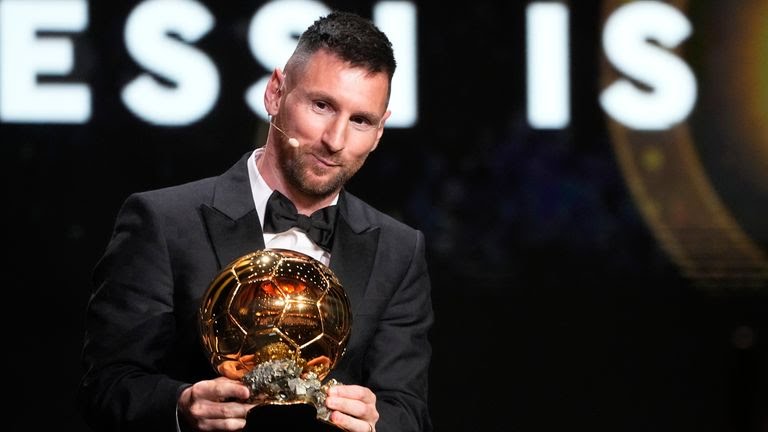
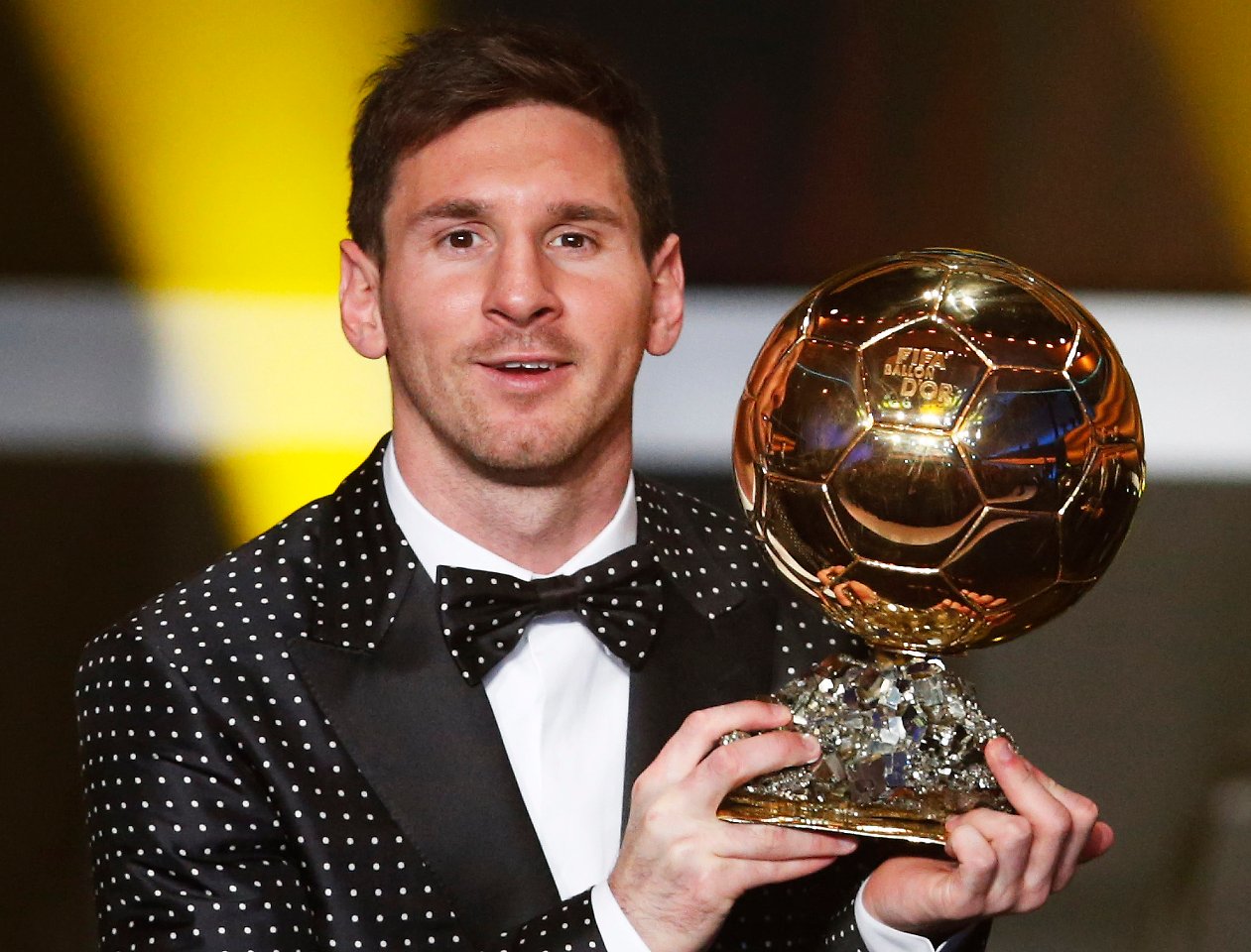
Ballon d’Or and the credibility question
By Amir Abdulazeez
I am writing on this not because I have any significant concern for the award or its credibility, or because it has any correlation with the well-being of anybody in need (which I am often more concerned about). I am doing so instead due to the massive perennial debate it generates, especially among youths in Nigeria, as well as the misinformed opinions surrounding it.
Again, the Ballon d’Or, like football itself, has transcended sport to become part of international politics and history. I became shocked when I saw a globally renowned Muslim scholar congratulating Ousmane Dembele for winning the 2025 version and hailing its award to a ‘practising Muslim’. Obviously, the crown now carries political significance that stretches well beyond the pitch.
Since its inception in 1956, the Ballon d’Or has been regarded as football’s most prestigious individual award. Founded by France Football (conceived by sports writers Gabriel Hanot and Jacques Ferran), the award was initially designed to honour the best European player annually, with Stanley Matthews of Blackpool becoming the pioneer winner. Later, it evolved into a global prize, celebrating many other icons. Many have rightly questioned the credibility of the award, but mostly on myopic grounds centred around player and club sentiments. However, as a long-time football observer, I believe there are much broader issues regarding the credibility of the award that are worth discussing.
Let us start with the politics. During the Cold War (1947-1991), Eastern European players (more aligned to the Soviet Union) often struggled to receive equal recognition despite dazzling performances, while Western European stars (more aligned to the United States and friends) enjoyed more favourable media attention. Although Russian goalkeeper Lev Yashin won the award in 1963, many argue that his case was only the exception that proved the unwritten rule of ‘politics, geography, and media exposure consistently play decisive roles’. Today, the award continues to reflect broader inequalities in the sport of football. European clubs dominate global coverage, which inflates the recognition of their stars. Players performing in less visible leagues, whether in South America, Africa, or Asia, rarely receive consideration, even if their contributions are extraordinary.
Another concern is the award’s inconsistent eligibility rules over time. Until 1995, only European players competing in European clubs were considered, excluding legendary figures such as Pelé and Diego Maradona from even receiving a nomination. It was only after a rule change that non-Europeans in European leagues became eligible, allowing George Weah to win in 1995. Yet, by then, the award had already excluded decades of worthy non-European and non-European-based winners. Mild allegations of racism also cast a dark shadow over the award. Many believe players like Didier Drogba, Samuel Eto’o, Yaya Touré, Sadio Mané and Mohammed Salah were routinely ranked below their pedigree. In 2021, French pundit Emmanuel Petit openly questioned whether African players were judged by double standards.
The selection of voters itself raises concerns. Initially restricted to journalists, it later expanded between 2010 and 2015 after a merger with FIFA’s “World Player of the Year,” adding coaches and captains to the electorate whose votes often reflected tribal, national or club loyalties rather than merit. The 2016 reversion to journalist-only voting may be a tacit admission of voting flaws, thereby creating difficulties in making comparisons across eras. For example, Lionel Messi’s consecutive wins (2009-2013) under a global, mixed electorate cannot be objectively compared to Michel Platini’s (1983-1985) under a European-only jury. The current co-organisation with UEFA, which began in 2024, signifies another attempt to lend the award more institutional weight. However, the constant changes in its format and governing alliances suggest an award in search of a stable identity, struggling to balance its commercial ambitions with its original purpose.
Bias towards attacking players has been an emerging hallmark of Ballon d’Or selections. Legendary defenders like Paolo Maldini, Alessandro Nesta, Sergio Ramos and Roberto Carlos, who defined an era of defensive excellence, always fell short. The exception of Fabio Cannavaro in 2006, along with a few others in the past, after a World Cup-winning campaign with Italy, serves as a testament to the rarity of a defender being recognised.
More recently, Virgil van Dijk’s 2019 narrow runner-up finish sparked debate about whether non-attacking players could ever realistically win in a sport increasingly obsessed with goals and flair. The award relies heavily on football journalists who often prioritise goal highlight reels, statistics and global recognition over tactical nuance and defensive brilliance. Strikers and playmakers dominate the headlines that directly feed into voting behaviour.
To combat positional bias, a more revolutionary approach could be implemented: nomination by quota. Why not have separate shortlists and voting panels for goalkeepers, defenders, midfielders and forwards? The top three or five of these categories could then be considered for the overall voting and eventual award. This would ensure that the unique skills of each position are evaluated by those who best understand them, guaranteeing that players are judged on their specialisations rather than against others with contrasting roles.
The criteria for judgment also lack clarity and consistency. Officially, the award considers individual performance, team achievements, talent, fair play and career consistency. In practice, however, voters often seem swayed by a single outstanding tournament or by sentimental narratives. Luka Modrić’s 2018 victory after Croatia’s World Cup run exemplified this. While Modrić was superb, critics argued that other players had stronger year-round performances, but the emotional weight of Croatia’s fairy tale run tilted the scales. But how come this same emotion did not sway voters to select any player from Leicester City’s 2016 Premier League incredible winning team? A pervasive, though often unstated, criterion for many voters is team success.
To win the Champions League or a major international tournament has become almost a prerequisite for contention. This creates an inherent unfairness, elevating players in dominant teams while punishing extraordinary individuals in less successful sides. This inconsistency reveals a fundamental confusion: is the award for the “best player,” “most popular player,” or the “most successful player”?
The timing and calendar controversies are another issue. International tournaments occur every two years, creating periods where national team success heavily influences voting. World Cup years traditionally favour tournament winners, regardless of club form. The recent calendar change, from July to August, aimed to address this imbalance but created new problems, with voters now contending with assessing performances from overlapping seasons and tournaments. This temporal confusion affects not just voting patterns but also the public’s understanding of what the award represents: is it recognition for calendar year performance, season achievement, or tournament success? The 2013 Ballon d’Or win by Cristiano Ronaldo was criticised following timing inconsistencies due to odd deadline extensions. The current system, which allows a player to win a major tournament in the summer and have their performance rewarded a year later, creates a disjointed narrative.
The question of authority is another big one. FIFA represents 211 national associations, UEFA oversees European football’s institutional framework, yet it is a private French publication that bestows football’s most prestigious individual honour. The comparison with FIFA’s The Best awards and UEFA’s Player of the Year exposes this imbalance. This raises the paradox: why should a magazine possess such outsized influence in determining football’s most prestigious individual accolade, overshadowing awards backed by governing institutions? While there is nothing fundamentally wrong with this, it only emphasises the need for France Football to show more responsibility by sanitising and standardising its award.
I am not in a position to coach France Football on how to reform its awards to minimise the credibility dilemma; they have much better experts who can do that. My concern is to see young football followers and analysts become more informed and equipped for deeper debates that are beyond sentiments. My other concern, which has little to do with the Ballon d’Or, is to see football giving a little back to its estimated 3.5 billion fans that have made it powerful. While fans give it a lot, the sport appears to be offering almost nothing significant in return.
It is sad to see football remaining silent, biased and indifferent in the face of global oppression and injustice. While it took FIFA and UEFA just four days to suspend Russia after it invaded Ukraine in 2022, both bodies have remained criminally silent for over two years since Israel launched its genocide on the football supporting people of Palestine.
Amir Abdulazeez, PhD, can be reached via abdulazeezamir@hotmail.com.