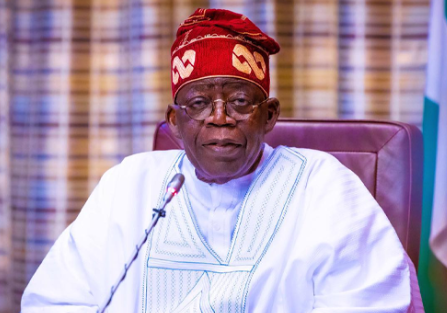
Asiwaju Bola Ahmed Tinubu

NBC bans Eedris Abdulkareem’s controversial song “Seyi Tell Your Papa” 

By Abdullahi Mukhtar Algasgaini

The National Broadcasting Commission (NBC) has banned Eedris Abdulkareem’s new song, “Seyi Tell Your Papa,” from all private and independent TV and radio stations in Nigeria, both on-air and online.  

The track, which criticises President Bola Tinubu’s administration, highlights Nigeria’s economic struggles with lyrics like: “Seyi, tell your papa, country hard. Tell your papa, people dey die. Tell your papa this one don pass jaga-jaga.” The song references Abdulkareem’s 2004 protest anthem, “Jaga Jaga,” further amplifying its political tone.  

In the banned track, the veteran rapper accuses Tinubu of failing to deliver on campaign promises, worsening socio-economic conditions. The NBC’s directive enforces a nationwide blackout of the song, citing possible violations of broadcasting codes.

Arewa, lamentations and 2027

By Kabiru Danladi Lawanti, PhD 

There is something about us, Arewa people. Whenever power shifts to the South, we start lamentations, accusing the leader, who is from the South, of nepotism or initiating policies that are deliberately aimed at destroying our region. 

We embrace this idea and write about it repeatedly. From 1999 to 2007, from 2010 to 2015, and now from 2023 to the present, we consistently reference our voting power in our writings. 

Recently, I read an article comparing our voting power and support for President Bola Ahmed Tinubu with other regions of the country. How long can we continue these lamentations? When will we stop lamenting and start acting?

We need to shift the conversation from an overemphasis on population-driven electoral power to a more strategic focus on economic productivity and revenue generation. The viability and strength of Arewa are not solely determined by the sheer size of our population, but by how effectively that population is harnessed for economic growth, innovation, and wealth creation.

Arewa’s fixation on securing political dominance through demographic advantage has frequently overshadowed the more critical question we need to be asking ourselves. 

How do we convert our vast human and natural resources into sustainable development outcomes?

While concerns about the inequities of political appointments and perceived nepotism under the current Tinubu administration are valid, ongoing lamentation over political spoils can be counterproductive if not paired with proactive strategies for economic transformation.

What has happened to Arewa after all these years of political power? What becomes of the “K” states after each election season? What has happened to Jigawa or Bauchi? Is it enough to have just a Badaru or Tuggar as compensation for the over 5 million we gave the President?

What is required is a change in strategy: a deliberate and coordinated effort to leverage our expansive landmass and youthful population to drive industrialization, technological innovation, and inclusive economic growth. Our governors need to be wiser. Have you ever checked the total amount of FAAC allocations coming to our states and local governments? What are we doing with this money?

In this regard, lessons abound from the developmental trajectories of nations such as China and India, both of which have shown how demographic advantages can be transformed into competitive edges through disciplined policies, strategic investments in education and infrastructure, and a clear vision for economic self-reliance.

The path to power lies not just in numbers – voting power – but in what those numbers yield after elections.

I have learnt my lessons. What we need is not political power at the centre but what we do with that power and what our Governors are doing with the huge resources coming to them from Abuja. 

The agitation for removing Tinubu in 2027 can be compared to the agitations of removing the military in 1999 or Jonathan in 2015. They are driven by elite interests, not necessarily by situations we find ourselves in, Arewa.

From Baba “Go Slow” to Baba “Going Very Fast” 

By Bilyamin Abdulmumin, PhD

Buhari was largely viewed as reluctant, whereas Tinubu engaged in tit-for-tat responses. Tinubu has demonstrated decisiveness on many occasions. For instance, when there was a public outcry over his Kano ministerial nominee, Maryam Shettima, he swiftly replaced her with Dr. Mariya Mahmoud, who enjoyed greater public approval. Buhari likely would have retained Shettima.

A few months after the ministers assumed office, the Minister of Humanitarian Affairs, a ministry infamous for waywardness—was caught in multiple scandals. In a swift response to public outrage, Tinubu suspended Betta Edu, and from all likelihood, she has gone for good.

No situation highlights the difference between Tinubu and Buhari more than the ongoing political crisis in Rivers State involving Governor Fubara and his former benefactor, Nyesom Wike. While Buhari would have turned a deaf ear to the situation, Tinubu reacted decisively. Those who once criticised Buhari for his passive leadership should now give a standing ovation to Tinubu’s stern control and decisiveness.

Nevertheless, Tinubu’s speech during the emergency declaration was notably one-sided. He sided with his FCT Minister, Nyesom Wike, heaping blame on Fubara for demolishing national assembly structures and failing to address pipeline bombings—while completely ignoring Wike’s role in the crisis. These reinforced accusations of federal government highhandedness in Nigeria’s most populous states.

Some argue that the federal government is involved in the debacles affecting Rivers, Lagos, and Kano due to its fear of losing these key states to the opposition. However, as the APC states, the allegations of internal conflicts in the Lagos government do not hold up. Since the state is governed by the ruling party, it seems to be just another political facade from the federal government.

A major issue for Tinubu’s camp is their position on Fubara and Uba Sani. If they oppose Fubara, they should also oppose Uba Sani. You cannot support Wike in Rivers while opposing El-Rufai in Kaduna. The two scenarios bear a striking resemblance.

Reflecting on how Nigerians criticized Buhari for lacking swiftness and displaying full control as the Commander-in-Chief of the Armed Forces of Nigeria, it is fair to say that Tinubu has now met that expectation.

Bilyamin Abdulmumin, PhD wrote via bilal4riid13@gmail.com.

Rivers State: The dangers of political betrayal and unconstitutional interventions

By Zayyad I. Muhammad

I strongly disapprove of Governor Siminalayi Fubara’s betrayal of his political godfather. Fubara entered the political arena without established structures, financial resources, or widespread recognition; he was relatively unknown. 

Former Governor Nyesom Wike provided him with the platform, support, and influence that ultimately led to his rise as governor. Yet, despite this, Fubara has turned against the very person who paved the way for his political ascent. 

Both sides should share the blame for not shifting grounds. The declaration of a state of emergency in Rivers State came at a critical time to address rising insecurity and unrest that threatened to spiral out of control. Left unchecked, the situation could have led to a resurgence of militancy and severely disrupted oil exploration activities, which are vital to both the state and national economy. 

Beyond the economic implications, the deteriorating security situation also risks derailing governance and has somehow ‘assisted’ Governor Fubara in escaping impeachment. President Tinubu may justify his decision—he has access to security intelligence and reports that the general public does not.

However, although addressing security concerns is essential, suspending an elected governor and members of the state assembly is not only unconstitutional but also sets a dangerous precedent for Nigeria’s democracy. This issue goes beyond the 2027 elections; it strikes at the heart of democratic governance and the principle of electoral legitimacy. 

Our democracy has matured to a point where a sitting governor can be removed only through due process, as outlined in Section 188 of the 1999 Constitution of the Federal Republic of Nigeria (as amended). If we are not careful, one day—God forbid—a president or his allies could create chaos in a state simply to justify declaring a state of emergency and unseating an elected governor for political gain. Such actions would undermine democracy and erode public trust in the electoral process. They pose a danger to our future. 

The Rivers state or any political conflicts should be resolved within the framework of the law, not through forceful interventions that threaten democratic stability.

The key actors in Rivers State must set aside their personal and political grievances to prioritize reconciliation. Prolonged instability is unacceptable, as it harms the people, governance, and economic progress. A peaceful resolution is the only path forward.

An elected Governor’s mandate is sacrosanct and must be respected. He is the top citizen in the subnational.

 Zayyad I. Muhammad writes from Abuja via zaymohd@yahoo.com.

Tinubu extends Nandap’s tenure as Immigration Comptroller-General

By Hadiza Abdulkadir

President Bola Ahmed Tinubu has approved the extension of Mrs. Kemi Nanna Nandap’s tenure as Comptroller-General of the Nigeria Immigration Service (NIS) until December 31, 2026.

Nandap, who began her career in the NIS on October 9, 1989, was appointed as Comptroller-General on March 1, 2024, with an initial tenure set to expire on August 31, 2025. Under her leadership, the NIS has seen significant progress in border management, immigration modernization, and national security.

In a statement on Monday, presidential spokesperson Bayo Onanuga said President Tinubu commended Nandap’s leadership and urged her to remain committed to the Service’s strategic priorities under the administration’s Renewed Hope Agenda.

The President also reaffirmed his administration’s commitment to supporting the NIS in safeguarding Nigeria’s borders and promoting legal and orderly migration.

Tinubu’s youth conference and the echoes of the past

By Lawal Dahiru Mamman

For 13 years, the Zambian national side had acted as a formidable barrier between Nigeria and footballing success, much like an inspirational goalkeeper. But on a fateful day, approximately 80,000 Nigerian supporters made the pilgrimage to the National Stadium, Surulere, in Lagos, to witness a potentially historic occasion.

That day provided the ultimate platform for the challenge, where Nigeria successfully broke the Zambian jinx for over a decade. This is a summary of a piece titled “The Match that Broke the Myth,” written by Uzor Maxim Uzoatu in the 1980s.

Nigeria has participated in international conferences and organized similar events at national and subnational levels. Specifically, national conferences often provide comprehensive reports for implementation after extensive deliberations from stakeholders nationwide.

But much like the imaginary soccer team above, which endured losses for 13 years, outputs from our symposia appear to be hexed. Reports are submitted, but implementation remains shelved due to forces akin to the Zambian inspirational goalkeeper.

For enlightenment, two precedents come to mind. Since 1999, President Muhammadu Buhari is notably the only president who has not convened a national conference. The late President Umaru Musa Yar’Adua is an exception, owing to his brief tenure and subsequent nine-month battle with ill health, which ultimately led to his passing.

In February 2005, President Olusegun Obasanjo convened the “National Political Reform Conference.” The gathering was an avenue to reassess, refocus, redefine, and redesign Nigeria’s political landscape to strengthen the bonds of unity.

Accordingly, it sought to enhance democratic consolidation processes, strengthen structures to solidify values that promote democracy and good governance, and open boundless opportunities for all Nigerians to be and feel part of the evolving political process and socio-economic development.

The committee was encouraged to conduct comparative studies, considering Nigeria’s unique realities, specificities, and historical context, to ensure a comprehensive understanding of the issues at hand during that era.

Four hundred and two delegates attended the conference, held between February and July 2005. Copies of the report from that conference were submitted, but nothing substantial happened afterward.

President Goodluck Jonathan convened another conference in 2014. The panel, chaired by retired Chief Justice Idris Kutigi, was assigned to advise the government on the framework for a national dialogue. To accomplish this, they consulted widely with Nigerians, ensuring that diverse perspectives were represented.

The conference, attended by approximately 500 delegates from across Nigeria, proposed substantial reforms. These included scrapping the current system of 774 local authorities to reduce corruption and save costs, creating 18 new states, revising revenue allocation, decreasing the federal government’s share of national income while increasing those of the states, and modifying the presidential system to include parliamentary elements.

Other key recommendations included power sharing and rotation, specifically advocating for the rotation of the presidency and the circulation of governorship among three senatorial districts in each state. These proposals aimed to promote greater representation, equity, and national unity. However, after passing over 600 resolutions and producing a 10,335-page report submitted to the presidency, the recommendations were never implemented.

On October 1, 2024, President Bola Tinubu, adhering to the tradition of past leaders, addressed the nation. At the time of his national broadcast, the country was uncertain whether the sequel to August’s #EndBadGovernance protest, Fearless in October, would take place.

Among numerous announcements, the president declared a National Youth Conference to assemble youths from across Nigeria for meaningful conversations that drive nation-building. Whether this particular aspect of his speech helped shelve the proposed protest remains uncertain.

What is the model for selecting delegates? What topics will be discussed during the proposed 30-day conference? While every youth awaits a response, it is important to note that numerous issues impact the youth, who constitute over 60% of the federation’s population.

In economic terms, recent statistics indicate that over 40% of Nigerian youths are unemployed, leaving millions of young people feeling disillusioned and despondent. This figure may actually be higher, given the ongoing challenges the nation faces in data collection and storage. Will this pressing issue be addressed at the conference?

According to the National Bureau of Statistics (NBS), an astounding 63% of the population—approximately 133 million individuals, nearly six out of ten Nigerians—live in multidimensional poverty, with the majority being youths. Will poverty be included on the conference’s agenda?

Limited access to quality education, caused by inadequate infrastructure, scarce resources, and a lack of strong support systems, leaves the dreams of many unfulfilled. According to the United Nations Educational, Scientific and Cultural Organization (UNESCO), the student loan scheme through the Nigerian Education Loan Fund (NELFUND) does not assist the 20.2 million uneducated young Nigerians. Will this become a subject of debate?

The National Drug Law Enforcement Agency (NDLEA) reported in 2023 that approximately 14.3 million Nigerians are involved in drug abuse, with young people predominantly affected. Regrettably, one in four women also participates in this harmful practice. Given its consequences, including widespread unproductivity and elevated crime rates, this critical issue merits discussion at the conference.

Despite youth affirmative action policies aimed at ensuring 30% representation in the public sector—including federal and state executive councils, boards of parastatals and agencies, and local government councils—and 35% representation in political party leadership positions, electoral bodies, and legislative assemblies for individuals between 18 and 35 years, there remains a significant issue of gross misrepresentation and inadequate youth participation in governance and decision-making.

Numerous other issues also impact Nigerian youth, such as migration for better opportunities, cultural constraints, child marriage and early pregnancy, cybercrime, youth radicalization, the role of young Nigerians in science, technology, engineering, and mathematics (STEM), and the erosion of cultural identity and values. These topics deserve thoughtful discussion.

As of the time the president promised to work toward modalities for this conference and the selection of delegates in “close consultation with our young people through their representatives,” skepticism looms large.

At the State House in Abuja earlier this month, the president inaugurated the planning committee of the National Youth Conference, tasking the youths—whom he described as the “heartbeat of the nation”—to seize the opportunity to redefine their future. Nigerians keenly await the modalities that the committee will set.

Our hopes lie in the words of Eric Teniola, a seasoned columnist, who said after the 2014 National Conference: “A conference will not solve all our problems, but it will give us a platform to exchange ideas and maybe iron out our differences. A conference may halt our present drift to anarchy.”

Therefore, we hope that this National Youth Conference, proposed by the president and his team, will be ‘The Conference that Breaks the Myth’ of unyielding conferences in Nigeria.

Lawal Dahiru Mamman writes from Abuja and can be contacted at dahirulawal90@gmail.com.

El-Rufai’s defection and APC’s growing fractures

By Abdulhamid Abdullahi Aliyu

In a move that has sent shockwaves through Nigeria’s political landscape, former Kaduna State Governor Nasir El-Rufai has officially parted ways with the All Progressives Congress (APC) and pitched his tent with the Social Democratic Party (SDP).

While party defections are common in Nigerian politics, El-Rufai’s departure from the ruling party carries significant political implications that could alter the dynamics leading up to the 2027 elections.

For a man instrumental in the formation of the APC and a staunch ally of former President Muhammadu Buhari, El-Rufai’s departure raises critical questions. Is this a strategic move to remain politically relevant? A protest against President Bola Tinubu’s leadership? Or does it signal widening cracks within the APC that could deepen in the coming years?

El-Rufai’s political journey within the APC has been marked by loyalty, controversy, and influence. As a key figure in the party’s 2015 victory over the PDP, he was regarded as one of the strongest voices in Buhari’s inner circle.

His tenure as Kaduna governor further solidified his image as a reformist, albeit one who often courted controversy. From restructuring Kaduna’s civil service to his hardline stance on security issues, El-Rufai commanded attention. Under Buhari, he wielded significant influence, not just within Kaduna but on the national stage.

Many expected him to secure a prominent role in Tinubu’s government. However, cracks began to show when he was dropped from the ministerial list, allegedly over security concerns flagged by the National Security Adviser.

El-Rufai’s departure from the APC is not a hasty decision; it represents the culmination of increasing frustration. His rejection as a minister was perceived by many as a calculated marginalization, signaling the start of his estrangement from the ruling party’s core decision-making processes. 

Reports suggest he became increasingly disillusioned with Tinubu’s governance style, particularly in handling economic and security challenges. The former governor is known for his bluntness, and sources indicate that his inability to influence policies within the APC played a significant role in his decision.

While his supporters argue that his move to the SDP is based on principle, critics suggest it is driven by personal ambition—positioning himself for a possible political comeback in 2027.

El-Rufai’s choice of the SDP, rather than the PDP or a new political movement, is intriguing. The SDP remains a relatively small force compared to the APC and PDP, raising questions about whether he genuinely believes in the party’s ideology or sees it as a convenient platform to negotiate his future.

Some analysts believe El-Rufai is playing the long game—joining a smaller party now to avoid confrontations with APC heavyweights while testing the waters for potential alliances with other opposition figures ahead of 2027. Others argue that he has limited options, given his strained relationship with Tinubu’s camp and his unlikelihood of returning to the PDP, a party he once fiercely opposed.

Expectedly, the APC has brushed off El-Rufai’s departure, with the Presidency dismissing it as driven by “inordinate ambition.” Kaduna’s APC leadership has also claimed they are unbothered, arguing that his influence has waned significantly since leaving office. 

However, political observers note that El-Rufai’s defection could have ripple effects. While he may not command a nationwide political structure, his ability to shape narratives, especially in northern politics, should not be underestimated. Some opposition figures, including former Senator Shehu Sani, have downplayed his move, arguing that El-Rufai’s political relevance has diminished.

El-Rufai’s defection is not just about one man leaving a party—it reflects deeper tensions within the APC. Since taking power in 2023, Tinubu has had to balance competing interests within the ruling party, from former Buhari loyalists to his own political allies. The cracks within the party are becoming more visible, and if not managed properly, they could deepen before 2027.

For El-Rufai, the road ahead is uncertain. Aligning with the SDP may be a strategic step, but it remains to be seen whether it will translate into real political leverage. Is this the beginning of a broader coalition to challenge APC dominance, or will it end up as another failed defection story in Nigeria’s political history?

One thing is clear—El-Rufai’s move has reignited conversations about Nigeria’s shifting political landscape. Whether it leads to a major realignment or fizzles out as an individual protest remains to be seen.

Abdulhamid Abdullahi Aliyu, an NYSC serving corps member, writes from the Center for Crisis Communication (CCC) in Abuja.

Kwankwaso condemns state of emergency in Rivers State

By Hadiza Abdulkadir

Following a prolonged silence and social media appeals urging NNPP chieftain and former governor of Kano State, Rabi’u Musa Kwankwaso, to address the ongoing political situation in Nigeria, Kwankwaso issued a statement to the press through his social media accounts.

Kwankwaso strongly criticized President Bola Tinubu’s recent declaration of a state of emergency in Rivers State. The proclamation includes the suspension of Governor Similayi Fubara and all elected state legislators, a move Kwankwaso deems unconstitutional and dangerous for Nigeria’s democracy.

Reflecting on past political lessons, he expressed concern over the National Assembly’s rapid ratification of the president’s decision, calling it a deviation from proper legislative procedures. “This 10th Assembly has become more rubberstamp than any of its predecessors,” he stated.

Kwankwaso also condemned the involvement of military leadership in a civilian power structure, warning that such actions could lead to chaos and erode public trust in democratic institutions. He emphasized the risks of permitting military influence over civilian governance, recalling the need to keep military forces away from political power.

As the situation unfolds, the implications for democracy in Rivers State and across Nigeria remain uncertain, highlighting the necessity for political and judicial bodies to uphold the rule of law.

Legal experts condemn Rivers State emergency declaration as unconstitutional

By Hadiza Abdulkadir

The federal government’s declaration of a state of emergency in Rivers State has sparked widespread criticism, with legal experts and political analysts condemning the move as unconstitutional and politically motivated.

Prominent legal practitioner Abba Hikima, Esq. argues that President Bola Tinubu lacks the legal authority to suspend a democratically elected governor, deputy governor, and the members of the State House of Assembly. He insists that both Nigerian law and judicial precedents explicitly prohibit such actions.

“There’s nothing in the law or practice of proclamation of a state of emergency in Nigeria that empowers the president to suspend elected officials. Several judicial precedents outrightly prohibit this, and the president is not unaware,” Hikima said.

He further lamented a growing trend in Nigeria where those in authority deliberately violate the law to weaken their opponents. According to him, victims of such unconstitutional acts are often forced into long and uncertain legal battles, with little hope of enforcing favorable judgments.

State of Emergency Justification Questioned

Hikima also questioned the rationale behind declaring a state of emergency in Rivers, arguing that the conditions required for such a measure have not been met.

“There is no actual breakdown of law and public order in Rivers State that necessitates extraordinary federal intervention. Several states in Northern Nigeria currently face worse security challenges, yet the president has not declared a state of emergency there,” he said.

While clarifying that he is not advocating for emergency rule in any part of the country, Hikima described the Rivers case as unfair, unwarranted, and driven by political motives rather than genuine security concerns.

Violation of Democratic Principles

The lawyer also criticized the appointment of a sole administrator to oversee the state’s affairs, pointing out that the president himself admitted that no government can function without all three arms.

“By appointing a sole administrator who will act as both lawmaker and executor, the president has contradicted his own statement. This move goes against the spirit of Nigeria’s legal and political system,” Hikima added.

Under a state of emergency, the federal government assumes temporary control over certain state functions, which could include deploying security forces, restricting rights such as movement and assembly, imposing curfews, or directing state resources toward security operations. However, Hikima warns that this latest declaration sets a dangerous precedent for Nigeria’s democracy.

National Assembly Urged to Resist Approval

With the National Assembly in session, Hikima has called on lawmakers to reject what he describes as a “brazen constitutional overreach.”

“The National Assembly has the power to prevent this embarrassment. The state of emergency can only come into effect after being approved by both houses with a two-thirds majority. Lawmakers have 48 hours to stand against this unconstitutional action,” he said.

As debate rages over the legality and necessity of the state of emergency in Rivers State, all eyes are now on the National Assembly to determine the next course of action.

A call for a presidential library in memory of Alhaji Shehu Shagari

By Bilyamin Abdulmumin, PhD

On the 25th of February, the former president Mallam Alhaji Shehu Shagari posthumously celebrated his 100th birthday. To honor this significant occasion, his grandchild, Bello Shagari, wrote him a letter in heaven, where he now resides, inshallah.

In the letter, Shagari told his grandfather the entire story he had missed during the seven years since he left. He perhaps started with what would have concerned him the most: Muhammadu Buhari completed his eight-year tenure but never fulfilled the promise to honor him, even though a similar gesture was extended to MKO Abiola for recognizing June 12 and renaming the Abuja stadium after him, as well as completing a mausoleum for Dr. Nnamdi Azikiwe.

The letter continued: Bola Ahmed Tinubu has become the President of Nigeria, but surprisingly, Nigerians are now more patient with the burden of reforms than they were before when they celebrated coups.

Another piece of information shared in the letter was the launch of General Ibrahim Badamasi Babangida’s autobiography, a book surrounded by controversies on all sides. Interestingly, the book cleared Shagari of corruption.

The objective of this article was the Presidential Library the Shagari family is considering, as mentioned in the letter. The family hopes to achieve that by converting his decaying house into a historical monument.

Just before that birthday, a fatherly figure sent me a viral video of an old house belonging to Shehu Shagari, which had fallen into disrepair. The video was interestingly captioned with a suggestion: converting the house into a presidential library. The viral video may have already reached the Shagari family, who might have already contemplated it.

I think that so far, the only official presidential library we have in Nigeria is the Olusegun Obasanjo Presidential Library (OOPL). The complex is described as a mini village, featuring an open-air amphitheater, an auditorium, a hotel, an amusement park, a wildlife park, an observation point, restaurants and bars, a Jumu’at mosque, and of course, a church.

I was surprised to learn that OOPL has a Jumu’at mosque. This highlights not only the size of the village surrounding the library but also the diverse local and international users.

Ultimately, a promising archive of this significance—a repository of presidential documents, a tourist attraction, and an academic center—stands as a proud monument not only for a specific state or region but for all of Nigeria.

As the only democratically elected president of Nigeria’s Second Republic, the call to preserve his legacy for future generations cannot be overstated. Dear Nigerians, in memory of Alhaji Shehu Shagari, let’s make this dream a reality.