By Prof. Abdalla Uba Adamu
As we enter into the ‘will they, will they not’ mode of uncertainty typical of Nigerian public culture about the change of Nigerian higher currency denominations announced by the Central Bank of Nigeria (CBN) on 25th October 2022, my mind went back to an article I wrote on 16th April 2007. This was in the wake of the removal of “Arabic inscriptions” on the Nigerian currency (the Naira) on 28th February 2007 in the new currency notes that removed the Ajami (Hausa written in Arabic script) writing that indicated the denomination of the respective currency note and replaced with the Latin alphabet. This is a ‘remix’ of that posting on the then-popular platforms of Blogspot. Mine was called Nishadin Hululu (Hausa Popular Culture).
The full historical overview of how the Arabic “script” came to become part of the essentially northern Nigerian Muslim Hausa educational package is given in Manuscript Learnability and Indigenous Knowledge for Development – Hausa Ajami in Historical Context. A version is available at https://bit.ly/3zoi7XN.
I rarely bother to visit Nigerian “Naija” websites on the web or any other group of politically motivated Nigerians. I know what I will find – the usual vituperative tirade against northern Nigerians, Muslims, Hausa, ad nauseum. Southern Nigerians have three fundamental articles in their crusade against northern Nigeria: Islamic fanaticism, conservative feudalism and their weird perception of the “born to rule” syndrome held by the ‘northerners’. No matter how many groups of Nigerians you interact with, these three form the main focus of the divide in Nigeria. They are the main reasons why Nigerian “unity” is virtually impossible.
I doubt if there is any other group of Africans who hang out their dirty ethnic laundry like Nigerians. Although, I accept, for the most part, such ranting is probably not personal; they are basically religious – the Christian versus Muslim divide, rather than any feeling of superiority of one ethnic group over the other. Any such feelings of superiority are part of a religious template that sees the acquisition of education as the central criteria for judging the value of a whole people. Thus education, not religion, is the central fulcrum around which the Nigerian nation wobbles.
Southern Nigerians acquired education through Christian Missionary activities from about 1849. Such education became the mainstay of acquiring Westernized modernity. Inevitably Western education brought by Christian missionaries to Nigeria became equated with Western Christian values. For the most part, Christian southern Nigerians are happy with this because it makes them “civilised” – in the absence of any cherished antecedent cultural values. Thus, any other worldview is considered barbaric.
Northern Nigerians, specifically the Hausa and the Kanuri, acquired education through conversion to Islam since 1250 and even earlier in the Kanuri kingdom. The constant eddy of scholars from north African learning centres throughout the 14th to 17th centuries ensured a sustained scholastic tradition in Muslim northern Nigeria. Muslim northern Nigerians, therefore, had a longer exposure to the concept of formalised learning and literacy than southern Nigerians. Universal basic education was indeed introduced around 1464 in the city of Kano when new methods of indigenising the Arabic script to Hausa phonology were created. This led to the creation of a novel way of writing out the Hausa language in a script that young scholars will understand. This method of indigenising Arabic script to the Hausa language became “Ajami”. It became one of the main ways of educating young pupils in northern Nigeria. Do you remember all those “Almajirai” you see in northern Nigerian cities? Well, most are fluent in Ajami writing. Currently, the most prominent modern Hausa political singer (though not the most talented or likeable), Dauda “Rarara” Adamu Kahutu, has an extensive catalogue of his songs, all written in Ajami which he reads as he records in the studio.
Ajami, therefore, is any literacy strategy in which any language is written in Arabic. Over 50 languages are currently written in the script. First, let us look at the parallel sphere. If any African language is written in Latin characters, it can be called Ajami. Ajami is not Islamic; any more than the Latin alphabet is Christian.
However, in a new era of reform, CBN decided to remove the “Arabic” script from the Nigerian currency in new currency notes launched on 28th February 2007. The removal of the Ajami script on the Nigerian currency reflected Nigeria’s deep-rooted religious divide because the Arabic script was seen as religious – and Nigeria is considered a secular country. This equates Arabic with Islam – ignoring the vast number of Arab Christians throughout the Middle East.
The logic of the removal of what the Nigerian economic establishment calls “Arabic inscription” on the Nigerian currency given by the Nigerian Government was premised on using a Latin inscription that is available to all Nigerians (even if in mutually exclusive languages), rather than an exclusive script tied down to a particular religious culture. According to the then Governor of CBN, Professor Chukwuma Soludo, during a sensitisation visit to the Sultan of Sokoto,
“I will also like to inform you that the removal of the Arabic inscription on the notes is not targeted at any group or religion but rather to promote our language and cultural heritage…As you can see, Naira is the symbol of our nationalism and our pride. It is pertinent to let you understand that Arabic is not one of our national languages, and it was inscribed on the notes forty years ago because the majority of people then could read it in the northern part of the country to the detriment of their counterparts in the South (ThisDay, 16th February 2007, posted to the web 19th February 2007 at https://bit.ly/3TQ4FEw.
Similarly, the CBN issued a rebuttal to the controversies by stating that the “de-ajamization” was to “conform (to) Section 55 of the 1999 Constitution, which recognises four languages, English, Hausa, Ibo and Yoruba as medium of conducting government businesses.” After all, as they claimed, after forty years of Western education, most people in Nigeria should be able to recognise Roman inscriptions. This, we believe, can strengthen our unity by ensuring equity and fairness. Indeed, the replacement was done in national interest and the desire to comply with the Constitution of the country.”
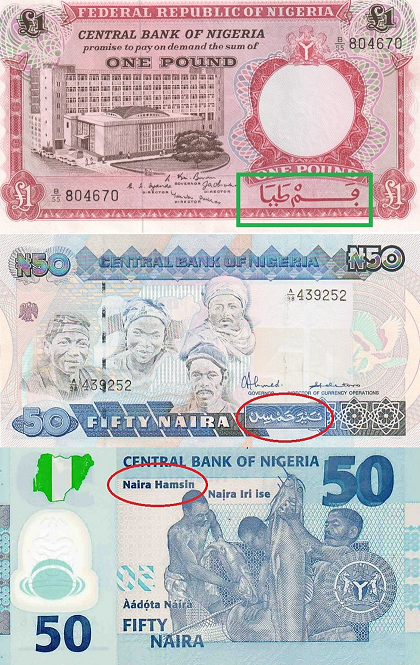
But how can national unity be attained when a large proportion of the country is still marginalised? To prevent this marginalisation, the British colonial administration introduced the Ajami letters on the first Nigerian modernised currencies, well aware of the large education gap – and therefore, the ability to read and understand Latin characters on the country’s currency notes. An example was the £1 note.
“Fam daya” was prominently written to enable those literate in Ajami, but not the Latin alphabet, to identify the currency.
Interestingly, the main argument was that the presence of Ajami on Nigerian currency was seen to the “detrimental” to southern Nigerians (who presumably do not understand it) – yet the inclusion of the Latin alphabet is not seen as detrimental to non-Roman literate northern Nigerians (mainly Muslim Hausa, who presumably do not understand it). In this warped logic, it is, therefore, easier to alienate Muslim Hausa northern Nigerians than southern Nigerians, especially since a Christian was the President of the country (and a Christian Governor of the Central Bank facilitated the alienation). Of course, when a Muslim becomes the President, the arguments might be revisited – and reversed, which another subsequent Christian president will also revisit, and so on endlessly. Farooq Kperogi actually imagined a nightmare scenario that might come out of this in 2022 at https://bit.ly/3TOt2T1.
The inclusion of the script on the Nigerian currency by the British colonial administration was an acknowledgement of the rich literary heritage of a vast number of people in Nigeria who could not read the Latin script– and not a strategy to impose Islam on anyone in Nigeria. Indeed, the British colonial administration had no reason to propagate Islam. Yet on the currencies circulated by the same administration, the “Arabic inscription” was conspicuously present. This was maintained until 2007 when the despised Arabic inscription was removed and replaced with the much-loved Latin ‘inscription’. An example with ₦50 illustrates this.
The ₦50 with the ‘Arabic inscription’ of Ajami merely indicates that it is fifty naira in Hausa. In the redesigned ₦50, the Roman name for the Hausa was ‘naira hamsin’ instead of the Ajamized ‘hamsin’ in the old note. Yet, ‘hamsin’ means fifty in Arabic! So, like it or not, Arabic remains on the naira. To get rid of it, you have to get rid of the Hausa language entirely since about almost 45% of Hausa words are based on the Arabic language.
Further, other multicultural countries pay such homage to multiple literacies in their currency notes. The Indian currency, for instance, has 15 language scripts, including Urdu (Ajami) – despite Arabic not being part of its national languages.
And while not explicitly stated, the links made by the Nigerian economic establishment with Arabic to Islam seem to be part of a move to “de-Islamize” Nigeria – scoring a cheap point, particularly in the way most northern Nigerian states re-introduced Islamic Shari’a in their governance from 1999 led by Zamfara State, and the earlier issue of Nigeria’s membership of the Organization of Islamic Countries (OIC) in January 1986, which the Nigerian Christian (as well as Marxist Muslim) groups were against.
We look forward to the new currency notes in December 2022.
Prof. Abdalla Uba Adamu wrote from the Department of Information and Media Studies, Bayero University Kano, Nigeria. He is, among many other things, the former Vice-Chancellor of the National Open University of Nigeria (NOUN). He can be reached via auadamu@yahoo.com.