Aminu Ado Bayero

Court adjourns hearing on Kano emirship tussle

By Uzair Adam Imam

The Federal High Court sitting in Kano has adjourned the hearing regarding the removal of Kano Emir Aminu Ado Bayero to June 13, 2024.

The lawsuit, filed by Aminu Babba Dan’agundi, a title holder and senior counsellor in the Kano emirate, challenges the repeal of the 2019 Emirate Council Law by the Kano State House of Assembly.

Presided over by Justice Abdullahi M. Liman, the court has set the case for ruling on June 13, 2024. Aminu Babba Dan’agundi, represented by Barrister M. S. Waziri, argues that the repeal of the 2019 law unlawfully stripped both the Emirate Council and the plaintiff of their powers.

Counsel to the 1st and 4th respondents, Mahmoud Abubakar Magaji SAN, urged the court to decline jurisdiction to entertain the matter, citing that the law has gone through legislative processes and the order was made after the action was done.

Ibrahim Isah Wangida, counsel to the 2nd and 3rd respondents, aligned himself with Magaji’s submission, stating that the applicant’s rights were not breached as the 2024 law was repealed and accented to before the applicant filed the action.

Sunday Ekwe, counsel to the 5th and 6th respondents, stated that they did not file any issue on jurisdiction, as the duty of the police is to maintain peace and wait to carry out the court’s order.

The court requested written submissions from both sides and will review them before rendering a decision on June 13.The respondents in the suit include the Kano State Government, Kano State House of Assembly, Speaker of Kano State House of Assembly, Attorney General of Kano State, Kano Commissioner of Police, Inspector General of Police, NSCDC, and DSS.

This legal battle is part of a larger crisis revolving around the emirship in Kano, following the dethronement of Aminu Ado Bayero and the reinstatement of Muhammadu Sanusi II by the Kano State government, creating tensions in the ancient city.

Currently, both emirs are holding court from separate palaces, with Sanusi operating from the main emir’s palace and Bayero presiding from the Nasarawa GRA mini palace.

Reinstatement of Emir Muhammadu Sanusi II and the resurgence of thuggery in Kano

By Aliyu Dalhatu Adamu

Kano people are known as peace-loving, as inculcated by the longest-serving Emir of the kingdom, Alhaji Ado Bayero,who led for over 50 years. His charisma and love for his people made him unique among all African traditional rulers. 

Kano people were traumatised by His Highness Alhaji Ado Bayero’s demise in June 2014, and the loss remained irreplaceable until 2020 when His Highness Alhaji Aminu Ado Bayero became the Emir of Kano. His emergence renewed the hope of the Kano people because he exhibited the same characteristics as his father. This makes him earn the love that people have for his father, which no one has in Kano.

The recent development of the Emir and reinstatement of the deposed Emir Sunusi Lamido Sunusi have seriously disrupted peace and stability in the state. This has opened doors for hooligans and thugs to widen their operations in the state.

It is a known fact that hooliganism and thuggery threaten the security of lives and property in every society. Hence, leaders are saddled with the responsibility of maintaining law and order to prevent potential offenders from engaging in such acts. 

It is unfortunate to say that the current administration of Governor Abba Kabir Yusuf has begun to do the other way around, as hoodlums and thugs are allowed to take over the Kano palace in the name of protecting the selfish and politically motivated interest of his political godfather. This has become a serious threat to the peace and safety of people in Kano as the hoodlums are harassing and intimidating people at will within the vicinity of the Kano Emir’s palace, all in the name of imposing Sunusi on the throne, which is facing outright absolute rejection by the good people of Kano.

This unbecoming attitude is becoming an eye-opener for young children who are now growing to witness this evil as a condoned behaviour. This may contribute to making hooliganism a wider phenomenon, a useful symbol, and a social obsession in the future tradition of the Kano Emirate traditional system.

Since the reinstatement of Sunusi Lamido Sunusi to Gidan Dabo, the palace and areas such as Kofar Kudu, Kano Municipal, Gwale, Dala, and the surrounding areas become the headquarters of thugs. Even medical workers at Hasiya Bayero Paediatric Hospital were attacked on the 27th of May, 2024. The Nigerian Medical Association (NMA) issued a statement condemning the barbaric development. Many other people living in the neighbourhood are not spared either.

This situation arose when the city’s public spaces were “swarming” with thousands of newly armed groups mandated to “protect” and pay allegiance to Emir Sunusi. These groups were recruited by the Kano state government only to praise their political master at the detriment of public safety.

Indeed, Gov Yusuf’s incompetence, ineptness, and clueless leadership style are undoubtedly taking Kano back to square zero. The pickle of the Kano emirship brawl is a cessation of Kano peace and stability as a courtesy to Senator Rabi’u Musa Kwankwaso, former Governor of the state Kwankwaso, by Governor Yusuf and the former Emir Sunusi Lamido Sunusi, in a bid to drag Kano to the state of anarchy. 

Hooligans also came to represent the dangers inherent in loosening constraints on society. Even when hooligans victimised people far from their concerns, the increase in their numbers, the apparent pettiness of their motives, and the savagery of their actions within Gidan Dabo suggested that certain members of the lower classes were either very beastly or very angry and that the mechanisms of state’s control were no longer in place to checkmate this.

Now, what we ask is, does the state government prioritise praising its political godfather over protecting the blood of theKano people?

Ironically, hooliganism and thuggery that previous administrations fought have now been revived by the present administration as the number 2IC in the government triggered the infiltration and indoctrination of youth into hooliganism and thuggery.

On this note, we are calling on the federal government, security agencies, intelligence communities, Nigerian Bar Association (NBA),  northern traditional rulers, religious leaders and all other relevant authorities to intervene. They should also advise the Kano state government to obey the court order restraining them from reinstating the deposed Emir Sunusi Lamido Sunusi and dissolving the remaining four Emirates in the interest of the good people of Kano. This will bring an end to hooliganism, public disrespect, defiance, chaos, and violence that are capable of destabilising the peace and security of Kano State.

Aliyu Dalhatu Adamu wrote from the Federal University, Dutsinma, Katsina State, via

aliyudalhatuadamu@gmail.com.

Kano Emirship Crisis: It always helps to live in the real world

By Dr Raji Bello

Following encouragement from some friends, let me say what I’ve been a bit reluctant to say. It is based on my conviction as a dispassionate and non-partisan observer and of course, as a non-indigene of Kano State.

The root cause of the emirship imbroglio in Kano, in my view, was the inability of Muhammadu Sanusi II to subordinate himself and his office to the Ganduje administration as required by the terms of his appointment. This is essentially what triggered every other thing that has happened and which has led us to where we are today. To correct any problem permanently, we need to examine its root cause.

I am not saying that Sanusi is not an emir of high intellect who is enormously popular among the people. This assessment of mine is based on only one criterion — his willingness or ability to comply with the terms of his appointment — and it is made without prejudice to his qualities, endowments and accomplishments as an individual, technocrat and emir. Like other human beings, the emir is not perfect. He might have excelled in 9 out of 10 criteria but his failure in the 10th is the cause of the emirship crisis because it happened to be a very important criterion.

All post-colonial emirs and traditional rulers have been obligated to demonstrate loyalty and due courtesy to government be it colonial, democratic or military. History is replete with examples of the huge price that was exacted each time an emir fell short on loyalty towards government.

As an intellectual of high standing, the emir must have been aware of that history. When he set out to be emir, he should have been conscious of the terms of appointment and should have fully reflected on whether it was the appropriate platform for someone of his disposition or not. The emir seems to want the Kano emirship in its pristine 19th century form when it didn’t answer to a non-traditional authority. This betrays a lack of situational awareness and good judgement because the reality is that the 19th century is long gone and can never be brought back. So if anyone is interested in becoming emir in the 21st century, it has to be under 21st century terms.

The Ganduje administration had accused the emir of multiple infractions from political partisanship, insurbordination and failure to demonstrate courtesy towards it. Some of these infractions had played out in public for all to see and hear which means that they were not false accusations. I do not fully endorse the former government’s actions (which bore traces of the usual Nigerian impunity) but it is clear that it was provoked into taking actions against the emir. I believe that all state governments are inclined by default to respect the traditional institutions within their states and hostilities only break out when there is a breach of the terms of appointment (usually, but not always) on the part of the traditional rulers.

There is no individual who is so important or popular that they would enjoy exemptions from complying with the terms of their appointment. This is an incontrovertible fact. A friend told me that the emirship style of Aminu Ado Bayero is a bit bland compared to that of Muhammadu Sanusi II. I replied that this is true but the Aminu style is actually the correct one.

Post-colonial emirship is not a radical or revolutionary platform and, after the 1976 Local Government Reforms, the traditional institutions in northern Nigeria lost all the vestiges of authority that were previously delegated to them under the Native Authority system. The post of traditional ruler is now just a custodianship of heritage whose essential features are loyalty, co-operation and circumspection.

Yes, Sanusi is wildly popular, has a deeper intellect, a gifted oratory and displays a higher sartorial elegance but it was Aminu Bayero who was doing the emirship correctly under its current terms. Those who cheered Sanusi as he breached the terms of his appointment were not helping him or the Kano emirship institution.

Preserving our heritage: The dethronement saga in Kano State

By Fatihu Ibrahim

Sometimes, our directionless life in Nigeria amazes me. Although we were once ruled by British colonists, we adopted the American presidential system, which is not only costly but also ineffective for our country.

With a heavy heart, I reflect on the recent dethronement of the 15th Emir of Kano, His Royal Highness Alhaji Aminu Ado Bayero. This event marks yet another instance where the government of Kano State has seemingly exercised its power dictatorially. Aminu was dethroned for no reason other than his association with the Ganduje administration. There was no justification for this action other than political disagreements and personal enmity.

This is the second time this government has taken action that deeply affects me. The first was the demolition of business buildings at the Eid praying ground, which caused the loss of billions of Naira worth of properties. This act indiscriminately affected nearly everyone in the Kofar Wambai market, regardless of political affiliation.

Some might argue about Sanusi Lamido Sanusi’s dethronement, which I also believe was wrong. However, at least there were allegations against him, whether true or false. In Aminu’s case, there was no such basis. He has tried to stay out of the political drama, avoiding the turmoil.

One wrong cannot right another. The most troubling aspect of this saga is how quickly the House acted, from proposing the motion to passing the verdict, in stark contrast to the usual legislative process. I recall advocating for gender-based violence laws in Kano State, which took months, if not years, to pass. The double standard is glaring.

The House of Assembly should focus on pressing issues. Our children have performed poorly in the SSCE qualifying exams, and our education system is dire, especially in primary and secondary schools. While I commend the governor for declaring a state of emergency on education, more must be done. Our universities are burdened with a 600 million Naira debt. Yet, the administration is spending 2.7 billion Naira on exotic cars for assembly members, ignoring the plight of the masses who elected them.

Ironically, the member who proposed the dethronement motion has no significant achievements. Many people who share his political affiliation vote for him out of blind loyalty to the party. It’s time we recognise the importance of voting for suitable candidates, regardless of their political views.

Yesterday, it was Sanusi; today, it’s Aminu. Who knows what will happen tomorrow? This cycle of dethronement could continue, with each governor bringing in their emir. What will become of our traditional institutions? Kano is renowned as one of the best Emirates in West Africa, if not the world. If this continues, can we still boast of being the Kano we once were?

Conflicts between the government and the emirate are not new; they date back to the colonial era and span various regimes. The government should find a way to resolve differences with traditional institutions without resorting to dethronement, preserving our history.

Perhaps someday, a governor will return the emirship to the HABE, the original heirs to the throne. There are still descendants of Muhammadu Rumfa and Sarki Muhammad Alwali, the last Hausa king. This, however, is a story for another day. Before anyone questions my loyalty or faith, I am a proud descendant of one of Shehu Dan Fodio’s flag bearers, making me Fulani by genealogy from the Kuninkawa clan.

May Allah bless Kano and its people. May we continue to lead in the political sphere in the north and Nigeria at large.

God bless Nigeria.

Fatihu Ibrahim wrote via fisabbankudi123@gmail.com.

BREAKING: Dethroned Bayero occupies mini-palace in Nassarawa

By Uzair Adam Imam

Alhaji Aminu Ado Bayero, the dethroned Emir of Kano, has returned to the ancient town and taken up residence in a palace in Nassarawa, fueling confusion and tension.

His return came in the early hours of Saturday, when his aircraft landed at Aminu Kano International Airport at around 4:30 am.

Upon his arrival, Bayero was greeted by a large crowd of supporters, who chanted verses from the Holy Quran, including Surah Al-Fatihah: “It is You we worship and You we ask for help.”

His convoy then made its way through the city, eventually arriving at the mini-palace in Nassarawa, where he has taken up residence.

Meanwhile, Sanusi II has taken over the traditional Gidan Rumfa palace, which has been the seat of the Emir of Kano for centuries.

Both palaces are now under heavy security cover, as the situation remains tense and uncertain.

From Gawuna is coming to Sanusi is coming!

By Abbas Datti

Following the Apex court’s ruling in favour of Eng Abba Kabir Yusuf as the legitimate elected governor of Kano State, there arises the compelling debates with regards to balkanization of Kano emirate, and potential return of Sunusi II to Gidan Dabo, as well as possible removal of the present emir, Alh. Aminu Ado Bayero.

Sunusi’s potential return to the throne is not without its challenges and complexities. Understanding the possibilities of post-Sunusi II and assessing the current political climate before making such a decision is paramount.

Considering Sunusi’s wide popularity and global influence, he may not necessarily obey Abba Kabir Yusuf as governor of Kano State. Sunusi’s tacit approval for women to confront their maltreating husbands in their matrimonial homes comes into play. Therefore, there’s a need for both Kwankwaso and Abba Kabir to ensure a delicate balance between addressing the fears that may arise from Sunusi’s reinstatement and charting a justifiable reason towards the dismounting of Ado Bayero’s biological son from the throne.

Supporters of Sunusi II passionately advocate for his reinstatement, citing his worldwide recognition and his radical approach to some social problems. Also, for opponents of the immediate past governor of Kano State, Sunusi’s enthronement is seen as a stab in the back to Eng Dr Abdullahi Umar Ganduje and the restoration of Kano’s kingdom dignity.

However, the broader implications of such a move require diligent, careful considerations. Both supporters of Aminu Ado Bayero and Sunusi are closely watching the unfolding events, with questions threatening the respect, dignity, and reverence enjoyed by the Kano emirate.

Balancing the expectations of various factions, addressing the concerns of opposing voices, and fostering an inclusive dialogue will be key to a successful solution to the emerging calls about removing Alh. Aminu Ado Bayero.

The possibility of enthroning back Sunusi is a multifaceted scenario with far-reaching possibilities. As the political stage sets for Sunusi’s potential return, the world observes with keen interest, eager to witness the unfolding of a narrative that could reshape the destiny of Kano State and redefine the dynamics of the leadership of Kano emirate.

Abbas Datti writes from Kano via abbasdatti448@gmail.com.

The antics of Kano throne: History may repeat itself

By Sadiq Ilyas

In 2017, Governor Abdullahi Ganduje reportedly disagreed with Sarki Muhammadu Sanusi II’s critical comments about the government’s handling of the state’s finances. Sanusi accused the government of mismanagement and corruption, particularly about the state’s debts.

The disagreement between the two escalated in 2019 when the Kano State government created four other emirates, reducing the powers of the Emir of Kano, who was Sanusi then. 

Sanusi challenged the creation of the emirates in court, arguing that it was politically motivated and designed to weaken his position as emir. However, in March 2020, a Kano State High Court ruled that creating the emirates was legal.

In March 2020, Sanusi was removed from his position as Emir of Kano by the Kano State government, citing insubordination and disrespect to the governor and other officials. Sanusi denied the allegations and challenged his removal in court, but his efforts were unsuccessful.

Since the removal of Sanusi as the 14th Emir of Kano, many people have reacted differently, and that generated sympathy around the Emir, who was seen as a victim, while the Governor is seen as the villain. 

The Kano Governorship election result is believed to be won majorly as protest votes against Ganduje’s policies, including creating new emirates and his perceived allegation of corruption. On the other hand, the New Nigeria People’s Party, NNPP, gave a margin of 128,000 votes to the ruling All Progressives Congress, APC. Although the APC plans to challenge the victory in court, the likelihood of overturning the election is slim.

The 14th Emir of Kano is believed to have supported the NNPP with many antics. First was his appearance in a white and red outfit, the Kwankwasiyya insignia, just before the election when he visited his mother. People also rumour that he financed the campaign of the NNPP of the Governor-elect Abba Kabir Yusuf. Though the 14th Emir was out of the country during the election period, he was believed to be in Makkah praying for the victory of the Governor-elect.

Since the announcement of the Governorship results in Kano, social media space was filled with slogans such as “Sabon Gwamna, Sabon Sarki”, meaning “new Governor, new Emir”. The atmosphere in the Emir’s palace becomes tense, and the Emir’s outfit choice for the Hawan Daushe Durbar says it all. He wore golden armour, which some analysts say is a sign of confrontation in times of war. But now that the battle with swords is over, the question is who is playing with the lion’s tail. 

Kwankwaso VS Ganduje

In a recent interview with reporters, Senator Rabiu Musa Kwankwaso, the leader of the NNPP and presidential candidate of the party in the 2023 election, has stated that the incoming government of Abba Yusuf, the Governor-elect of Kano State, will review the dethronement of the 14th Emir of Kano, Muhammadu Sanusi II.

“We tried not to intervene in the issue of bringing or removing any Emir. But now, an opportunity has come. Those given this opportunity will sit down and see the issues. Then, they will look at what they are expected to do. Besides the Emir, even the emirate has been divided into five places. All these need to be studied,” Kwankwaso stated.

He also said that, as elders, they would continue to advise the incoming government to do the right thing.

Meanwhile, Kano State Governor, Dr Abdullahi Umar Ganduje, has reiterated that the four new emirates created by his administration are here to stay.

“The four new emirates are a symbol of unity, progress, and the well-being of the people. They were created to honour the people of these regions and recover the reputation of the traditional institutions,” Ganduje said during the Workers’ Day celebrations held at Sani Abacha Stadium in Kano.

He added that the emirates were created to upgrade and promote their tradition, and they have brought development to these places. “I assure you that these emirates are permanent. They have come to stay. Even if we are not in government, these emirates are untouchable. I promise you this by the grace of God, they have come to stay,” he added.

It remains to be seen how the situation will unfold in Kano State regarding the dethronement of Sanusi II and the creation of new emirates.

History may repeat itself

During the administration of Governor Abubakar Rimi in the late 1970s and early 1980s, there was an attempt to create five emirates in Kano state by splitting the Kano Emirate into five. 

This move was met with opposition by some members of the royal family and other traditional rulers, who saw it as an attempt to weaken the influence of the Kano Emirate.

However, Governor Rimi went ahead with the plan and created the new emirates of Gaya, Karaye, Bichi, Rano, and Kano. 

The Kano Emirate was reduced in size and given a more ceremonial role, while the new emirates were granted more administrative and political powers.

When Governor Sabo Bakin Zuwo took over in 1983, he reversed the decision and restored the Kano Emirate to its original size and status, with the other emirates abolished. 

His decision was seen as an attempt to restore the traditional balance of power and to address the concerns of those who opposed the creation of the new emirates.

In 2019, Governor Abdullahi Ganduje created four new emirates in Kano State, including Gaya, Karaye, Bichi, and Rano, in addition to the Kano Emirate. The move was met with controversy and legal challenges, with some arguing that it was politically motivated and aimed at reducing the influence of the Kano Emirate. This followed the dethronement of the 14th Emir Muhammadu Sanusi II. And from all indications, history may repeat itself, with the NNPP becoming a new government.

Experts opinion 

Following the recent dethronement of Sanusi as Emir of Kano and the creation of new emirates by the Ganduje administration, Nadir Nasidi, a historian at the Ahmadu Bello University Zaria, has spoken out against the move, stating that it is unnecessary and unpalatable.

In an interview, Nasidi stated, “Kano is the only emirate in the whole country with one unifying emir, but the creation of unnecessary emirs isn’t a palatable one. Many people, including myself, told the Ganduje administration that what he was doing wasn’t a good one.”

While acknowledging that Sanusi’s dethronement was final and he could not be brought back, Nasidi suggested that the other emirates be reduced to local chiefs under the overall Emir of Kano, who would be chosen from among the existing kings.

He said, “Nobody will bring back Sanusi. He’s gone already. But the other emirates must be reduced to local chiefs under the overall emir of Kano. They can choose amongst all the kings one person to be the overall king.”

Nasidi’s suggestion comes amid ongoing debates about the wisdom and legality of creating new emirates in Kano State. The creation of four new emirates in the state was met with widespread criticism, with some people accusing the government of trying to weaken the influence of the Emir of Kano.

Critics argue that the move is politically motivated and aimed at reducing the Emir’s power and influence. On the other hand, supporters of the new emirates say that it will promote development and bring the government closer to the people.

As the debate continues, it remains to be seen whether the incoming administration will consider Nasidi’s suggestion or continue with its plans to bring back Sanusi Lamido as the Emir and reverse the creation of the emirates in Kano State.

Sadiq Ilyas wrote via silyas1989@gmail.com.
Academics, politicians, traditional rulers converge in Kano to discuss Nigeria’s economy

By Uzair Adam Imam

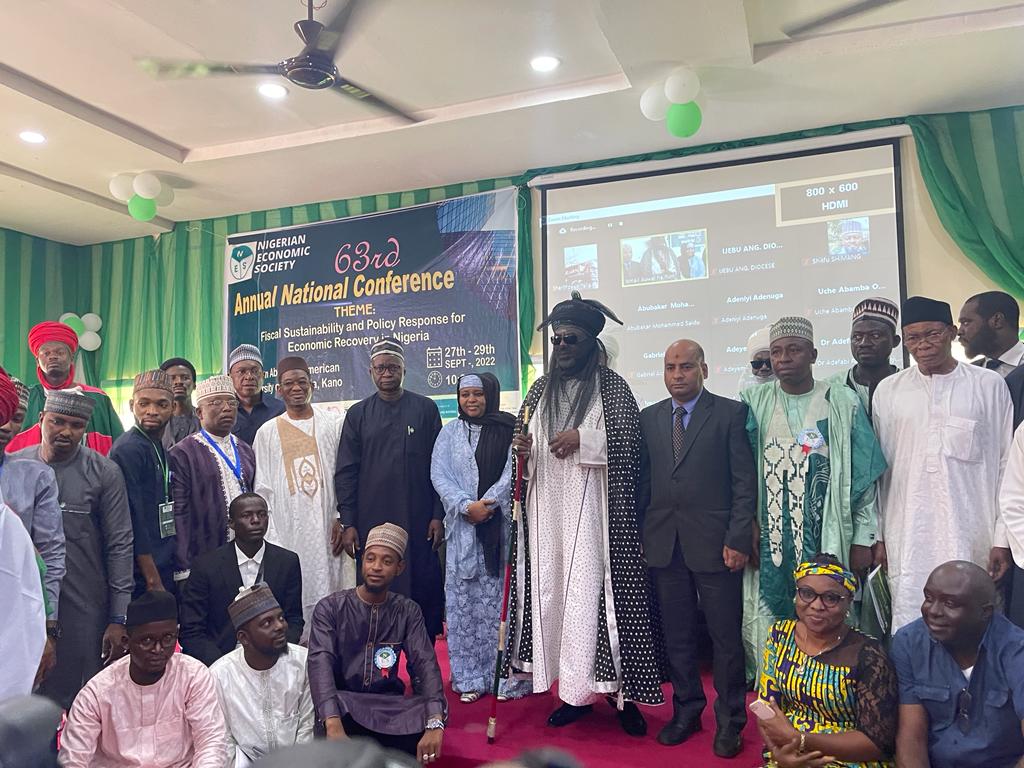
A 2022 and the 63rd annual national conference of the Nigerian Economic Society (NES) ended successfully Thursday, September 29, 2022.

The conference, which started Tuesday, was aimed at providing possible ways to enhance fiscal sustainability in Nigeria as the country ranks fifth on the list of ten countries with the highest debt exposure.

The event hosted academics, politicians and traditional rulers from all parts of the country to grace the event held in Maryam Abacha American University of Nigeria, Kano.

Speaking at the closing ceremony, Prof. Umma Ahmad Jalingo, the second woman president of NES and the first one from the north in 63 years, commended the successful completion of the event.

She said the past three days had been very impactful, adding, “Today, September 29, has marked the culmination of this program with yet an important component.”

His royal highness, the Emir of Kano, Alhaji Aminu Ado Bayero, commended the organisers for holding the conference in Kano.

The emir said the conference was relevant, looking at Nigeria’s current economic situation. He also commended all the papers presented.

Some of the papers presented included “Impact of Fiscal Policy on Financial Inclusion and Development in Nigeria” by Taiwo A. Segun, “Fiscal Policy Options and Poverty Reduction in Nigeria” by Muhammad B. Ado and “Public Debt and Poverty in Nigeria: The Role of Governance Quality” by Omowuwi O. Idowu, among others.

NES was founded in 1957, three years before Nigeria’s independence, and aims to provide intellectual leadership in understanding and to manage economic, social and political changes in Nigeria.

Current system of government fails Nigeria – Dantata

By Uzair Adam Imam


One of the renowned businessmen and philanthropists in Nigeria, Alhaji Aminu Dantata, has said that the current system of government has failed Nigeria.


Dantata stated this when he received a condolence visit by the Northern Elders Forum over the death of Sani Dangote and Othman Bashir Tofa.


He added that there is a need for a collaborative effort by the elders in order to bring to an end the disturbing multiple problems facing the country.


“You will agree with me that the Presidential system of government presently in operation has failed the nation; what we need now is to adopt the parliamentary system, which is less expensive,” he said.


Reports disclosed those on the entourage included General Sale Maina, Hakeem Baba Ahmed, President Coalition of Northern Groups, Nastura Shariff, Dr Sadiq Gombe, Hajiya Najaatu Mohammed, among others.


The Northern Elders Forum had also called on the Emir of Kano, Alhaji Aminu Ado Bayero, Deputy Governor Nasiru Gawuna, and Alhaji Yahya Hamma.