Almajiri system

What’s the fate of the Almajiri?

By Abdulsalam Alkali

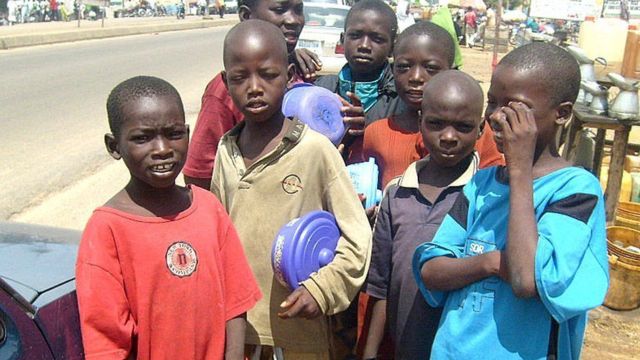
Almajiranci is an informal educational system that is predominantly practised in Northern Nigeria. Almajirai are teenagers ages 4-17 who are sent away from their dwelling by their respective parents to seek Islamic knowledge, a source for sustenance and clothe themselves by begging for alms from people.

The Almajiri system has produced prime leading Islamic intellectuals in Northern Nigeria. Still, along the cord, the system has been altered with the rise in population, making it a system that makes children of tender age susceptible to danger.

It’s awful how Almajirai are abandoned to cater for themselves even though parents should be responsible for their children’s needs and provide them with education. Sadly, parents choose to neglect their responsibility towards their children and abandon them at the early phase of their lives. This is unfair and should be tackled; else, it will erode our societal values.

Numerous discussions and symposia have been held on the predicaments of the Almajirai and how to reform the system. But it is all an exercise in futility because there has been practically no action to stem the tide.

The government, civil society organisations and traditional leaders have a role to play. First, the government should enact legislation prohibiting parents from taking their children to the Almajiri school. In addition, the government should make primary and secondary school free and compulsory so that poor and vulnerable parents can send their children to both formal and informal schools for our society’s good.

Abdulsalam Alkali writes in Maiduguri, Borno State, via abdulsalamyusufalkali71@gmail.com.

Outrage trails brutal flogging of Almajiri in Kano 

By Uzair Adam Imam 

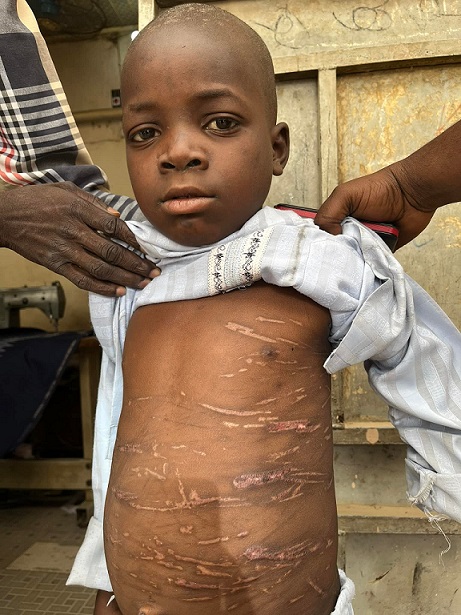
Many people reacted with shock over a viral video showing an eight-year-old Almajiri beaten mercilessly by his ‘Tsangaya’ Quranic teacher.

The Daily Reality gathered that punishment was due to the kid’s failure to bring food to the teacher, which is an age-old practice in many Tsangaya schools.

A source told our correspondent that the kid was found roaming the street after running away from the school.

The source added that a relative brought the victim to Kano from Magamar Gumau Local Government Area of Bauchi State for Qur’anic studies after his mother’s demise.

“I don’t want to go back to the school. The teacher will kill me. I want to return to my father,” said the kid.

Begging outlawed in Kano

Kano State is becoming a haven for beggars, despite the state government’s ban on street begging and subsequent measures the government to enforce the order.

In 2019, the Ganduje administration banned street begging, introducing new approaches to improving the education of the almajiri system.

In a statement, the Chief Press Secretary to Governor Abdullahi Umar Ganduje, Malam Abba Anwar, said the effort was to consolidate the free and compulsory primary and secondary education fully.

“If an Almijiri teacher thinks he cannot accept the new policy, he has to leave the state. 

“When Almajiri are caught begging, it is not only that beggar is caught but also his parents or guardians. Such parents or guardians would be taken to court to face the wrath of the law,” the governor threatened,” the statement said.

But despite the ban, street begging has held to its position in the state, as beggars are still on the state’s streets. 

Citizens blame government 

Some people blame the government for not consolidating its position of improving the  Almajiri education system to mitigate the menace of bagging in the state.

A former president of Foundation Against Child Abuse, Abdulmalik Shu’aibu Sani, blamed the government for playing politics with the menace. 

Abdulmalik Shu’aibu said, “Government decides to play politics in handling this issue. If the government had actually banned or changed the Almajiri education system in the state, this boy wouldn’t have been beaten like a slave.”

“I believe this will surely be a joyous and celebratory idea if the government could implement the new system or at least tax parents to pay for school fees. With that money, their children will be fed.”

Amina Shu’aibu said, “I know the government will not do this. Anything about it is political.”

Some concerned citizens described the punishment as disheartening, stating that the system is not what it used to be.

Abdulmalik Shu’aibu Sani said such heartless people should be brought before the law to reap what they sow while calling on the government to take action.

He lamented that the kid was too small for that brutal beating, saying he could not take responsibility for himself and his teacher. 

Adam Zahraddeen, one of the active members of the Almajiri Foundation in the state, said that in the past, Almajiri parents paid a certain amount of money and “that money will be used to feed his child by the Malam.

“It is heart-touching to see such forsaken small kids wandering on streets searching for what to eat. 

“The government should by now end the Almajiri system of education and rethink how to reform the system. 

Amina Adamu, who said she almost cried on watching the video, stated that she felt sorry for the boy.

She said, “Seeing the picture of this boy in this situation, I feel bad, sad, and sorry for the kid. He looks so pathetic. I feel like no matter what this boy has done, he doesn’t deserve to be beaten mercilessly like this.”

We are not heartless 

Auwal Ilyas, one of the senior students at an Almajiri school in the state, said what happened was entirely contrary to what is obtainable in the system. 

He stated, “The person who did this beating was very wrong. I believe a true teacher who answers his name will not do the same. So it must be a gardi (a senior Almajiri) that committed such a pathetic and regretful thing. I know gardi used to ask for food but not Malam.

“How will a teacher ask this very small kid to bring him food? In our school, our teacher, my father, take responsibility for any Almajiri. Malam provides two square meals for them, breakfast and lunch,” Auwalu added.

ABU student launches free cardigan campaign for Almajiri

By Ahmad Deedat Zakari

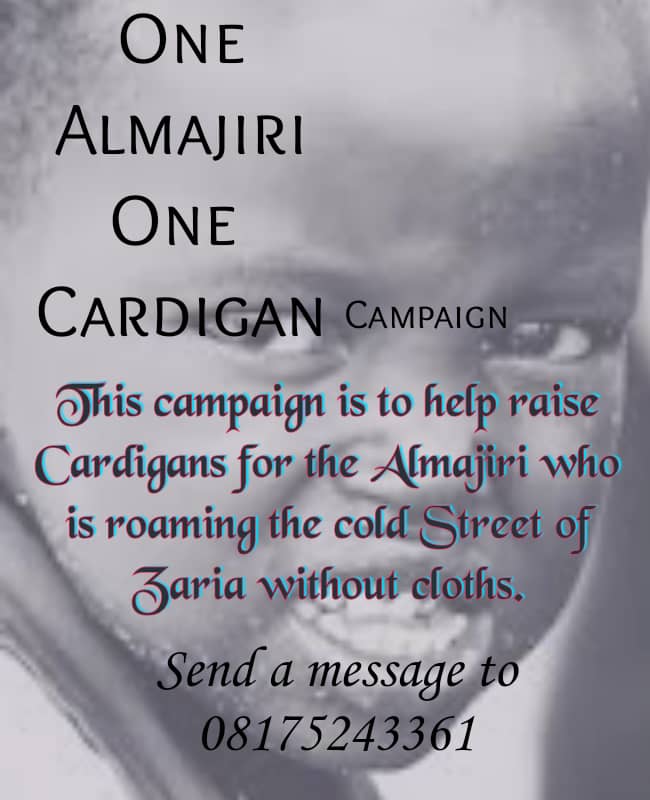
Lawrence Aklogado, a final year student of the Faculty of Law, Ahmadu Bello University, Zaria, has launched a campaign to donate cardigans for Almajiri roaming the streets of Zaria in the harmattan cold.

Mr Aklogado launched the kind and caring campaign on Monday, January, 31 and tagged it as “One Almajiri, One Cardigan.”

In an interview with The Daily Reality, Mr Aklogado stated his reasons for the campaign.

“Zaria was 4° degrees sometime last week. I walk to lectures every morning by 7 o’clock and see two categories of people. The student, staff and workers all rolled up in thick clothing yet complaining of the cold and the Almajiris who are putting on thorn clothing and yet not complaining of the cold.

These guys are white from head to toe, some of them not even having footwear. I only imagined how this period is hard for them. So I sat down and thought of how I could help. I don’t have money to buy cardigans and share because, truly, I was broke, and I don’t want to start telling anyone to please donate money for the almajiri. So the idea came to tell people to donate a cardigan for the almajiri.”

I designed the flier and started sharing it. The response was huge on the first day. And I am glad.” Mr Aklogado said.

When asked further on his target, he said, “My target is 100 plus cardigans for the Almajiris, and I have gotten 25 thus far. I go from hostel to hostel, and the main challenge is most students have just a cardigan too, but I am not giving up though”

The campaigner has been applauded by many people for the thoughtful and kind gesture.

Who will save our children?

By Lawi Auwal Yusuf

Any sympathetic person will surely ask himself these questions over the unfortunate fate of Almajiris: what wrong have they done to deserve such ruthless treatment? Are they not humans? Are they divinely condemned? Is it because we have heartless hearts? Or is it just because we have brainless brains? 

However, the Social Contract Theory extrapolates the relationship between the State, Citizens and Laws. Both the state and citizens have an overwhelming obligation to obey the law. These laws made it possible for leaders to assume the office and couples to marry and have legitimate children. Through these laws, leaders must cater to the needs of people and parents to take care of their children. Ultimately, justice is the philosophical underpinning and moral wisdom behind this idea. 

I wonder why leaders and parents breach the trust bestowed on them. Indeed, we need a professor in the law of trust to prove this before a jury so that the culprits will be locked up in prisons. 

Politicians have made these innocent children scapegoats of their misrule. They are severely castigated for offences committed by the government. Also, the lackadaisical and pitiless attitudes of parents worsen their plight. Even animals don’t dump offspring. On the contrary, they vigilantly look after them and guard them fiercely against any harm until they can take care of themselves.

Everyone abandons these children. They are left on their own to fend for themselves. Therefore, they scavenge through garbage, looking for food, wearing shabby clothes. They wander freely without a specific purpose or destination, with no shoes in the scorching heat. They equally have no one to attend to them when they fall sick. It seems like the ancient Indian caste system is gradually manifesting in 21st century Nigeria, and Almajiris form part of the Dalit (Untouchables) social group. 

When you ask them to define democracy, they will tell you that “it’s a government of the elites, for the elites and by the elites.” This is because it is purposely designed to cater to the needs of nobles only in their perception. It’s nothing to commoners but an inevitable woe. So they see it as subjugation, tyranny and distress. 

Almajiris have carried the cross for too long. They’re tired of this impudent desertion and have endured this problematic situation, and cannot withstand it any longer. Finally, they’ve been pinned down by the neck and are crying out for help with a thunderous scream, “we can’t breathe!” But, of course, this is cruelty in its cruellest form. 

These children are the future custodians of our society. Their desolation denotes that we undermine its continuity, progress and prosperity. We will bequeath to them a country that negligently failed to help them, forsake their welfare and future. They will take over a nation unable to develop humans, plagued by injustice and misery. Hence, it is unlikely that they will be patriotic to Nigeria. Is this what we are preparing for the next generation?

Indeed, they will remember us as imprudent forefathers that ruined their lives, put them in dismay and plotted the doom. The ones that disappointed them, those that couldn’t save them from grief. Those ancestors whose labour had been in vain. Indeed, they will utterly forget us, let alone pray for our eternal rest. 

We expect Tsangaya schools to consistently roll out erudite personalities, honourable scholars like late Dr Ahmad Bamba, Sheikh Ja’afar Mahmud Adam, Prof. Isa Ali Pantami or prof. Muhammad Sani R/Lemo. Unfortunately, we saw something entirely different. 

Nowadays, Almajiris are not purposely taken to Tsangaya for learning. Due to a lack of awareness concerning contraceptives, parents incessantly born children they can’t support. At long last, they discard them. How will a minor learn without provision for his necessities, vehement supervision of parents and also fend for himself far away from home? It can NEVER be possible.  

Let’s assume there are only one million Almajiris in the North, and only 5% ended up in criminality. Hence, there will be an additional 50,000 criminals to terrify the region, which is about 15% of the police workforce. So, how many more millions are there? 

Consequently, we are paying the price for our actions and inactions. We are suffering due to failure to resolve this criminogenic problem. We’ve undergone the agonies of Maitatsine dogmatism, and now we are in the bondage of Boko Haram, banditry, kidnappings, to mention a few. Have we learned lessons, or we will remain indifferent? Or are we now determined to dispel the injustice and save these downtrodden children? 

Lawi Auwal Yusuf wrote from Kano, Nigeria. He can be reached via laymaikanawa@gmail.com. 
The Almajirci Syndrome: A menace to our society

By Aisha Abdullahi Bello

The word “Almajiri” is derived from the Arabic word “Almuhajir”, which means an immigrant or someone who migrates from one place to another. So, originally, Almajiri is an immigrant who leaves his place of birth at a very tender age to acquire Islamic education.

It was believed by the people then that if a child received Islamic education at a very young age, he was likely to retain it throughout his lifetime. This had made many parents enrol their male children in the system.

In the ancient days, the system was so organised, and the parents were much responsible that they didn’t just dump their children at the “allo [slate]” schools the way today’s parents do. They also made it mandatory upon themselves to provide necessary food items and other provisions for the children, which would be enough for them throughout their stay with the “malams [teachers]”.

At each interval, maybe a period of three to four months, the children were readied for a return to their various homes. So, you’ll find out that each Almajiri would at least visit his parents thrice or even four times a year.

Now, the system is no longer what it used to be. Everything seems to have changed completely; the system, the parents and the children have all turned into something else. If you call the name ‘almajiri’, instead of the title to ring the bell of a child who came from a distant land to acquire knowledge, a different bell will ring. The name suggests an unlucky child whose parents gave birth to and later abandoned on the streets to fend for himself by whatever means.

I am used to asking myself, what could be the cause of this disguised child abuse in the name of almajirci”? What is the essence of bringing a child to this world if you cannot cater to his basic needs such as food, clothing, shelter, and quality education? Could this problem (almajirci) be attributed to poverty, lack of parental care, or is it a lack of adequate measures to tackle the menace by the government? These are the series of questions that are yet to be answered.

The rate at which the syndrome is growing could be checked if the parents control their birth rate through family planning measures. The government should try to enlighten parents on the benefits of family planning and its impact on society as much as possible.

To sanitise the system, the government should create a committee that will focus on the issues by standardising it to suit the present time. This could be achieved by taking the statistics of all almajirai, providing them with uniforms and building classrooms for them to have a conducive learning atmosphere. This will go a long way in curbing the extent to which they wander over the city.

The government and well-to-do individuals in the society should join hands together to create skill acquisition programmes and sponsor programs on TV and radio to educate the almajirai on how to acquire skills and make use of them for survival.  These skills could be tailoring, dyeing, soap making, blacksmithing, shoemaking, etc.

With this, I believe the rate at which the almajirci syndrome grows will hopefully reduce to some considerable level and, if carefully sustained, will someday become history.

Aisha Abdullahi Bello sent this article via aishaabdullahibello@gmail.com.

The Almajiri system should be reformed not banned – Independence Northern Youth Talk

At the conclusion of the Independence Youth Talk on the theme “Fathering the Orphaned Arewa Towards Nigeria’s Development”, a communiqué was issued, which contains the following resolutions:
1. That Northern Nigeria is urged to live up to its responsibility by mobilizing and harnessing the precious resources at its proposal, which include internally generated revenue and foreign exchange earnings to provide physical and social infrastructure, education for about 9 million out of school children, etc.

2. That Northern Nigeria should be directly involved in the development of agriculture through a mechanized system of farming, industrialization and import substitution programmes so as to discourage its over reliance on oil, which forms the fulcrum of the national economy, as well as importation.

3. Northern Nigeria should take its constitutional responsibilities to ensure maximum security for citizens and their properties through the legitimate use of the instruments of law enforcement against insurgency, banditry and kidnapping, which bedevil the region.

4. Northern Nigeria is urged to take a leading role through social engineering and the implementation of viable economic policies to ensure an enabling environment for businesses to thrive.

5. The Almajiri system of education, which has raised a number of issues to the governments of Northern Nigeria must be reformed instead of being banned.

6. It is resolved that a special conference should be convened in the North on its economy and security so as to address the challenges of Neo-liberal democracy and the crises of development in the region.

Name and Signature of Chairman, Society for Arewa Development and the convener, Independence Youth Talk.
Sahabi Sufiyan

…………………………


Beggars still on Kano streets despite govt’s ban

By Uzair Adam Imam

Who could have thought that the lingering issue of street begging would still be persistent despite the imposition of an outright ban on begging by the state government? Likewise, who would believe that the state government will continue to be the captive of the past, allowing Almajiri parents to drop around their children for Qur’anic education without shelter, food or clothing?

This and many more have called into question the government’s effort to end street begging in the state.

Recalling the statement issued by the Chief Press Secretary to the Governor of Kano State, Abba Anwar, the Kano State Government announced the ban of street begging in the state. It said that the effort was to fully consolidate the free and compulsory primary and secondary schools education.

“The decision was meant to integrate the Almajiri system into the policy and address the lingering problem of street begging,” Governor Abdullahi Ganduje said in the statement. He further warned that Almajiri teachers must accept the newly introduced approach by the government and that “If Almijiri teacher thinks he cannot accept the new policy he has to leave the state. 

“When Almajiri are caught begging, it is not only that beggar is caught but also his parents or guardians. Such parents or guardians would be taken to court to face the wrath of the law,” the governor added.

The statement disclosed that the newly introduced system was meant to allow the beggars to continue their studies to secondary school and beyond.

But despite the declaration, promises and threats against beggars and their teachers, beggars are still on the state’s streets. They beg from car to car, tricycle to tricycle and from person to person freely and in the presence of security personnel.

Meanwhile, Almajiris in Kano were neither being thwarted from begging nor introduced to western education, as the governor promised.

One of the Almajiri teachers in the state who spoke with The Daily Reality said, “I had no idea of the new policy the state government introduced and no official of the government contacted him ok the policy.”

An educationalist, who prefers not to be named, opined that; “I believe this will definitely be a joyous and celebratory idea if the government could be able to implement the new system.

“But sometimes government plays politics, and I am afraid this might be one, considering the length of time since the assertion was made.” He observed.

Some beggars who were brought to the city from Minjibir explained to our reporter that they face no challenge from anyone. According to them, they move around freely in every nook and cranny, including Nassarawa GRA, where the Kano State Government House is situated.

“We are brought here for Qur’anic education from Minjibir Local Government. Our Tsangaya is situated at Rimin Kebe, Ungogo LGA, and we are not even aware of the ban on begging in the state.”

The lingering problem of street begging is known to anyone living in Kano and the North, or even the country as a whole. But it is worse than expected in the North. 

Kano State Government’s idea of banning street begging is an idea many residents applauded when launched. The ban was introduced to enable the Almajiri to acquire western education while undergoing their Qur’anic education. The ultimate goal was to empower them in society.

The misfortune of Tsangaya students in Nigeria

By Lawi Auwal Yusuf

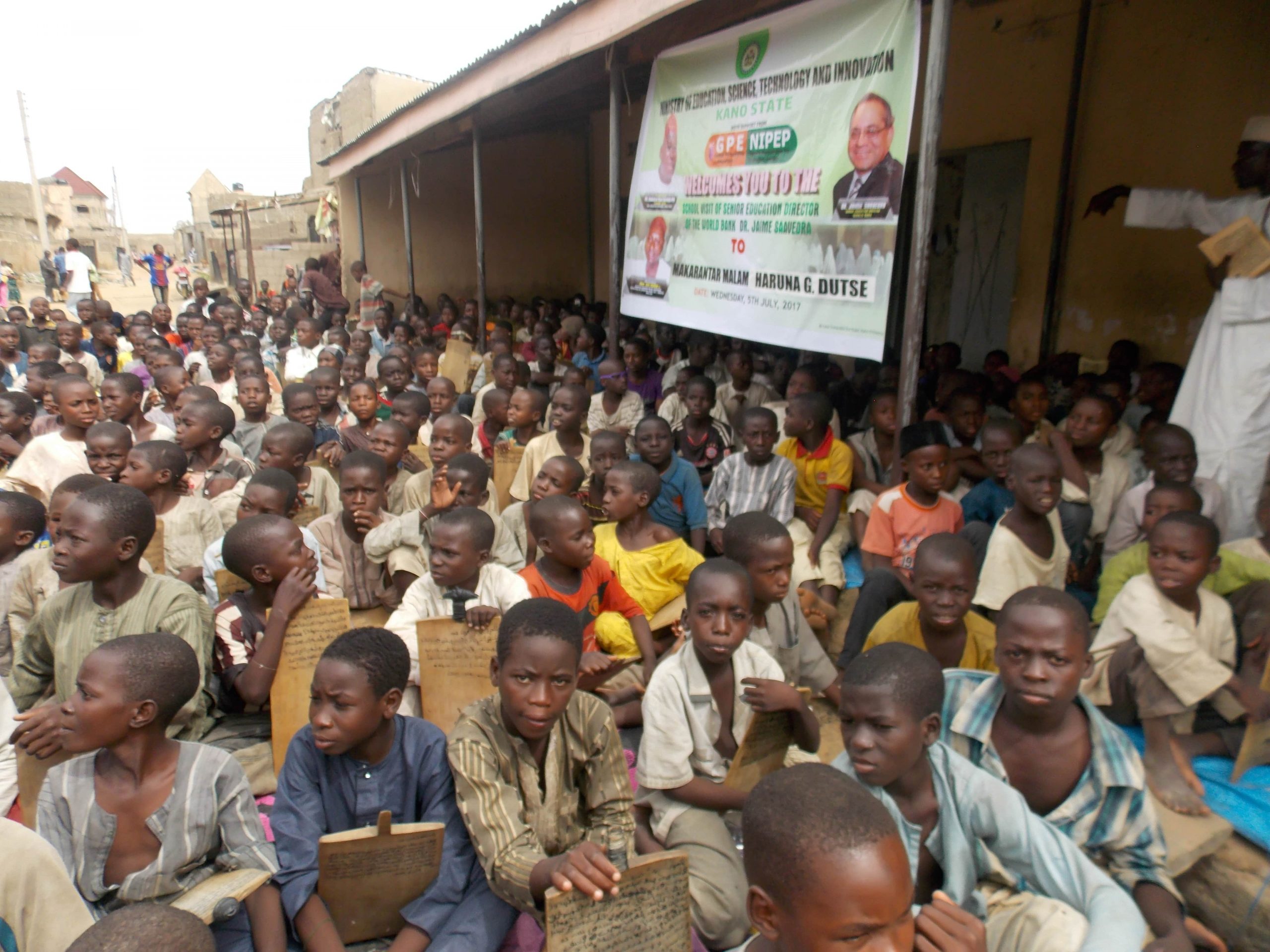
The Tsangaya system in northern Nigeria started more than a century ago. It is a traditional and informal system of Islamic education where male children are taken to a far place from home to memorise the Qur’an and study other religious books. This will help them to concentrate more on their studies than in the comfort of their homes. They can be seen in every part of the region, and they mostly come from rural areas and are predominantly taken to the cities, while some come from neighbouring countries.

It has taken a parallel dimension in the last decades as there has been a massive influx of these young children into the urban areas.

This rural-urban migration is exacerbated by rising poverty in the countryside, dilapidated infrastructures, unemployment, rising cost of living and a corresponding decline in the standard of living. Moreover, monetisation of the rural economy, desertification, effects of climate change and lack of social amenities worsen the situation.

Similarly, this mass movement has its repercussions on the metropolitan areas such as overcrowding, squalor housing and homelessness, poverty, the spread of diseases, starvation, poor sanitation, joblessness, criminal activities and fanaticism.

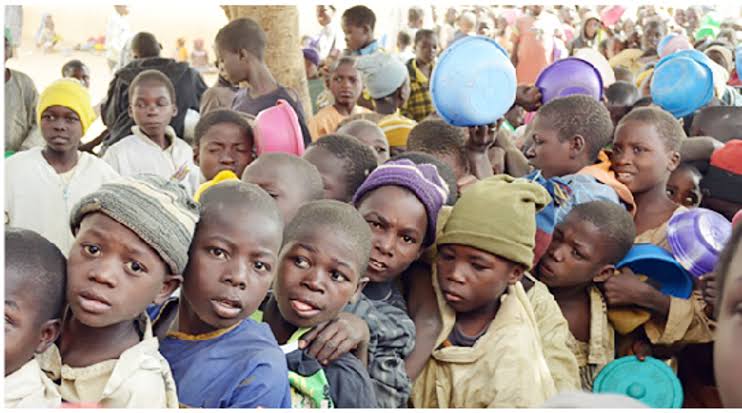
The pitiful and awful plight of these vulnerable children, including minors of about five, is very sorrowful, disheartening, and sympathetic. These oppressed kids below the legal age of responsibility and accountability roam in nooks and crannies of cities hungrily begging for food wearing tattered, shabby and ragged clothes without shoes in the scorching heat. They wander from house to house, in marketplaces, on the streets, motor parks/stations, mosques, traffic intersections and social gatherings in search of livelihood. They scavenge through refuse and garbage, looking for food and other valuable materials. These miserable children sleep on the roadsides, under bridges, marketplaces, uncompleted buildings and other unfortunate places under intense bites of mosquitoes and other insects.

Moreover, they defecate in the open as there are no toilets to use. They equally lack access to safe drinking water, prophylaxes, vaccines and immunisations that can help to prevent them against dangerous diseases.

Some of them are not much acquainted with their parents, siblings and other extended family members. They know little about their hometowns. They depart home when they are too young and are rarely visited or go home to reunite with their families, while others never return. Some years ago, I overheard one of them narrating his ordeal that there were only two rooms in their mud house. One was for the parents and the other for the children. The father wanted to marry a second wife while there was no vacant room to accommodate the bride. So he enrolled them in Tsangaya school and arranged the children’s room for her. This is why tribal and political bigots revile and vilify the Northerners on this savage and barbaric behaviour.

These filthy children are left to fend for themselves as no one cares about them. Everyone abandons them. They do not get the psychological support, love and affection of their parents and the bond of kinship ties. They live their entire unwholesome lives away from home. In addition, they also fall victim to child labour, exploitation and abuse. Hence, the teachers and other older co-students ruthlessly maltreat the younger ones and confiscate the food and money they get.

They have equal rights to benefit from the state resources and the public treasury like every citizen. They have equal rights with the children of the so-called prominent personalities, the President, governors, ministers, lawmakers and traditional rulers whose kids are taken to Europe and America to study. They also have the rights to normal life, adequate healthcare, decent shelter, and qualitative education with the requisite skills to make them marketable in the labour market and equal opportunities. Unfortunately, they have been deprived of these constitutional rights and are treated in their fatherland as sub-humans.

In their teenage, they spend much of their time on the course of their subsistence than their studies. Therefore, only a few of them receive the desired education. The unfortunate ones grow up without adequate knowledge, socialisation, professional training, and skills that necessitate them to wander the street and do menial jobs. Appallingly, some end up in theft, mugging, thuggery, drug dealing/addiction, sexual and other street offences.

It is very irritating that these vibrant, vigorous and exuberant youths are not made very productive to our nation. It vexes me to see them idle, redundant and wandering freely without a specific purpose or destination. Had they been adequately trained and made more productive to the society, they would have become professionals in different fields and therefore facilitate its development. It would have been more advanced than it is now. Sadly, all the intelligence, talent and youthful exuberance are being squandered negligently and not made helpful for their benefit and the whole society.  This is why Nigeria still lags behind its peers.

This mindlessness of the Nigerian authorities resulted in the December 1980 fracas in Kano. Maitatsine took advantage of this and brainwashed thousands of his students into extremism and fundamentalism. The conflict, which lasted for almost three weeks, put the city at an impasse and led to the loss of nearly 5,000 lives, including Maitatsine himself and enormous property worth millions were destroyed. The survived students initiated another tumultuous disturbance in the subsequent years, whereas in Bulumkuttu, Maiduguri and Kaduna in October 1982, over 3,000 lives were lost. Other riots broke out in Yola in 1984, where over 1,000 people were killed, and more than 60,000 people were displaced. And it also took place in Gombe in 1985.  

Furthermore, Boko Haram is more destructive, disastrous, and catastrophic that analysts see as an offshoot of the Maitatsine sect re-emerged with similar ideologies, putting the country in a war for more than a decade. Maiduguri has the largest concentration of these students, where you can find a Tsangaya school with thousands of students. Since the beginning of their offensive attacks in 2009, tens of thousands of lives were lost, and more than 2.3 million people were displaced, and roughly 250,000 fled to the neighbouring countries. The Global Terrorism Index declared it the world’s deadliest terror organisation in 2010. They have engaged in mass kidnappings of innocent civilians, including schoolgirls in Dapchi and Chibok and aggravated famines and food insecurity.  

The government should reinvigorate the Nigerian educational system to meet international standards. Similarly, there is a need to introduce an integrated educational system that will completely uproot the dichotomy between Islamic and Western education that will correspond with our religion and culture. A system that will give room for the memorisation of the Qur’an, Islamic subjects alongside the other conventional subjects to be acceptable to all. This was what Muslim countries like Sudan, Libya, Malaysia, Pakistan, Saudi Arabia, Egypt and many others have done. A similar provision should be put in place for Christians to be fair and just to all. In addition, primary education should be entirely free, compulsory and accessible to all.  

The governments at all levels should make genuine efforts to eradicate poverty in the villages, combat desert encroachment and revamp agriculture which will help tremendously improve the income of the rural dwellers. And also provide adequate and effective infrastructures and social amenities to make their lives better and easier.

Apart from all these, the government should urgently evacuate and return them all to their homes and enact a statute that will be strictly and rigorously enforced outlawing this incessant desertion. The legislation should also oblige the parents to be responsible for their children’s custody, supervision, and safekeeping.

There is a difference between a man and a father. The latter is a title of birth and guard. So, it is natural to take up the mandate; it is unnatural not to.

Lawi Auwal Yusuf writes from Kano, Nigeria. He can be reached via laymaikanawa@gmail.com.