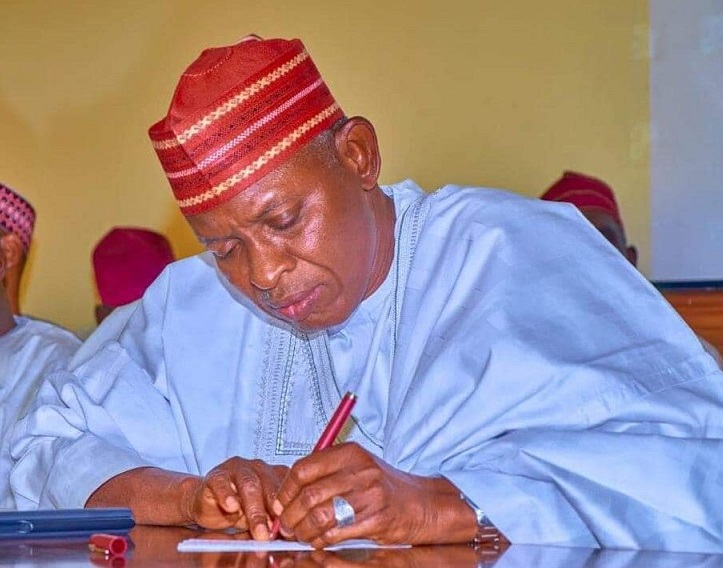
Abba Kabir Yusuf

Amendment of Kano emirates council law scales first reading

By Uzair Adam Imam

Heavy security was present at the Kano House of Assembly on Wednesday as lawmakers commenced the amendment of the State Emirates Council law that created five Emirates.

The amendment, sponsored by the majority leader and member representing Dala constituency, Lawan Hussaini Chediyar Yan Gurasa, scaled its first reading.

Armed security operatives from the police and Nigeria Security and Civil Defence Corps (NSCDC) took over strategic places at the assembly complex, while journalists who came to cover the day’s proceedings were asked to identify themselves before they were allowed entry.

All roads leading to the assembly complex were barricaded.The Kano state emirates council law, 2019, which created five new Emirates, was first assented to by the ex-Governor Abdullahi Umar Ganduje on December 5, 2019.

The governor assented to an amendment to the law on October 14, 2020, and signed another amendment on April 11, 2023.

Section 3(1) of the law established five distinct Emirates of Kano, Bichi, Rano, Gaya, and Karaye, with Kano and Karaye having eight local government areas of jurisdiction each, while Bichi and Gaya Emirates share nine local government areas of jurisdiction each, and Rano emirate enjoys jurisdiction over 10 local government areas out of the 44 local councils in the state.

Section 4 of the law established the state council of chiefs membership, which includes the five emirs, secretary to the state government, commissioner for local governments, and five chairmen, with one each from the Emirates, as well as 10 kingmakers and representatives from the business community and the security agencies, and not more than two appointees by the governor.

Section 5 provides for the chairmanship of the council of chiefs, which shall rotate among the emirs. When Emir Muhammad Sanusi, who chaired the council, was deposed on March 9, 2020, the law was amended to read, “there shall be the chairman of the council, who shall be the emir, Kano emirate.”

A principal officer of the Assembly, who does not want his name mentioned, said, “We were ready for this a long time ago, and only God can stop this amendment.

“We wanted all these emirs to go 20 days after this administration was inaugurated, but here we are. So, tomorrow (Thursday) there would be a special session of the assembly to consider and pass the amendment.”

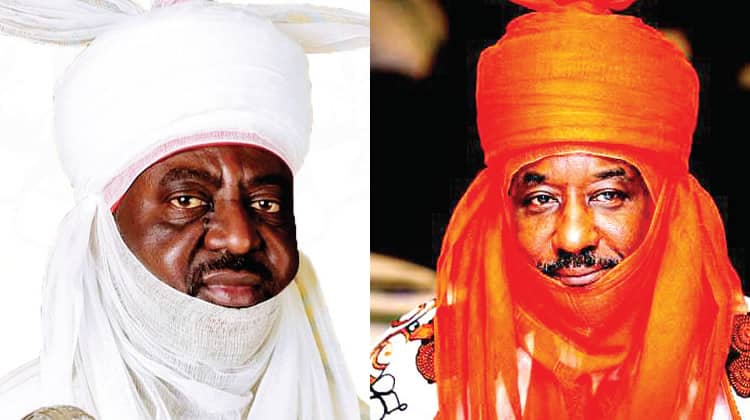
However, the minority leader of the assembly, Abdul Labaran Madari, told BBC Hausa, “12 APC members in the assembly were not opposed to the amendment, provided none of the five Emirates would be dissolved, and the Emir of Kano, Aminu Ado Bayero, would not be deposed and replaced with Muhammad Sanusi.”

Madari said, “Though the NNPP lawmakers in the assembly have the numbers to effect the amendment, the opposition members would ventilate their opposition.” He added that the ruling party had perfected its plan to dissolve Bichi Emirate, as well as reinstate the deposed Emir Sanusi.

“The other emirates would be left with three local government areas of jurisdiction each.”

Ramadan: Kano governor urges reopening of borders to ease food crisis

By Uzair Adam Imam

Kano State Governor, Abba Kabir Yusuf, has appealed to President Bola Ahmed Tinubu to consider reopening the country’s borders for the importation of foodstuff in order to address the current food crisis.

Governor Yusuf stressed that the closure of the borders has had a significant impact on the people of Kano State, leading to increased food prices and suffering.

In a statement issued by the governor’s spokesperson, Sunusi Bature Dawakin Tofa, Kano Governor Abba Kabir Yusuf called for the reopening of the country’s borders to address the current food crisis.

The statement was released following a meeting between the governor and the Controller General of the Nigerian Customs Service, Alhaji Bashir Adewale Adeniyi, at the Government House in Kano.

Governor Yusuf noted the critical condition of hunger and starvation in the country, which has been exacerbated by the sharp increase in commodity prices.

The statement read in part; “We wish appreciate the President’s intervention on the ongoing national food initiative which he considers Kano as the host for the initiative to be launched believing that the programme will cushion the effects of food scarcity if implemented”

Governor Yusuf stressed the urgent need for intervention, including the reopening of the borders to allow for the importation of commodities.

In his meeting with the Controller General of Customs, Bashir Adewale Adeniyi, Governor Yusuf highlighted the hardships faced by the people, particularly during Ramadan.

He stressed that the opening of the borders would be a crucial step in alleviating the distress of the people.

In addition to advocating for the reopening of the borders, Governor Yusuf commended the Customs Service’s initiative to distribute food items to the people of Kano, who have been facing hardship and hunger.

He urged the Customs Service to ensure that the food reaches those who are most affected. The governor also pledged his support to the Customs Service in its efforts to benefit the people of Kano and Nigeria as a whole.

In his response, Adeniyi emphasized the importance of building strong ties between the Nigerian Customs Service and the Kano community.

He emphasized the Service’s commitment to collaboration and constructive dialogue, and pledged to implement policies that would improve business processes and strengthen engagement with all stakeholders.

In addition to his interaction with stakeholders, the Controller General Adeniyi revealed that the Customs Service had made extensive plans to address the challenges of food scarcity and hardship in Kano. This includes the distribution of food items to the people of Kano.

Unraveling the power of PR in the conflict between Sheikh Daurawa and governor Abba Kabir

By Auwal Sani

In the heart of Kano State, recently, conflict ensued between the state’s religious police popularly known Hisbah [Command], Kano State government and the controversial TikToker, Murja Kunya. This conflict has not only sparked public debate but also highlighted the critical role of effective public relations (PR) in governance.

It all began with Kano State Governor, Abba Kabir Yusuf’s critique of Hisbah’s modus operandi, particularly in response to perceived deviations from the established laws. The governor’s remarks triggered a flurry of reactions, especially online, culminating into the unexpected resignation of Hisbah’s Director-General, Sheikh Aminu Ibrahim Daurawa. This abrupt departure further fueled tensions and political discord within the state.

However, amidst the turmoil, the saga took an intriguing turn with the involvement of Murja kunya, an ardent supporter of the Governor and his party (NNPP). Murja’s arrest by Hisbah and her miraculous release from prison without proper legal procedure raised eyebrows from various quarters, prompting questions about influence and justice.

Central to this unfolding drama is the apparent lack of effective PR strategies employed by both the government and Hisbah. A failure to conduct thorough situational analyses, engaging stakeholders, and maintaining open communication channels exacerbated the crisis, leading to a breakdown in trust between the authorities and the public.

Governor Yusuf’s comments, though well-intentioned, underscored the importance of a robust PR team to navigate sensitive issues and convey messages effectively. Collaborating with Hisbah’s leadership could have fostered dialogue and addressed concerns constructively, preventing further escalation of the situation.

Furthermore, the need for a crisis communication response team within the government and Hisbah is imperative. Timely and convincing damage control measures are essential to clarify intentions and restore public confidence in governance institutions.

Equally crucial is, the proactive engagement of relevant stakeholders by Hisbah before undertaking operations. Consultations with religious, governmental, and civil society leaders, among others, would ensure a comprehensive approach to addressing societal issues while mitigating potential conflicts.

Moreover, adequate training of Hisbah members on legal frameworks and rules of engagement are essential in preventing human rights violations and ensure professionalism in their duties. Additionally, investing in PR expertise within Hisbah’s communication department is essential to bridge the gap between the organization and the general public.

In hindsight, the confrontational response of Hisbah’s former Director-General to the governor’s criticisms highlights the need for professionalism and diplomacy in addressing internal challenges. Written correspondence or a formal meeting could have provided a more constructive platform for dialogue and resolution.

As the saga begins to fade, however, it serves as a stark reminder of the intrinsic link between effective public relations, transparent governance, and social harmony because, only through proactive engagement, strategic communication, and a commitment to openness can institutions like Hisbah navigate the complexities of contemporary society while upholding their mandates with integrity and accountability.

Auwal Sani writes from Kano State and can be reached via auwalsani986@gmail.com

On Shaikh Daurawa’s resignation

By Ibrahiym A. El-Caleel

Resignations are normal in the corporate world. Corporate culture makes employees understand that they work for their bosses, not really the organization per se. Your deliverables are the deliverables of your boss. If you achieve them, he will achieve his. If you fail, he fails. This is why bosses hold employees with high sense of accountability.

As such, employees leave bosses. They don’t really leave organizations. Whenever it goes sour between you and your boss beyond reconciliation, then you look for another job! Take a bow and go. It’s very normal there. That’s what they do. In fact I have met a high performing CEO of one of Nigeria’s beverages companies who told me that he spends a maximum of 5 years in any organization that hires him. And he leaves whenever the ovation is high. Within 15 years of starting his career, he is already an MD/CEO!

It’s only in civil service and public service that people think resignation is a big deal. In corporate world, it’s part of the culture. It is okay for both employee growth and corporate efficiency and effectiveness. An organization does not deserve an employee who is not happy with his job, or who believes his boss is frustrating his job. It impacts corporate performance. You cannot get anything significantly great from an employee who is not motivated to deliver.

Shaikh Daurawa’s resignation from Kano Hisbah is both good for him as an individual, and perhaps Hisbah as an organization. Had he stayed, he will feel tied down by the public condemnation he received yesterday from his boss, Gov Abba Kabir Yusuf. He will not be able to give Kano Hisbah his very best again. He would be an apathetic leader, who no longer cares about how TikTok’s Murja is corrupting the moral upbringing of Kano adolescents. He will now be very doubtful of every single operation he is going to make. What will be the reaction of my boss, Gov Abba? Will he be happy or not? Will he publicly lash me? These questions will always ring a bell in his heart.

Now that he has resigned, he has saved his image and mental peace. It also opens doors for him to greater job opportunities because his next boss will know that the man cannot compromise on his work ethics. It will be part of his discussion with his next boss. And if there’s a governor who truly has interest in moral policing, he would be happy to employ Shaikh Daurawa.

For Kano Hisbah, perhaps Gov Abba will have time to reflect on what he truly wants the organization to be doing under his tenure. Chase alcohol only? Or cut the hair of youth who styled them badly? This resignation gives the governor an opportunity to re-define how the enforcement agency will function in his tenure.

If you ask me, Shaikh Daurawa did very well by resigning. I could have done the same. I wish him the very best in his next job. I also wish Kano Hisbah the very best in getting their next Director-General.

Ibrahiym A. El-Caleel writes from Zaria, Kaduna State.

Kano Hisbah boss Daurawa resigns following governor’s criticism

By Sabiu Abdullahi

The Commander General of Kano Hisbah Board, Sheikh Aminu Ibrahim Daurawa, has tendered his resignation following criticisms from Governor Abba Kabir Yusuf over the board’s methods of operation. 

Sheikh Daurawa announced his resignation in a brief video clip posted on his official Facebook page on Friday.

His departure comes less than 24 hours after Governor Yusuf expressed disapproval of the tactics employed by Hisbah in combating acts of immorality within the state. 

Governor Yusuf, while addressing Ulama at the Government House on Thursday, voiced his objections to the approach of Hisbah, particularly condemning their practice of conducting raids on public spaces to apprehend individuals engaged in immoral activities, which he deemed uncivilised. 

The governor also expressed dissatisfaction with the methods used by Hisbah in apprehending suspects, urging the board to reevaluate its current operations to address societal wrongs. 

In response to Governor Yusuf’s remarks, Sheikh Daurawa defended the actions of Hisbah under his leadership, stating that the board had taken measures to combat immorality, particularly targeting social media influencers.

He asserted that Hisbah’s actions were in accordance with Islamic principles. 

However, acknowledging the governor’s stance, Sheikh Daurawa announced his resignation from his position and extended well wishes to Governor Yusuf and his administration. 

The resignation of Sheikh Aminu Ibrahim Daurawa marks a significant development in the ongoing discourse surrounding the methods and effectiveness of Hisbah’s operations in Kano State.

Of Abba’s triumphant welcome and court’s escape from embarrassment

By Mansur Hassan, PhD.

The executive governor of Kano state, His Excellency Abba Kabir Yusuf, made a triumphant return to Kano in grand style after the Supreme Court affirmed his position as the duly elected governor.

The air in Kano was filled with excitement as millions of residents gathered yesterday to welcome their leader to the commercial city centre.

His Excellency embarked on the journey from Kaduna at 9 am, and despite the approximately 13-hour journey, he arrived at Filin Mahaha Kofar Na’isa in Kano state by 10 pm. The extensive duration was attributed to the massive crowds that lined the streets, eager to catch a glimpse of their beloved governor.

The overwhelming love demonstrated by the people of Kano towards Governor Abba Kabir Yusuf serves as a powerful testament to the justice upheld by the Supreme Court. This judicial affirmation not only solidifies democracy but also underscores the importance of respecting the choices made by the masses.

Notably, President Bola Ahmad Tinubu hailed Governor Abba Kabir Yusuf as a hero, acknowledging his steadfastness and reaction during the previous judgements of the tribunal and the Court of Appeal. The governor’s resilience in the face of challenges has earned him widespread admiration.

As Governor Abba Kabir Yusuf begins his tenure, we express our heartfelt wishes for a successful term and the continued implementation of pro-masses policies that uplift the welfare of the people of Kano state.

In extending our wishes, we also hope for good health and wisdom for Senator Dr. Rabi’u Musa Kwankwaso, the grand commander of the Kwankwasiyya movement. May his guidance contribute to the betterment of the state and the nation as a whole.

Dr. Mansur Hassan is a Senior Lecturer in the Department of Mathematics, Yusuf Maitama Sule University Kano

Abba vs. Gawuna: S’ Court to rule on Kano governorship election dispute Friday

By Sabiu Abdullahi

The eagerly awaited judgement in the Kano State governorship election dispute has been set for Friday, January 12, 2024, according to an announcement from the Supreme Court.

The case involves Governor Abba Yusuf of the New Nigeria Peoples Party and the All Progressives Congress candidate, Dr. Nasiru Gawuna. 

A notice issued to all concerned parties outlines the court’s directive that each side can bring no more than two legal representatives during the judgement proceedings.

This decision comes after a five-member panel, led by Justice John Inyang Okoro, listened to arguments in late December last year and subsequently reserved judgment. 

The appellate court had previously upheld the tribunal’s decision, which removed Governor Abba Yusuf and declared Dr. Nasiru Gawuna as the rightful winner.

However, disputes arose among NNPP supporters, particularly concerning alleged conflicting judgements delivered by the appellate court. 

While NNPP supporters contested the ruling, pointing to discrepancies in the judgements, APC supporters celebrated the verdict in favour of their candidate. 

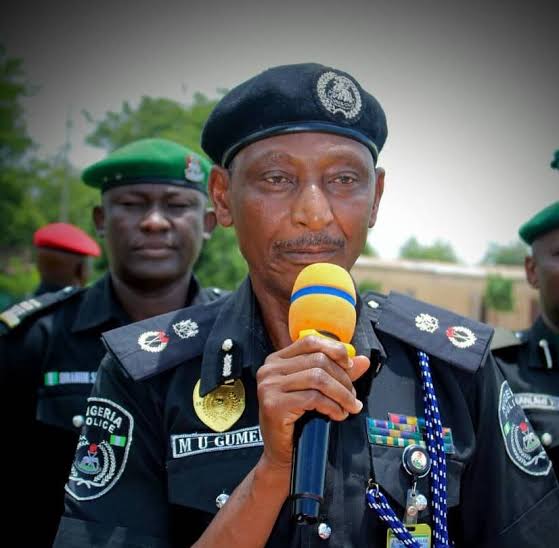
The tense situation in the state prompted the Kano State Police Commissioner, Gumel, to impose a ban on protests and rallies.

Despite efforts to ease tensions through a peace accord signed by the leadership of both parties, incidents of violence have been reported, underscoring the heightened anxiety surrounding the election dispute.

Senator Rufa’i Hanga: A mark of representation with difference

By Mansur Hassan, PhD

Senator Rufai Sani Hanga, the esteemed representative of the Kano Central Senatorial Zone, has made an indelible mark on the political landscape with the construction of an unprecedented constituency office – a pioneering initiative in northern Nigeria.

As the Deputy Minority Whip in the red chamber, Senator Hanga recognizes the paramount importance of serving his constituents. Beyond the legislative responsibilities, he has demonstrated a commitment to actively listening to the needs of the people he represents, ensuring their voices are heard in the corridors of power.

The recently built largest constituency office stands as a testament to Senator Hanga’s dedication to fostering development and enhancing the lives of those he serves. This state-of-the-art facility not only symbolizes progress but also serves as a hub for engaging with the community, addressing concerns, and strategizing on impactful legislative initiatives.

What sets Senator Hanga apart is not just the physical structure of the constituency office, but the comprehensive vision he brings to his role. Alongside the office inauguration, he has unveiled plans to launch a series of developmental programs. These programs are poised to uplift the socio-economic conditions of the people in Kano Central, showcasing a holistic approach to representation.

In an era where effective governance requires more than just legislative prowess, Senator Rufa’i Hanga emerges as a beacon of leadership. His dedication to bridging the gap between the government and the grassroots is commendable and serves as an inspiration for other political leaders.

As we applaud Senator Hanga’s achievements, it is imperative to acknowledge the collaborative efforts of key figures like H.E. Abba Kabir Yusuf and Madugun Kwankwasiyya Senator Dr. Rabi’u Musa Kwankwaso. Their collective commitment to the welfare of the people reinforces the idea that progress is a shared responsibility.

In conclusion, let us extend our well-wishes with a resounding “Long live Senator Rufai Sani Hanga!” May his leadership continue to illuminate the path toward a brighter and more prosperous future for the people of Kano Central Senatorial Zone.

Dr. Mansur Hassan is a Senior Lecturer, in the Department of Mathematics, Yusuf Maitama Sule University Kano

Governor Abba Kabir Yusuf extends compassion, sponsors Umrah for parents of late Asma’u Sani

By Uzair Adam Imam

The Kano State Governor, Abba Kabir Yusuf, has exhibited profound compassion by sponsoring the lesser Hajj (Umrah) pilgrimage for the parents of Asma’u Sani, a young girl he had initially sponsored for a surgical operation in India.

Tragically, Asma’u passed away before the scheduled departure to the Indian hospital, prompting the governor’s empathetic response.

In a poignant gesture of condolence, Governor Abba Kabir Yusuf, accompanied by his deputy, Comrade Aminu Abdussalam, visited the grieving family at Alkalawa Quarters in Gwarzo local government area.

During the visit, the governor directed that the funds earmarked for Asma’u’s surgery be redirected to sponsor her parents for the Umrah pilgrimage in Saudi Arabia, symbolizing a compassionate response to the family’s loss.

Moreover, Governor Abba Kabir Yusuf pledged to immortalize the memory of the late Asma’u. He instructed the local Imam to secure a plot of land for the construction of either a hospital or an Islamiyya school, to be named in honor of the departed soul.

This commitment underscores the governor’s dedication to preserving the legacy of individuals who have made a positive impact on their communities.

Expressing his deep sorrow over the untimely death of young Asma’u, Governor Abba Kabir Yusuf described the event as shocking and deeply pathetic.

The governor’s words reflected the genuine empathy he holds for the family in their moment of grief.

Malam Sani, the father of the deceased, moved by the governor’s honorable gesture, offered prayers for the success of Governor Abba Kabir Yusuf’s electoral affirmation at the Supreme Court.

This acknowledgment highlights the reciprocal respect and admiration between the governor and the bereaved family during this challenging time.

Governor Abba Kabir Yusuf’s compassionate response to the tragedy exemplifies leadership that extends beyond governance, embracing a heartfelt connection with the people.

The sponsorship of the Umrah pilgrimage and the commitment to immortalize Asma’u Sani through community development initiatives stand as enduring symbols of empathy and solidarity in the face of loss.
 

Kano Governor files appeal against tribunal ruling, claims error in ballot analysis

By Sabiu Abdullahi 

Governor Abba Yusuf of Kano state has filed an appeal at the Supreme Court challenging the decision of the Kano State Governorship Election Petition Tribunal. 

The tribunal had declared Yusuf Gawuna of the All Progressives Congress (APC) winner of the March 18th, 2023 election, deducting over 165,000 votes from Yusuf’s tally due to alleged lack of proper endorsements on the ballot papers. 

In a notice of appeal filed by his lawyer, Wole Olanipekun, SAN, Yusuf argues that the tribunal made a significant error in its analysis of the evidence presented by the APC. 

According to the appeal, the analysis conducted by the APC’s own witness only identified 1,886 ballots without proper endorsements, a stark contrast to the 165,616 deducted by the tribunal. 

The appeal argues that the tribunal erroneously deducted over 165,000 votes from Yusuf’s tally due to a misunderstanding of the evidence presented. 

It claims that the analysis conducted by the APC’s witness identified only 1,886 ballots lacking proper endorsements, significantly less than the number deducted. 

The appeal further clarifies that even among the ballots flagged, many had partial endorsements like signatures or stamps, not justifying their complete removal. 

The appeal emphasizes that all the disputed ballots carried official markings like the INEC logo, coat of arms, and serial numbers, confirming their legitimacy. 

Governor Yusuf’s legal team is confident that the Supreme Court will recognize the errors in the tribunal’s decision and restore his rightful victory.

The outcome of this appeal will have significant implications for the political landscape of Kano state and could set a precedent for future election disputes. 

The Supreme Court is yet to schedule a hearing for the appeal.

Both parties will present their arguments to the justices, who will then issue a final ruling on the matter.