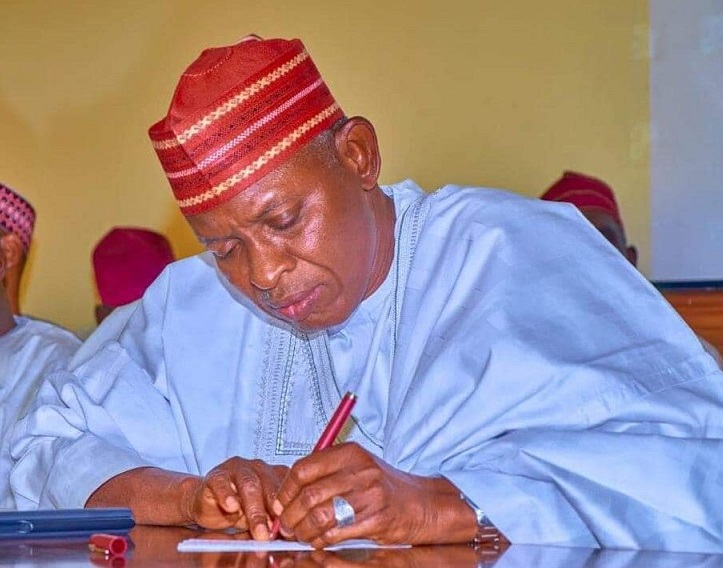
Abba Kabir Yusuf (Gida-Gida)

Kano launches comprehensive anti-corruption strategies

By Uzair Adam

The Kano State Government has implemented a series of measures to strengthen its anti-corruption framework and improve governance.

Speaking during the commemoration of the 2024 International Anti-Corruption Day and Human Rights Day on Tuesday, Governor Abba Kabir Yusuf unveiled the Kano Integrated Governance Accountability System.

The system, to be implemented across all 44 local government areas, will utilize an e-portal to enhance transparency in contract awards and public administration.

Governor Yusuf highlighted the state’s progress in developing a Central Criminal Register Software designed to streamline the criminal justice process, ensure fairness, and combat corruption effectively.

“To bolster our anti-corruption efforts, we have proposed amendments to the Kano State Public Complaints and Anti-Corruption Law and are working on a Proceeds of Crime Bill to ensure transparent management of recovered assets,” Yusuf stated.

He described the significance of eradicating corruption as a “cancer that erodes trust and undermines institutions.”

He also linked anti-corruption efforts to protecting human rights, stressing the administration’s commitment to justice, equity, and accountability.

The event featured a symposium and an evening musical concert to engage stakeholders, particularly youth, in the fight against corruption, human rights abuses, and gender-based violence.

The Governor commended the Kano State Public Complaints and Anti-Corruption Commission, which is led by Barrister Muhuyi Magaji Rimingado, for its dedication to promoting transparency and accountability.

He also extended appreciation to federal anti-corruption agencies, including the EFCC, ICPC, and the National Human Rights Commission, as well as development partners like the MacArthur Foundation and ROLAC, for their collaborative efforts.

In his address, Barrister Rimingado reiterated the Commission’s commitment to tackling corruption and urged young Nigerians to participate in the fight actively.

The state’s Attorney General, Haruna Isa-Dederi, also praised the Governor for providing an enabling environment and revealed that the Ministry of Justice now has an Anti-Corruption Unit empowered to investigate and prosecute cases.

Representing the ICPC Chairman, Ibrahim Garba-Kagara highlighted the challenges of combating corruption, citing insufficient political will and public awareness as key obstacles.

However, he commended Kano State’s proactive approach and encouraged youth participation.

The symposium drew participants from various sectors, including representatives from primary, secondary, and tertiary institutions and officials from the EFCC, DSS, Code of Conduct Bureau, civil society organizations, and the Kano State Police Command.

The initiatives unveiled underscore the state’s commitment to fostering transparency, accountability, and inclusive governance.

Navigating Kano’s complex politics and challenges 

By Abubakar Hassan Muhammad BUK 

Kano State politics has been a subject of interest in Nigeria, especially since the Supreme Court judgment restored Abba Kabir Yusuf as the governor of Kano State. Yusuf, a member of the New Nigeria Peoples Party (NNPP), had his election initially nullified by lower courts, but the Supreme Court unanimously upheld his victory in the March 2023 election.

The State has a rich history of leadership, dating back to the Kingdom of Kano, which existed from 1000 AD to 1349. The state’s capital and largest city, Kano, is Nigeria’s second most populous city after Lagos. The incumbent governor, Abba Kabir Yusuf, was sworn in on 29 May 2023.

Kano State faces several challenges, including attacks by Islamist terrorist groups, inter-religious violence, and extreme poverty. The state operates under Sharia law within the legal framework of the Nigerian constitution. The Supreme Court’s decision to restore Yusuf as governor has received mixed reactions from Nigerians, with some praising the judgement and others expressing concerns.

The State has a diverse economy with a strong focus on industry, agriculture, and Islamic banking. The state is home to several large markets, including Kurmi Market and Kantin Kwari Market, which specialise in textiles and grains. Agriculture is also a significant sector, with crops such as millet, cowpeas, and sorghum being cultivated for local consumption.

Kano State politics are complex and multifaceted, reflecting the state’s rich history and cultural diversity. Under Governor Yusuf’s leadership, the state faces significant challenges and opportunities for growth and development. But he has been trying his best to overcome these challenges.

Abubakar Hassan Muhammad wrote via abubakarsadik2023@gmail.com.

Rabi’u Kwankwaso Bilingual College, Niamey, PTA requests Governor Yusuf to return their children to school

By Abdullahi Sulaiman

The Parents Teachers Association of Rabiu Musa Kwankwaso Bilingual College, Niamey, Niger Republic, has appealed to His Excellency, Governor Abba Kabir Yusuf, to honour the promise made by the former Governor of Kano, Dr Rabiu Musa Kwankwaso to return their children to their school in Niger Republic. 

The students have not been in school for over a year now, while their peers in the Niger Republic have already resumed classes in the new session five weeks ago.

Dr. Ibrahim Habu, Chairman of the PTA, commends Governor Yusuf for prioritising education with substantial budget allocations. However, he urges him to address the unresolved issues of Bilingual College students in Kano from the last academic session. He calls for immediate action to ensure no child from the college is left idle at home.

The PTA Chairman urges all stakeholders to work collaboratively to fulfil Rabiu Musa Kwankwaso’s vision of establishing a Bilingual college, emphasising the importance of equipping students with bilingual skills in French and English to enhance self-reliance and global competitiveness among Kano’s next generation of citizens.

The Chairman also calls on the people of Kano State to continue supporting Governor Yusuf’s educational initiatives. These initiatives will ensure sustainable development in the education sector and contribute to the overall development of Kano State.

Open Letter to the Governor of Kano State: There is a need for a balanced executive council composition

Your Excellency, sir, I want to use this opportunity to draw your attention to the trend followed by your predecessors: forming a composition of the state executive council that is not all-inclusive and fails to address the need for every local government to be well-represented in accordance with the principle of federal character establishment. 

The negligence or oversight of this administrative arrangement has become a typical setback, leading to the marginalisation of Warawa L.G.A. since its establishment by law in 1991. This undermining of not only its human capacity development but also the general welfare of its indigenes is evident in the few developmental projects the state has executed so far.

Sir, none of your predecessors on record has ever given us fair representation or equal opportunity through appointment to serve as a state executive council member, either as Commissioner or Special Adviser, since the establishment of Warawa Local Government. Your Excellency, your administration’s adoption of a similar trend is a significant setback to your performance indicators for good governance and fulfilling your campaign promises.

Among the twenty-four (24) Commissioners and about thirty-two (32) Special Advisers you appointed and cleared before the State Assembly, none is an indigene of Warawa L.G.A. Not only that, Your Excellency Sir, so far, all of your political appointments for the various positions of heads of respective Ministries Departments and Agencies (MDAs) ranging from about (7) Director General DGs, (44) Managing Directors MDs and Deputies, Executive Directors EDs, (5) Executive Secretary ES, and even Project Coordinators none is an indigene of Warawa L.G.A. 

Your Excellency Sir, only if you imagine having a similar composition of Federal Executive Council members at the Federal level without Kano State having any ministerial position designated (not even minister of state). 

At the same time, another state gets two or more. It appears disheartening that this recurring marginalisation is so severe that a ward from another L.G.A. will have two or more appointees and even an additional appointment as head of some MDAs. In contrast, Warawa ends up with none as a constitutionally recognised L.G.A.

Except for state constituency allocation and the ongoing 5 km entrance road projects, road developmental projects are not sponsored by the state as obtainable in other L.G.A that are well represented in the Council and beyond. Warawa L.G.A is autonomous like every other Local Government Area. The constitution and electoral act made it mandatory that no single election into the office of the executive governor of Kano state would be declared conclusive without the votes of this administratively neglected local government area.

For this reason and beyond, in the principle of justice, fairness, and equity, we call upon you to address the issue by giving us a fair and equal opportunity to develop this resourceful local government area. Our interest is to be part of this administration’s history written in gold, as we were part of the struggle that brought it on board.

Thank You.

Yours Sincerely,

Engr. Ismail Abdu Garba

Engr. Ismail is a lecturer, research scholar, and member of the Kwankwasiyya Scholars Assembly (KSA). He is also the Chairman of the Warawa Education Election Campaign Committee for 2019 and 2023. He can be contacted via madaarie@gmail.com.

What sets Kwankwaso apart in Nigeria’s political landscape

By Aiman Fodio

I respect Senator Rabiu Musa Kwankwaso as a leader and admire his dedication to charitable causes, especially education. He is, by no means, a saint; he is human, like all of us, subject to the frailties that come with the human condition. Yet, when we consider moral reasoning, pragmatism in leadership, ethical choices, and the complex compromises of politics, I believe he emerges as a stand-out figure in Nigeria’s presidential landscape today.

We all concur that the nation cannot grow without a productive, well-educated populace. Therefore, we must commend his efforts in providing scholarships and educational support to countless underprivileged youths. 

In Nigeria, where quality education is often reserved for the privileged few, he at least tried to bridge that gap. These are nothing short of transformative. He’s not just speaking abracadabra on X (Twitter) about change; he actively works to make it accessible, particularly for those who need it most. Don’t just come and tell me that he did all that with the government money or looted; I challenge you to bring someone with a comparable track record which surpasses his commitment to uplifting the marginalised.

As we know, Nigeria is a developing nation grappling with the intricacies of governance that differ from those in developed and developing countries. This climate needs politicians who starkly contrast with the transactional politics that often dominate our region. 

Kwankwaso is unique in that his power hinges on support from ordinary Nigerians, while many of his contemporaries are tethered to elite alliances. This dynamic has made him the Jagora—leader and guide—to many, though some may derisively label him the ‘Local Champion’.

Most (about 95%) oppose him with divisive ideologies that tarnish his reputation and undermine his connection with his supporters. Many view his popularity with scepticism, trying to erode his strong rapport with his base. Yet, Kwankwaso resonates with the public, not because of propaganda, but because of his track record and genuine empathy. For this reason, he remains one of the few politicians whose influence is authentically rooted in the people’s will, making him a formidable figure on the national stage.

One aspect of Kwankwaso’s political style that I find particularly troubling is the pervasive influence of godfatherism. It’s disheartening to observe his tendency to exert undue influence over his protégés, such as Governor Abba. This dynamic creates a political climate where loyalty to a godfather supersedes the imperative of serving the collective interests of the populace. 

Godfatherism has no place in a progressive political landscape; it stifles authentic leadership and compromises the integrity of those who are meant to govern. Kwankwaso should let Governor Abba Kabir Yusuf focus on the ideals that empower him, granting him the latitude to evolve and serve his constituents with the autonomy they deserve. That would earn Kwankwaso more respect.

Despite this concern, I firmly believe that Kwankwaso remains one of the most qualified and deserving candidates to lead Nigeria. The need to choose the “lesser of two evils” becomes glaringly apparent in a milieu often characterised by many less competent alternatives.

While no leader is without their shortcomings, his extensive experience and interest in uplifting the marginalised position him as a formidable candidate. We must weigh our options carefully, recognising that his potential to enact positive change far outweighs the flaws that may come with his political relationships. Ultimately, our choice should reflect the need for a leader who prioritises the people over personal ambition, and I still see that potential in him.

Aiman Fodio wrote via aimanfodio@gmail.com.

Political unity on display as Senator Kwankwaso’s daughter marries in Kano

By Abdullahi Mukhtar Algasgaini

Senator Rabiu Musa Kwankwaso, PhD, FNSE, National Leader of the NNPP, welcomed Nigeria’s top political dignitaries to Kano for his beloved daughter’s wedding.

The illustrious event, held under the serene ambience of Kano’s cultural heritage, saw the presence of Kano State Governor Engr. Abba Kabir Yusuf joined hands with his mentor and received many prominent leaders. Among them were Senator Abdulaziz Abubakar Yari, CON, former Governor of Zamfara State; Senator Abdul Ahmed Ningi; and His Excellency Adamu Aliero, former Governor of Kebbi State.

Social media commentators praise the politicians’ display of unity. Others add that the occasion transcends political affiliations, bringing together leaders from diverse backgrounds to celebrate a union rooted in love and tradition. The wedding symbolises more than just a family milestone—it has become a testament to the power of unity, respect, and collaboration in Nigeria’s political sphere.

The event was a magnificent display of cultural pride and leadership, leaving a lasting impression on all attendees and further solidifying Sen. Kwankwaso’s role as a unifying figure in the nation.

Court restrains Emir Bayero from renovating Nassarawa mini-palace

By Uzair Adam

A Kano State High Court has once again issued an order preventing the 15th Emir of Kano, Alhaji Aminu Ado Bayero, from carrying out renovations to the Nassarawa Mini Palace.

The legal action was initiated by the Kano State Government, the Attorney-General of Kano, and the Kano Emirate Council, who filed a motion through their counsel, Rilwanu Umar SAN, on September 12.

They requested the court to stop Ado-Bayero from making any changes to the palace located along State Road in Kano.

In her ruling, Justice Dije Abdu-Aboki, the Chief Judge of Kano State, found the applicants’ request valid, noting that the Emir had neither submitted a counter affidavit nor provided a written defense.

Abdu-Aboki referred the case to High Court 15 for further proceedings.

During the session, counsel for the applicants argued that Bayero had been removed from his position by the Kano State Emirate Council Repeal Law of 2024.

Despite being served on September 14, the respondent had not filed a response or appeared before the court.

The applicants also requested that the court declare the Nassarawa Mini Palace as the property of the Kano State Government and the Kano Emirate Council, not the personal property of Ado-Bayero.

Previously, on September 13, the court issued an Interim Injunction, preventing the Emir and his representatives from demolishing, renovating, or making any alterations to the palace until the case is resolved.

The court ordered that the status quo regarding the palace’s structure and design be maintained during the legal process.

Kano State Government: Please revitalise the abandoned technical schools in 44 LGAs

By Bilal Muhammad Bello (BMB)

It is widely recognised across Kano State that the 44 LGA Day Technical Schools have been abandoned and remain under incomplete construction. These schools were established in 2012 during the second tenure of former Governor Senator Rabi’u Musa Kwankwaso. 

The initial progress on these schools was swift under Kwankwaso’s administration. However, the subsequent government, led by former Governor Dr. Abdullahi Umar Ganduje, halted the continuation of the project.

The abandonment of these schools has not only led to their physical decay but also created opportunities for theft and vandalism, with some individuals stealing materials from the school premises. The neglected sites have also become hubs for illicit activities, posing a threat to the safety and well-being of the surrounding communities.

It is crucial to bring this matter to the attention of His Excellency, Engineer Abba Kabir Yusuf, the current Governor of Kano State. Your commitment to advancing education in both urban and rural areas, particularly through the construction of classroom blocks, the reduction of registration fees for higher education institutions, and the provision of postgraduate scholarships, is commendable and has garnered praise from Kano residents and visitors alike.

During your 2019 and 2023 gubernatorial campaigns, you pledged to resume work on the 44 LGA Day Technical Schools. I respectfully appeal to your administration to take swift action to complete these schools. By doing so, you will transform these temporary sites into permanent institutions, ensuring they fulfil their original purpose and preventing further loss of valuable materials.

Bilal Muhammad Bello (BMB) wrote from Mass Communication, Bayero University Kano.

Court adjourns ruling on Kano palace renovation dispute

By Uzair Adam 

The Kano State High Court has adjourned a ruling on the ongoing dispute over renovations to the historic Nasarawa mini palace in Kano until October 10, 2024. 

The case, presided over by Chief Judge Justice Dije Aboki, involves an application seeking to halt the 15th Emir of Kano, Aminu Ado Bayero, from proceeding with modernisation plans for the palace.

The plaintiffs, which include the Kano State Government, the Attorney General, and the Kano Emirate Council, are pushing to preserve the palace’s original structure, arguing that renovations would compromise its cultural and historical significance. 

The Daily Reality reports that the Emir is the sole defendant in the case.

During the hearing, the plaintiff’s counsel, Habib Akilu, noted that the defendant’s legal team was absent and moved for an interlocutory injunction to prevent any renovation until the court delivered its final judgment.

The plaintiffs had previously secured an interim injunction on September 13, 2024, following the release of a proposed plan to modernise the palace. 

In support of the motion, a 33-paragraph affidavit deposed by the Matawallen Kano, Ibrahim Ahmed, emphasised the palace’s importance as a symbol of cultural heritage, warning that any changes could erase its architectural and historical integrity.

Justice Aboki has ordered that all relevant court processes be posted publicly to keep all parties informed.

Kano: REMASAB workers lament non-payment of salaries for past 6 months

By Uzair Adam 

“I have not been paid for over six months now. I have two wives and ten children. I had to feed them with sicklepod (Tafasa in Hausa) for breakfast before I left home this morning,” said Malam Muntari Yakub (not his real name), an employee of the Refuse Management and Sanitation Board (REMASAB), in a shaky and traumatised tone.

Malam Yakubu’s experience is similar to that of many REMASAB staff who have not received their salaries for over six months due to outstanding debts owed by the Kano State government. 

The situation has made life even more difficult for them amid the soaring economic crisis in the country.

The workers, whose duties include sweeping streets and evacuating refuse, told our reporter that Governor Abba Kabir Yusuf’s current administration has paid them only four times since he took office more than a year ago.

They lamented that their situation had worsened due to the nine months of unpaid salaries they were still owed from the previous administration of Governor Abdullahi Umar Ganduje, who left office in 2023.

Yakubu recounted his distressing experience amidst the salary stoppage and the threat of hunger, “I am not a rabbit, and none of my family members are, but we eat sicklepod (Tafasa) to stave off hunger and avoid death. I had to gather some this morning for breakfast before leaving home.”

“Our salary is just ten thousand naira. You can imagine what we can buy with this meagre amount, especially with the rising cost of food. Despite struggling with this small amount, the government has left us stranded without pay for over six months,” Malam Yakubu said.

Another worker, who requested anonymity, revealed how his wife left him due to the enormous debt he had accumulated and his inability to provide for his family since his salary was stopped, exacerbated by the current economic situation in the country.

He said, “It is painful to say that my wife left me because of this situation I am in today. No matter how small the salary, it’s better to cover some of your family’s needs than none at all. After she left, the landlord also evicted me because I couldn’t pay the rent.”

The man added that despite the demanding nature of their job, most of them have to walk to their assigned streets to work, and no equipment is provided for them.

Buy your own equipment or quit the job

The workers who spoke to our reporter alleged that, despite several months of unpaid salaries, no equipment is provided for them. When they complained, their supervisors threatened them, saying they should either buy the equipment themselves or quit if they couldn’t afford it.

Another worker, who preferred to remain unnamed, said, “I had to borrow money to buy this broom you see in my hand. When I complained, my supervisor told me to buy it myself or stay home until REMASAB provides one.”

A woman with small children at home under her care said the situation at REMASAB is shocking, especially considering that one has to buy a broom. “This worsens our debt because we have to borrow money to eat and buy brooms,” she added.

Confusion over new workers receiving salaries

However, there is confusion among the workers following reports that new employees hired by Governor Yusuf after he assumed office in 2023 have been receiving their salaries.

The workers complained that despite the outstanding salary debt owed to them by the Kano State government, the new workers are paid every month, making them wonder if they are still considered employees.

“The new workers are also working with us. We call them ‘Askarawan Kwankwasiya,’ and you will see them wearing red caps or hijabs. We were shocked when we learned they are being paid monthly because we thought we might all have been sacked,” they said.

Workers remind Governor Yusuf of his promises

The workers passionately pleaded with Governor Yusuf to come to their aid, as they also had families who depended on them. 

They reminded the governor of his promises: “When he first came into power, there were rumours that we were all sacked. 

But the governor called us to a meeting at the Coronation Hall of the Government House. He told us that he had not sacked us. 

He promised to resolve our issues and said we would soon be paid. He told us that if the accountant had not travelled out of the country, we would have received our salaries that month.

“However, months later, we have yet to receive any payment. We don’t know if the accountant is still out of town. 

“We want to call on the governor to remember his promises, including doubling our salaries, and come to our rescue.”

When contacted about the situation, Ahmadu Haruna Danzago, the Managing Director of REMASAB, declined to comment, stating he was not the appropriate person to address the inquiries. 

“You should contact the Director of Operations, as he is responsible for answering these questions,” Danzago said.

Workers undergoing biometric 

Addressing the questions, Ibrahim Nasir, the Director of Operations at REMASAB, responded to some concerns.

He clarified that the organisation is currently working to resolve issues that have led to delays in worker payments. 

Nasir explained that a new biometric system had been introduced to centralise monthly salaries, but some workers had difficulties completing the biometric process. 

Regarding the alleged outstanding debt of seven months, Nasir disputed this claim, stating, “They owe us only three months, not seven. 

Some workers were previously disengaged but were later reinstated by the Kano State Government.”

Nasir indicated he was unaware of the allegations that workers were compelled to buy their own materials. 

He explained, “We typically purchase materials in bulk, and we have recently exhausted our stock. We are in the process of providing a new supply of materials.”