
Army nabs suspected arms dealer, rescues kidnapped victim as troops hit terror networks
By Uzair Adam
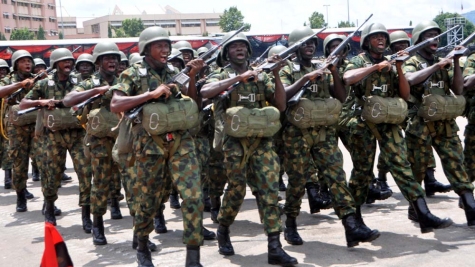
The Nigerian Army has apprehended a suspected arms dealer, rescued a kidnapped victim, and disrupted terrorist logistics networks within the last 24 hours.
A credible source at the Army Headquarters reportedly disclosed that the troops of Operation FANSAN YAMMA, on Thursday, apprehended a suspected terrorist informant during an ambush at Ungwan Gombawa in Kontagora Local Government Area (LGA) of Niger State.
The source said troops of 1 Brigade also arrested an alleged major terrorist logistics supplier and arms dealer at Danjigba in Bukkuyum LGA.
According to him, preliminary investigations reportedly linked the suspect to two coordinators in Anka LGA, believed to be responsible for storing weapons sourced from the Niger Republic.
He said the troops recovered military uniforms, a helmet, boots, financial receipts amounting to about N4 million, and audio evidence linked to arms transactions.
The source added that troops responding to intelligence on the recent abduction of students of GGSS Maga in Kebbi State stormed a terrorist camp in the Gando–Sunke Forest, which belongs to a kingpin known as Bello Kaura.
He said the attackers fled the location, allowing troops to destroy the camp and its support facilities.
The source explained that another suspected informant travelling from Sokoto was arrested at Augie, where troops recovered five ATM cards, clothing, and N78,900.
In another development, he said troops survived an ambush along the Kaiga–Mara road in Katsina State, forcing the attackers to flee.
He added that an operation carried out in Shinkafi and Zurmi LGAs also resulted in a firefight during which troops captured two AK-47 rifles, ammunition and two motorcycles.
Under Operation Enduring Peace in Plateau State, troops foiled a kidnap attempt in Jos South, rescuing a victim who sustained gunshot wounds.
The source also confirmed that eight suspected criminal herders were arrested in a separate raid in the same LGA.
Similarly, troops of Operation Whirl Stroke responded to a road incident in Nasarawa State, where three passengers were reportedly kidnapped and a driver was injured. Efforts to rescue the victims are ongoing.
He added that troops arrested two herders accused of destroying crops in Guma LGA of Benue State.
According to him, the Chief of Army Staff, Lt.-Gen. Waidi Shaibu recently undertook operational visits to Borno, Kaduna, and Zamfara, during which he assessed ongoing operations and urged troops to remain disciplined, alert, and committed to the fight against terrorism.

NYSC redeploys Corps member who threatened to sleep with students, deepens investigation
By Ishaka Mohammed
The National Youth Service Corps (NYSC) has withdrawn Oyaje Daniel from his Place of Primary Assignment (PPA) in Igabi Local Government Area of Kaduna State and redeployed him to the NYSC state headquarters for closer monitoring. This came after his threat on social media to sleep with his female secondary school students.
As part of the sanctions, Daniel has been denied access to the free accommodation at the headquarters despite being required to report there daily for the remainder of his service year.
The Daily Reality earlier reported that the affected Corps member serving at Judeen International School in Kaduna had threatened to sleep with his female secondary school students, whom he considered more voluptuous than undergraduates.
According to John Adesogan, who appears to have been Daniel’s schoolmate, the Corps member was summoned by the NYSC Disciplinary Committee at the state headquarters after his comment attracted public outcry.
John Adesogan said, “The Alumni President of our college, Comr. Philip Ayuba Bobai and I went with Daniel to the NYSC Headquarters to further engage with the officials handling the matter.”
He further revealed that the NYSC had constituted an investigation team to visit Daniel’s former PPA to determine whether any other form of misconduct had occurred. This is in addition to NYSC’s efforts to track other Corps members who made comments similar to Daniel’s on the same post.
Daniel has taken to social media to express remorse. Reacting to a comment from one Sabastine Ezekiel, who urged him to “be strong”, Daniel wrote, “Thank you, my leader. I’m sorry for disappointing your expectations. I was careless with my comment, thinking I was catching ‘cruise’. But I have learned my lesson. All I want is another chance to live up to my name and trust.”
Adesogan urged fellow Nigerians to use social media responsibly, maintain discipline, and create a safer, more decent online environment.

Plateau state shuts all primary, junior secondary schools over security concerns
By Abdullahi Mukhtar Algasgaini
The Plateau State Government has ordered the immediate closure of all primary and junior secondary schools across the state as a precautionary security measure.
The directive was issued on Friday by the State Universal Basic Education Board (SUBEB). In a statement released in Jos, the Board’s Public Relations Officer, Mr. Richard Jonah, confirmed the directive.
Jonah addressed parents and guardians, assuring them that the shutdown is a temporary step.
He emphasized that the decision was imperative to avert potential security threats to students and school infrastructure.
While the statement did not specify the nature of the security threats or a potential reopening date, the move underscores the government’s priority to ensure the safety of schoolchildren amid ongoing security challenges in the region.

Tinubu cancels attending G20 Summit, assigns Shettima
By Ibrahim Yunusa
Amidst the heightened security tension, President Bola Ahmad cancels his planned trip to G20 Leader’s Summit in Johannesburg, South Africa and delegated Vice president, Kashim Shettima to represent him in the meeting.
Disclosed by Stanley Nkwocha, the Senior Special Assistant to the President on Media and Communications, Office of The Vice President, Shettima has departed Abuja for the G20 Leader’s Summit.
President Tinubu has cancelled the trip to South Africa awaiting the security briefings on the current escalated terrorists operations in Kebbi and Niger state.
The Presidential statement said, President Cyril Ramaphosa, the South African leader who also serves as the current President of the G20 group had invited his Nigerian counterpart to participate in this year’s edition.
The Summit, scheduled to take place from Saturday, November 22nd, to Sunday, November 23rd, at the Johannesburg Expo Centre, will bring together leaders from the world’s top 20 economies, including the European Union, the African Union, financial institutions, among others.

Four days to face Barcelona, Cole Palmer fractures his toe
By Ibrahim Yunusa
Chelsea attacking midfielder, Cole Palmer, suffers home injury and fractures his toe four days to meet Barcelona in Champions League.
Palmer who is almost back from a long groin injury has this small issue while his club, Chelsea, is counting on him in their Champions League clash with Spanish club, Barcelona.
With Barca, 11th and Chelsea, 12th in the Champions League table with difference of two goals to Chelsea with the same point, seven, their Tuesday’s clash will determined who will be on the top of the other in being in the top eight of the table.

Pupils’ abduction: Niger State Gov’t blames St. Mary’s School
By Ibrahim Yunusa
An unidentified number of pupils and staff of St. Mary’s School in Papiri community of Agwara Local Government of Niger State were abducted by terrorists in the early hours of today, Friday.
The terrorists raided the school between 2:00 am to 3:00 am and kidnapped a number of pupils that yet to be identified by authorities.
While condemning the attack, the Niger State Government blames the school of not complying with the directives of closure of boarding schools issued by the state government.
Statement issued by the Office of the Secretary of the State Government, Alhaji Abubakar Usman, disclosed that prior intelligence report received by the government alarming an increased threat level in parts of Niger North Senatorial District, the state government in response to the credible security alerts issued a clear directive suspending all construction activities and also ordering the temporary closure of all boarding schools within the affected areas as a precautionary measure.
“Regrettably, St. Mary’s School proceeded to reopen and resume academic activities without notifying or seeking clearance from the State Government, thereby exposing pupils and the staff to avoidable risk.” the statement added.
This incident comes days after 25 students were kidnapped in Maga of Kebbi state resulting a height tension and deteriorating of security of educational institutions across the region.

Genocide nomenclature in Nigeria, by Dr. Aliyu U. Tilde
By Aliyu U. Tilde
International perception of religious conflicts in Nigeria is influenced by a propaganda that is overwhelmingly based on biased naming of their victims and perpetrators. When you search the Internet for the killing of Muslims in Nigeria by Christians, the best result you can get would be very scanty. But when you ask about Christian genocide, killings, etc., the result would be very lengthy. Something is amiss.
It is not that Muslims are not being killed by Christians or fellow Muslims. For twenty years, before Boko Haram and bandits started killing mostly Muslims, wholesale massacres of Muslims have been taking place in Northcentral Nigeria especially. And the mass killings have continued even after 2009 when Boko Haram appeared. However, the Internet turns blind when you search for them. Therefore, international observers hardly remember them and researchers hardly notice them. The reason is in the name.
Same Crime, Different Names
When the victim is a Christian, media reporters, who are predominantly Christians in the country, call them Christians, even in a conflict that may have nothing to do with religion. The headlines will quickly read: Fulani kill Christians, Christian communities attacked, genocide of Christians, etc. The Internet sees only what is posted.
On the flip side, when the victims are Muslim, they are given neutral names: villagers, worshippers, civilians, locals, people, Nigerians, etc. The 25 abducted Kebbi school girls are called “school children”, not “Muslim school children”. Their religious identity is cancelled, deleted or hidden deliberately. So when any scholar or reader searches the Internet on Muslim killings or genocide, he hardly gets much.
Again, if the attackers are Muslim, they are eagerly reported as Islamists, jihadists, Fulani (Muslim) militants, terrorists, etc. The Internet easily apprehends them and hands them over to the researcher who receives them with delight and uses them as the statistics of his own narrative, thus multiplying the spread of the bias.
However, if the perpetrators are Christian-affiliated, they are reported as youths, tribal militias, unknown gunmen, attackers, mob, etc. The Christian identity is deleted, hidden and allowed to escape the policing of the Internet.
Thus, the Internet-dependent world of today, as was the mainstream Christian southern press, is afflicted with the illusion that Christians are always the target, and Muslims always the perpetrators, which is false by history, statistics and morality.
Forgotten Massacres of Muslims
The Internet hardly reflects the following carefully planned and executed war crimes against Muslims by their Christian neighbours:
— Kasuwan Magani (1981) – The first major religious crisis began with the nocturnal attack of innocent Muslims by Christians.
— Kafanchan crises (1987, 1999) – Multiple waves of massacres of Muslims.
— Zangon Kataf (1992) – So horrendous that Christian leaders were convicted and a retired General was sentenced to death.
— Tafawa Balewa recurring pogroms (1991, 1995, 2000, 2001) – Ending in the cleansing of the town of its Muslim founders and majority.
— Plateau crises (2001, 2004, 2008, 2010, 2012) – More than 40 Muslim settlements were wiped out.
— Yelwa massacre (May 2004) – Exceptionally barbaric; the Christian President suspended the Governor and declared a state of emergency.
— Southern Kaduna (2011) – In Matsirga, Zonkwa, Kachia, and many other southern Kaduna towns where over 1,200 Muslims were killed by Christian militias.
— Wukari crises (2013–2014) – Jukun Christian militias carried out mass slaughter of Muslims.
— Taraba/Jalingo/Ardo Kola (2012–2017) – Entire Muslim communities wiped out.
— Mambilla Plateau massacre (June 2017) – 727 Muslim Fulani herders massacred under the supervision and protection of Christian officials of Sardauna LGA and Taraba State Government.
— Numan massacre (November 2017) – Hundreds of Fulani Muslims killed by Bachama Christian militias.
All of the above gruesome Christian-on-Muslim killings are called ethnic clashes, reprisals, intercommunal violence, farmer-herder conflict, youth violence or mob attack. When Muslims attack Christians, often in defence or reprisal, it is called Islamic violence, jihad, Christian genocide or religious persecution. The asymmetry is astonishing and it is not without its reasons and motives.
Reasons
The naming bias exists because Western institutions are Christian, culturally, and so is the Nigerian media predominantly. This tilts their sympathies, metaphors and moral instincts toward Christian victims. A Muslim killed in Kuru is a Nigerian villager; a Christian killed in Jos is a Christian.
The evangelical world and funding structure of NGOs also share a quota of the biased narrative. Organizations like CSW, Genocide Watch, Open Doors, WWW, ICC Evangelicals, name them, are Christian and their reports are the fodder of CNN, US Congress, BBC, and form the basis of Western narrative. Muslims are not blessed with such infrastructure of global lying and propaganda.
Then Christian traders of conflict especially from the Northcentral, IPOB secessionist, and evangelical entrepreneurs feed this inverted narrative for the purpose of gaining NGO sympathy, Western evangelical funding, UN, US and UK political pressure, diplomatic leverage as well as weapons and security alliances. Moreover, foreign governments are easily animated by the mention of religious persecution rather than ethnic conflict.
There is also this strange desperation to prove Christian persecution in Nigeria which, for lack of sufficient data, is compelling many Christian clerics and politicians to claim Muslim victims as Christians. A picture of a Muslim burial is tagged “Muslim murder 25 Christians in latest violence across Nigeria—Pastor killed, churches torched.” In the instance of the kidnapping of 25 girls from a secondary school in Kebbi, even American officials and former Rep. Riley Moore are insinuating that they are Christians. Fortunately, to forestall any false claim, the school has just released the names of the victims: 100% Muslim.
The same thing with the killings in Bama, abductions in Katsina, and so on. We hope they will not claim that General Alkali and Brig. M. Uba are Christians too. Some people sabi lie. A reverend just told the Internet world that he carried out 70 mass burials, some up to 500 people in mass graves—he alone, he claimed. Where are the graves? No answer. Chineke! IPOB have also jumped into the fray. I watched a video showing cattle grazing while a group of masked men, speaking Hausa with a heavy Igbo accent, claimed to be Fulani terrorists ready to kill Christian Igbo.
Finally, let us also not forget the frequency of complaint and the readiness to exaggerate. Muslims hardly complain over and over when they are killed. They shout once, mourn for three days and carry on, “leaving everything to God.” Christians, on the other hand, as a Christian TikTok girl said, see it as an opportunity to complain, at home and abroad, for the reasons I just mentioned. The Internet algorithms will then definitely be in favour of the Christian narrative.
In the end, a false portrait is painted—that Christians are being wiped out everywhere; Muslims are never victims; Christians never kill; and Muslims kill for religion but Christians for “land” and “in clashes.”
Conclusion
A balance even in vocabulary is always important for proper understanding of any situation. Muslims in Nigeria are learning so since President Trump assigned himself the role of Peter the Hermit. They must learn the art of nagging and complain endlessly as their Christian counterparts do. Finally, they must adopt the Nigerian vocabulary of conflict reporting, naming the religious identity of their attackers and victims, whether Christians or Muslims. Only this would open the eyes of the Internet to their suffering, bring their victims to the notice of researchers and catch the attention of the West and global institutions.
With this egalitarian balance of nomenclature, the world would see a better picture of conflicts in Nigeria and assist the country in overcoming its problems. Without it, the narrative will remain one-sided and the Muslims in Nigeria will always be blamed—and punished—for crimes over which they do not have monopoly.
Dr. Aliyu U. Tilde is a political analyst based in Bauchi State Nigeria.

Trump’s statement on christian genocide is reckless, US lawmaker warns
By Uzair Adam
US Congresswoman Sara Jacobs has condemned President Donald Trump’s threat of unilateral military intervention in Nigeria over claims of a Christian genocide, calling the rhetoric “reckless” and potentially harmful to communities already grappling with widespread insecurity.
Jacobs, a Democrat representing California’s 51st Congressional District and a ranking member of the House Subcommittee on Africa, made the remarks on Thursday during a congressional hearing reviewing Nigeria’s redesignation as a Country of Particular Concern.
She argued that framing Nigeria’s complex security challenges solely as a religious conflict misrepresents reality and could inflame tensions.“It is counterproductive to adopt overly simplistic narratives about the multiple, complex, overlapping security challenges across the country,” Jacobs said.
Drawing on her experience with counter-Boko Haram strategies during her tenure at the State Department, she emphasized that both Christian and Muslim communities are affected by insecurity.
She cited recent killings and the church kidnapping in Kwara State, as well as the abduction of 25 schoolgirls in Kebbi State, to illustrate the wide range of victims.
“The violence affecting both Christian and Muslim communities is real, and the Nigerian government can and should do more,” she said, cautioning that Trump’s statements risk deepening divisions.
“We are already receiving reports of increased tensions between Christian and Muslim populations following this rhetoric,” Jacobs added.
She further stressed that Trump’s threat of military action would violate both US law and international norms. “Any unilateral military action in Nigeria would be illegal.
Congress has not authorised the use of force in Nigeria, and any action without Nigeria’s consent violates international law,” she said.
Jacobs concluded that while Nigeria faces serious security challenges, resolving them requires careful analysis, dialogue, and cooperation rather than inflammatory threats.

Pope counters genocide claims, says Nigeria’s crisis hits both Muslims, Christians
By Sabiu Abdullahi
Pope Leo XIV has played down claims that Christians alone are the targets of mass killings in Nigeria, stressing that the country’s insecurity threatens people of every faith.
The Catholic leader made the clarification during an interaction with journalists as he departed his Castel Gandolfo residence in The Vatican.
A reporter sought his view on the safety of Nigerian Christians, a topic that has drawn considerable attention in Western political debates.
The pontiff said Nigeria’s violence cannot be separated from terrorism, economic pressures, and fierce disputes over land.
“I think in Nigeria, in certain areas, there is certainly a danger for Christians, but for all people. Christians and Muslims have been slaughtered,” he stated in response to EWTN News.
“There’s a question of terrorism. There’s a question that has to do a lot with economics, if you will, and control of the lands that they have. Unfortunately, many Christians have died, and I think it’s very, it’s important to seek a way for the government, with all peoples, to promote authentic religious freedom.”
His remarks come after former U.S. President Donald Trump designated Nigeria a Country of Particular Concern over alleged religious persecution.
Abuja strongly rejected the designation, arguing that the crisis is not an assault on one religion but a complex conflict involving multiple groups.
Cardinal Pietro Parolin, the Vatican secretary of state, also echoed a similar view last month. At the launch of the 2025 Religious Freedom Report by Aid to the Church in Need, he said the violence in Nigeria fits more into a “social conflict,” often between herders and farmers, rather than a religious confrontation.
In an effort to address the growing narrative in Washington, National Security Adviser Nuhu Ribadu led a federal delegation to the United States on Wednesday.
The team met with Congressman Riley Moore, whom Trump appointed to review Nigeria’s situation. Moore later said he and the delegation held a “frank, honest, and productive discussion.”

Nnamdi Kanu sentenced to life imprisonment
By Muhammad Abubakar
A federal court in Abuja has sentenced Nnamdi Kanu, leader of the banned Indigenous People of Biafra (IPOB), to life imprisonment for terrorism-related charges. The judge stated that Kanu’s calls for “sit-at-home” orders incited violence and constituted acts of terrorism.
The court ruled that for several of the charges, the law prescribes either life imprisonment or the death penalty. In delivering the verdict, the judge described Kanu as a “tyrant” capable of violence and said he should no longer remain a part of society.
The prosecution immediately called for the death penalty following the conviction. Kanu has previously been imprisoned, first in 2015 and again in 2021 after a controversial extradition from Kenya.
Supporters of Kanu have staged protests, and opposition politicians have criticised the government, alleging that the trial was politically motivated.